
Manual or Motorised Pergola Louvres: What Suits You?
Pergola buying guide
Both manual and motorised louvre systems can give you control over a pergola roof, but they place different demands on your routine. Manual operation depends on your ability and willingness to reach the mechanism whenever you want a change. A motor can reduce physical effort, yet raises questions about power, controls and service. The sensible choice depends on how often you expect to move the louvres, who will operate them and what the exact model includes. First establish that the roof has adjustable louvres at all; a bioclimatic label or motorised option does not automatically mean sensors, app control or a particular mechanism.

How manual and motorised louvres operate
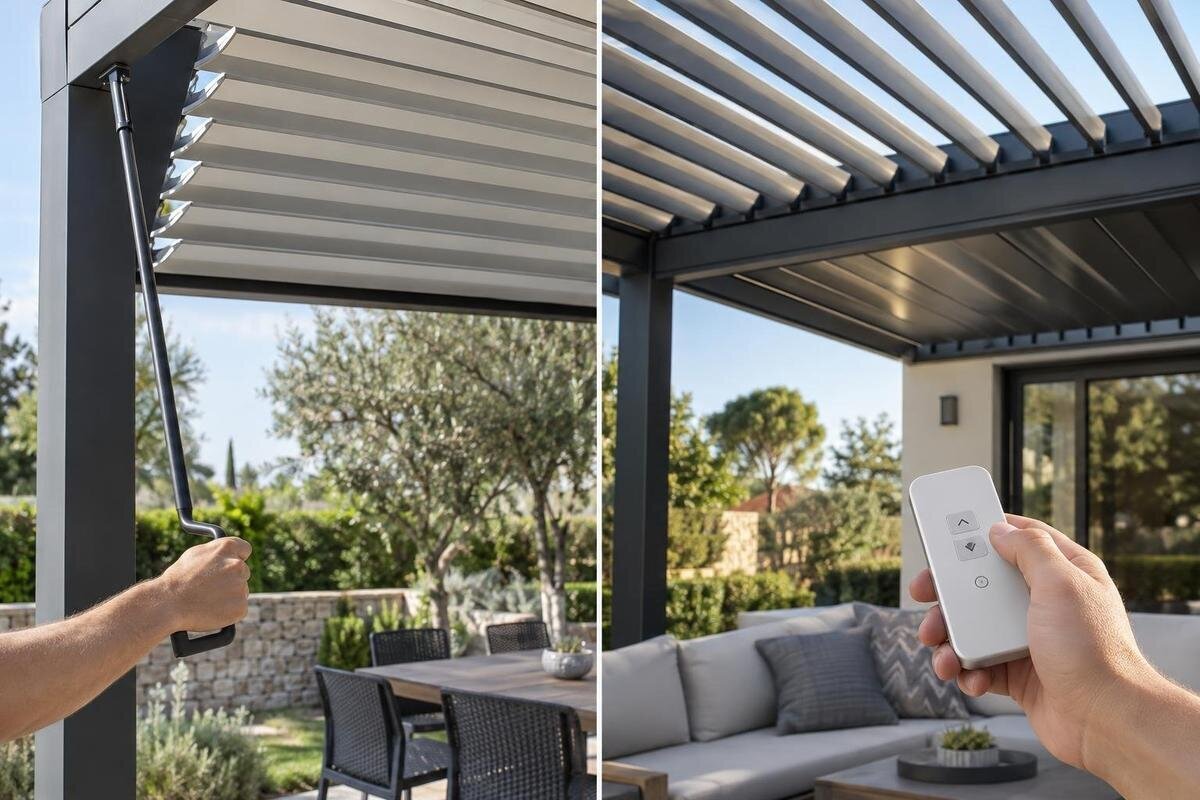
With manual louvres, you supply the movement through the operating mechanism specified for that product. It may use a crank, handle or another arrangement, so check the instructions rather than assuming a particular control. You need to reach it and make each adjustment yourself. How much effort that takes depends on the mechanism and its installation, so a product photo or the word manual is not enough to judge. A motorised system uses an electric drive to move the louvres, reducing the physical action at the roof. It still needs an interface, such as a switch or another specified control, and that arrangement varies by model. Compare the complete setup, not just the two labels.
Keep louvre movement separate from automation. A motor does not, by itself, promise app control, remote access, scheduled movement or a weather sensor; each feature must be specified for the exact configuration. The Bloomcabin Bioclimatic Pergola listing identifies a bioclimatic model with listed sizes from 9 to 24 m², but the model name and area do not establish how its roof is operated. Request the relevant manual or written specification before treating either option as available. A motor can move a roof when you use its control without responding automatically to changing conditions.
How often will you adjust the louvres?
Think about what a normal week would look like under the roof. Would you change the angle once when you begin using the patio, or return to it as the sun moves and your activity changes? If you expect only occasional adjustments, a manual control may fit your routine, provided the mechanism is accessible. If you expect frequent changes, the effort of walking over and operating it yourself may become a reason to leave the roof in one position. Consider the times you actually use the space, rather than assuming you will adjust the louvres every time conditions shift.
Frequency only matters if the selected product offers adjustable louvres. Use the Bloomcabin Pergola listing to identify the regular model, then confirm its roof configuration before comparing controls. Once you know which options are available, consider a few ordinary uses of your patio: sitting down for breakfast, working outside or sharing an afternoon meal. Would you want to adjust the roof during each activity, or would one setting usually suit the time you spend there? Include the inconvenience of interrupting what you are doing to reach a manual mechanism. The useful comparison is not simply how many adjustments you could make, but how many you would realistically make with each control. If the answer changes depending on who is at home, include that person's preferences rather than basing the choice only on your own routine.
Check the reach and position of a manual control
Reach is a practical test, not a minor detail. Find out where the manual control sits in the installed arrangement and whether you can use it from a clear position without moving furniture or reaching across a table. If it comes with a handle or crank, ask how it is held and what movement is required; a product image rarely shows this clearly. Consider the people who will operate it, not only the person who selected it. If a manual control would be awkward for regular users, a motor may remove that part of the routine, if the exact model offers one.
A wall-mounted layout does not tell you where its control will be. When considering the Bloomcabin Wall-Mounted Pergola page, ask for the control position and access requirements for the exact arrangement. Check these against a patio plan with the table, chairs and other furniture in their usual places, including chairs pulled out for use. Consider whether a wall, doorway or other fixed feature blocks the approach. If a removable handle is specified, ask where it can be stored and whether retrieving it would make routine adjustments inconvenient. For a fixed control, consider whether you can stand comfortably while completing the full operating movement. This is more useful than checking reach alone: being able to touch a handle does not necessarily mean you have enough room to use it comfortably.
Choose an interface everyone can use
More than one person may use a patio, and the control should make sense to each of them. A manual mechanism can be straightforward when users know where it is and are comfortable operating it; it is less convenient if only one person can reach or manage it. Motorised operation can reduce physical effort, but the interface still matters. A fixed switch, remote control and phone-based system are different experiences, and none should be assumed from the word motorised. Think about who will be present and how they prefer to operate everyday equipment.
Ask which interface is supplied and whether alternatives are available. Use the exact model on the regular pergola product page when making the enquiry, rather than assuming a handle, switch, remote or app is included. For a shared patio, consider an ordinary handover: could someone else adjust the roof without borrowing your phone or asking where the remote has been left? If app control is offered, clarify whether several users can have access and whether another control is available for visitors. If a remote is supplied, agree on a convenient storage place. Ask to see how opening, closing and stopping are controlled, rather than judging the interface by its appearance. These questions help distinguish a control that suits the whole household from one that is convenient only for its main user.

Power supply and what happens during an interruption
Power is a clear practical difference between a manual and electrically driven option. The louvre movement in a manual system does not depend on an electric motor; a motorised system does. For a powered option, establish the specified supply and whether electrical work is included in the installation or must be arranged separately. A nearby socket or existing outdoor circuit is not, by itself, proof that it suits the product. Ask for the requirements in writing and have a qualified electrician confirm any proposed electrical provision. Clarify who will arrange that work so it is accounted for in both the quote and the installation plan.
For the model on the bioclimatic pergola product page, first establish whether a motorised configuration is available and what it includes. If it is, ask what happens when the power supply is interrupted: can the roof still be operated, is any backup included, and is there a documented manual override? Do not assume that motorised louvres can be moved by hand when power is unavailable. Also ask how normal operation is restored afterwards and whether the user needs to take any action. Keep the answers separate from questions about weather sensors or app access; they concern the basic ability to operate the roof. Consider whether the documented arrangements would suit your household when you are using the patio, rather than judging the powered option only under normal conditions.
A motor is not the same as automation
Automation is an extra layer, not a synonym for electric operation. A motor can move the louvres when you press a control without sensing weather or acting on a schedule. If you want a rain or wind sensor, timed settings, app operation or integration with another home system, ask whether it is offered for the exact configuration and what it does. Check how a user can override an automatic action, whether settings can be changed and what happens if power or a sensor is unavailable. Base your decision on documented behaviour rather than a general label.
When enquiring about the wall-mounted pergola listing, describe the automatic response you want rather than asking only whether the roof is smart. For example, if a weather sensor is important, ask which sensor is offered, what action it triggers and how you can override that action. Have the agreed features included in the specification for the chosen configuration. Separate features you would use regularly from those that merely sound appealing: you may want a convenient powered control without schedules, phone access or automatic responses. If more than one type of control is offered, ask how manual commands and automatic actions interact. That gives you a clearer basis for choosing than a long feature list, while avoiding the assumption that any automation package comes with the motor.
Maintenance and service for both systems
Manual does not mean maintenance-free, and motorised does not automatically mean unreliable. Both arrangements have moving parts that need the care described by the manufacturer. A powered system also has a motor and control components, so ask how those parts are inspected and who should service them. For a manual mechanism, find out whether the instructions specify checks for the operating parts and how to respond to stiffness or unusual movement. Avoid adding lubricants or adjusting components unless the product instructions permit it; care routines differ between mechanisms.
For after-sales questions, identify the exact product and operating mechanism. When enquiring about Bloomcabin's regular pergola model, ask who would handle a problem with the selected control and how you would arrange assistance. Clarify whether replacement operating parts are available, what the written warranty covers and which routine care remains your responsibility. For a powered configuration, distinguish support for the roof mechanism from support for the motor and controller; ask whether the same provider handles both. Make the equivalent enquiries about the handle and operating mechanism of a manual option. Keep any supplied operating and care instructions together so that everyone using the roof can refer to them. The purpose is not to predict a fault, but to know whom to contact and what information they would need if operation changes.
What the full quote should include
Compare the whole configuration, not only the price of the control. A motorised option may add a drive, controller and electrical provision to a quote, while a manual option may have a different operating mechanism; what is included varies. Ask for costs to be itemised so you can see whether the roof, louvre mechanism, control unit, electrical work and installation are included. Also ask about service or replacement parts without assuming a fixed maintenance cost. This makes offers easier to compare, especially if one includes optional features or a different roof package.
If you request a quote against the Bloomcabin Bioclimatic Pergola model page, specify the size and control configuration you want assessed. Ask the seller to identify the roof mechanism, manual or motorised operating components, controller, electrical work, installation and optional automation separately. Mark each item as included, optional or excluded, rather than trying to infer this from a package name. Where two quotes differ, establish whether the difference is in the operating method or elsewhere in the roof specification. An offer with sensors or a different roof mechanism is not directly comparable with one containing only the roof and basic control. Once the scope matches, weigh the additional cost against the convenience you expect to use, rather than treating every extra feature as equally valuable.

What to compare in a model's documentation
Make a written checklist for each candidate: pergola model and roof type; whether the roof has adjustable louvres; manual or motorised operation; the exact mechanism and user control; any power requirement; and the instructions for operating it. Add the control's position and check whether users can reach it in the planned patio layout. If a feature is optional, record that explicitly. A catalogue heading or photograph can help identify a product, but it cannot replace the manual, technical specification or written confirmation for the configuration you are buying.
The supplied Bloomcabin product details identify regular, bioclimatic and wall-mounted pergolas, with listed sizes from 9 to 24 m². They do not establish that each model has adjustable louvres or that both manual and motorised versions are offered. Record those details as unconfirmed until the seller identifies the available configuration. Keep the model name, selected size and operating option together in your comparison so that an answer about one arrangement is not accidentally applied to another. If the configuration changes during the quotation process, revisit the affected entries, particularly control position, power and included accessories. A short, consistent record is easier to compare than a collection of feature descriptions referring to different versions.
Which operating method suits your routine?
Manual operation may suit you if adjustments will be occasional, the control is easy to reach and you are comfortable operating the specified mechanism whenever needed. It can also fit a preference for a direct control without an electric drive for louvre movement. These advantages apply only when the exact product offers a suitable manual system and the people using it can manage the operation comfortably. A low adjustment frequency does not compensate for an awkward control position or an unsuitable mechanism.
Motorised operation may suit a routine with frequent changes, several users or a control point that is difficult to reach, provided the model supports it and its power and service arrangements are acceptable. It is not automatically the better choice for every roof: an unfamiliar interface, unavailable power or optional costs can outweigh the convenience. If you are undecided, ask to see the exact mechanism demonstrated or read its manual before ordering. Choose the system you will actually use, rather than the one with the longest feature list.
Frequently asked questions
Does motorised operation always come with a remote?
No. Motorised describes how the louvres are driven, not the control interface. A model may specify a switch, remote, app or another controller, and those options vary. Check which device is included and whether alternatives are available for the exact roof configuration.
What happens to motorised louvres during a power interruption?
The answer depends on the model and any documented backup or manual override. Do not assume the roof can be moved by hand if power is unavailable. Ask what the manufacturer specifies for operation during an interruption and for restoring normal operation afterwards.
Are manual louvres difficult to operate?
That depends on the mechanism, its position and the movement it requires. Ask to see the exact manual control in use or read the model instructions. Consider whether the people who will use the patio can reach and operate it comfortably.
Does a motorised pergola automatically respond to rain or wind?
Not unless the selected configuration includes suitable sensors and automation. A motor can move the louvres when someone uses its control without responding to weather. Confirm which sensors, actions and overrides are specified for the exact model.
Can a motor be added to a manual pergola later?
Only if the manufacturer confirms that the exact model and roof configuration support a retrofit. Do not assume that a motor can be added to any pergola or louvre mechanism. Ask for written confirmation and have any proposed work assessed by the appropriate professional.
The right operating method is the one that fits how you use the patio. Manual louvres may be enough when adjustments are occasional and the mechanism is comfortable to operate. Motorised operation may be more convenient when you expect frequent changes or want to avoid reaching a manual control. Neither choice needs an extensive feature package to be useful. Once you know which configurations are available, give the greatest weight to everyday operation: who will adjust the roof, how easily they can do it and whether the power and support arrangements suit your household.
