
Fabric Roof or Aluminium Louvred Roof for a Pergola?
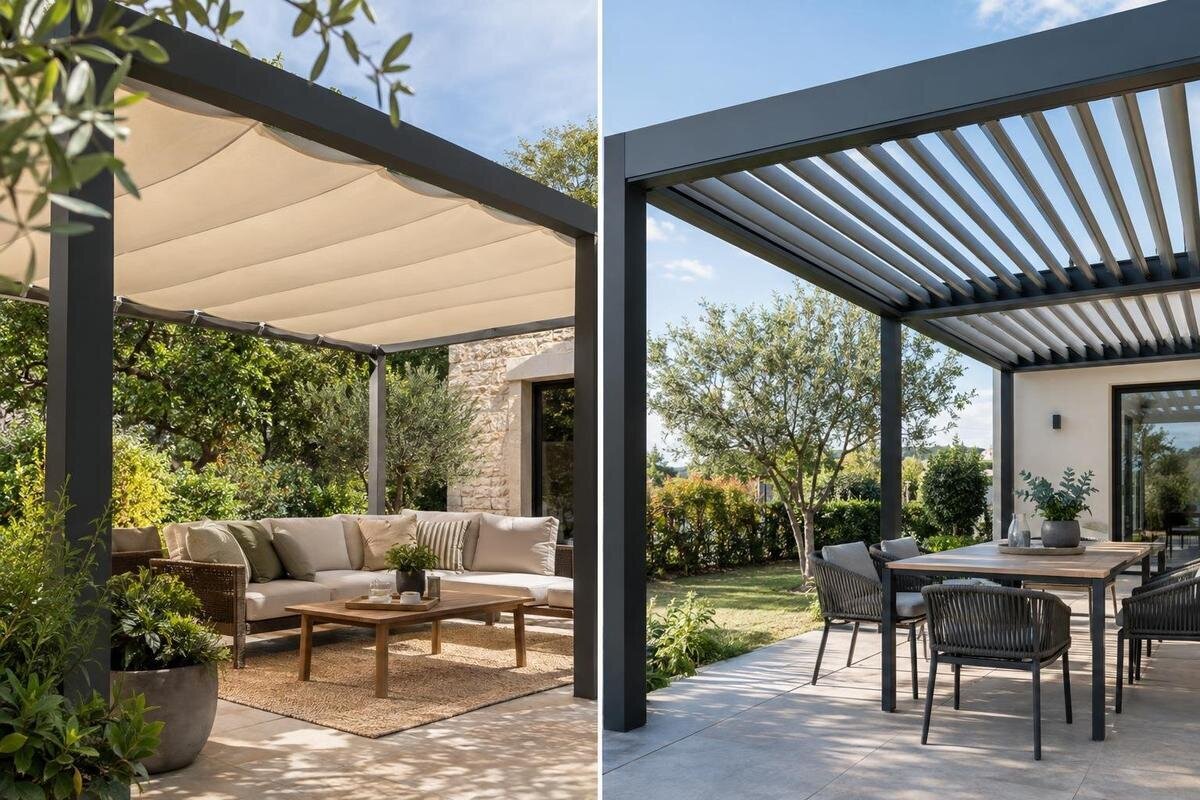
Pergola roof guide
Choosing between a fabric-roof pergola and an aluminium louvred pergola is less about a material label than about how you want the roof to work. A fabric canopy may be fixed or designed to move; a louvred roof changes the position of its slats. That affects whether you can expose the sky, how you manage shade and which parts need routine care. Rain and wind performance are separate questions: neither fabric nor aluminium, by itself, sets the limits of a particular pergola. Compare named models using their operating diagrams, maintenance instructions and written weather guidance, and treat gaps in that information as questions to resolve rather than assumptions.

How fabric and louvred roofs create cover
A fabric-roof pergola uses a textile canopy over a supporting frame. Depending on the model, it may stay fixed, be tensioned in place, or slide, fold or roll; the word fabric does not mean retractable. An aluminium louvred roof uses separate slats whose angle changes within a mechanism’s range. That gives a different kind of movement, but the amount of opening and the positions available vary. Check the actual roof diagram and operating instructions, not just the headline description. A product photo generally shows one configuration, so it cannot confirm the canopy’s travel, the controls, the textile specification or how far the louvres open.
Write down the full model and roof variant before weighing the options. The Bloomcabin Bioclimatic Pergola listing identifies a model with an area range from 9 to 24 m², but that information alone does not establish its roof construction, movement or controls. For a fair comparison, record the quoted size, fixed or moving parts, and exact roof configuration for each option. Keep the drawing with the quotation so that both refer to the same version. This avoids comparing a photograph of one configuration with a price for another, or treating a broad product category as a complete description of the roof being offered.
What operation looks like in everyday use
On a fabric roof, the operating routine depends on whether the canopy is fixed or moves and, if it moves, how its track or folding mechanism works. Ask whether it has only a deployed and stored position or can stop part-way, whether it is operated by hand or by a supplied control, and whether furniture must be moved first. Those details matter if you expect to adjust shade each day rather than set the roof once. Check that controls are reachable from where you will use them. Ask to see the instructions for the model you have been quoted; do not assume that folded fabric in a photograph proves it is retractable or that a pictured control is standard.
Louvres change position by rotating or tilting the slats, but the method and range are model-specific. When considering the Bloomcabin Wall-Mounted Pergola, separate the mounting arrangement from the roof mechanism: the model name does not tell you whether operation is manual or powered. A movement diagram should show the available positions, while a demonstration can help you judge whether adjustment is convenient. If the quoted version is motorised, ask what happens during a power cut and whether any manual override is documented. Neither a motor nor a backup function should be assumed from the product category. Check that the demonstration uses the configuration you are considering, rather than simply a similar display model.
Shade, daylight and airflow
A deployed fabric canopy gives a continuous overhead surface, but its effect on daylight depends on the textile specification, including its weave, colour and any stated light-transmission properties. Ask whether the sample or specification applies to the option in your quote; a screen image is a poor way to judge brightness. If the cover retracts, it can expose more of the sky, but only to the extent allowed by its travel. Think about the rooms, doors or seating below: do they need shade at certain times, or would occasional direct sun be useful? A fixed canopy and a retractable one answer that question differently, so compare actual positions rather than names.
Louvres allow the roof opening to be changed, so the angle and gaps can be adjusted within the product’s range. The resulting shade depends on where the sun is, the slat orientation and the setting you choose; no roof label guarantees the same result through the day. Opening the slats also exposes part of the overhead area, while open sides remain open unless separate screens are specified. This can help you manage light and airflow, but it is not a promise of a particular indoor or outdoor temperature. If you are considering the Bioclimatic Pergola catalogue model, ask for a roof-section drawing or demonstration to establish its actual positions before assessing the shade it could provide.
Rain cover requires model-specific evidence
Fabric roofs vary in whether they are designed for shade only, water resistance or a more specific rain-cover purpose. Ask for the exact fabric description and what the manufacturer says about rain, seams, edges and any required roof position. Terms such as water-resistant need a clear definition in the model documents; they do not mean the same thing as a guarantee of dry seating in every storm. If the roof moves, ask whether it should be retracted or secured before weather changes, and what conditions its instructions address. Do not infer rain suitability from a dark, dense-looking fabric or from a photograph taken after rain.
With louvres, ask whether the closed position is intended to shed rain, how the joints are managed and where water is directed. Seals, overlaps, gutters or drainage outlets may form part of a design, but their presence and performance are not established by the word aluminium. Rain driven in from the sides can remain an issue even when the overhead roof is closed, so distinguish overhead rain cover from protection for the whole seating area. For an option such as the Bloomcabin Pergola, establish the roof configuration first, then compare its stated rain use with the other model. A model name or area range cannot answer either question.

Wind, hail and site exposure
Wind guidance should cover the exact roof position, not just describe the frame as sturdy. A fabric canopy may need a particular action when deployed, partly moved or stored; a louvred design may have different instructions for open and closed slats. Ask which conditions mean you should stop operating the roof, and whether the guidance says to close, open or retract it. Follow the model’s documented limits rather than a rule borrowed from a similar-looking pergola. Hail, flying debris and heavy rain may also be treated differently by the manufacturer, so ask which events are addressed and which require the roof to be left unused.
Conditions vary from site to site: a terrace may be exposed to gusts, driving rain, hail, dust, falling leaves or salt-laden air. Ask the supplier which of these the weather and maintenance guidance addresses, rather than treating South Africa as one exposure profile. If you are considering the wall-mounted pergola option, assess the attachment location separately from the roof’s operating limits. A mounting format does not establish a wind limit or suitability for a particular wall. Where the wall, ground or proposed structure is uncertain, have a qualified professional assess it using the product information. Do not estimate capacity or anchoring requirements from a sales image.
Routine care for fabric and louvres
For a fabric roof, use the cleaning procedure for the specified textile, not a routine borrowed from a similar-looking awning. Ask which products and tools are allowed, how to remove everyday dust or marks, and whether the canopy should be dry before it is stored or retracted. Check how the instructions deal with seams, edges and tensioning points, where dirt may collect or movement may be affected. Avoid assuming bleach, abrasive pads or pressure washing are suitable. If the patio is near trees or a braai area, ask how to deal with sap, leaf marks or smoke residue; do not apply a treatment until the manufacturer says it is appropriate.
A louvred roof has a different maintenance routine: cleaning the slats and checking any moving parts or water routes included in that model. Ask how to remove leaves or grit without forcing the mechanism, and whether any joints, channels or outlets require inspection after cleaning. Use only the products named in the care instructions, and do not add lubricant or adjust a moving part unless the manual tells you to. For the listed Bioclimatic Pergola model, use its own care instructions to identify the finish, components needing attention and maintenance intervals. Note any change in movement or drainage and report it through the supplier’s service channel, rather than trying to correct an unfamiliar mechanism yourself.
Repairs, spares and replacement
Ask whether a fabric cover can be replaced separately from the pergola structure, and whether the manufacturer can supply a matching textile or repair a seam. The answers affect how you plan for damage or wear, but they are not guaranteed by the fact that a canopy slides or folds. Find out which parts need a trained service person, how to identify the correct size and fabric, and whether maintenance requires the cover to be removed. Keep the model and fabric references with your purchase documents. A broad description such as canopy roof may not give enough information to order a component later.
A louvred system may have replaceable slats and separate moving or drainage components, but the parts list depends on the design. Ask whether pivots, seals, a motor or controls are fitted to the version you are considering, which items are serviceable, and how faults should be reported. If the Bloomcabin Pergola model page is on your shortlist, ask about spare parts and repair arrangements for the quoted version; the listing information supplied here does not confirm them. Put the same questions to each supplier, including which replacement components or service work are excluded from the quote, so you can compare ongoing support as well as roof movement.
Make a fair, like-for-like comparison
Compare equivalent covered footprints, not just the overall frame or the area that looks shaded in a product photo. Ask what the quoted area measures and check the plan for post positions, access routes and the space used by any moving roof parts. A wall-mounted option and a freestanding arrangement also have different site requirements, so record those separately instead of assuming the same installation conditions. The Wall-Mounted Pergola size range runs from 9 to 24 m², but an area figure alone cannot show how a particular version will fit your patio. Compare the exact dimensions and post layout on the drawing with the space available.
Then compare roof-specific items in the same order: fixed or moving canopy, amount of opening, method of operation, stated rain use, weather limits, cleaning, replacement parts and included accessories. If a screen, cover or control appears in an image, confirm whether it belongs to the quoted version. Record the same questions for each model and mark unanswered points as unknown; do not fill a gap because another model has a familiar-looking roof. This makes a like-for-like check possible even when two systems work differently. It also keeps separate what you know about the roof from what you know about the frame, mounting and site.

Documents to request before ordering
Before ordering, bring the information together in one set of documents labelled with the exact model and option: the quotation, operating diagram, care instructions and written rain and wind guidance. Check that they describe the same roof configuration and controls. The operating information should show the roof’s positions and explain how it should be used, stored or adjusted in relevant weather. If sales language says all-weather or low-maintenance, ask what those words mean for this configuration. Keep any written clarification with the quotation, rather than relying on a general description that may apply to several different versions.
Keep product information separate from site assessments, while making sure the people involved have the details they need. The supplier should identify the quoted mechanism and included parts; an on-site professional may need to assess the proposed support, access and exposure. Establish who will resolve any outstanding site questions before installation is arranged. Retain the final parts list and care instructions alongside the quotation, and make a note of the appropriate service contact. These records give you a clear reference if the canopy or louvres stop moving smoothly, rain behaves differently from the sales description, or a component needs servicing later.
Match the roof to how you use the patio
A fabric roof may be the better fit when a particular fixed or movable canopy gives the kind of shade you want and its care routine suits your household. It is not inherently simpler, more durable or more weatherproof. An aluminium louvred roof may suit you when adjusting the overhead opening matters, if the actual mechanism is easy to operate and its care and weather instructions fit the site. It is not automatically an upgrade: extra control is useful only if you will use it, and the exact rain performance still needs evidence. Judge the offered model, not a broad material stereotype.
Test the choice against a normal day on your patio. Would you adjust the roof often, leave it in one position, or want the ability to expose more sky? Can you reach the controls and keep the moving area clear? Would you rather clean a textile surface or inspect slats and drainage routes? If a demonstration is available, operate the exact version being quoted and ask about the positions not shown in the display. Rank the needs that matter most—shade, opening, rain guidance, routine care and repair—and choose the model that answers them clearly, rather than the one with the most impressive category name.
Frequently asked questions
Does every fabric-roof pergola retract?
No. A fabric roof may be fixed or have a movement mechanism, and the type of movement varies. Check the exact model’s operating instructions rather than relying on a photograph or the word fabric.
Will an aluminium louvred roof keep the patio dry?
Not necessarily. Ask what the roof is designed to do when the louvres are closed, how water is directed away and what the guidance says about wind-driven rain. Open sides may still let rain in.
Which roof is easier to clean?
There is no universal answer. Fabric care depends on the specified textile, while louvred systems may need attention to slats, moving parts and drainage routes. Compare the care instructions for the exact models.
Can either type be operated by hand?
That depends on the model. Some systems may be manual and others powered; the roof category alone does not tell you which. Confirm the controls supplied and ask what happens if power is unavailable.
Which roof is better for a coastal or windy site?
You cannot decide from the material name alone. Ask for the model’s weather guidance and care instructions for the relevant exposure, and have a qualified professional assess site questions where needed.
The choice comes down to how much roof adjustment you want and which care routine suits your patio. Compare the actual fabric canopy—fixed or movable—with the positions offered by the louvred system, rather than assuming one material is an upgrade over the other. Neither name alone establishes rain or wind performance. The better fit is the model whose shade, opening, upkeep and stated weather limits match the way you intend to use the space.
