
LED Strips or Spotlights for a Pergola: What to Compare
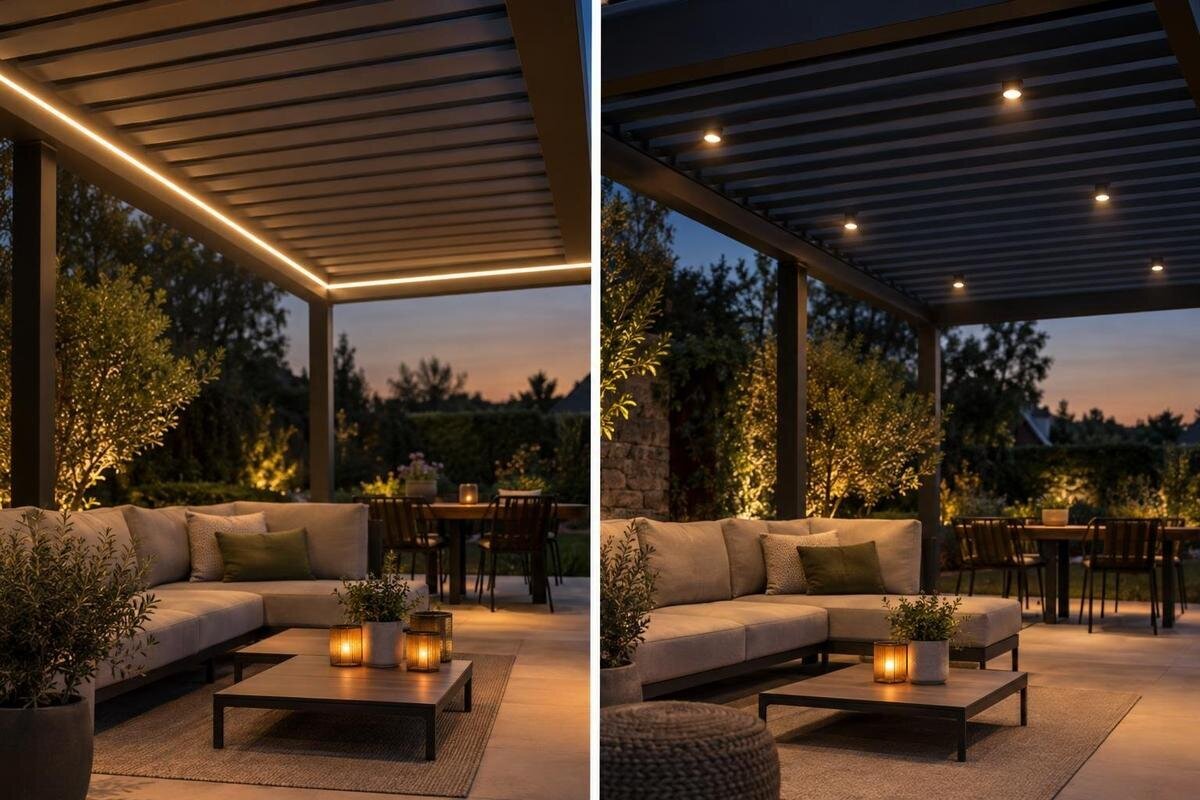
Pergola lighting
LED strips and spotlights can both light a pergola, but they do not solve the same distribution problem. A strip can follow a supported line and make light appear continuous along it; spotlights put light at separate points, with the result shaped by their optics and spacing. Neither format is automatically brighter, less glaring or easier to maintain. The practical choice depends on where the structure is approved to carry fittings, what you want illuminated, the views from seated positions and how a failed unit can be reached and replaced. Compare an actual layout and exact product specifications, not just the fitting names.

Before you choose 1
Decide what the light needs to cover
Begin by deciding what must be visible under the pergola. A dining table, an access route and a seating area are different targets, even when they occupy the same footprint. Mark the table and chairs at their intended positions, along with the doorway or route people use. Consider what the light must let you do there: distinguish food on a table, find a seat or see the threshold, for example. For a long table, note whether the whole length is used; for a route, mark turns and entrances. The aim is to establish whether light should run along a line, reach particular patches, or do both—not to choose the fitting that looks most attractive in isolation.
Then note which activities take priority and which viewpoints matter. A light that looks balanced from the garden may shine towards someone sitting beneath it, while a well-lit table can leave the route to the door dim. Make a rough plan using the furniture you actually use, including chairs that move, rather than an empty pergola outline. If the layout changes between weekdays and gatherings, mark both arrangements or decide which matters most. Record areas that should remain relatively dark as well as those that need illumination. This is a comparison tool, not an electrical plan: final locations still have to match the pergola maker’s permitted positions and the fitting manufacturer’s instructions.
How strips and spotlights distribute light
An LED strip is a linear source. If it follows an approved mounting line, it can create a continuous visual trace along that line, subject to how the strip is made and fitted. That does not mean it will spread evenly over a table or floor. Its profile, diffuser if supplied, position, output and nearby surfaces all affect the result; joins, corners or separate runs can interrupt the line. Check whether the proposed system is specified as a continuous run or as sections, and how its optics are described. If the manufacturer provides distribution information, use it alongside the product description. Compare the complete strip assembly, not the general idea of a strip, and do not equate visual continuity with broad coverage.
Spotlights create separate points of light. Their pools may overlap, sit apart or fall short of the target, depending on the fitting’s stated beam distribution, mounting position and spacing. The word spotlight does not guarantee a narrow beam or an adjustable head, so use product data rather than a fitting’s appearance in a photograph. The mounting height and the space between positions matter to the result; fixture count alone cannot tell you whether there will be gaps. If you are comparing the Bloomcabin Pergola, confirm permitted fixture positions for the exact model and configuration; its name or a lifestyle image does not establish where a light may be mounted.
Before you choose 2
Use only documented mounting positions
Before deciding between formats, find out which positions the pergola manufacturer supports for lighting. Use the documentation for the precise structure and configuration, or request written confirmation of a proposed mounting point. A beam, slat, channel or panel is not automatically a suitable fixing surface because it is accessible. Accessory approval can be configuration-specific; do not assume a similar-looking part on another model is equivalent. If the design has moving parts, check that the proposed fitting will not interfere with their movement or operation. Keep a record of the model and configuration covered by the approval, rather than relying on a generic pergola lighting diagram.
Those approved positions determine whether a strip has a suitable continuous route or whether spotlights can sit where their documented distribution is useful. Check joins, corners and the edges of the structure rather than assuming a line can continue uninterrupted. Spotlight positions may be fixed by the approved mounting plan, so judge their spacing only after those points are known. The Bloomcabin Bioclimatic Pergola is a distinct model; confirm its positions for the exact configuration instead of borrowing a layout from another pergola. If a desired fitting has no supported location, revise the layout or ask the manufacturer about an approved alternative.
Match the layout to furniture and routes
Put the intended furniture on the same plan as the approved mounting locations. For a strip, ask whether the permitted line sits in a useful relationship to the table, seats and entry route; a line close to the perimeter may be visually continuous yet distant from the main target. For spotlights, map each actual point and compare the target areas with the fitting’s documented distribution. A count of fittings is not a coverage plan. Distinguish between coverage at floor level and coverage on a tabletop or another working surface; do not assume that a pool of light shown on the floor represents the light reaching the table. Show the length and orientation of a long table, rather than representing it with a dot, so the ends are considered too.
Review the plan from places where people will sit and stand, not only from above. Note whether a proposed fitting faces a seat, leaves a gap along a route or directs the centre of its beam away from the intended target. Check doors and any fixed screens that affect the boundaries of the space, and note furniture that is likely to shift. A wall-mounted layout can have different boundaries from a freestanding one, so do not copy positions between categories. For the Bloomcabin Wall-Mounted Pergola, relate the approved locations to the furniture and viewing positions you have drawn. The model name alone does not establish the lighting layout or which fittings are included.

Before you choose 3
Compare glare from seated positions
Glare is partly a question of whether the bright source is visible from normal viewpoints. A strip can appear as a long luminous line when it is exposed to a seated person’s view; a concealed or shielded arrangement may look different, but that depends on the approved fitting and details. A spotlight can be a small bright point in the eye line. Neither format is automatically comfortable. Compare the actual source, optics and mounting position shown in the proposal, and consider reflective surfaces that could return light towards a seat. Ask whether any cover or shielding shown is part of the specified fitting, rather than assuming an extra screen can be added. A source’s shape alone does not predict how it will feel to look towards it.
Mark the eye positions of seated people, especially at the dining table, and draw sight lines to each proposed fitting. Check more than one chair: a light out of view from one seat may be prominent from another, and visitors will not always sit facing the same way. A night-time view or visual mock-up can help, provided it represents the selected fitting and location; a daytime product photograph cannot show how bright a source appears after dark. For the regular Bloomcabin pergola model, make this review against the documented positions for the selected configuration rather than a generic image. The purpose is to compare likely visibility, not to promise a glare-free result.
Check where light may spill
Also ask where light will land beyond the main target. A strip at the edge of a pergola may send light towards an adjacent wall, planting or open garden, depending on its orientation and optics. A spotlight might have a more controlled distribution, but only the manufacturer’s data can establish that for the particular fitting; the name alone is not enough. If the preference is to keep light on a table and away from a window or neighbouring area, include those surfaces in the comparison instead of treating spill as an afterthought. This is separate from glare: a fitting can avoid the eye line and still illuminate an unwanted area. Nearby reflective surfaces may also affect how the result appears.
Ask for distribution information for the exact strip assembly or spotlight, then compare it with the intended location and approved mounting positions. Do not assume a spotlight can be aimed, or a strip can be turned away from a surface, unless the product instructions allow it. When planning lighting for Bloomcabin’s bioclimatic pergola, include surfaces beyond the seating area on the drawing, especially if the structure is close to a wall or window. Mark both the areas you want lit and those you would prefer to leave dark. This gives you a clear basis for comparing the two formats without assuming that either one will keep light within the pergola.
Before you choose 4
Plan for replacement and access
Replaceability deserves as much attention as the initial appearance. LED strip systems differ: some allow a section or component to be changed, while others may require a longer run or complete assembly to be replaced. Spotlights differ too; some use a replaceable lamp, while others have an integrated light source. Check the exact manual, component references and replacement method for both options. Ask whether a fault affects one point, one section or a wider assembly, and whether the relevant parts can be identified and sourced in future. Do not assume a strip is inherently simpler or a spotlight inherently easier to service; the product details determine the difference.
Then consider access in the finished setting. Furniture, screens or the way the pergola is installed may make a fitting awkward to reach, and replacement might require a qualified person or more work than the product photograph suggests. Ask who is expected to maintain the fitting and whether access depends on dismantling any part of the structure. Several spotlights mean separate service points, while a long strip run may have different access requirements. For the wall-mounted pergola from Bloomcabin, assess access in the intended installation rather than relying on an image of another setup. Include any expected professional servicing when comparing the options.
Confirm outdoor suitability and electrical compatibility
The strip-versus-spotlight choice does not decide whether a fitting is suitable outdoors. A pergola can be open to the weather, and being beneath a roof does not by itself establish protection from every exposure. Consider rain, windblown moisture, dust or direct sun where relevant, but use the product’s stated rating and instructions rather than generic assumptions. Check the complete proposed system: the light fitting or strip, any specified profile or connectors, and any power supply or controls. A rating stated for one part is not proof that every component suits the site. Match the manufacturer’s information to the actual location, rather than relying on the appearance of the roof above it.
Have a qualified electrician review the exact fitting manuals alongside the pergola manufacturer’s mounting approval and the proposed supply and control arrangements. The review should cover compatibility across the complete system, including drivers and dimming components where proposed. If lighting is being considered for the bioclimatic model from Bloomcabin, identify the model and accessory combination clearly; the product category does not establish that a particular fitting is included or approved. Keep this electrical compatibility check separate from the comparison of light coverage: a layout that appears to illuminate the right areas still needs a suitable supply and control arrangement.
Before you choose 5
Compare complete, like-for-like proposals
Compare options on equivalent information, not on names or the number of lights pictured. For each proposal, record the exact fitting, declared light output and distribution, mounting location, controls and dimming capability if specified, and which components are included. Note how the system is expected to be serviced and which parts may need replacement. Ask what the output figures describe and whether the layouts assume the same structure and mounting positions. If distribution diagrams are available, compare them against the same furniture plan. Comparing one long strip with two spotlights is not meaningful unless both proposals address the same target areas. If you’re considering Bloomcabin’s regular pergola, distinguish the pergola specification from the lighting specification in each proposal.
Ask the supplier or installer to state assumptions clearly: which light option is proposed for this model, whether the fitting and control system are included, how the layout was checked, and what replacement components the manufacturer identifies. Request comparable layouts before weighing quotation totals; a single figure does not show whether a strip run, several fittings or associated components are included. If both formats are proposed, compare the combined plan with each single-format alternative and confirm every location is approved. That makes it easier to assess whether extra sources solve a coverage problem or simply add components and future service needs. Keep the proposed configuration and its documented positions consistent across each comparison.
Make the choice from a model-specific plan
Bring the comparison together in one drawing showing the pergola outline, approved fitting positions, strip runs or spotlight locations, furniture, target areas, seated sight lines and replacement access. Pair it with the fitting data and the pergola maker’s guidance. Label any assumptions about furniture or how the space will be used, so the electrician and supplier can comment on the same arrangement. Highlight unresolved differences between the proposals, such as a table end with uncertain coverage or a fitting that may be difficult to reach. The drawing is not an electrical design or installation instruction; it records what each option is intended to achieve and what still needs clarification.
A strip is the stronger candidate when a supported continuous line suits the effect and target, and its distribution, outdoor suitability and maintenance arrangements are confirmed. Spotlights are a better fit when documented positions and beam patterns cover the intended areas without unacceptable glare or spill. Neither has an automatic advantage in brightness, comfort or upkeep, and fixture count is not a substitute for comparing coverage. A combination is worth considering only if both types and locations are approved and it solves a clear need. If neither layout fits the supported points, change the arrangement rather than adding a fitting wherever space appears available.
Frequently asked questions
Do LED strips give more even light than spotlights?
Not necessarily. A strip can look continuous along its route without spreading evenly over a table, while spotlights may leave gaps or overlap. Check the exact distribution information, approved positions and surfaces you want lit; compare layouts rather than product names.
Can I use LED strips and spotlights together?
Possibly, but only if the pergola documentation supports the proposed positions and both fitting types are suitable for the location. Compare a combined layout with each single-format option to see whether it solves a real coverage problem.
Are LED strips suitable for any pergola?
No. The exact strip system must suit the outdoor exposure and have a mounting position approved for the specific pergola and configuration. Check the fitting instructions and pergola documentation, and ask a qualified electrician to review compatibility.
Are spotlights easier to replace than strips?
There is no universal answer. Some spotlights have replaceable lamps; others have an integrated light source. Strip systems also differ in whether a section or a larger assembly needs replacement. Check the exact manual and future parts availability.
Can I mount either type anywhere under the pergola?
No. A visible or accessible surface is not automatically an approved mounting point. Use the documented positions for the exact model and configuration, and confirm any proposed alternative with the manufacturer before it is included in the plan.
The strip-versus-spotlight decision is best made after the approved mounting positions are known. A strip suits a supported continuous line; spotlights suit particular points only when their documented distribution reaches the intended areas. In either case, judge the arrangement from real seated views, account for spill and check how the system can be serviced. The shape of a fitting suggests a possible effect, but the exact layout and specification show whether it will work beneath your pergola.
