
Estimating the Cost to Heat a Pergola Seating Area
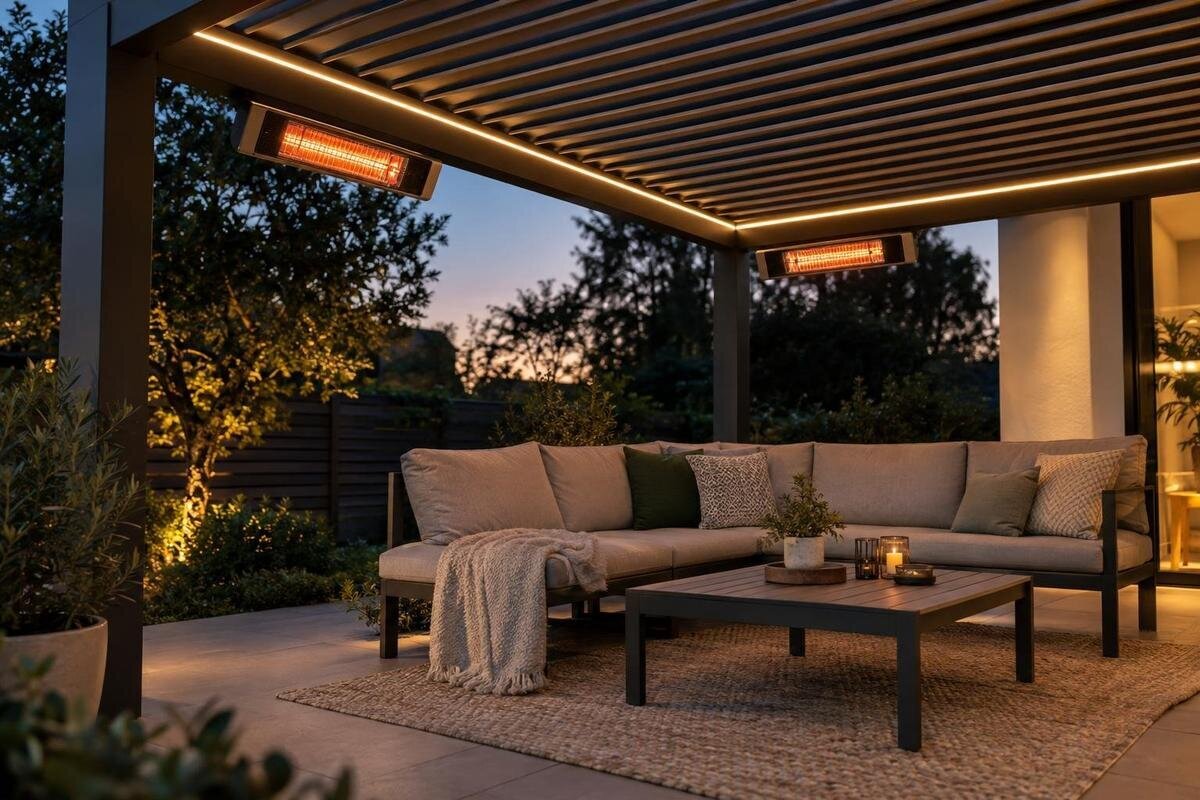
Pergola heating cost guide
Heating a pergola seating area has no standard cost per evening. A useful estimate starts with the heater’s rated electrical input, the number of hours it actually draws power and the electricity tariff that applies. Together, those give the energy used in kilowatt-hours and a running-cost estimate in rand. They do not tell you whether the seats will feel warm: radiant warmth can improve comfort in a defined seating zone without heating all the air around it. This guide shows how to calculate the bill impact, build a monthly range and separate energy use from heater, structure and installation costs.

The running-cost formula
Use the formula: heater input in kilowatts multiplied by operating hours equals energy use in kilowatt-hours (kWh). Multiply the kWh by the electricity tariff in rand per kWh to estimate the running cost. Convert watts to kilowatts by dividing by 1,000; for instance, 1,500 W is 1.5 kW. If it draws its full rated input for two hours, it uses 3 kWh. If two heaters operate at different ratings, calculate them separately before adding their consumption. The calculation applies to the appliance, not to the pergola’s floor area. Keep the units clear and use the input shown on the exact heater’s label or manual, rather than guessing from a general coverage claim.
At a hypothetical tariff of R3.00 per kWh, 3 kWh costs R9.00. This is an arithmetic example, not a current South African tariff; use the rate on the account or supplier schedule for your property. If two units run together, calculate each one or add their inputs before multiplying by the shared hours. This gives the energy cost for that period, rather than the total change in a household bill. It excludes the heater’s purchase price, electrical work, any fixed monthly charge and unrelated appliances. Since estimated hours may be rough, round the result sensibly instead of presenting cents as if the use pattern were exact.
Use the heater’s rated input
The heater’s rated electrical input is the starting point for the calculation. Check the exact model’s input in watts or kilowatts and note whether the figure applies to the setting you expect to use. A multi-setting appliance may have more than one input, so calculate using the likely setting rather than automatically choosing the maximum or minimum. If the rating is in watts, divide by 1,000; if an advert omits it, request the manual or data sheet for that exact model. Do not substitute a different heater’s rating because its appearance or product category seems similar. Without a selected heater, the most useful result is a range based on clearly labelled assumed wattages.
Structure size cannot supply the missing number. The Bloomcabin Pergola catalogue page lists the structure in sizes from 9 to 24 m², but that is not a heater input, coverage promise or running-cost figure. Keep the pergola’s stated area and the heater’s electrical rating as separate items in your notes. A larger footprint does not, by itself, specify how many heaters are needed; that depends on the exact equipment, its instructions and the seating area. If the heater is not yet selected, mark the estimate as provisional rather than treating an assumed wattage as a product specification.
Estimate actual hours of use
Hours are often the main variable in a household estimate. Work out how long the heater is likely to be switched on during a typical meal or gathering, including any warm-up period recommended in its manual and any time it stays on after people have moved indoors. Do not automatically count the whole evening if the heater will be off for part of it. Note the hours per visit, the expected visits per week or month, and whether one heater or several will operate at once. A written pattern makes it easier to compare occasional use with longer or more frequent evenings without changing the other assumptions.
For a monthly projection, multiply the kWh per session by the number of sessions in the month you are budgeting for; a four-week example is only a convenient shortcut. When planning a seating area with the Bloomcabin Bioclimatic Pergola range, distinguish occasional meals from regular evening use. Give each pattern its own session count and duration rather than using one monthly total for both. After installation, a short record of actual operating hours can replace the initial assumptions. Include seasonal changes if you expect to use the heater less often in some months, and avoid treating a busy month of entertaining as typical of the whole year.
Apply the tariff on your account
Use the variable energy rate that applies to the hours in your estimate. Check the tariff information on your electricity bill, account portal or supplier schedule, and make sure the unit is per kWh. Some accounts have different rates at different times or consumption blocks, while others show a single unit rate; do not assume a rate from another home applies to yours. If evening use falls into a particular time band, use that band’s rate for those hours. The pergola does not set the electricity tariff, so another household’s estimate may not be a useful comparison unless its rate and usage pattern are similar.
Where a bill separates fixed monthly charges from the cost of each extra unit of energy, estimate the heater’s marginal running cost using the additional kWh, not by dividing every line on the bill by total consumption. If the unit rate changes after a usage threshold, calculate the extra use using the rate that would apply, or give a low and high estimate if the boundary is uncertain. Keep any tax or other variable charge consistent with the rate you use. If you cannot tell how the next kWh is billed, ask the supplier; do not present an average bill figure as a precise heater tariff.

Radiant comfort is not the same as warm air
Radiant comfort is a separate question from electricity cost. An infrared radiant heater transfers energy to people and objects in its path; in an open-sided seating area, that can make occupants feel warmer without bringing all the surrounding air to a chosen room temperature. A convective heater behaves differently, so check the exact appliance description rather than treating every outdoor heater as identical. The kWh formula still works whatever the heating method, but the comfort people experience depends on where the heat reaches and how exposed the seating area is. A low running-cost estimate is not, on its own, evidence that a particular setup will feel comfortable.
Air around someone receiving radiant warmth can remain cool, while a person outside the heater’s effective range may feel little benefit. Breezes, open sides, changing seating positions and obstacles can affect how evenly warmth is experienced. These factors do not change the arithmetic per kWh, but they may affect how long people choose to run a heater or whether more than one zone is used. When considering the bioclimatic pergola product page, keep your comfort goal specific: warmth for the occupied seats is different from a target air temperature throughout the structure. Use that distinction when discussing the proposed seating area and exact heater with a supplier.
Work through a session and monthly example
Consider a single-session example. A 1.5 kW heater running at full rated input for two hours uses 3 kWh; at a hypothetical R3.00 per kWh, that is R9.00. If two 1.5 kW heaters run together for the same two hours, they use 6 kWh and the example cost is R18.00. These figures illustrate the arithmetic, not prices or specifications for particular appliances. If you are comparing structures such as the Bloomcabin Wall-Mounted Pergola listing, record the heater assumptions separately from the structure price so the two costs remain clear. At the same tariff and runtime, doubling the combined input doubles the estimated energy use.
For a monthly illustration, take one 2 kW heater used for three hours on two evenings each week across four weeks. That is eight sessions, or 2 × 3 × 8 = 48 kWh; at the same hypothetical R3.00 per kWh, the energy cost is R144.00. If you use it once a week, halve the session count; if your applicable rate is R4.00 per kWh, multiply the same 48 kWh by R4.00 instead. This is a transparent scenario, not a forecast of your tariff or a guarantee of actual consumption. Change one assumption at a time to see which has the greatest effect on the estimate.
Account for thermostats and multiple heaters
A heater with a thermostat, timer or stepped setting may not draw full rated power continuously throughout a session. The full-input formula is a clear estimate when you assume the unit runs at that rating for every counted hour; cycling can make actual energy use lower. Do not invent a duty-cycle percentage to make the estimate look exact. If the manufacturer provides expected consumption for a relevant mode, use it with the stated conditions. Otherwise, show the full-run calculation and identify it as an assumption. For a permanently wired heater, ask a qualified electrician about an appropriate way to verify consumption rather than adding unapproved measuring equipment.
Where separate heaters serve different seating zones, calculate each one using its own input and on-time, then add the kWh. A unit used for one hour and another used for three should not be counted as if both ran for three. A shared switch or control arrangement does not, by itself, say how much energy was consumed; input and operating time still matter. For a proposed layout around the wall-mounted Bloomcabin model, list each heater separately in the estimate, even if you expect to operate them together. This makes it easier to revise the total when only one seating zone is occupied, without changing the assumptions for the other.
Pergola floor area is not heater coverage
Floor area helps describe a space, but it is not the same as a heater’s effective coverage. A pergola may have a sizeable footprint while people occupy only part of it; conversely, a compact table can still be exposed to moving air. Identify which seats are used, whether occupants remain in one place and how open the sides are. Then compare that use with the conditions in the exact heater manual. Avoid assuming a universal number of watts per square metre: that shortcut ignores heater design, exposure and the comfort people are seeking. A floor plan can help you describe the area, but it cannot replace a heater’s stated coverage information.
The regular Bloomcabin Pergola is listed in sizes from 9 to 24 m², a structure-area reference when laying out a seating plan. That figure does not say that one heater will cover the entire footprint, nor does it specify how warm the surrounding air will feel. For budgeting, use the footprint to consider where people might sit and whether separate zones are relevant; use the heater maker’s information for its intended coverage. This distinction helps prevent an electricity-cost calculation from being mistaken for a performance guarantee. If the intended seating layout is still changing, keep the heater estimate flexible too.

Keep equipment and installation costs separate
Separate the energy bill from the money paid before the first use. A full budget may need to account for the heater, compatible controls, an approved mounting arrangement and electrical work assessed for the chosen installation. Those amounts depend on the exact equipment and site, so do not fold an invented installation allowance into the kWh estimate. Ask for itemised costs when comparing options and keep one-off work distinct from recurring use. This makes it easier to see whether a higher-output proposal changes the purchase cost, the running cost or both. A product’s name or pergola size alone is not a price for a complete heating setup.
Before relying on a layout or running-cost plan, confirm that the exact heater is specified for the intended outdoor exposure, that its manufacturer permits the proposed mounting and clearances, and that the pergola documentation allows that fixing point. Ask a qualified electrician to assess the electrical supply and required protection for the actual equipment; do not use the cost formula as a wiring or installation plan. If you are considering the Bloomcabin Bioclimatic Pergola listing, its product identity and area range do not document approval for a particular heater. Request the exact manuals and mounting information before treating a configuration as settled.
Build a range from clear assumptions
Build a useful estimate as a range rather than a single confident number. Set out the selected heater input, hours per session, expected sessions per month and applicable tariff. Calculate a lighter-use case, your most likely pattern and a higher-use case, keeping the inputs visible so they can be changed. If you are comparing options in the Bloomcabin Pergola range, use the same heating assumptions wherever the proposed equipment and usage are unchanged. Where they differ, identify the difference beside the total. Note whether multiple units run together and whether your tariff varies by time or consumption level. This lets you see whether a cost difference comes from the proposed equipment or simply from assuming more hours of use.
Keep the estimate in a small note or spreadsheet with a separate entry for each heater’s kW, hours and sessions, followed by the applicable tariff and total cost in rand. Label placeholder values clearly, then replace them as the equipment and usage plans become more definite. If an electrician or supplier identifies a different compatible heater or mounting arrangement, update the affected entries and the separate one-off budget. Date each version so that an earlier assumption is not mistaken for the current plan. The estimate should remain easy to revise when an input changes, rather than appearing to be a fixed price for heating the seating area.
Frequently asked questions
How do I calculate the cost of running an outdoor heater?
Convert the heater’s rated electrical input to kilowatts, multiply it by the hours it runs to get kWh, then multiply by the tariff in rand per kWh. For several heaters, calculate each one’s use and add the kWh before applying the relevant rate.
Does the rated wattage show exactly what I will pay?
It gives a useful estimate when you assume the heater runs at that input for the full time counted. A thermostat, timer or lower setting can change actual consumption. Use the exact model’s manual, or label a full-input calculation as an assumption.
Will a heater warm the entire pergola?
Not necessarily. A radiant heater can make people in its effective path feel warmer without heating all the surrounding air. Open sides, breezes and where people sit affect comfort, so check the exact heater’s stated coverage conditions rather than relying on the pergola’s floor area.
Should I use my electricity bill’s average cost per kWh?
Not always. A bill may include fixed charges, time-based rates or consumption blocks. For an estimate of extra heater use, use the variable rate that applies to those additional kWh and to the hours when you plan to use the heater.
What should I confirm before choosing a heater?
Get the exact heater’s rated input and instructions, including its outdoor-use rating and permitted clearances and mounting. Confirm that the proposed fixing is approved for the pergola, and ask a qualified electrician to assess the electrical supply and protection for the actual equipment.
A practical pergola-heating budget has two parts: an estimate of electricity use based on expected usage and a separate allowance for equipment and professional installation. The first can be calculated once you know the input, running hours and tariff; the second depends on the exact approved products and site. Remember that radiant comfort is about where heat reaches people, not whether the air throughout the open space becomes warm. With those distinctions clear, you can compare realistic usage patterns without mistaking a hypothetical per-session cost for a quoted price or guaranteed comfort.
