
Frozen Pergola Louvres: Why the Roof Must Stay Still
Pergola weather guide
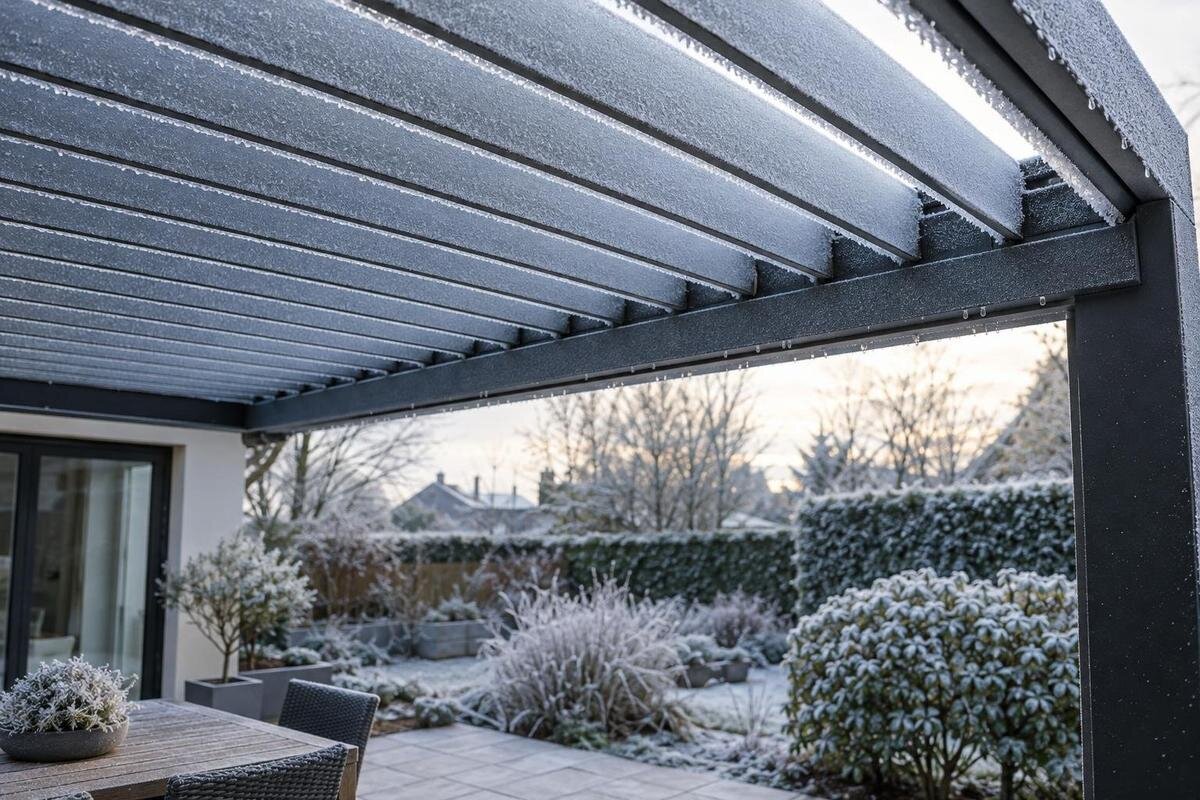
Frost can stop a normally free-moving louvred pergola roof from moving. Ice may form in narrow gaps, around pivots or along water paths; a control that still responds does not mean the roof is safe to move. The sensible response is to leave the roof still, avoid force and check the instructions for the exact model. This guide explains how to recognise possible ice binding, what not to do and which manufacturer-approved details to confirm.
01
How frost can bind louvres
Every louvred roof has moving surfaces with clearances that allow the blades and connected parts to travel. If moisture freezes across one of those gaps, even a small ice bond can resist movement. Moisture might be dew, rainwater, condensation or meltwater left from an earlier thaw; the precise route depends on the roof’s design. Ice is not always obvious from below. A white coating on an exposed surface does not establish whether the moving parts are bound, and the absence of visible frost does not establish that they are clear. On some designs, the binding point may be hidden from a normal viewing angle, even when the outer surfaces look dry.
Conditions can differ across the same roof. A sheltered edge, joint, overlap or shaded area may remain damp or cold while another part looks dry, and refreezing can make a thin film harder to see. Where the design channels water, ice may also form along a runoff path. These are possible mechanisms, not a diagnosis of a particular pergola. Surface temperature can vary from the air around it, so neither a mild-feeling morning nor sunshine on one side is a reliable clearance test. The moving parts, operating limits and approved response to icing must come from the exact model’s documentation.
Clues that ice may be involved
An overnight freeze followed by unusual resistance in the morning is a useful clue, especially if frost or a thin glaze is visible near louvre edges or joints. The roof may stop partway, move unevenly or fail to start, but none of those signs proves ice is the cause. From a safe position, note what is visible, when the problem occurred and whether there was recent moisture. Separate those observations from your interpretation: “frost visible along one edge” describes what you saw, whereas “the drive is frozen” assumes a cause you may not be able to see. Do not make another attempt just to gather evidence. The Bloomcabin Bioclimatic Pergola listing can help identify the product when reporting these symptoms, but cannot diagnose the stoppage.
A stalled or slow roof can also have a control interruption, an obstruction, wear or another fault; the same symptom has more than one explanation. Avoid opening covers, reaching into the mechanism, removing a blade or testing parts by hand. If the manual describes a safe visual check, limit yourself to that and follow its boundaries. Record the control response only if it has already occurred, rather than repeating it. Treating every stoppage as ice can delay service, while treating ice as a simple obstacle invites force.
02
Why a stalled roof should not be forced
When ice restrains a moving part, a powered drive, if fitted, may continue to apply force at the point of resistance. That can place unusual load on a drive, pivots, connecting links or alignment. A manual push can create the same problem, with extra leverage in a direction the assembly may not be designed to take. If the ice bond releases suddenly, the mechanism may move without warning. The force needed to break a bond is not a reliable test of whether the rest of the roof is clear.
Do not use a pole, spanner, crowbar or improvised handle to move a louvre, and do not copy a release method from a different pergola. Avoid leaning on blades or trying to separate iced surfaces with a sharp object. For a roof identified in your paperwork as a Bloomcabin Wall-Mounted Pergola, request guidance under that exact model name rather than borrowing a procedure for another roof. A shared catalogue category does not establish that mechanisms or recovery methods are interchangeable. Keep people clear if ice could fall or a part could move.
What to do when movement stops
If movement stops against resistance, release the control and leave the roof where it is. Do not hold a button down, repeat short bursts, alternate open and close commands or switch to manual movement to see if the bind clears. If the product instructions specify a stop or fault response, follow them; do not improvise a reset or override. Avoid operating the roof again until the instructions say it is permissible and the reason for the resistance has been addressed.
From the ground, note visible ice, water or debris and the position at which the roof stopped. Describe whether the blades appear fully closed, partly open or uneven, without trying to move them into a position that is easier to describe. Do not climb onto the structure or reach into its mechanism. Keep people clear while there is a chance of sudden movement or falling ice. When asking for help, distinguish the last command you gave from what the roof actually did; these are separate pieces of information. If it matches your paperwork, the Bloomcabin Pergola listing can serve as a product-name reference. Give that name together with the observed stopping position so the response concerns the correct roof.
03
Letting ice clear without improvised treatment
Do not chip, scrape or prise ice from blades, pivots or connections. Nor should you apply hot water, a heat gun, flame, salt, chemical de-icer, lubricant or solvent as a default remedy. A quick surface thaw may leave hidden ice in place, and water can refreeze as conditions change. Heat or a product that seems harmless on an exposed surface may be unsuitable for a particular finish or moving assembly. Use any such treatment only if the manufacturer explicitly approves it for your exact model; otherwise, leave the mechanism undisturbed.
A change in ambient conditions does not guarantee that every hidden point has thawed. Shaded joints, overlaps and drainage paths can remain icy after exposed surfaces look clear, so do not judge by the roof’s upper face or by how warm the air feels. There are two separate questions: whether the visible ice has disappeared and whether the model’s conditions for restarting have been met. Answering the first does not settle the second. Follow the stated restart procedure rather than using a brief movement as a thaw test. If resistance remains, stop and seek appropriate service. When requesting that procedure for the Bioclimatic Pergola shown in the catalogue, identify your supplied model and explain whether ice remains visible or only the resistance remains.
Check the drainage route after a freeze
Freezing can affect water handling as well as blade movement. On designs that route rain through a channel, gutter or outlet, ice or compacted debris may slow drainage; retained water can then refreeze. A clear roof surface does not tell you that the whole route is clear, and an apparently dry outlet does not confirm that water is moving as intended. Check only what can be seen safely from ground level. If water is visible, describe where it is collecting or emerging rather than assuming that the nearest outlet is blocked. Distinguish water seen during the freeze from water seen after thawing, so the sequence is clear when you report it. Do not poke into a channel, dismantle a cover or open a roof to clear a frozen route.
Ask for the drainage diagram and operating guidance for the exact model, and use them to understand which visible route belongs to the assembly and which checks are permitted. Do not assume every louvred pergola drains in the same way, or that a generic diagram applies to both wall-mounted and freestanding configurations. When considering the Bloomcabin Pergola catalogue page, keep questions about outlet layout separate from questions about blade movement: a product name alone answers neither. Report persistent pooling, leakage or abnormal flow after a thaw rather than dismantling parts.
04
Finding the approved procedure for your model
Start with the product label, invoice, manual, handover documents or written order record, and match the exact model and any options named there. Ask for the current manual and the manufacturer-approved response to frost, ice-bound louvres or a stopped roof. The guidance should clarify whether operation is allowed in stated cold conditions, what to do when movement is resisted and whom to contact if the roof does not recover. If the instructions do not mention icing, ask for written, model-specific advice rather than treating silence as permission to operate.
Also request the weather-performance limits and drainage diagram for that exact configuration, along with any instructions for its controls or accessories. Read these as related but distinct information: an operating limit describes a permitted condition, while a recovery procedure explains what to do after a stoppage. One should not be treated as a substitute for the other. If you are matching paperwork to a Wall-Mounted Pergola listing, verify that the manual corresponds to the supplied roof and options, not merely a similar photograph or name. Where a document offers several configurations, identify which parts apply to yours before relying on a procedure. Ask for clarification if the control instructions and roof instructions seem to conflict. Avoid relying on generic advice or a video showing an unverified mechanism; appearance alone cannot establish a safe release method.
Enclosures do not remove the frost risk
Side screens, glazing or other enclosure components can affect airflow, shade, condensation and how moisture dries, depending on their layout. That does not automatically prevent frost on the louvres or confirm that the roof can move in icy conditions. More shelter is not, by itself, evidence that the mechanism is clear or that the complete structure has any particular winter performance. Treat the pergola and enclosure as a specified combination, rather than assuming that adding side components makes the roof frost-safe.
Before selecting an enclosure, ask whether it is compatible with the exact pergola model and whether the combination changes operating instructions, drainage access or cold-weather limits. The Bloomcabin Bioclimatic Pergola model page identifies a catalogue family; it does not establish that a particular enclosure is included or approved. Request guidance for the intended configuration instead of modifying, sealing or heating the space as a way to free a frozen roof. Confirm that any weather information applies to the complete assembly, not just one component.

05
Questions to ask before buying
Describe the conditions at your own site and ask what the manufacturer permits when frost or ice is present. Useful questions include whether movement must stop in those conditions, how to respond if the roof stalls and whether an approved thaw or service procedure is available. If a Bloomcabin Wall-Mounted Pergola model is on your shortlist, ask which manual and operating limits apply to the exact model and options you would receive. Make the question specific: you need to know how to handle an ice-bound mechanism, not simply whether the product is described as suitable for winter. When comparing answers, distinguish a stated procedure from a general reassurance. If a response only discusses rain or ordinary cold weather, the question about frozen moving parts remains unanswered.
Request the operating instructions, weather-performance information and drainage diagram before relying on a particular configuration. Ask how to identify the supplied model later, what visible signs should prompt you to stop operation and which support contact handles a persistent fault. Keep the answers with the quotation or order details so that the configuration discussed can be matched to the one supplied. If you plan to add side components, confirm their compatibility and whether they affect drainage or the operating guidance. Compare the complete proposed assemblies rather than treating an answer about a bare roof as an answer about every enclosure option. Do not infer frost, storm, watertightness or snow performance from another model’s description; limits and approved responses are model-specific.
What to check after a thaw
Once the manufacturer-approved conditions for returning to service are met, look for visible changes from ground level: a louvre that no longer lines up with its neighbours, a new gap or a part that appears loose. A visual difference alone does not prove damage, so do not try to realign anything yourself. If the roof still moves unevenly, makes a new sound or stops again, discontinue operation and report what happened. One normal movement after a thaw does not prove every hidden point has cleared or that no stress occurred.
Make a short record of the weather, what was visible, where movement stopped and any approved action taken. Keep the sequence clear: conditions before the stoppage, the initial symptom, what happened during the thaw and any later abnormal behaviour. Distinguish observations you made at the time from details you are unsure about, rather than filling gaps with a likely explanation. Send the record with the exact model name and, if useful, photographs taken safely from the ground to the manufacturer or installer. There is no need to reproduce a fault simply to obtain a better photograph or description. This information can help distinguish a one-off icing event from recurring drainage or mechanical trouble. Follow the stated maintenance schedule and keep water routes accessible as intended, but leave adjustments, dismantling and release of seized components to appropriately qualified service personnel.
Frequently asked questions
Can I move the louvres if they are covered in frost?
No. If the louvres are visibly iced or resist movement, leave the roof still. Do not repeatedly use the control or try to free the mechanism by hand. Follow the instructions for your exact model.
Can I pour warm water over frozen louvres?
Do not use warm water, heat, salt or a chemical de-icer unless the manufacturer explicitly approves it for your model. A surface may clear while ice remains in a hidden joint, and water can refreeze.
What if the control responds but the roof does not move?
Stop issuing commands. A control response does not show that the mechanism is free; ice, an obstruction or another fault could be involved. Do not keep testing it. Check the model instructions and seek manufacturer-approved advice.
Should I leave the roof open or closed during frost?
There is no position that applies to every pergola. Do not move an ice-bound roof to reach a general-purpose position. Check the exact model's guidance before frost occurs, and leave a roof still if movement is resisted.
How can I tell when it is safe to operate the roof again?
Visible frost disappearing does not prove that concealed joints or water paths have thawed. Use the model's approved restart procedure. If resistance remains, or the roof moves unevenly or stops again, discontinue operation and request appropriate service.
A frozen or frost-bound louvred roof is not something to free by force. Ice may be hidden where moving parts meet, while the same symptoms can point to another fault. Leave the roof still, avoid improvised thawing and follow only the approved response for its exact model. Once the stated conditions for returning to service are met, stop again if resistance or abnormal movement remains. Keeping the model name and a clear record of what happened makes it easier to get relevant guidance without guessing at the mechanism.
