
Fungus Gnats in the Greenhouse: Causes, Prevention and Control
Greenhouse plant health · Adults above, larvae below
Fungus Gnats in the Greenhouse: Causes, Prevention and Control
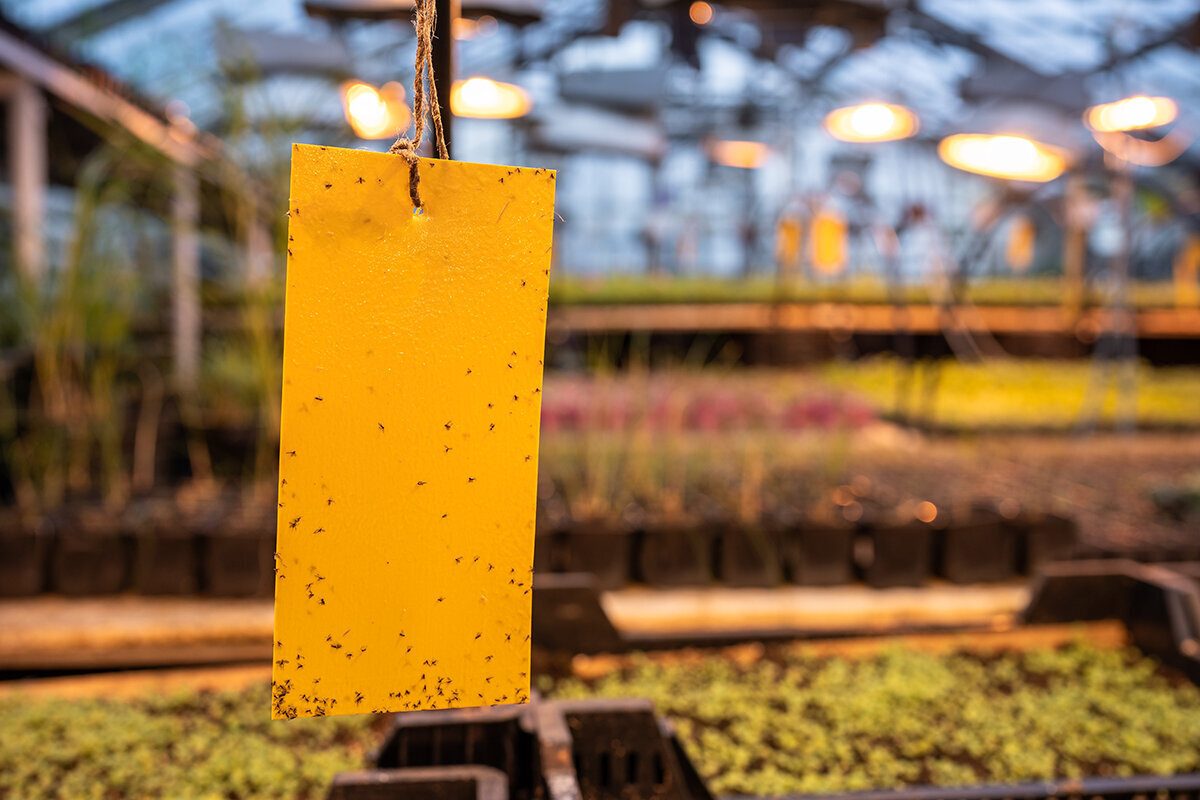
A yellow sticky trap makes fungus gnats visible, but it does not cure the root zone. Captured adults usually reveal a damp biological system developing in the upper growing medium.
That distinction shapes the response. Catching flying adults supports monitoring and can reduce pressure. More important are damp surfaces, algae, organic debris, vulnerable propagation material and larvae near the roots. The aim is not to dry every pot completely, but to create a crop-appropriate moisture rhythm: enough water for the plant, with less permanently usable habitat for fungus gnats.
Yellow traps provide clues. If weekly catches rise, check moisture, hygiene and propagation conditions beneath the crop instead of mistaking the card for the complete solution.
The first 48 hours
Protect sensitive crops first
Fungus gnats are especially troublesome where careful horticultural work has gone into seed trays, rooted cuttings, newly potted plants and slow-growing young plants. Strong, established crops often tolerate a light infestation better. Fine roots, seedlings and cuttings that have not rooted fully have far fewer reserves. First separate the vulnerable propagation area from the rest of the stock rather than treating the whole greenhouse as a precaution.
01
Pause automatic routines
Check whether timers kept running unchanged through cool, overcast weather or whether plants used less water. What suited last week may already be too much today.
Check whether timers kept running unchanged through cool, overcast weather or whether plants used less water. What suited last week may already be too much today.
02
Remove standing water and algae
Empty saucers and trays, dry puddles beneath benches and remove green growth from floors, pots and watering areas.
Empty saucers and trays, dry puddles beneath benches and remove green growth from floors, pots and watering areas.
03
Inspect new plants separately
Do not place new young plants, houseplants or damp bags of growing medium directly with propagation stock. Inspect the material and place a dated yellow sticky trap nearby.
Do not place new young plants, houseplants or damp bags of growing medium directly with propagation stock. Inspect the material and place a dated yellow sticky trap nearby.
Identify first, then act
Not every small dark fly is a fungus gnat
Adult fungus gnats are delicate, dark, long-legged flies, generally about1.5to3.0mm long. They fly weakly, hover or stagger near pots and sometimes run across the growing-medium surface. Long legs and thread-like antennae on a well-positioned sticky trap are useful first clues. If visible, a typical Y-shaped wing vein can be checked more closely with a hand lens.
The decisive clue is in the growing medium: the larva is slender, translucent to whitish, legless and has a clearly visible, shiny black head capsule. Look mainly in the moist upper layer rather than only deep in the pot. Larvae are particularly easy to find in wet propagation cells, beneath dead leaves or around persistently damp pot edges.
Likely fungus gnatDelicate · long-legged
Shore flyStockier · spotted wings
Protect beneficialsLook for a wasp waist
Working ruleConfirm the insect and habitat
Probably a fungus gnat
Look for weak, erratic flight, long thread-like antennae and clear wings. Larvae have a visible dark head capsule. They feed on fungi, algae and organic material; at high densities, fine roots and root hairs may also be at risk.
Possible confusion: shore fly
Shore flies also occur around algae and excessive moisture. However, adults appear stockier and have pale spots on their wings. Their larvae lack the distinctive black head capsule of fungus gnat larvae and feed mainly on algae.
Do not harm beneficial insects unnecessarily
Small parasitic wasps and predatory midges can also end up on sticky traps. If you see a narrow wasp waist, or identification remains uncertain, examine several specimens more closely. Not every tiny winged insect in a greenhouse is automatically a pest.
Why the distinction matters
Removing algae helps with both fly groups. Root protection and targeted larval measures matter chiefly where fungus gnats are confirmed. A yellow trap’s catch total alone cannot make that distinction.
A life cycle on two levels
One pest, two different work areas
Fungus gnats pass through egg, larva, pupa and adult stages. Development time changes with temperature, moisture and food supply, so a calendar figure is not a reliable guarantee. In practice, the key is spatial separation: adults are monitored and caught in the airspace, while eggs, larvae and pupae are linked to the damp growing-medium surface. A robust plan must address both levels of the cycle.
Above the crop
Monitoring level
Monitoring level
Adults→
Egg laying→
Traps record→
Adults emerge
In and near the
upper growing-medium layer
upper growing-medium layer
Eggs→
Larvae→
Pupae→
Root risk
Above the crop: what yellow traps show
Weak-flying adults gather around pots, lower leaves and damp growing-medium surfaces. Females favour a moist, organic environment for egg laying close to food for their larvae. Yellow traps show adult activity and changes in infestation pressure over time. They do not reveal how many larvae live in an individual pot. Newly emerged adults start the visible phase again.
In the growing medium: where action matters most
Tiny eggs are laid on or near the damp surface. Young larvae feed where fungi, algae and decomposing material are available, then pupate in the growing medium or organic residues. High larval pressure is especially consequential for seedlings, cuttings and already weakened roots.
Why infestations develop
Moisture is not the enemy – constant wetness is
Sheltered, warm air + wet upper growing medium + organic residues + repeated watering without a drying interval = favourable fungus gnat habitat.
Peat-rich and other organic growing media can suit plants very well. Problems arise when the surface stays wet for days, little air reaches the root zone, algae grow, leaf residues remain or pots stand permanently in drainage water. Fungus gnats prove neither poor cleanliness nor automatic root damage. They are, however, a valuable prompt to examine the biological conditions created by watering, drainage and working practices.
Drainage
Water must be able to drain away
Blocked drainage holes, compacted growing medium, full saucers and poorly drained surfaces keep the area beneath plant benches wet long after the crop’s actual water need has been met.
Algae
Green growth is a clue
Algae indicate recurring surface moisture and an available nutrient supply. They particularly favour shore flies and often accompany the persistently damp conditions that also support fungus gnats.
Organic residues
Remove damp material consistently
Dead leaves, old propagation plugs, used growing medium and plant debris hold water and enable fungal growth. Remove this material before it becomes habitat for the next fungus gnat generation.
Interpret symptoms carefully
Larvae can stress roots – but diagnosis needs perspective
Fungus gnat larvae feed mainly on fungi and decaying organic material. At high density, they can graze root hairs or enter tender roots. Seedlings and cuttings are particularly vulnerable because even limited damage can noticeably hinder establishment. Injured or already stressed roots may also become more susceptible to further root problems. Therefore inspect not only visible flies, but always the plant’s condition and root zone.
Yellowing, slow growth, wilting and poor rooting are not exclusive fungus gnat symptoms. Low light, cold growing medium, dense soil, nutrient imbalance, root disease, water shortage after excessive drying or potting errors can look similar. Examine moisture and roots before naming the infestation as the only cause. A well-controlled setting for crop zones is provided by the Classic Aluminium Greenhouse.
Healthy zonePale fine roots; crop-appropriate moisture.
Food zoneAlgae, plant residues and old propagation material.
Risk zonePersistently wet surface; confirmed larvae.
Do not assume too quicklyAdults do not prove root feeding.
Practical threshold: Confirmed larvae in a propagation area are reason to improve the environment immediately. Waiting for severe wilting makes crop management harder and leaves less scope for gentle, targeted action.
Watering is the most important lever
Plan a drying rhythm, do not force drought
Advice to let growing medium dry is useful only when crop, root volume, weather and growth stage are considered. Basil in a small propagation cell, a rooted cutting, a large citrus container and a resting succulent need very different intervals. The aim is partial surface drying between waterings where the plant species tolerates it. The active root zone must still receive adequate water.
Water when neededAllow partial surface dryingRewater before drought stress
1. Look below the surface
Check the upper centimetres with a finger, lift the pot or use a moisture sensor suited to the container size. A pale surface can hide a still-saturated lower root zone. Conversely, a dark surface may be entirely appropriate for a moisture-loving crop. Pot weight, the surface and plant condition together give the clearer picture.
2. Match water volume and intervals
If a bench repeatedly remains wet, check dripper output, runoff and drainage. Water deliberately into the required root zone instead of topping up small amounts with every timer pulse. Closed trays should not remain full for days after plants have taken up water.
3. Respond to the weather
Reduce watering after cool, overcast spells and when ventilation is limited. This can be especially important during South Africa’s cooler winter conditions in many regions. In bright, hot weather, demand may rise sharply without automatically creating fungus gnat conditions, provided the medium drains and the surface receives a suitable break from wetness.
Tomatoes show clearly that crop need comes first: their water use changes greatly with plant mass, light levels and fruit load. A controllable environment is offered by the Classic Aluminium Greenhouse. Apply the same principle to every pot: water the root zone for the plant’s needs, not the fungus gnats’ habitat out of habit.
Diagnosis at four monitoring points
Bring together several clues before treatment
A single control tool captures only part of the system. Combine yellow traps, growing-medium checks, root inspection and brief written records. This turns an irritating cloud of small flies into an assessable observation: where is pressure greatest? Are larvae present? Which crops are vulnerable? And do catches fall after watering and hygiene have been corrected?
Yellow traps
Adult activityLarval check
Surface-near larvaeRoot inspection
Crop vulnerabilityWatering log
Habitat patternYellow traps
Place cards just above the crop canopy or near the growing-medium surface in vulnerable areas. Label every card with location and date, use comparable positions each week and assess trends rather than one catch. Yellow traps document adult activity, not larval numbers in every pot. Outside enclosed greenhouses, use sticky traps sparingly because non-target organisms may be caught.
Larval check
Inspect the damp upper growing-medium layer, especially at pot edges, beneath plant debris and in wet propagation cells. Work with several representative containers, not only the most obvious pot. A finding confirms near-surface larval activity, but does not yet provide a complete picture of root health or distribution across the greenhouse.
Root inspection
Select two or three representative seedlings, cuttings or struggling pots. Healthy roots are mostly pale, firm and branched. Also check for rot, unusual odour, excessive wetness and visible larvae. This assesses crop vulnerability, not adult flight pressure elsewhere.
Watering log
Record crop, watering, weather conditions, leaks, algal growth and trap catches. A short weekly entry reveals local patterns that memory rarely captures reliably. The log shows whether watering and infestation pressure are linked; it cannot identify the insect species on its own.
Treatment by priority
Correct the environment first, then target larvae
A reliable approach combines compatible measures. Begin by correcting the conditions that sustain the cycle. Add biological controls when larvae are confirmed or pressure persists despite correction. Use an agricultural remedy only if its current South African registration and authorised label cover the exact site, crop, pest and user category. A remedy registered for ornamentals is not automatically suitable for edible crops.
1
Drainage, dry storage and hygiene
Empty saucers and puddles, remove algae and dead plant material, and discard heavily affected old growing medium where horticulturally sensible. Store fresh bags of medium cleanly, closed and protected from damp ground. Clear blocked drainage holes and check that all pots receive even, but not constant, water. These foundations help prevent a new wave after other measures.
Suitable for:
Every infestation, crop and season.
Every infestation, crop and season.
2
Physical control and crop management
Use yellow traps for early warning, trend monitoring and partial reduction of adult insects. Do not replace larval checks with masses of hanging cards. Remove old leaves from the growing-medium surface, allow suitable spacing for air movement and do not keep propagation cells wet merely because nearby larger plants need more water.
Suitable for:
Low to moderate pressure and early intervention.
Low to moderate pressure and early intervention.
3
Biological controls against larvae
Depending on availability, crop, temperature and production method, insect-pathogenic nematodes such as Steinernema feltiae and soil-dwelling predatory mites, for example Stratiolaelaps scimitus may be suitable. These are living beneficial organisms whose success depends, among other factors, on freshness, temperature, correct application and appropriate growing-medium moisture conditions. Order beneficials only when the area, delivery date and application are ready. Follow the specialist supplier’s instructions for storage, dosage, water quality and compatibility. Nematodes need moisture to move through the growing medium, but not a permanently flooded tray.
Suitable for:
Confirmed larvae, propagation areas and coordinated preventive programmes.
Confirmed larvae, propagation areas and coordinated preventive programmes.
4
Use registered products precisely and according to the label
If crop management and biological measures are insufficient, choose only an agricultural remedy currently registered for the precise application site, crop and pest. Before purchase, check the South African Registrar’s current information and read the original label in full. Follow all directions and user restrictions. Broad-spectrum treatments can harm beneficials and often leave the persistently wet root-zone cause unchanged.
Suitable for:
Persistent situations after confident identification.
Persistent situations after confident identification.
Check compatibility: Nematodes and predatory mites need suitable moisture but do not automatically tolerate every plant-protection product, cleaning product or tank mix. Plan release, hygiene and any product use as one connected system. Combine measures only when the supplier expressly confirms compatibility, and check every combination against current supplier information and the binding product label.
Reset the propagation area
Make the next propagation cycle less attractive from day one
After a crop cycle, remove plant debris and loose growing medium from benches, floors, joints and water channels. Clean reusable trays and tools, remove algae from splash zones and check that benches drain completely instead of retaining a thin water film. Start new propagation with clean containers, freshly and dry-stored medium, labelled trays and several already dated yellow sticky traps.
Then give each crop its own watering logic. A regularly misted cutting zone has different needs from a bench of vigorous tomato seedlings; neither zone should dictate watering for the other. Separate sowings, cuttings and established potted crops where possible. This is more precise crop management and a calm, effective form of integrated pest management.
The order at a clean bench
EmptyRemove residues and old medium.
CleanWash trays, tools and surfaces.
DryFix leaks; remove standing water.
MonitorDate yellow traps before cropping.
If the greenhouse is to remain both a productive workspace and a high-quality garden room over the long term, good access, controlled ventilation and clear zones make routines more pleasant. Discover the durable, configurable Classic Aluminium Greenhouse and plan bench access, roof ventilation and a dedicated propagation area around the jobs you genuinely perform regularly.
Frequently asked questions
Practical answers from the potting bench
Calm observation and a coordinated reset usually achieve more than one drastic product or drying every crop indiscriminately.
Do yellow traps eliminate fungus gnats completely?
No. They catch adult insects and show where activity is greatest. They do not directly and reliably control larvae in the growing medium. Keep using yellow traps for monitoring, correct persistently wet conditions at the same time and apply a suitable measure where larvae are confirmed.
How dry may greenhouse pots become?
Only as dry as the particular crop can tolerate without stress. Let the upper growing-medium area dry in a controlled way where the plant allows it. Seedlings, cuttings and moisture-loving species must not suffer complete root-ball drying. Decide using pot weight, the feel of the medium, weather and plant condition rather than a universal number of days.
Do fungus gnats damage mature plants too?
In vigorous, well-rooted plants, adults are often mainly a nuisance. High larval densities can nevertheless affect fine roots, especially if the medium stays wet or the root system is already weakened. Comparable damage matters more in seedlings and cuttings. Inspect roots and larvae before attributing every growth problem to fungus gnats.
Are shore flies treated in the same way?
Cleaner, less persistently wet surfaces and algae removal help with both fly groups. Shore flies are more closely associated with algae and do not usually damage roots directly. Their stockier bodies and pale wing spots help distinguish them from delicate, long-legged fungus gnats.
When are nematodes or predatory mites useful?
Choose biological controls according to the crop, evidence of larvae, infestation pressure, temperature, availability and watering method. They are living organisms with specific requirements for storage, application and growing-medium moisture. Follow specialist supplier instructions closely. They support control most reliably when drainage, hygiene and watering rhythm are corrected at the same time.
Sources and further guidance
Reliable resources for identification and integrated control
Registration status and binding directions can change. Before buying agricultural remedies or biological controls, check the current authorised label, specialist supplier guidance and the South African Registrar’s information. Use an agricultural remedy only for a use covered by its current registration and label.
More from Bloomcabin: Greenhouse setup: layout, plants and care · Made-to-measure aluminium greenhouses · Smart greenhouses for home gardeners
- German Environment Agency: fungus gnats, prevention and yellow traps
- North Rhine-Westphalia Chamber of Agriculture: nematodes against fungus gnat larvae
- Hortipendium: Fungus gnat biology and development
- South African Government: register an agricultural remedy
- South African Government: agricultural-remedy registration requirements
- South African Government: agricultural-remedy application process
A repeatable weekly routine
Adjust the period of wetness
A greenhouse with low fungus gnat pressure is rarely the result of a perfect trap or one drastic treatment. What matters is a brief, disciplined check made regularly before damp growing medium becomes a permanent habitat.
Check moistureAssess the upper medium and deeper root zone together before the next planned watering.
Empty standing waterCheck saucers, trays, benches and floor edges; remove persistently wet spots consistently.
Review yellow trapsDate cards and compare them with the previous week rather than estimating catches from memory.
Inspect vulnerable rootsWhen catches rise or growth stalls, inspect a representative cutting, seedling or propagation pot.
