
Hedges or Pergola Screens: Planning Privacy and Garden Space
GARDEN PRIVACY GUIDE
Choosing between a hedge and pergola screening is a choice between two different kinds of privacy. A hedge gives a living boundary, but it takes planting space, changes with the seasons and needs time and care to fill out. A pergola screen can interrupt a particular view soon after installation, yet its coverage depends on position, size, material and compatibility with the structure. Compare the views you want to block with the garden area you are willing to give up, how long you can wait and the maintenance you can sustain.

Points to compare 1
Map the views you want to block
Privacy is easier to plan when it is tied to a real view rather than a general sense of exposure. Sit where you normally eat or read, stand at the garden entrance, and look towards neighbouring windows, a path or a street that concerns you. Note which view feels intrusive and which outlook you would like to keep. A screen that hides a seated view may leave a standing person exposed; a hedge along the boundary may soften a longer view but also close off part of the garden. Check more than one position, including the places where you spend time. An upper window may overlook a side screen, so note whether the exposure is level, diagonal or from above.
Sketch the pergola, seating, access route and proposed hedge line, then draw the sightlines you want to interrupt. Mark the side and approximate span needed for each one instead of assuming every edge needs screening. This helps preserve an open view elsewhere. If you are considering the Bloomcabin Bioclimatic Pergola, use the sketch to explain where privacy is needed rather than simply asking for a screened pergola. A short section may be enough if the sketch shows only one exposed angle. Take the plan outside and compare it with the actual viewpoints before deciding how much of the side to cover.
Measure the hedge at its mature size
Allow space for a hedge as a planted strip, not a thin line along the boundary. The bed needs room for the selected plants to reach their expected mature spread, with access for planting, pruning, weeding and replacement. That final width varies by species and by the shape you plan to maintain, so use mature-size guidance from a nursery rather than judging by the small plants on display. A narrow strip that looks generous in the first year may later press against a path, patio furniture or the side of a pergola. Mark the future width on your plan before committing. If paving, walls or buried services are close, ask an appropriate local professional about suitable placement.
Compare the planting strip with the pergola footprint and the route around it, not only with the boundary. A hedge occupies a strip of ground along its length; a pergola also takes up space, even though a side screen does not need a planting bed. Include room to sit, pass through and maintain both options, and avoid leaving a gap so narrow that trimming becomes awkward. If you are considering the Bloomcabin Wall-Mounted Pergola model, obtain its exact plan dimensions before setting out a nearby hedge bed. Measure the remaining space beside paths, doors and planting rather than judging the fit by appearance alone.
Points to compare 2
Allow time for a hedge to fill in
A newly planted hedge does not provide the same immediate screen as a dense, established row. The time needed to close gaps depends on the species, starting size, planting conditions and care; sun exposure, soil, water and local weather all play a part. There is no reliable single growth timetable for every garden. If privacy is needed by a particular date, ask a nursery or landscape professional to assess suitable plants and sizes for the actual site, then plan for the period when the branches have not yet joined. Larger plants may look fuller at first, but they are not a guarantee of instant, even cover. Avoid crowding plants simply to hide gaps sooner, because mature spread still matters.
Ask whether the selected hedge keeps its leaves throughout the year and how its density changes across the seasons; branches may remain while visual cover changes. Also account for establishment watering, pruning, leaf and clipping clean-up, and replacement if a plant does not thrive. These are part of the privacy plan, not occasional extras: a gap can reopen a direct view, while a heavy trim may change the hedge’s appearance and density. If ongoing care is limited, choose plant types and a form that can be maintained consistently rather than relying on the fastest possible growth. Ask for expected upkeep as well as expected size.
What a pergola screen can and cannot cover
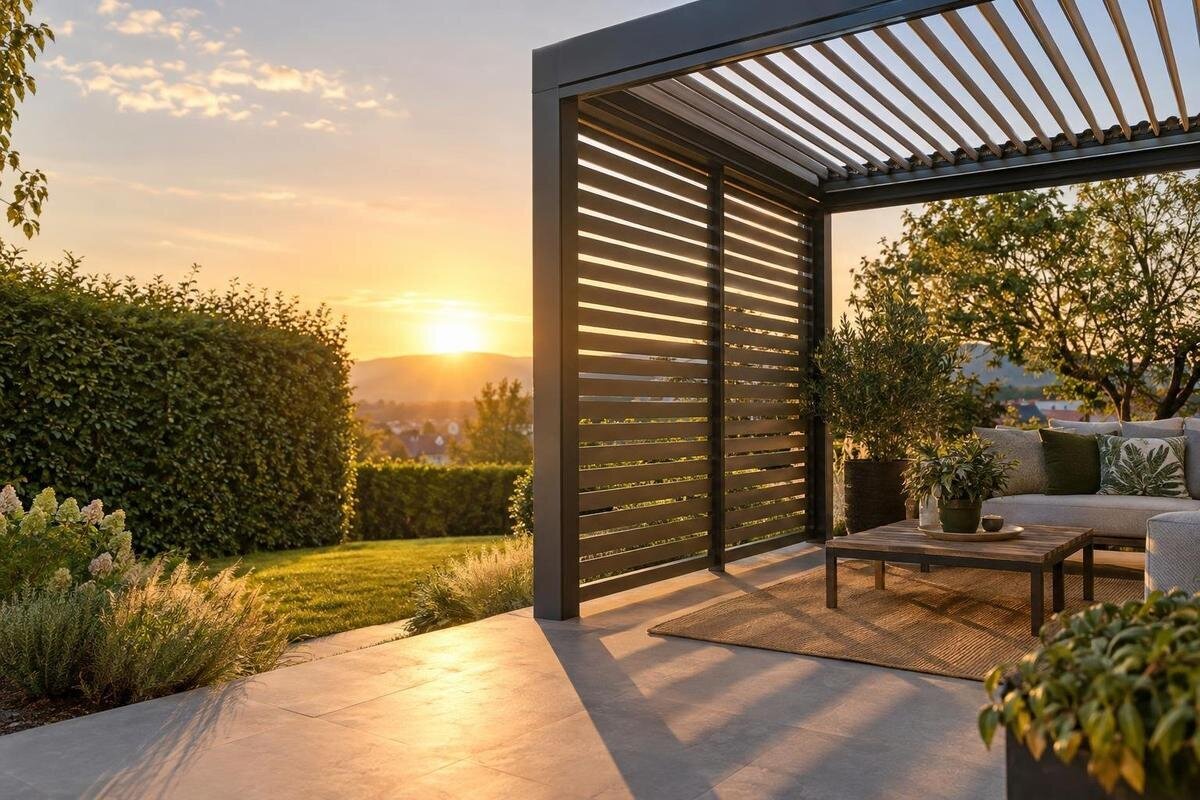
An appropriately selected and installed pergola side screen can provide cover as soon as it is in place, without waiting for a plant to fill out. Its useful coverage is bounded by position and dimensions: it may block a direct view from one seat yet leave an oblique view, a higher window or the opposite side open. Check the proposed screen from the locations you marked, and consider the edges as well as the centre. A gap at an end, below or above may matter if it lines up with the view you are trying to interrupt. If you need privacy from several directions, assess each sightline separately. A screened pergola is not automatically a private enclosure.
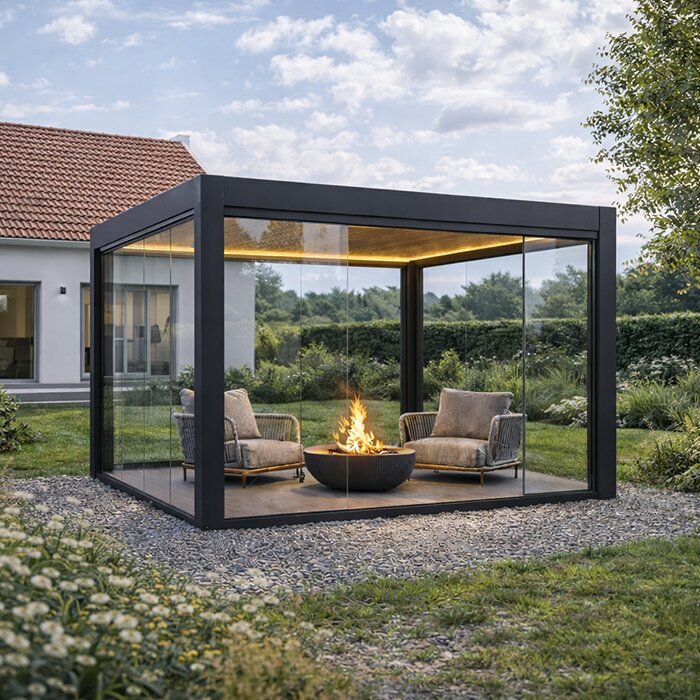
For the Bloomcabin Pergola, confirm with the supplier which side options are approved for the exact model, what area they cover and whether they are supplied with the structure or as separate accessories. Do not plan around an off-the-shelf or third-party panel until fit and compatibility are confirmed. The difference from a hedge is not only speed: a screen gives a defined plane of cover when deployed, while plants form a growing line. That makes its height, span and alignment important. If the concern is a view from an upper storey, a side screen may not address it; identify that limit before choosing.
Points to compare 3
Balance privacy with light and airflow
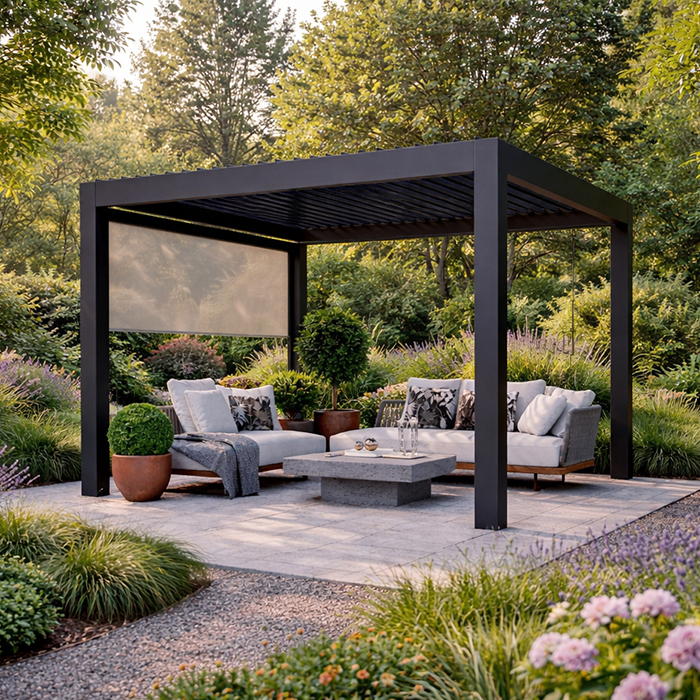
Opacity changes more than a view. A dense side treatment can reduce daylight on that side and make the pergola feel more enclosed; a more open weave may retain some visual connection but leave faces or movement visible. Air movement also depends on the material’s openness, the area covered and the way the side is arranged. A hedge’s effect changes with leaf density and pruning. Treat privacy, shade, light and airflow as related but separate requirements: a screen that solves one does not automatically solve the others. If you want to keep sight of the garden, decide which outlook matters as well as which view you want to block.
When comparing side treatments for the Bloomcabin Bioclimatic Pergola, review the actual material and coverage details; do not infer airflow or light transmission from the model name. Where possible, view a sample at the intended location or make a simple visual mock-up at approximately the proposed height, then look from inside and outside. Note the effect on the garden view and daylight near the house. Compare this with the expected density of the hedge, including seasonal changes discussed with a nursery. Aim for the least coverage that addresses the sightline while preserving the openness you value.
Compare maintenance over time
Hedge maintenance is spread over time: establishment watering, keeping the bed clear, trimming to the desired width and height, and removing fallen leaves or clippings. The exact schedule depends on plant type and growing conditions, so follow plant-specific guidance. Think about where you will stand to prune and whether tools can reach the bed without crossing furniture or damaging nearby planting. Consider how much the hedge’s shape may change between trims as well. A tight, formal profile may call for more regular attention than a looser form; the important question is whether the upkeep matches your habits and available access.
A pergola screen does not need pruning or expand with plant growth, but it still needs care. Dust, pollen and leaves can affect its appearance, and the maker’s instructions should guide cleaning and any checks. If the chosen system has moving parts, ask what access and maintenance they require. Materials differ, so avoid applying a generic cleaning rule. Leave access where both sides need attention, and make sure planting will not conceal joints or block a moving panel. Maintenance changes type rather than disappearing: plants need horticultural care, while screens need the cleaning and checks appropriate to their construction.
Points to compare 4
Use planting and screening for different jobs
You do not have to treat every side in one way. If one sightline is the main problem, a compatible side screen may cover that section while planting creates a softer boundary elsewhere. Conversely, a hedge can define a longer garden edge while a screen addresses an exposed seating angle during the hedge’s establishment. This mixed approach can avoid making the whole space feel closed, but it works best when each element has a clear job. Sketch where one form ends and the other begins, and leave room for plant growth, cleaning and access. Check the view from the intended seats again after placing both on the plan.
For a combined layout around the Wall-Mounted Pergola, establish which approved screen options are available before deciding where the planting should begin. Position plants so their future foliage will not cover the screen’s usable area, obstruct access or crowd the seating. If a hedge is intended as a green backdrop rather than a complete visual barrier, explain that when discussing plant size and spacing with a nursery. The screen and hedge need not provide the same degree of privacy. Giving each a separate role helps you judge whether both are useful or whether they would simply duplicate coverage and take up more space.
Keep paths and garden use in the plan
A privacy solution changes the usable layout as well as the view. Plot the pergola, furniture, paths, door openings and the room needed to move around seating before drawing a hedge bed. A planted strip can take width along a garden edge; a side screen occupies a vertical plane but can make the space beneath a pergola feel more enclosed. Check whether chairs can be moved without brushing plants or a screen, and whether the route to the rest of the garden remains comfortable. Include the approach from the house and the turn into the garden, even if privacy is not a concern along that path. Allow space to care for the chosen solution.
Use confirmed dimensions for the Bloomcabin Pergola model to mark its footprint alongside the proposed hedge bed and screen positions. Trace the route from the house, past the seating and into the garden, including the turns around furniture. This shows where the planting strip and screened side would affect everyday movement rather than just the view from a chair. If space is tight, focus coverage on the view that matters instead of assuming a full-length hedge or a fully screened side is necessary. A small change in alignment may protect the seating area while keeping the rest of the garden open.
Points to compare 5
Check privacy across the day and seasons
Privacy can look different at different times. A patio may feel open in daylight, then seem more exposed when lights are on after dark and the surrounding area is dimmer. A screen material that appears to provide privacy in bright conditions may offer a different level of visual cover later. A hedge’s density can also change with the season and viewing angle. Test the plan when you actually use the space, not only during a quick daytime inspection. Include views from neighbouring windows where relevant, because distance and height affect what can be seen.
Walk the same sightlines after dark with the usual lights switched on and off, and check the view from both sides where possible. A sample of screen material held at the proposed position can help reveal visibility and glare without relying on a product label. For the Bioclimatic Pergola model, assess the proposed compatible side treatment in this lighting rather than assuming its daytime appearance will carry through to the evening. For planting, ask whether seasonal changes in foliage would leave a gap at the critical angle. Compare both options at their least private, not only when they look their best.
Compare space, costs and ongoing care
Compare the whole commitment rather than what each option looks like on installation day. For a hedge, include plants, bed preparation, watering during establishment, pruning time, possible replacements and the land it will occupy as it grows. For a screen, ask about the supply and installation scope, approved accessories, cleaning requirements, maintenance access and, if it is adjustable, the space needed to use it. Prices and care needs vary; gather like-for-like information for the actual plans rather than comparing young plants with a finished screen as if both deliver the same result. Include the value of preserving garden space in your decision, not only the initial view.
Bring the comparison together in a written brief: the view to be covered, the proposed dimensions and material, the items included in the price, any separate accessories and the expected care. For a Bloomcabin Wall-Mounted Pergola, ask the supplier to confirm the compatible side arrangement and the scope of supply and installation. For a hedge, ask a nursery about mature spread, seasonal density and care suited to the site. Compare what each proposal will leave exposed and how much usable garden area will remain. That gives you a more useful basis for choosing than the labels “natural” or “instant”.
Frequently asked questions
Will a new hedge provide privacy straight away?
Not reliably. A young hedge may have visible gaps until it establishes and fills out; the timing depends on the plant type, starting size, site and care. Ask a nursery about mature spread, seasonal density and realistic expectations for your garden. If you need cover sooner, consider an appropriate interim option or a compatible pergola-side screen rather than assuming a new row will block the view immediately.
Do pergola screens block views from every angle?
A side screen covers only the area it occupies. Views may remain around its ends, from another direction or from an upper window, and the result also depends on the material and lighting. Test the arrangement from the seats and viewpoints that matter; one screened side does not make a pergola a fully enclosed private room.
Which option uses less garden space?
A hedge needs a planting strip, room for mature growth and access for maintenance. A screen uses a pergola side rather than a planting bed, but the structure, seating and access paths still take space. Compare a site plan showing the exact model dimensions with the hedge’s expected mature width; the better fit depends on your layout.
Are screens included with a pergola?
Do not assume that a screen or third-party panel is included. Confirm which side configurations and approved accessories are available for the exact pergola model, whether they are supplied separately and how much of the view they cover. Check compatibility before planning furniture or planting around a particular screen.
Can I use both a hedge and a pergola screen?
Yes. A screen can address a particular exposed sightline while planting softens another edge or fills out a boundary over time. Allow for future plant growth and maintenance access, and check that any screen is approved for the exact pergola model. Give each element a clear purpose so the garden is not more enclosed than you want.
Use a hedge where you can allow a planted strip to mature and accept the care needed to keep it in shape. Use pergola screening where a defined view needs prompt coverage and an approved side treatment suits the exact model. If different sides have different purposes, combine the two selectively. The strongest plan protects the sightlines that matter without taking more garden space or openness than you are willing to trade.
