
Can a Louvred Pergola Stay Dry in Heavy Rain?
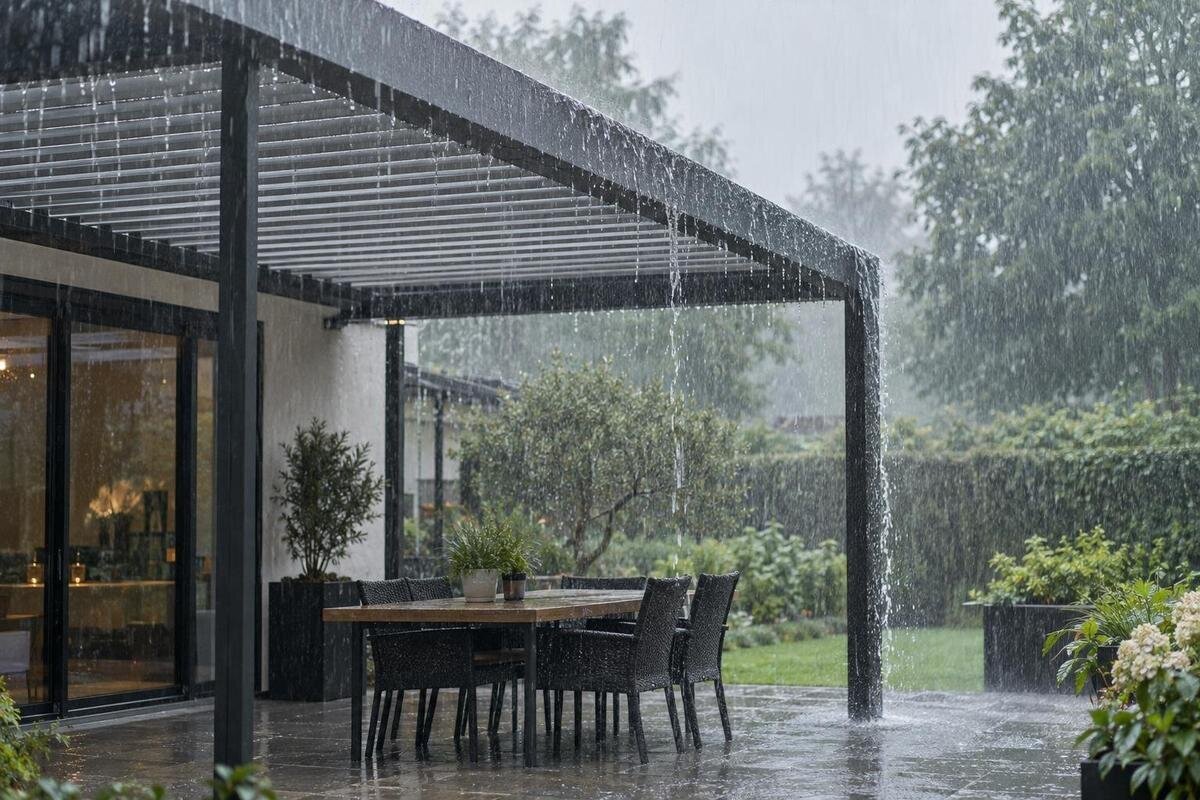
Pergola rain performance
A louvred pergola is not automatically watertight just because its blades close. The roof may channel rain through an intended drainage route, but heavy-rain performance depends on the exact design, test conditions, wind-driven rain, exposed edges, drainage and enclosure. A roof that manages falling rain can still leave a seating area wet when wind pushes water in from the sides. Here is how to separate what the roof is designed to do from what a particular model has actually been shown to handle.

Define the rain conditions before judging performance
Heavy rain is not a single performance condition. Consider how intense the rainfall is, how long it lasts, whether wind is present and the direction from which rain reaches the roof. A short downpour can put a large volume of water onto the roof quickly; a prolonged spell keeps the drainage route working for longer, while gusts push droplets towards and under exposed edges. These are different demands. A near-vertical shower may leave the area beneath the roof dry while the same rainfall, driven sideways, reaches it. An unqualified weatherproof claim does not reveal which conditions were assessed or what counted as a successful result.
Before comparing products, describe the exposure at your home: which sides are open, how sheltered the site is, how long heavy showers usually last and whether the louvres will be closed throughout. When considering the Bloomcabin Wall-Mounted Pergola, look for information covering that model and your intended configuration, including rainfall and wind conditions, blade position and any enclosure details. If those details are missing, do not assume that heavy means the most intense downpour your site may experience. Also define the required outcome: no water through the roof, dry furniture and a fully dry enclosed area are not interchangeable claims.
How closed louvres direct rainwater
A louvred roof is made of moving blades and their meeting points, rather than one uninterrupted sheet. In the designed closed position, blade profiles and seals may guide rainfall towards a channel or gutter, but the overlap, end joints and perimeter treatment vary by model. The manufacturer's drawing is more useful than a photograph of blades that appear shut: an image cannot show how the joints are made or whether the intended closed position has been reached. Ask which position was used for any weather observation, and whether the blades need to be fully closed before the result applies.
Also ask what the model guidance says about partly open blades. A roof left ajar has a different exposed area and should not be judged by closed-roof claims; do not assume that a particular louvre angle offers a known degree of shelter unless the documentation says so. For the Bloomcabin Pergola, as for any model, confirm the specified closed position, how blade ends and seals meet, and the stated operating procedure. If the available drawing shows only the overall roof, request details of the joints. These checks help distinguish water following the intended route from ingress at a connection without assuming every louvred design works in the same way.
Check the full pergola drainage route
Once rain leaves the blade surface, it needs a route away from the roof. Depending on the design, channels in the louvres may feed perimeter gutters or internal channels, then carry water through parts of the frame to an outlet. Not every pergola uses the same arrangement, and the discharge point may not be where you expect. Ask for a drawing that traces water collection, movement through the frame and final discharge. It should show where the route changes direction or passes between components. A roof can collect rainfall as intended but still send it to a place that affects the seating or paving beneath it.
For heavy rain, ask how the model manages the conditions stated in its performance documents, what happens if an outlet is obstructed and where any overflow would go. A drainage diagram explains the intended water path; on its own, it does not prove a storm limit or tell you how much flow the system can manage. If you are considering the Bloomcabin Bioclimatic Pergola, request the drawing for the precise configuration. Check whether the discharge point and any onward drainage are included in the proposed arrangement, rather than assuming that water leaving the frame has reached its final destination.
Wind-driven rain can enter through exposed sides
A louvred roof may manage water falling onto its closed surface without sealing the space beneath it. When wind drives rain at an angle, droplets can pass below the perimeter and land on furniture or the floor, even if the roof's drainage is working as intended. The exposed sides, wind direction and gusts all matter. Rain crossing an open terrace can behave differently from rain arriving behind a wall. This distinction is useful when working out what has happened: water through a roof joint calls for a different investigation from spray carried under an open edge.
Assess the seating area, not just the roof outline. Note which sides face the weather at your site, nearby walls or buildings, and whether gaps remain between the roof edge and any screens. A wall may block one approach while another side stays exposed; wind direction can also change during a storm. A sheltered angle therefore cannot guarantee dryness from every direction. Ask whether any published observation used open sides or a particular enclosure, then compare that set-up with your intended use. This matters if you expect cushions, dining items or equipment to remain outside during a downpour.

Examine roof edges and wall junctions
The roof surface is only one part of the weather boundary. Water may be most noticeable at the perimeter, at blade ends, where channels meet the frame, or where a pergola connects to a house. A claim about integrated roof drainage does not necessarily mean that the vertical sides are sealed or that the connection to a façade is rainproof. When considering the wall-mounted pergola configuration, examine the proposed connection to your existing wall or roof overhang separately from the roof's own drainage. That interface needs its own documented detail; the product name does not establish how it will work at your home.
Ask to see a section or installation detail for exposed edges and wall interfaces, and confirm which seals, covers or other components are included in the configuration. Establish where water is expected to emerge and whether drainage from an adjoining building is separate from the pergola's route. If water appears near a junction, its source may need to be identified before deciding what to address. A qualified installer or building professional can assess the actual connection; a product image cannot show it. If the boundary between roof and wall is unclear, do not treat the whole terrace as a sealed room.
Read pergola weather-performance evidence in context
A test result is useful only when you know what was tested. Look for the exact model and roof configuration, the louvre position, test duration, rainfall conditions and wind conditions if these were assessed. Check whether the sides were open or enclosed and how the result defines water ingress. A drip at a joint, wetting beyond the roof edge and water reaching an enclosed area are different observations. A photograph taken after a shower, or a broad statement that a product passed a test, cannot answer these questions without information about the method and its limits.
Compare claims only when their conditions and definitions are comparable. A controlled observation can support a bounded statement, but it cannot automatically be extended to stronger rain, changing gusts, another model or a different enclosure. When reviewing the Bloomcabin Pergola listing, distinguish the general product description from any model-specific evidence about heavy-rain behaviour. Request the report or a clear written summary, including exclusions and the required operating position, and check that it covers the arrangement you intend to buy. If the test details are unavailable, treat the maximum weather performance as unverified rather than inferring it from a product category.
Assess side enclosures as part of the system
Screens, glazing or other side treatments can reduce direct exposure, but adding an enclosure does not automatically make a louvred roof watertight. Rain can reach panel joints, door openings, corners, thresholds and the meeting line between roof and side. A component may be supplied separately or have its own limits; performance depends on whether the combination has been assessed together. Do not assume that closing the sides removes all wind-driven water or that any enclosure can be added without affecting drainage or operating requirements.
Ask for documentation that names both the roof and the specific enclosure configuration, rather than separate claims for each component. It should make clear which openings can be closed, where water may still pass and whether the stated weather limit changes when panels are fitted. If you are exploring enclosure options for the Bloomcabin bioclimatic model, confirm which side components are included and whether that combination has been assessed together. If an area must stay dry for an activity or stored items, establish how much incidental water is acceptable; a screen intended for privacy is not automatically a rain seal.
Installation and maintenance affect drainage
The intended drainage path relies on the assembly matching its specified design. Misaligned components, incomplete connections or a poorly managed outlet can change where water travels; debris can also obstruct channels and outlets. These are reasons to ask who checks the finished installation and which parts need access for cleaning, not reasons to alter the roof yourself. The model's instructions should explain permitted operating positions and maintenance checks. If water appears where the documentation says it should not, note when it happens and seek a model-specific assessment rather than assuming that all leakage is normal.
Before the wet season, and after leaves or other debris have built up, check only the parts you can reach safely and follow the manufacturer's care instructions. Ask whether drainage points can be accessed for cleaning without removing components and what routine checks are required. Avoid drilling extra holes, sealing joints with an unapproved product or changing an outlet to solve a drip: these changes may redirect water or affect the intended operation. For a hard-to-reach roof, uncertain connection or repeated leak, ask a suitably qualified installer to inspect the full drainage route and exposed edges.

Questions to ask before choosing a model
Make your enquiry specific to the product you are considering, whether that is the Bloomcabin wall-mounted model or another configuration. What does heavy rain mean in its published test? Were the blades fully closed, and were the sides open? Where do collected water and any overflow go? Which limits apply to wind-driven rain, and do they change with a side enclosure? Ask for the drawing or test summary behind each answer. This makes it easier to compare a general product description with performance evidence instead of relying on words such as all-weather or weatherproof.
Also ask whether the claim covers the intended installation and any adjacent wall connection, what maintenance keeps the drainage route working, and what the documents exclude. If you are relying on the pergola to protect furniture, electronics or a doorway, describe that use plainly and ask what degree of water ingress is considered acceptable. Keep the written response with the model-specific diagrams so you can check that the arrangement described matches the one you are considering. Vague assurances about a product category should not become a promise that the area will stay dry in every downpour.
Match the roof to your dry-space requirement
A louvred pergola may suit a requirement for shade and a roof that channels rainfall within stated conditions, provided some exposure at the sides is acceptable. It is not a sound basis for a no-water guarantee if the area is open to wind-driven rain or every surface must stay protected during a storm. State what you need to keep dry: protecting people briefly, keeping a dining table usable and protecting stored equipment can allow different amounts and locations of water ingress. Do not treat watertight as a useful answer until the expected outcome is defined.
If no incidental water is acceptable, compare a pergola with a purpose-designed enclosed space or another roof system whose documented limits cover the conditions you have in mind; adding panels alone is not proof of that performance. If the Bloomcabin Pergola is on your shortlist, weigh its model-specific instructions, drainage details and test evidence against your site's exposure and the items you need to protect. A defensible expectation is specific: a named configuration, in its specified position, using its documented drainage route and within stated weather conditions—not universal dryness in every storm.
Frequently asked questions
Can a louvred pergola be completely watertight in heavy rain?
There is no universal answer. A particular configuration may manage water within its stated test conditions, but wind-driven rain, open sides, roof junctions and overflow can still let water in. Treat watertight as a claim to verify against model-specific evidence, not a promise that applies to every storm.
Should the louvres be fully closed when it rains?
Follow the instructions for the exact model. A performance claim may apply only in a specified position, and a partly open roof is a different configuration. Ask how the closed position is defined and whether the documentation sets operating limits; a roof that looks shut may not be in the tested position.
Where does rainwater drain from a louvred roof?
The route varies by design. Ask for a drawing that traces water from the blades through any channels, frame and outlets to the discharge point, including what happens if a route is obstructed. The drawing should match your model; do not assume it drains like another pergola.
Will adding side panels keep the area dry?
Not automatically. Panels may reduce direct exposure, but joints, doors, thresholds and roof-to-side connections still matter, and wind can drive rain into openings. Look for performance evidence for the complete roof-and-enclosure arrangement, rather than relying on separate descriptions of each component.
What should I ask a supplier before buying?
Request the model-specific weather limits, test conditions, definition of water ingress, drainage diagram, overflow route, required louvre position and any exclusions for wind or enclosure configuration. Compare these details with your site's exposure and the level of dryness you need.
In heavy rain, a closed louvre roof and a dry seating area are not always the same thing. Rain needs to follow the roof's intended route within its documented conditions, while wind-driven water may still enter at exposed sides or junctions. Judge a model from its exact test and drainage details, and assess the enclosure and site as part of the same arrangement. If that evidence is unavailable, the performance remains unverified; it is not a guarantee of watertightness.
