
Replacing Pergola Seals: Finding the Correct Profile
Pergola repairs and parts
Replacing a pergola seal is not a matter of finding a strip that looks roughly the same. It must fit the channel and meet the adjoining part in the correct orientation; a similar-looking profile can still be the wrong shape for the joint. Before ordering, identify where the seal sits, record the pergola’s exact model and photograph the existing profile. This guide explains what to note, what to ask a parts supplier and when to leave inspection or fitting to a qualified service professional.

Why the joint matters when matching a seal
Pergola seals are not one interchangeable category. Depending on the design, a seal may sit at a roof-panel edge, between moving elements, beside glazing or at a wall-side joint. It may locate in a groove, cover an edge or press against a second surface. Suppliers may use terms such as gasket, weather seal, brush strip and glazing seal differently, so a broad label or catalogue image cannot identify the right replacement. Begin with the physical location and the two components that meet there. That is more useful than colour, overall length or a resemblance in a product photo. One pergola may also have different profiles at different joints.
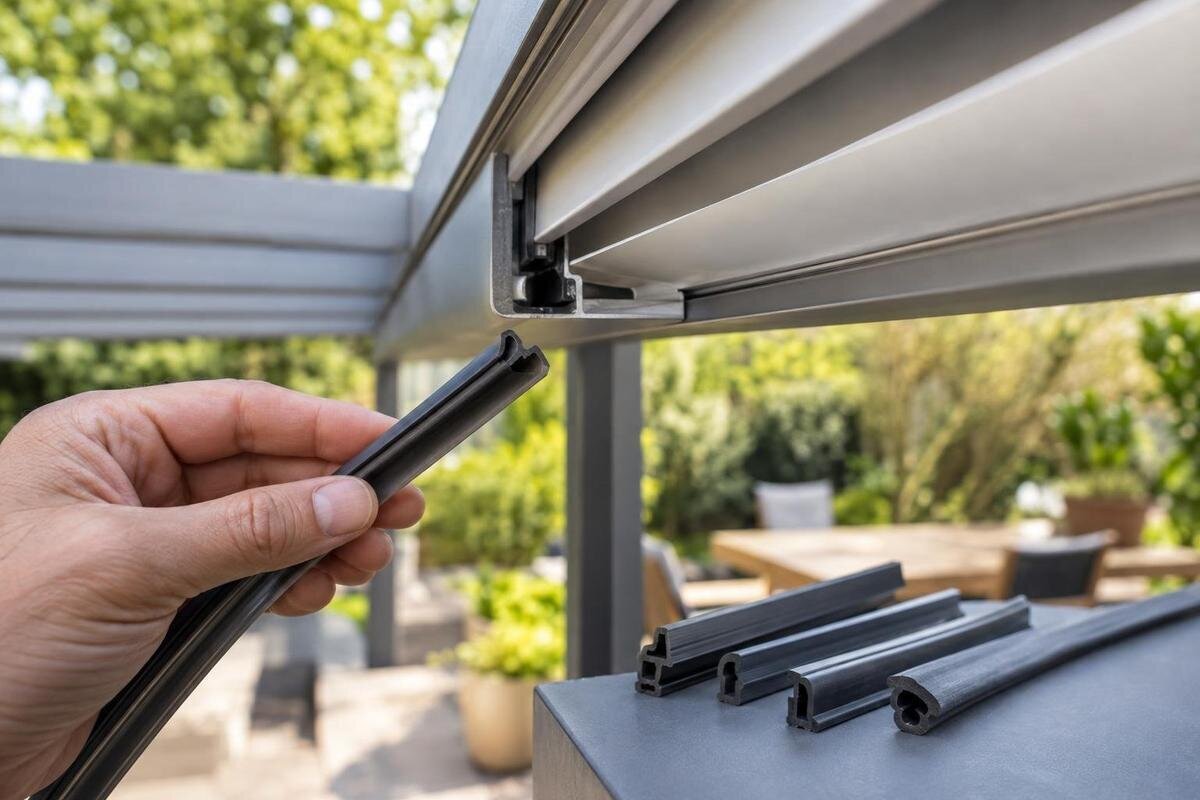
The profile’s cross-section and working orientation matter as much as its length. Where present, a retaining foot needs to engage the channel; a lip or contact face needs to meet the adjoining part. A strip that looks close from above may be too wide or shallow, or shaped for the opposite edge. It may also be designed to move with one component rather than stay on the fixed frame. Treat the seal and its channel as a pair. The correct replacement is the one confirmed for that joint and model, not simply a strip that can be trimmed until it appears to fit.
The seal’s position on the pergola
Before searching for a profile, map its position. Note which side or corner it is on, whether it sits on a fixed frame or a moving section, and the exact parts it touches. Use names from the manual where possible; otherwise write a practical description such as the rear edge of the roof panel beside the house. If there are several similar runs, mark each on a simple sketch and use left, right, inside and outside consistently. State your viewpoint too: left when standing in the garden facing the house is clearer than left on its own. Give each run a label and use that label on its photographs and measurements. This helps the parts team connect a close-up to the correct joint without having to infer its position.
Record what prompted the inspection, but keep observations separate from conclusions. A visible split, loose edge, flattened area or water mark describes what you can see; it does not prove which part has failed. Include whether the condition is local or runs along the seal, and whether it is beside a fixed or moving component. If your paperwork names the Bloomcabin Pergola, reproduce that model name in your enquiry. The product entry can help identify the model wording, but it does not confirm which seal fits.
The model and production details to record
Gather the original order confirmation, invoice, assembly or service manual, and any parts list that came with the pergola. Record the full product and model name, variant, order reference and any serial or product number if one was supplied. A size or purchase date can also help a parts team search its records. Do not rely on a short description such as aluminium pergola or patio cover: it may not distinguish one product family from another. Transcribe identifiers as written, including any letters or suffixes, rather than shortening them to a familiar model name. If a detail is unavailable or a label is unreadable, say so instead of guessing. Keep the paperwork together with your location sketch and photographs so the information can be considered as a set.
A model name alone may not identify every component detail. A different configuration, production revision or earlier repair can affect which part reference is relevant, so do not assume that a currently listed product uses the same seal as an older installation. If your order records the Bloomcabin Wall-Mounted Pergola, include the full name and order details as written. Mention any known previous replacement at the affected joint, distinguishing information in your records from anything you only suspect. This gives the parts team a clearer basis for checking the configuration and avoids presenting an earlier repair as part of the original specification.
Seal profile and channel dimensions
A profile is the shape seen when looking squarely at the end of a seal. If a sample is already detached, photograph that end without stretching or compressing it. Note visible features such as a flat base, a lip, a hollow section or a retaining edge, but use the manual’s terminology where it provides one. These descriptions help explain what you see; they are not a substitute for a part number or a dimensioned drawing. Never cut an installed strip just to make a cross-section photograph.
The channel matters just as much as the strip. Show its opening and any visible recess or retaining groove, along with the surface that the seal meets. A straight-on photograph is more useful than an angled view, which can distort apparent width or depth. Label measurements clearly: the visible width of an installed seal, the width of a detached profile and the channel opening describe different things. Do not use one figure for all three or estimate hidden dimensions from a photograph. Ask whether a supplied drawing is dimensioned and whether it shows the profile from the end. Keep any drawing with the model identification, using the Bloomcabin Pergola listing where needed to clarify the product name. That allows the parts team to relate the shape and measurements to the right product enquiry.

Photographs that show the seal clearly
Take a small set of photographs rather than one close-up. Include a wide view showing where the seal sits on the pergola, a closer view of the whole affected run, and clear images of any damaged area and accessible ends. Place a ruler beside the profile, in the same plane, if you can do so without disturbing it. Include a label or identifying detail if it is safely accessible, and note which side of the structure each image shows. Keep the original image files so that details remain clear when shared.
Take photographs only from a stable, reachable position. Do not climb onto a roof, reach into a moving section, run a motorised assembly just to expose the seal, or remove covers or panels for a better view. If a sample is already detached, keep its orientation and location noted so the parts team knows where it came from. When the paperwork names the Bloomcabin Bioclimatic Pergola, use that exact name in the photo folder or accompanying message. Label the images by location and view, rather than sending several unidentified close-ups. If an important detail remains hidden, explain what could not be photographed and ask a qualified service professional if access requires dismantling.
What visible damage can and cannot tell you
Cracking, tearing, a section that has come away, or a visibly flattened area are useful observations to report. They may be reasons to request an inspection, but they do not identify the correct replacement by themselves. Note where the condition begins and ends, whether it appears on one side or across a run, and whether the seal still appears to sit in its channel. Avoid pulling at the strip to test it: that can change its position and make the original condition harder to assess.
A water mark or leak is a symptom, not a diagnosis of seal failure. Water may reach a visible mark from another joint or a drainage issue, so replacing the nearest strip may not address the cause. Photograph the mark and its relation to the seal, and describe when you noticed it without guessing at the route water took. Do not cover a gap with an extra strip or apply sealant unless the product instructions or service team specifically calls for it. If the source is unclear, request a technical assessment.
The parts diagram and reference number
Look for a parts list or technical drawing for the exact pergola model and configuration. A diagram may give the seal a part number and show which edge or assembly it belongs to; use that reference in your enquiry if available. Include the drawing title or page reference as well, so the recipient can find the same entry rather than interpreting a number without context. Check whether a label identifies the seal itself or a larger assembly containing it, and ask if the distinction is unclear. If the paperwork is missing, ask the original supplier or manufacturer’s support team to locate the relevant documentation from the model and order details. The Wall-Mounted Pergola model listing can help clarify the product name, while the parts diagram or service team must confirm the seal reference.
When requesting confirmation, ask whether the part number matches your model, configuration and exact location. Check whether the diagram distinguishes left from right, fixed from moving parts, or separate corner and end pieces. If a part has been replaced or superseded, ask what documentation confirms that the alternative is suitable for your specific joint. Do not treat a similar-looking drawing as a match if its dimensions, orientation or location are unclear. Keep the response and reference number with your other records so you can check the supplied item against the confirmation.
Measurements and quantities for a replacement request
Measure each accessible run separately and record the start and end points, rather than sending one combined length for the whole pergola. Note the number of runs, their approximate lengths and whether any corners or short sections are involved. Use millimetres and state if a measurement is approximate or difficult to reach. Match every measurement to the location labels on your sketch, especially where two runs have similar lengths. For a partly accessible run, distinguish the portion you measured from any estimate of the full length. If a seal is still installed, it may be compressed or partly hidden, so its visible width is not necessarily the profile’s original size. Explain how you took each measurement instead of presenting an estimate as an exact specification.
An already detached sample can provide a useful reference for its length and cross-section, but wear or distortion may have changed its shape. Do not stretch it, cut it shorter or remove an installed section just to obtain a measurement. Ask the supplier which dimensions it needs for the relevant part and whether it requires the channel measurement as well. Record the number of separate positions as well as total length: a single total does not identify which profile belongs at each joint. If your records identify the Bloomcabin Pergola model, attach that information to the measurement sheet. Keep separate entries for visibly different profiles rather than combining them into one quantity, and ask how the confirmed replacement is supplied before finalising the order.

Compatibility and fitting responsibility
Before ordering, ask the supplier to confirm the part reference against the full model name, configuration and location you have recorded. Confirm that the profile drawing and channel description correspond, and ask whether the orientation or end details matter. If the original part is no longer available, ask whether a substitute is documented for that exact joint and what reference supports the match. A verbal description such as same size or similar shape is not enough if the cross-section and contact surface have not been checked.
Clarify who should fit the replacement and what instructions apply before any work begins. If access involves a moving roof component, a motorised assembly, electrical parts or dismantling, leave the work to a qualified service professional rather than improvising a repair. Check the product instructions and relevant terms before removing components; do not assume that a part can be changed without affecting other work or coverage. For an enquiry concerning the Bioclimatic Pergola model, keep the fitting question alongside the compatibility request so both refer to the same component and location. Ask whether the quoted item is the seal alone or includes any separately identified end or corner pieces. Resolve that distinction before ordering rather than assuming that every item shown in a drawing is included.
Records to keep after ordering
Keep the supplier’s confirmation, part number, drawing, order details and the photographs you sent. Add a note showing where the seal belongs and which measurement relates to each run. If someone else carries out the work, ask them to record the part reference and location for your files. This information makes a future parts enquiry clearer and helps distinguish a replacement at one joint from another visually similar strip. Keep the original enquiry and the final confirmed reference together, particularly if the supplier corrected an initial identification or offered a documented alternative. Store any label or packaging that identifies the supplied component until you have confirmed it matches the order. If the reference differs from the confirmation, raise the discrepancy before treating the item as the agreed replacement.
Follow the instructions supplied for the specific replacement; do not trim, stretch or add material as a trial fit. If the original symptom remains or returns, record what you observe and where, then share it with the supplier or service professional rather than making further changes by guesswork. Date that observation so it can be distinguished from the condition recorded before replacement. Keep the model identification with this repair history—for example, the Bloomcabin wall-mounted model entry if it matches your original paperwork. A record linking the model, joint and fitted part is more useful than an isolated photograph of the old seal.
Frequently asked questions
Can I use a universal rubber strip as a pergola seal?
Not unless the supplier confirms that its profile, channel fit and contact surface match your exact joint. Similar colour or length does not establish compatibility, and trimming a generic strip to size does not correct a mismatched cross-section.
How can I identify the seal profile without removing it?
Photograph its position, the visible channel and any accessible end or cross-section. Add the pergola’s model details and check the manual or parts diagram. If the profile cannot be seen safely, ask the service team to identify it rather than dismantling the assembly.
Should I remove the old seal to measure it?
Do not remove an installed seal just to get a sample unless the product instructions say that this is a safe owner task. A detached sample can be useful, but wear or compression may affect its shape; treat its measurements as a reference, not proof of a match.
Does water getting in always mean the seal has failed?
No. Water marks can have more than one possible source, including an adjoining joint or a drainage issue. Record where you see the water and any visible seal damage, but do not assume that replacing a strip alone will resolve the cause.
What should I send with a parts enquiry?
Include the full model name and order or serial reference if available, the seal’s location, clear photos of the profile and channel, measurements for each run, the quantity needed and any existing part number. Describe the symptom separately from your observations.
A useful replacement request identifies the pergola, the joint, the channel and the profile as parts of the same matching job. Clear photographs, a parts reference and separate measurements for each run are more reliable than a guess based on colour or length. Ask for compatibility to be confirmed before ordering, and use a qualified service professional if accessing or fitting the seal means dismantling components or working around a moving or motorised assembly. That approach helps avoid an improvised strip that appears to fit but does not match the original joint.
