
Repair or Replace an Older Pergola: A Decision Checklist
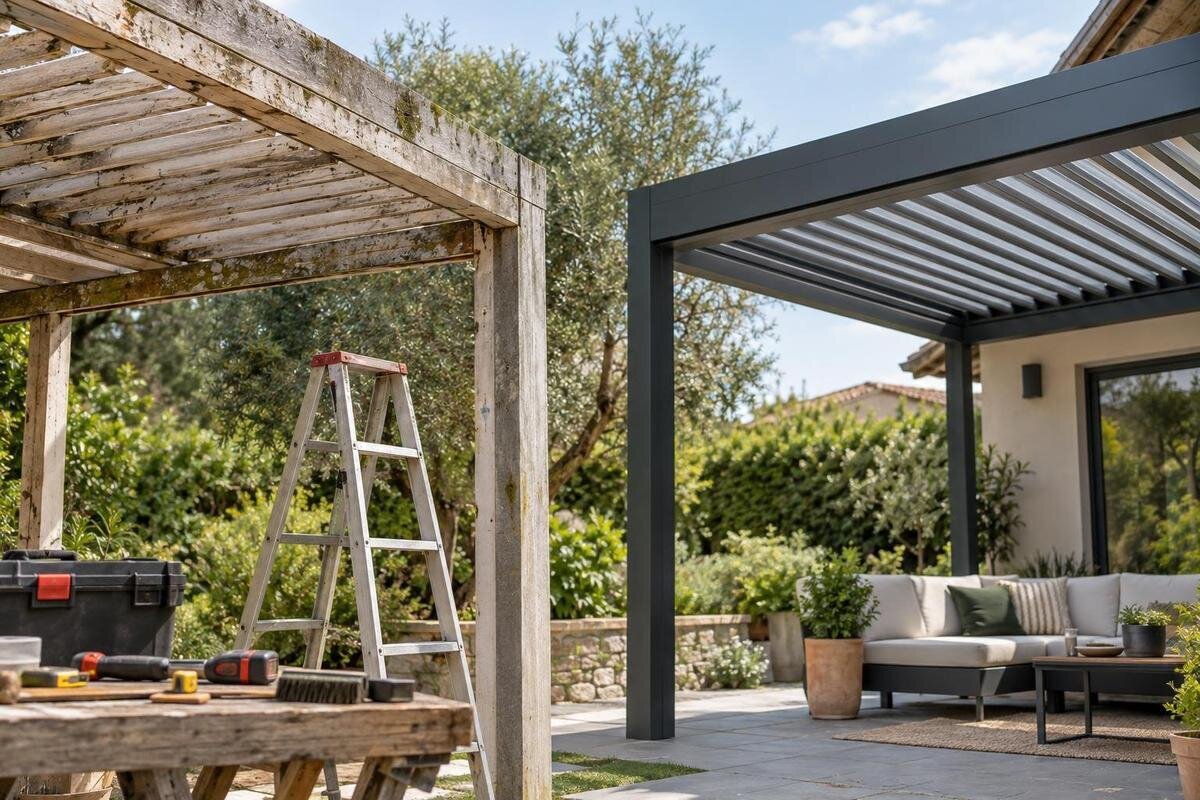
Pergola repair and replacement
An older pergola does not need replacing simply because it has reached a certain age, and a low-cost repair is not automatically good value. The useful question is whether the fault is understood, the rest of the structure remains suitable, and a compatible part and competent service are available at a sensible overall cost. This checklist helps you assess those points before authorising work or requesting a replacement quotation. It focuses on the condition and support for the existing unit, rather than predicting a universal lifespan.

Age alone does not settle the decision
Age is useful context, not a diagnosis. Two pergolas of similar age may have faced different exposure, use, installation conditions and maintenance, so a calendar date cannot tell you whether a frame or mechanism is still serviceable. A tidy surface is not proof of sound connections, while a faded finish or dated appearance does not by itself establish structural trouble. Record what is actually happening: uneven movement, a leak or drainage issue if relevant to the design, visible deterioration, noise, loose components, or a feature that no longer meets your needs. Keep observations separate from explanations such as 'the motor has failed', if a powered system is fitted, until a competent person confirms the cause.
Treat the decision as three possible outcomes rather than a forced repair-or-replace choice. Repair may be sensible when a fault is clearly identified and a compatible component can be fitted without leaving other damage unresolved. Replacement may be sensible when several elements are affected, parts support cannot be confirmed, or the current layout no longer works for you. A third outcome is to wait for a proper diagnosis or written scope. That is not indecision: it prevents a visible symptom being mistaken for its cause, or a low component price being accepted while related work remains unresolved. The aim is to address the pergola's condition and use, not to keep an old unit at any cost.
Record the model and the symptoms
Before contacting a supplier or service provider, look for the brand, exact model, serial or product label, installation date if known, and any invoice or installation paperwork. A model name alone may be insufficient: versions and supplied components can differ, and visual similarity does not establish compatibility. If a label is accessible from ground level, photograph it clearly; do not remove covers or climb to retrieve it. If records are missing, take one wide image of the whole pergola and separate close images of the affected area, attachment points and any visible label from a safe position. Keep the original photographs so details are not lost through cropping.
Write down what happens, where it happens, how often, and whether the symptom has changed. Note whether it occurs during opening or closing, in rain, or during ordinary use, but do not deliberately repeat a fault to make a video. Record previous repairs, replaced parts, dates and whether the same symptom returned. Ask other regular users what they have noticed; one person may see an intermittent issue that another misses. Clear notes help a technician distinguish a recurring fault from a new one and reduce guesswork. Never touch exposed wiring, open a powered mechanism or operate a visibly unstable pergola just to collect evidence.
Distinguish symptoms from underlying faults
A symptom describes what you can see; it does not identify the failed part. A roof section that moves unevenly, a leak at a joint, a component that rattles, or a control that responds inconsistently if fitted can each have more than one cause. Note the exact location and circumstances rather than ordering a replacement part based on appearance. If the issue changes with position or occurs only sometimes, describe that pattern to the service provider. Photos can show context, but they may not reveal what is happening inside a connection or mechanism. Use them to support a diagnosis, not to make one.
Ask whether the fault appears isolated or linked to a wider issue. One failed accessory may leave the rest serviceable; the same failure returning after a repair, or several related symptoms appearing together, calls for investigation before another part is fitted. Request an explanation of what was assessed and what supports the diagnosis. Compare that explanation with previous repair records: does the proposed work address the cause, or repeat an earlier repair? If repair is not practical, you can use the Bloomcabin Bioclimatic Pergola listing as a reference for a separate replacement enquiry rather than as a guide to diagnosing the existing unit.
Structural warning signs need a qualified assessment
Visible movement, a bent or cracked member, a support that appears to have shifted, loose connections, or deterioration around an attachment deserve more than a cosmetic judgement. If the pergola seems unstable, a component could fall, or a moving part behaves unpredictably, stop using it and keep people clear while you arrange an inspection. Do not stand beneath it to investigate, tighten fixings or straighten anything. These signs do not prove that replacement is necessary, but they do mean a photograph or quick visual check should not be treated as a safety decision. Document the concern from a safe position.
Ask the inspector to consider the frame, supports, connections to the building or ground, visible fixings, and any moving roof, drainage or powered components where fitted. The inspection depends on the actual model and installation, so an opinion from a distant image may not be enough. If the existing unit is wall-mounted, Bloomcabin Wall-Mounted Pergola is only a product reference: its listing cannot establish whether your wall, fixing points or existing structure can support a new unit. Have the relevant conditions assessed for the specific site.

Assess the whole unit, not only the failed component
Look beyond the part that has stopped working. A pergola may have a repairable mechanism but a deteriorated frame, or a sound frame with several worn components; either way, the condition of the whole assembly matters. Note whether concerns are confined to one area or spread across the frame, roof, joints, fasteners and controls where present. Ask a qualified service provider to distinguish replaceable components from parts whose condition affects the rest of the unit. Do not assume that a clean or unmarked surface proves the frame is sound underneath, or that one damaged component means every part has failed. A component-by-component assessment is more useful than a blanket verdict.
Repeat call-outs or a growing list of defects can change the value calculation, even when each repair seems small on its own. Review what has already been spent, what still needs attention and whether the underlying cause has been resolved; past expenditure is a record, not a reason to keep spending. If the proposed work is extensive, include a replacement estimate in the comparison. Use the Bloomcabin Pergola product page to identify the model you want priced, while asking the provider to distinguish the new installation from repairs to the existing unit.
Verify parts support before approving a repair
Before ordering a part, confirm the exact pergola model and version with the manufacturer, supplier or qualified service provider. Ask for the relevant part number and written compatibility confirmation. Check whether the proposed work uses a component intended for that unit, a complete assembly, or an alternative specifically approved for it. A part that looks similar or fits physically may still not work correctly. Consider the manual, original order details, photographs and diagnosis together. If the exact version cannot be identified, resolve that first; guessing at a component can waste money and leave the original fault untouched.
Ask whether the part is still supported and available for your exact model, whether an approved substitute can be confirmed, and whether related parts must also be changed. Do not assume availability from a product catalogue. The Bioclimatic Pergola product listing describes a product model; it is not a spare-parts catalogue or evidence that its components fit an older pergola. Powered components and wiring should be assessed and repaired by a qualified service professional, not opened or adapted as a home repair.
Compare complete repair and replacement scopes
Ask for a written repair scope that separates diagnosis, parts, labour, access requirements, related work and exclusions. It should identify what will be replaced or adjusted, what has not been assessed, and whether the original cause is thought to be resolved. If more faults are found once work begins, ask how additional work will be approved before the bill changes. Compare the estimated repair cost with earlier repair spending and the possibility of further work only where a qualified provider can explain it. Avoid basing the choice on a single part price that leaves labour or associated repairs out of view.
Obtain a replacement estimate on a comparable basis. Ask what is included for removal of the old unit, any required site work, delivery and installation, and which items remain your responsibility. Do not assume old supports, electrical connections or fixings can be reused; ask for site-specific confirmation. The wall-mounted pergola product page can identify a model to discuss, but it is not an installed price or a quotation for your property. Compare written scopes and exclusions side by side rather than comparing a repair total with a product listing alone.
Check a replacement against the site and your needs
Replacement only solves the problem if the new pergola suits the site and the way it will be used. Record the available footprint and clearances, how the existing structure is attached, where access is needed, and any nearby doors, paths, trees or services that affect the space. Measurements from existing plans or accessible ground-level checks can support an enquiry, but a qualified installer must confirm the actual requirements and what can be reused. Wall-mounted and freestanding arrangements are not automatically interchangeable, and a new model should not be assumed to use the old mounting points. If the property is shared or managed, confirm who needs to approve a changed installation.
Write down what you expect the pergola to do now: the area you want to cover, how you use it, and whether you need a particular opening or control arrangement. Separate essentials from preferences before comparing alternatives, and check product documentation rather than relying on a photograph or model name. The regular Bloomcabin Pergola listing gives a listed area range of 9 to 24 m²; that is a catalogue fact, not a measurement of your present footprint or confirmation that a model fits your site. Ask for suitability and installation requirements to be assessed for your actual conditions.

Choose repair, replacement or further inspection
Repair is the stronger candidate when an assessment identifies a limited fault, the surrounding structure is judged serviceable, the correct part is confirmed and the work addresses the cause. Replacement deserves serious consideration when there is wider damage, repeated failure, no compatible part, or a significant mismatch between the pergola and your current needs. Cost matters, but there is no universal percentage at which replacement becomes the better choice. Age, remaining condition, future parts support and the work required all affect the comparison. Ask for the reasoning behind the recommendation, not only the final figure.
Choose 'pause and inspect' when the diagnosis is uncertain, the quotation omits important work, or a safety concern has not been resolved. Record which question remains unanswered and whether it needs an inspection, a revised quotation or confirmation of a part. This makes the pause purposeful without committing you to either repair or replacement. If you also request an estimate using Bloomcabin’s Bioclimatic Pergola product page, keep that enquiry separate from approval to carry out work. Record your eventual decision, the reasons for it and any conditions that must be met before the work can begin.
Get the agreed work and outcome in writing
Before approving a repair, have the service provider confirm the diagnosed fault, parts and work included, exclusions, and who will perform any specialist or powered-system work. Ask what will be checked when the job is complete and how the provider will address the situation if the initial diagnosis proves incomplete. Confirm that part compatibility has been checked rather than assumed. A clear scope is useful even if you decide not to proceed, because it lets you compare another repair opinion or replacement proposal on the same facts. Keep the report, photographs and part references with the pergola's paperwork.
For replacement, ask for a site-specific proposal that names the chosen model and sets out the removal and installation work. State which existing components you hope to retain, and have the installer record what can be reused rather than leaving it as an assumption. If your enquiry refers to the Wall-Mounted Pergola listing, the proposal should also address the wall and attachment requirements for your property. Keep the accepted proposal with the completion records so you can distinguish what was supplied, what was retained and what work was carried out.
Frequently asked questions
Should I replace a pergola just because it is old?
No. Age can prompt a closer review, but it cannot tell you whether the frame, fixings or any moving parts remain serviceable. Base the choice on a confirmed diagnosis, the condition of the rest of the assembly, parts support and the complete scope of repair compared with replacement.
Can a photo show whether the frame is safe?
A photo can show visible movement, a crack or a loose component and help explain the concern, but it cannot establish what is happening inside a connection or whether the pergola is safe. Keep clear and arrange a qualified inspection if stability is in doubt.
What details help identify the correct spare part?
Provide the exact model and serial details if available, the manual or invoice, any part number and clear photos of the whole pergola and the affected area. Include previous repair dates and symptoms. Do not remove covers or components to find a number; ask the service provider how to identify it safely.
What if the original part is no longer available?
Ask the supplier or service provider to confirm the exact model and version, and whether an approved compatible alternative or assembly is available. If no match can be verified, compare the repair scope with a separate replacement assessment. Similar appearance or a part that seems to fit does not establish compatibility.
How should I compare repair and replacement costs?
Compare written estimates on the same basis: diagnosis, parts, labour, related work and exclusions, plus removal and installation if replacing. Include recurring faults and disruption in the discussion, but do not rely on a universal percentage threshold. A qualified assessment can clarify what each estimate will address.
Base the decision on this particular pergola: what has failed, what remains serviceable, and whether the proposed repair addresses the cause with compatible parts. If those points are still uncertain, an inspection is a sensible outcome in its own right. It keeps a guess from becoming an unnecessary repair or a rushed replacement.
