
What Pergola Rain Sensors Detect — and What They Don’t
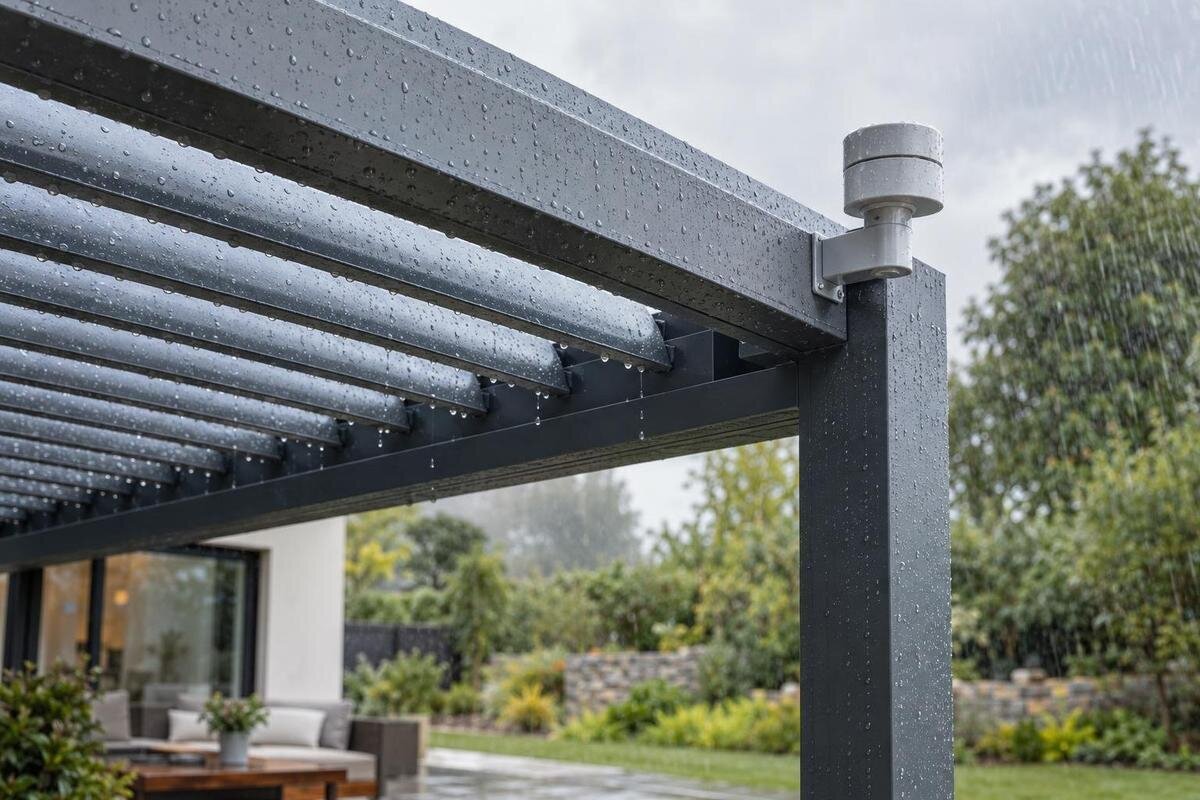
Pergola controls
A rain sensor can sound like a straightforward promise: rain starts, the pergola roof closes. In practice, detection is only one part of that sequence. A sensor responds to a condition its design recognises at its own location; a controller must interpret the signal, and a compatible roof mechanism must be able to carry out the programmed action. Thresholds, delays, reset behaviour and fault handling belong to the specific equipment. This guide explains what to look for in the documentation and where the limits lie. No motor, sensor or automation feature is assumed for any Bloomcabin pergola; confirm the specifications for the exact model and accessory.

What a rain sensor detects at its own location
A rain sensor is a local detector, not a miniature weather station. Depending on its design, it may signal that a sensing surface has become wet or report another defined precipitation condition. Its output describes what happened at the sensor itself. It does not, by itself, show how much rain has fallen across the patio, whether a storm is approaching or whether every part of the roof is wet. The phrase “rain sensor” alone does not tell you whether it reacts to first drops, sustained wetting, a set intensity or a measured amount; those details belong in the device specification.
Read the pergola details, sensor data sheet and controller manual together, but distinguish what each describes. The Bloomcabin Pergola name identifies the product; it does not establish that a sensor or motor is included. Find the exact sensor model, sensing method, output type, compatible controller and roof mechanism. Check whether named components are included in the quoted configuration or offered as optional accessories. The sensor sheet explains the input; the controller documentation explains how that input is used. If a description says only “rain sensor” or “weather automation”, ask the supplier to explain the complete response for that setup. This gives you a clearer basis for comparing packages than an accessory name alone.
How a trigger becomes a roof action
An automatic response is a chain, not a function of the sensor alone. The sensor registers a condition and sends an output; a controller receives it and applies a rule; an actuator, if present and compatible, carries out a movement. That rule might use a fixed or adjustable threshold, a minimum wet period, a schedule or another input, but none of those settings should be presumed. A sensor can register rain while the roof stays still if the signal is not connected, automation is disabled, a manual mode is active or the system has no powered mechanism. Detection and completed movement are separate events.
Ask for the full sequence in writing: what condition creates the signal, how the controller treats it, what action follows, and what cancels or holds that action. A product category such as the Bloomcabin Bioclimatic Pergola does not itself confirm a motorised roof or rain input; check the exact configuration and compatibility in its documentation. This distinction matters with new systems and retrofit accessories alike: compatibility involves the sensor, controller and roof mechanism, not just a matching brand name or connector. No single threshold, delay or response time applies to every system.
Why sensor position matters
A sensor samples conditions at its own position. One beneath an overhang or in a sheltered corner may receive different rain from an exposed part of the roof. A spot affected by splash or runoff from another surface may become wet for a different reason, while wind can drive rain into one area and leave another less exposed. These are examples of why the manufacturer's mounting instructions matter: placement affects the signal, and a controller cannot correct for a sensor reporting conditions unlike those you need it to respond to.
Ask the supplier or installer to identify the intended mounting point and explain how it follows the manufacturer's guidance. When considering the Bloomcabin Wall-Mounted Pergola, distinguish the pergola's mounting arrangement from the position proposed for any separate sensor. Keep that position distinct from the roof drainage and the area you want protected. A useful discussion identifies all three: where rain is detected, where water leaves the roof and where you expect shelter. The reading at the sensor may not mirror conditions at a table, doorway or across the entire roof, particularly when rain is wind-driven or the sensor is sheltered. Explain which area matters most to you so that the installer can address the difference between local detection and your expectations of cover.
Wetness is not the same as a rainfall total
Detection and measurement are different things. A basic output may switch between wet and dry; that can be enough to trigger a control rule, but it does not provide a rain total. Another specified device might report a graded value or use a defined precipitation threshold. If you need to know whether the system reacts to drizzle, sustained rain or a particular intensity, find that criterion in the technical sheet. Do not assume the sensor measures rainfall in millimetres, or that its output indicates how much water has reached the roof, unless the specification explicitly says so.
Ask how the system decides that the wet condition has ended as well as how it begins. If a device responds to surface wetness, retained moisture may keep it in a wet state after rain stops; dew, splashes or cleaning may also affect it. A different sensing method may behave differently. When comparing the regular pergola listing with a separate sensor, assess the roof and detector specifications independently. Look for a documented reset or dry-out rule and whether that setting is fixed or adjustable. Then distinguish the sensor returning to a dry state from the controller's next action: what does the documented rule instruct the roof to do at that point? A description of wetness detection alone does not answer both questions.

What rain detection cannot tell you
A rain-only input cannot tell the controller that a gust is approaching, hail is falling or lightning is nearby. Nor does detection at one point establish that water is pooling, a drain is blocked, a joint is leaking or water is being carried away as intended. Those questions involve other measurements, the roof design and site conditions. If a package includes wind or other weather inputs, verify each sensor's function and the actions assigned to it. A list of sensors alone does not explain how the system behaves if readings conflict.
When reviewing the bioclimatic pergola listing, keep rain detection separate from broader weather protection. Establish which weather accessories, if any, are included in the exact package and what each contributes. If several inputs are specified, ask which instruction takes priority when they call for different actions. That question concerns the controller's rules, not simply the number of sensors supplied. Rain detection should not be treated as a forecast or an all-weather guarantee, and it cannot replace the product's stated operating limits. Where site conditions need technical review, ask an appropriate professional to assess those conditions rather than expecting the rain input to describe the whole installation.
The roof mechanism determines the available response
A rain signal does not dictate one standard roof movement. Depending on the documented mechanism and controls, a system might close louvres, move a retractable cover, hold its current position, send an alert or take no action. These are possibilities to investigate, not standard features. The specification should name the response for the actual configuration, any permitted positions, whether rain can interrupt a movement already under way and how a manual command affects automatic operation.
For a roof represented by the bioclimatic model page, use the documentation for the exact mechanism to establish the available movement. Ask what “close on rain” means in the proposed configuration: which part moves, what position it is meant to reach and how completion is indicated, if an indication is provided. These details connect the control rule to the physical result you expect. The sensor, controller and actuator must be specified as a compatible system, and the proposed response must remain within the documented operating conditions. A sensor supplies an input; it cannot change what the roof mechanism is designed to do. Keep the requested action and the confirmed final position separate when discussing the response with the supplier.
Thresholds, delays and reset rules
Timing and threshold rules shape what the user experiences. A controller may wait for a condition to persist before triggering, ignore brief wetting or hold a response until a drying condition is met. Filtering short events can reduce reactions to momentary drops, but it can also mean that action is not immediate. If a controller uses separate activation and reset thresholds, the condition for switching back differs from the one that first switched it on; this is sometimes called hysteresis. The manual should distinguish sensor behaviour from the controller's timing rules.
Ask whether the trigger is fixed or adjustable, who may change it, and what the documented delay and reset behaviour are. Find out how the system handles intermittent showers and whether settings apply to one roof zone or more than one. For the standard pergola product page, identify the matching accessory and controller before discussing adjustable settings. Read any stated timing carefully: a delay before issuing a command is not the same as the time taken to complete a roof movement. Ask which event starts and ends the quoted period. Do not choose a value by guesswork; the setting needs to suit the specified sensor, controller and roof mechanism. Record the agreed settings so that later changes can be distinguished from the original setup.
What happens if power or communication fails?
Ask what happens when any part of the control path is unavailable. A wired sensor, a wireless connection and a network-dependent controller can have different dependencies; do not assume that Wi-Fi is needed, or that local control works without it. Confirm separately what the manufacturer documents for loss of power, loss of communication, sensor fault or actuator fault, and whether the user receives an indication. A rain signal cannot produce an automatic roof movement if the controller cannot receive it or the mechanism cannot complete the specified action.
Also establish whether manual control is available and how to tell whether the system is in automatic, manual or fault mode. When considering the wall-mounted model page, discuss these control details for the selected configuration rather than inferring them from the mounting category. Ask how a user can distinguish a dry reading from a missing signal, if the controller provides that information. Both may leave the roof without a rain-triggered movement, but they describe different situations. Have a qualified installer assess connections and commissioning where needed. For fallback behaviour, use the manufacturer's fault-response instructions for the exact controller and roof; do not assume a particular position or recovery action from a general marketing description.

What to confirm before buying or adding a sensor
Before choosing an add-on, identify the pergola model and roof mechanism, the sensor model, the controller model, and the actuator or motor specification if the roof moves automatically. Compare them with explicit compatibility statements rather than a general claim that an accessory is “smart” or “universal”. The documentation should identify the sensing method and output, supported connection, trigger and reset rules, and the precise action available on that roof. If a link in the control chain is unclear, ask the supplier to resolve it before ordering instead of expecting an installer to make incompatible components work.
Bring the operating details together in a brief description of the package you intend to buy. It should identify what starts the rain response, what the roof is expected to do, how the user recognises completion and what happens when the wet condition clears. Include how automatic operation is enabled or disabled and which controls remain available to the user. This is more useful than collecting separate assurances that each component is compatible: it shows whether the proposed parts and settings deliver the same sequence you expect. Check that the written description agrees with the supplied instructions. Also establish who handles servicing and which cleaning and maintenance instructions apply, so that responsibilities are clear before the equipment is installed.
Test the complete response at handover
Commissioning should demonstrate the complete response, not merely show that water can wet a sensor. Ask the supplier or installer to follow the manufacturer's test procedure and show the reported sensor state, the controller's decision and the resulting roof action. The demonstration can confirm any programmed delay, reset behaviour and manual override described in the documentation. Do not improvise a test with electrical equipment or alter wiring; use the specified process and a qualified person for work that requires technical competence. Record the component models and settings supplied with the system.
After handover, follow the manufacturer's cleaning and inspection instructions, and ask whether checks are needed after servicing or a controller change. Do not assume a test interval or cleaning method that has not been specified. Keep the component details, agreed settings and operating instructions together so that a later service visit can refer to the installed configuration. Learn to recognise any indication that automation is unavailable and use manual control only as instructed. A rain signal is not confirmation that the roof has completed its movement. Until the actual response has been demonstrated, do not rely on it to keep people or rain-sensitive items dry; even after a demonstration, the system's stated limits still apply.
Frequently asked questions
Does a pergola rain sensor measure how much rain has fallen?
Not necessarily. A wet-or-dry output reports a condition at the sensor; it does not give a rainfall total. A device that measures intensity or accumulated rainfall should state this in its specifications and explain its output. If you need a quantity, check for a stated measurement and units rather than treating a trigger level or event log as a rain gauge.
Will every shower automatically close the roof?
No. The system may require a particular threshold or duration, or automation may be switched off. The sensor also needs to be connected to a compatible controller and, for roof movement, a suitable powered mechanism. The exact trigger and action depend on the documented setup; a rain sensor label alone does not promise automatic closure.
Can a rain sensor detect wind or hail?
A sensor specified only for rain or wetness cannot report those other conditions. Responding to wind or hail would require suitable additional equipment and a documented control rule. Check what each sensor measures and how the system handles different or conflicting readings; do not assume that rain detection provides all-weather protection.
Will the system work if Wi-Fi or power is lost?
There is no universal answer. Some control arrangements may rely on local connections, while others may depend on a network or cloud service; sensors and controllers may also have different power requirements. Check the exact manuals for the behaviour during power or communication loss, any fault indication and whether local controls remain available.
Can I add a rain sensor to any pergola?
Not automatically. Confirm that the sensor is compatible with the controller and, if the roof is to move, its mechanism and actuator. The proposed mounting location and any manufacturer requirements also matter. A sensor on its own does not make a manually operated roof automatic; ask a qualified installer to assess the exact components and connections.
The useful question is not simply whether a pergola has a rain sensor. It is what condition that particular sensor registers, where it is positioned, how the controller interprets its signal and what the exact roof can then do. Confirm the trigger, delay, reset and fault behaviour in documentation for the matching components, and ask to see the complete response demonstrated. A sensor is a local input, not a forecast or a guarantee that the covered area will stay dry. Understanding that distinction makes the intended response—and its limits—clear before you rely on it.
