
Assessing Scratches on a Powder-Coated Pergola
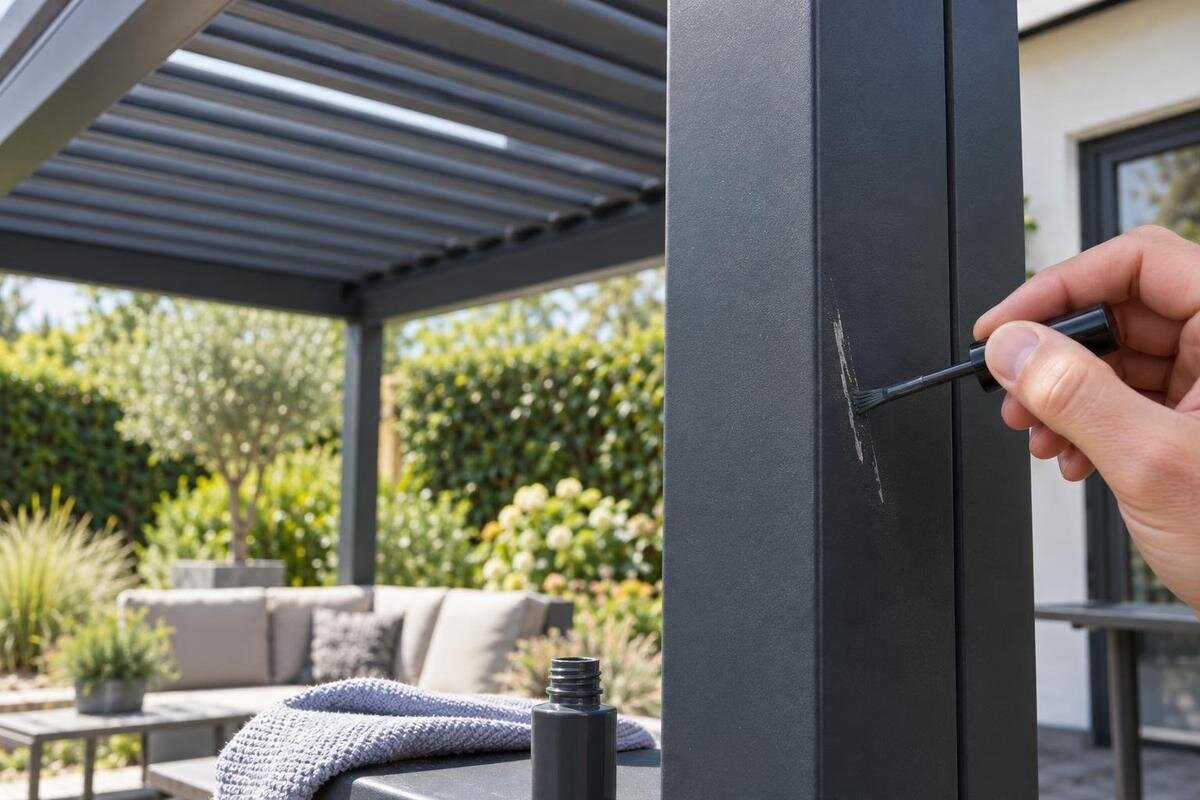
Pergola care and repairs
A fine mark on a pergola can be difficult to read at first glance. It may be dirt or material transferred by contact, a scuff that has changed the sheen, or a scratch that has cut through the powder-coated finish. Those cases do not call for the same response. A careful assessment protects the remaining coating and gives a supplier useful detail for identifying an approved repair system, rather than relying on a near-match paint. Start with gentle inspection, then gather the exact product and finish information available.

01
What a surface mark can tell you
Begin with what you can see, not with a repair product. A streak sitting on the finish may be dirt, plant residue or material transferred by a chair, ladder or tool; against a smooth colour it can resemble a scratch. A rub can also change the way light reflects while leaving the coating in place. Neither a dark line nor a pale mark, on its own, proves that the underlying surface is exposed. Note where the mark sits and whether it follows a likely contact path. Take a quick photograph before cleaning so you have a fair before-and-after comparison.
View the area in daylight from straight on and at an angle, then compare it with an untouched part of the same member. A surface smear may have irregular edges or a direction consistent with contact, while a cut can show a defined groove or a different layer. These are clues, not a depth test: shadows, dust, surface texture and lighting all affect what you see. Do not run a blade, coin, fingernail or abrasive over the mark to test it. Probing can enlarge the damage and remove useful evidence, even if the mark initially seemed minor.
Clean the area gently before reassessing
Check the pergola’s care instructions before choosing a cleaner. If they permit it, use clean water and a small amount of mild detergent on a soft, non-abrasive cloth. Work lightly over the mark, rinse away any residue and dry the area with a clean soft cloth. Do not let detergent dry on the surface. Avoid scouring pads, steel wool, blades, abrasive powders, paint thinners and other solvents as diagnostic shortcuts; they can alter the finish or make the original mark harder to assess. If you cannot find the care guidance, ask the supplier what cleaning method is suitable before trying a stronger product.
Inspect the area again only when it is fully dry, using the same light and viewing angle. If the mark lifts or changes substantially and the colour beneath looks continuous, it was probably dirt or transferred material; applying paint may be unnecessary. If it remains, that still does not prove it has cut through, because a scuff can persist in the coating. Note what changed and stop if the surface starts looking patchy or different. Avoid repeated scrubbing: once gentle cleaning has clarified the appearance, more pressure is unlikely to improve the assessment.
02
Signs the coating may be damaged
A visibly different layer, a small bare patch, lifted edges or flakes separating from the surrounding finish are stronger signs that coating may be missing. A defined line or chip can help distinguish a cut from a smear, but lighting and surface texture can make a shallow mark look deeper than it is. A reddish stain may merit attention, especially if material is visibly exposed, but colour alone does not confirm corrosion. Do not pick at loose-looking edges or cover the area before it has been documented. A clear photograph gives a repairer more useful evidence than an attempted scratch test.
Location matters as well as appearance. Damage around a joint, fastener, end of a member or moving part deserves closer assessment, as does a dent, bend, crack, loose connection or sharp edge. Describe these observations separately: a scratch across a post and a loose connection nearby are two things for the repairer to assess, even if you noticed them together. If your records identify a bioclimatic model, the Bloomcabin Bioclimatic Pergola listing can help you check its catalogue name. Use that name alongside a precise description of the affected component, rather than reporting only a scratched pergola. The listing identifies the product family; it does not establish the condition of your installed unit or the appropriate repair.
Record the exact location and pattern
Describe the affected part so another person can find it: for example, the outside face of a particular post, the underside of a beam, an end cap or a louvre edge. Use the names in the manual if available; otherwise, label the parts on a simple sketch. Record the approximate length and width, the number of marks and whether they form a line or a cluster. Keep measurements approximate and do not rub a tool across the damage. If you use a direction such as north-west post, explain how you are orienting the pergola so that the description is unambiguous.
Note whether the mark is near a regular contact point, such as furniture, a ladder, stored tools or cleaning equipment, or whether there is no obvious cause. Several parallel lines may suggest repeated contact, but treat that as a possibility rather than a diagnosis. Record when you first noticed the marks and whether you saw the contact happen; distinguish what you witnessed from what you suspect. If your documents name the Bloomcabin Wall-Mounted Pergola, use that model wording on your sketch and in the repair request. Give each affected area its own label so the supplier can connect your description, measurements and photographs without confusing marks on different sides of the structure.

03
Take photos that show scale and context
Take three clear photographs before any repair: one showing the whole pergola and the affected side, one showing the component in place and a close-up of the mark. Keep the close-up in focus, use even daylight where possible and avoid flash reflections that hide a groove. Hold a ruler alongside the area without dragging it across the finish to give a rough sense of scale. If the edge of the mark is difficult to see, take another picture from a different angle. Keep the original images unedited; sharpening, filters or colour changes can make the surface look unlike the real thing.
Name the images to match your sketch, such as post, outside face, close-up, and add the date. Use the same label for the overview and detail photographs of each mark so the recipient can follow the sequence. Include the model wording in your message rather than expecting a close-up to identify the pergola; the Bloomcabin Pergola listing is a reference if that name appears on your order. Do not use a product image as a colour sample: screen brightness and photography can change how a finish appears. Keep the full-resolution originals, check that the files show the detail clearly, and share order or identification details privately through the supplier’s support channel.
Find the finish information in your records
Check the purchase confirmation, manual, delivery paperwork, product labels and any handover documents from the installer. Look for the complete model name, order reference, serial or identification number if one is provided, installation date and any stated colour or finish code. Record the affected part as well as the pergola model; a post, beam or louvre may have its own part reference. Do not guess a code from a colour name, a photograph or a similar-looking structure. If a label is fixed to the pergola, photograph it without removing it and keep the image with your other records.
Colour is only one part of a visual match. Gloss, texture and the condition of the existing finish affect how a repair will look; an older surface may not appear the same as a new sample. If your records identify the Bloomcabin Bioclimatic Pergola, include that model name with any recorded finish code, keeping the two details separate. Do not treat a catalogue colour description as a confirmed repair specification. Where information is missing, tell the manufacturer, seller or original installer exactly which details you have and which you need them to identify. Also describe whether the affected face is prominent from the seating area or visible only at close range, so the discussion covers the appearance you hope to achieve.
04
Request an approved colour-matched repair system
Use the model and finish details, photos and measurements to ask the manufacturer, supplier or original installer for a repair system approved for that exact finish and type of damage. Ask whether a touch-up product is available, whether the mark is within its intended use and whether it is meant for owner application or a qualified repairer. A close colour is not enough: the repair material must be confirmed as compatible with the existing coating and underlying surface. Request instructions for the actual repair, not a general guide for a different finish or component. Make the intended outcome clear too: are you asking about a small local touch-up, a professional refinishing option or replacement of the affected part? Ask the recipient to identify the suitable option rather than assuming that a bottle of paint will address every type of damage.
Send the exact model name rather than a broad description such as grey pergola. For an enquiry about the Bloomcabin Wall-Mounted Pergola model, confirm the unit against your order documents or product label. Ask for written guidance on preparation, permitted tools, application limits, drying or curing conditions, weather requirements and clean-up. Check whether the recommendation names a complete repair system or a single product, and ask what else is required before ordering. This helps you understand the proposed work without improvising missing steps. If the supplier cannot confirm compatibility, do not substitute general-purpose paint or a product selected from an online colour chart.
When to call a qualified repairer
Arrange a professional assessment if coating is flaking over a larger area, damage appears in several places, the underlying material is exposed or staining may indicate corrosion. A bent or cracked member, loose joint, sharp edge or mark that reaches a moving louvre or mechanism is not simply a cosmetic touch-up question. Do not dismantle a structural member to inspect a hidden surface. If a moving part appears obstructed or damaged, avoid operating it until it has been assessed; keep people clear of any sharp or unstable area.
Ask the service provider to identify the cause, the extent of coating loss, whether touch-up is suitable and whether component repair or replacement should be considered. For a unit recorded as the Bloomcabin Pergola model, include the order reference and affected part as well as the catalogue name. Ask the provider to explain what each proposed option would address and what visible marks might remain. Keep cosmetic expectations separate from questions about a damaged component, so a colour match is not mistaken for resolution of the whole problem. Review the product’s warranty and care documents before agreeing to work, and ask the seller how the proposed repair relates to any applicable terms rather than assuming either cover or exclusion.

05
Avoid quick fixes that obscure the damage
Do not cover a suspected breach with nail polish, marker, generic enamel, car touch-up paint, clear varnish or leftover paint from another job. A colour may look close in its container and still differ in sheen or texture; a different material may also be unsuitable for the finish or exposed surface. A thick dab can hide an edge that a repairer needs to assess. Avoid sanding, scraping, wire brushing, polishing compounds and strong cleaners unless instructions for the exact repair expressly allow them and identify who should carry them out.
Do not take apart a louvre assembly, remove a cap or drill a test hole to see what lies beneath. That can create fresh damage or affect a component unrelated to the scratch. When seeking help for a model identified in your records as the Bloomcabin bioclimatic pergola, describe what is visible without dismantling it. Tell the repair provider about any cleaner, polish or paint already used, including where it was applied and whether the appearance changed. Do not try another product to undo the first attempt without advice. Prevent further contact with the area while you wait, without sticking tape over the mark or concealing it before assessment.
Prevent repeat rubbing and monitor the mark
Once the mark has been assessed, look for a source of repeated contact. Furniture edges, stored tools, ladders, planters, branches or cleaning equipment may rub against an outdoor structure. Move the source where practical or change how the area is accessed. Do not attach a bumper, adhesive film or protective strip until the manufacturer confirms it is compatible; it could retain dirt or interfere with a moving component. If similar marks return, photograph the new pattern and report the likely contact instead of repeatedly touching up each line.
If the mark is judged superficial, save dated photographs and check it during ordinary cleaning rather than testing it repeatedly. Seek reassessment if it grows, the coating lifts, a different layer appears or a joint or component changes. Keep any assessment and repair instructions with the model and part details. For a unit identified as the Bloomcabin wall-mounted pergola, retain the exact wording from the order rather than relying on a saved product picture. If a repair is carried out, record the date, affected area and product or service used. Photograph the finished area once the work is complete so later comparisons distinguish the original mark, the repair and any new damage. Follow the supplier’s advice where coating is breached or the frame may be affected.
Frequently asked questions
How can I tell whether a scratch has gone through the coating?
Clean the area gently using a method permitted by the pergola’s care instructions, then inspect it dry in good light. A visible underlying layer, missing coating, lifted edges or flakes are stronger signs of damage than a colour change alone. Do not scrape or probe the mark; send clear photos to the manufacturer, supplier or installer if you are unsure.
Can I use a generic touch-up paint?
Do not choose a product by colour alone. The touch-up system needs to be confirmed as suitable for the exact finish and type of damage, and its instructions should say whether it is suitable for owner application. Ask the manufacturer, supplier or original installer to confirm compatibility before buying or applying anything.
What should I include in a repair request?
Provide the exact model wording, order or identification number if available, any colour or finish code, the affected part and its location. Include an overview photo, a photo showing the component in place, and a focused close-up with an indication of scale. Note what gentle cleaning changed and whether the mark appears to be spreading.
Should I touch up a rust-coloured mark or flaking coating myself?
No. A stain does not confirm corrosion, but exposed material, flaking or a spreading mark needs an assessment before it is covered. Avoid sanding, scraping or painting over it. Ask a qualified service provider to check the coating and, if relevant, the affected component.
Will an approved repair be invisible?
That cannot be assumed. The result can depend on the existing finish’s colour, sheen, texture and age, as well as the size and location of the repair. Ask the supplier or repairer what appearance to expect and whether a sample or component-level repair is appropriate before work begins.
The useful distinction is whether the mark sits on the finish or has removed part of it. Clean gently, record the location and product details, and request a repair system confirmed for the exact coating. If the finish is lifting, the underlying material is visible, or a frame member or moving part is affected, leave the assessment to a qualified service professional. Clear photos and a record of the assessment provide a better basis for deciding on a repair than an unverified dab of paint.
