
Can a Restaurant Pergola Earn Back Its Cost?
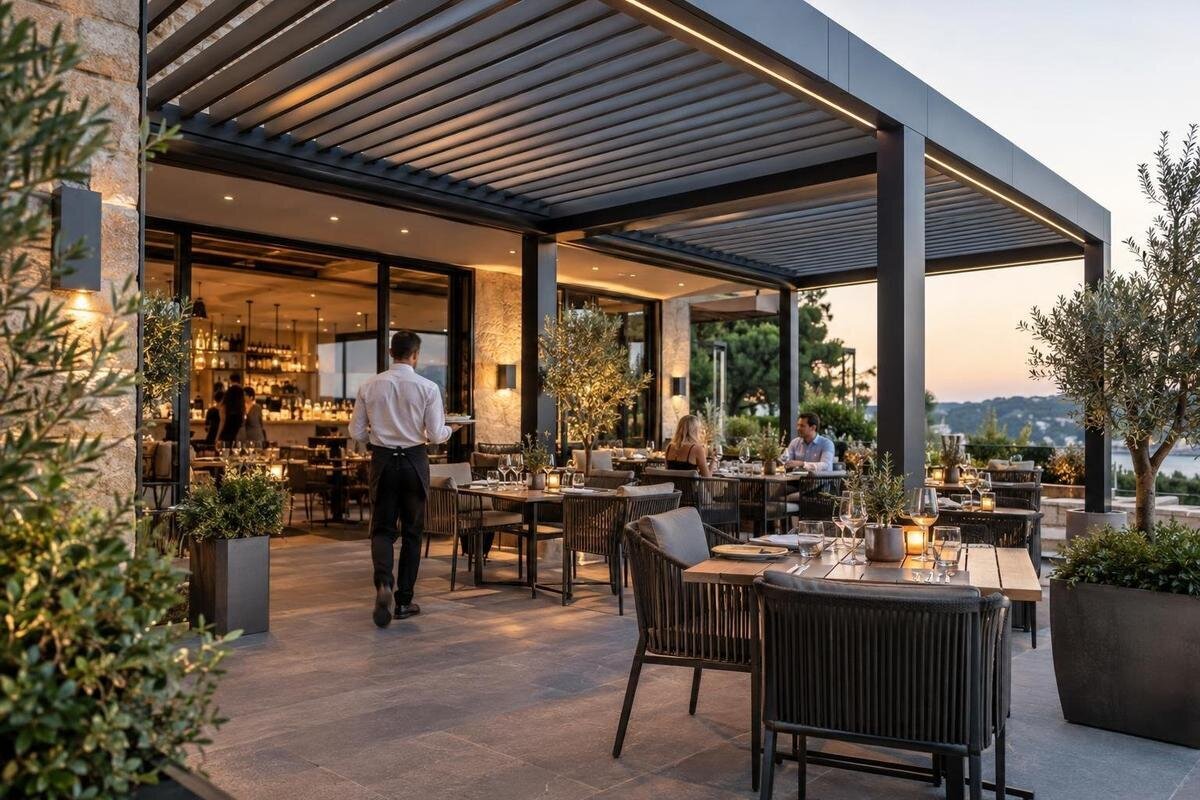
Restaurant terrace planning
Outdoor dining can add capacity, but a restaurant pergola should not be judged on the assumption that it will bring more customers or guarantee more sales. The useful question is whether genuinely additional terrace trade could cover the project’s upfront and ongoing costs, and over what period. To answer it, separate days when the terrace can actually trade from covers the restaurant can serve, then estimate the contribution those covers leave after variable costs. Compare that amount with a site-specific project cost and test cautious assumptions. The result is a decision aid, not a promise of revenue.

Define what “pay for itself” means
Define the test before looking at a model or quote. “Pay for itself” usually means that cash generated by genuinely additional terrace trade repays an initial outlay within a chosen period. The relevant amount is not gross sales: it is the contribution left after the variable costs of serving those extra covers. A terrace can look fuller yet miss this test if diners would otherwise have sat indoors, kitchen capacity limits extra orders, or additional service costs absorb the margin. Keep demand, operating capacity and the investment itself as separate parts of the calculation. A claim that more customers will come is not an input until the restaurant has a defensible basis for it.
Set the evaluation period and cost boundary at the outset. Put the full project outlay in the initial amount and recurring expenses in annual performance; do not leave a cost outside simply because it is absent from a structure quote. If an estimate names Bloomcabin Pergola, record that product identity alongside the proposed project scope. Assess demand and contribution separately from the choice of structure so that a preferred design does not influence the sales assumptions. For an initial screen, use simple payback; a wider appraisal may also consider the timing of cash flows and alternative uses for the investment. Apply the same basis to every proposal, and distinguish cash flows from accounting profit.
Count days when the terrace can actually trade
Use the restaurant’s actual trading calendar rather than assuming 365 serviceable days. Mark when the terrace could be open, then review past bookings, point-of-sale records, weather-related closures, staff notes and seasonal patterns. Break the calendar into relevant shifts: lunch may be workable when dinner is not, or vice versa. A useful day count is the number of periods in which the restaurant could genuinely serve customers outdoors under the proposed operating plan, not simply days when a structure would be standing. Keep planned opening hours distinct from days the venue currently trades, and label estimates where records are incomplete.
Classify past periods by why the terrace was unavailable. A service lost to rain, wind, heat or another condition is a possible candidate only if the proposed system and site have been assessed for the conditions in question; it is not automatically recoverable. Periods lost to weak demand, a private booking, maintenance or limited staff may not become usable because the terrace changes. Build cautious, central and high day counts from the evidence, and make each one visible in the model. This keeps an optimistic assumption from being mistaken for a historical fact and makes it easier to update the estimate when better records are available.
Separate extra seats from extra covers sold
Compare the existing terrace with the proposed arrangement on an actual floor plan. Count net new seats, seats relocated from indoors, and seats lost to circulation or changes to the building frontage separately. A seat is not usable capacity if guests, staff or equipment cannot move around it comfortably. Include space required for service and any routes identified in the relevant access or fire review before counting. A page for Bloomcabin Wall-Mounted Pergola can identify an item in a proposal; its name is not a restaurant floor plan or confirmation of the site’s usable area. Base the estimate on the measured, reviewed layout.
Then estimate covers actually served, not seats merely available. Use booking and till records to see how often existing outdoor tables fill by day and meal period, and how frequently diners are turned away or moved indoors. New seats may generate no extra cover when demand is weak; they may simply shift a party from an indoor table. Allow for another table turn only where the restaurant can reset and serve a further party in that period. Keep existing demand and genuinely incremental guests separate, and exclude covers that would have been served elsewhere in the venue.
Estimate contribution per additional cover
Estimate contribution per extra cover from the restaurant’s own figures. Start with the actual average spend for the relevant menu and meal period, then deduct variable food and beverage costs and other costs that rise directly with a guest, such as payment charges or consumables where applicable. Use a consistent accounting basis and the same period for spend and cost data. The result is contribution before project operating costs and investment recovery, not the guest’s bill or the venue’s gross revenue. If menu mix differs between services, use separate estimates rather than applying one overall average to every additional cover.
Average spend alone can be misleading because the amount left after variable costs also depends on what guests order. Use a weighted contribution figure based on the expected mix of additional covers, supported by the restaurant’s records. Do not apply a full-venue margin to terrace trade without checking that it reflects the guests, menu and service period being modelled. If extra service requires more labour, cleaning, equipment or energy, account for those costs separately where appropriate. Put each cost either into the per-cover contribution or the annual operating total, not both, and keep that allocation consistent when comparing different operating cases.

Include the full project and operating cost
Build an upfront cost schedule from an itemised project proposal. It may include the structure, design or survey work, delivery, site preparation, professional installation, work to services if specified, and fees for applicable reviews or approvals. Record temporary closure or disruption during the work if it affects trade. If a proposal identifies Bloomcabin Bioclimatic Pergola, use the actual project quotation and list what is included or excluded; the model name alone is not the total cost of a restaurant-ready project. Do not substitute a catalogue description for a site-specific scope.
Add costs that continue after opening: cleaning, maintenance, repairs, extra labour, utilities and any service contracts or insurance changes that apply. Use supplier information or operator estimates to support allowances rather than presenting guesses as fixed facts. Include the operating costs of proposed features only if they are part of the project scope, and ask the relevant professional to confirm service and installation requirements. Consider maintenance or repair downtime in the day-count estimate as well as any direct expense. Ongoing costs can reduce a positive contribution substantially, so keep them visible in the calculation.
Check whether the terrace can support the model
Projected seating capacity is useful only if the space works for the restaurant. Have the operator’s actual floor plan reviewed against entrances, customer routes, staff paths, service access, furniture storage and the way tables are cleared. Complete applicable access, fire and planning reviews for the premises with the relevant qualified professional or authority before treating proposed seats as available. For a proposal using the wall-mounted Bloomcabin model, assess the arrangement in relation to the existing building and the operator’s service requirements. Use project drawings and written, site-specific confirmation to establish the workable layout, and reflect any resulting changes in both the seat count and the cost estimate.
Map the busiest service as well as a quiet one. A layout that creates seats but blocks a service route, queues guests at a doorway or slows table clearing may cap covers or require additional labour. Ask floor staff and the kitchen manager to test the sequence on the drawing: arrival, seating, ordering, food delivery, payment and reset. Consider furniture movement, stock, cleaning and access when weather changes. If the arrangement reduces indoor capacity, include displaced covers in the comparison rather than treating every terrace seat as a net addition.
Calculate a break-even point and payback period
Write the calculation so another manager can check it. Annual incremental contribution equals the sum, across day types, of serviceable days × additional covers actually sold per day × contribution per additional cover. Then subtract incremental annual operating costs to find annual net benefit. Use separate totals for weekdays, weekends or seasons when records show different patterns; a high-season average can distort a year-round estimate. For a simple, undiscounted screen, payback period in years equals upfront project cost ÷ annual net benefit, provided the benefit is positive and reasonably stable. Show each input alongside the formula.
To test a target payback period, divide the upfront cost by the number of years, then add annual incremental operating costs. That is the annual contribution the project must generate under this simplified model. Divide it by contribution per cover to find the required additional covers per year, then compare that number with serviceable days and demonstrated demand. For a quotation identifying the regular Bloomcabin pergola, use the complete quoted project cost once inclusions and exclusions are clear. Keep this required-cover calculation beside the demand estimate: one shows what the investment needs, while the other estimates what the restaurant could sell. For uneven cash flows, use a fuller financial appraisal.
Test a weak season and other uncertain inputs
Create at least three cases rather than hiding uncertainty inside one confident average. In a cautious case, use a lower serviceable-day count, fewer genuinely additional covers and a contribution figure supported by the restaurant’s records. Base the central case on the best available evidence, and keep the high case operationally plausible. State which source supports each input and which figures are estimates. Do not label an optimistic case a forecast or treat a hoped-for rise in occupancy as evidence. If costs are not firm, show a range based on supplier estimates rather than an unexplained contingency percentage. The spread shows what the decision depends on.
Change one assumption at a time to see what matters most: serviceable days, covers sold, contribution, upfront cost or annual upkeep. Then combine adverse but credible changes to test whether the project still meets the restaurant’s target. When assessing a proposal for the bioclimatic Bloomcabin model, keep its project-specific quote and operating assumptions together in each case so that the financial comparison remains traceable. Record how far each uncertain input can fall before the result becomes unacceptable. A case that works only when several optimistic inputs coincide is fragile, even if its simple payback looks attractive. This test helps distinguish a manageable shortfall from a result that depends on nearly every assumption being favourable.

Compare project quotations on the same basis
Make quotations comparable before entering them in the calculation. Record the exact model or project description, measured footprint, design and installation scope, site work, review responsibilities, exclusions and any continuing service costs. If a proposal specifies the Bloomcabin Wall-Mounted Pergola, keep that product identity beside its written scope and quoted amount. Compare the included work, not just the totals: another proposal may cover tasks that this one excludes. Ask each supplier to identify what is confirmed for this restaurant and what still depends on a survey or access, fire and planning review. Use the same cost boundary and evaluation period for each option.
Put the operator’s requirements in the brief: capacity sought, service pattern, customer and staff access, maintenance responsibilities, closure constraints and the financial threshold. Have actual drawings and the operating plan reviewed by the relevant professionals where applicable, rather than assuming a catalogue model suits commercial use. Clarify who will provide missing information and whether changes alter the scope or cost. A cost-recovery result is only as comparable as the project assumptions behind it; an apparently cheaper proposal may simply leave more work outside the quotation.
Set a decision rule before committing
Set a go-or-no-go rule before choosing a preferred proposal. Define the maximum payback period the business will accept, the minimum annual net benefit needed to justify the investment, and whether the cautious case must remain viable. These are operator decisions, not industry-wide benchmarks. If the final scope specifies the regular Bloomcabin Pergola model, carry that exact scope and quoted cost into the decision sheet; redo the calculation if the plan or inclusions change. Record which case meets each threshold and where it falls short. Do not approve on a high-case result alone if the downside would be unacceptable.
After opening, compare actual results with the assumptions by day and meal period: terrace availability, covers served, contribution, extra labour and ongoing costs. Separate guests newly attracted from those who would have dined indoors, and record closures or operating bottlenecks. Review a full seasonal cycle where possible before treating early weeks as a stable annual pattern. If performance differs, update the model rather than defending the original forecast. This gives management a practical basis for adjusting reservations, staffing or the way the space is used.
Frequently asked questions
How do I calculate a simple payback period?
Divide the upfront project cost by the annual net benefit, provided that benefit is positive. Calculate the benefit from genuinely additional covers and their contribution, less ongoing costs. This is a simple, undiscounted screen; it does not show the full value of later cash flows.
Can I count every new seat as an extra cover?
No. A seat is capacity, not a sale. Count only additional guests the restaurant can serve and reasonably expects to attract, excluding diners who would have used an indoor table or another terrace seat anyway.
Should I count every day that the terrace might be open?
No. Use the restaurant’s trading records and proposed operating plan to estimate serviceable days. A day previously lost to weather is not automatically recoverable; check whether the specific project and site support the conditions you expect to trade in.
Which costs belong in the calculation?
Include the full quoted project outlay, including applicable design, site work, installation and review costs. Add ongoing expenses such as extra labour, cleaning, maintenance and utilities where relevant. Keep the cost basis consistent across proposals.
Does a pergola product listing confirm suitability for a restaurant?
No. A product listing identifies a catalogue item; it does not confirm that it suits a particular commercial site or operating plan. Use actual project drawings and obtain the applicable access, fire and planning reviews from the relevant professionals or authorities.
A restaurant pergola can only be assessed against the trading pattern it may change and a fully costed project. Build the case from actual terrace availability, genuinely additional covers and contribution after variable costs; subtract ongoing costs before calculating payback. Then challenge the weakest assumptions, compare project quotations on the same basis and confirm the relevant site reviews. If the result depends on unverified demand or a perfect season, the model is not ready to support a commitment. If it holds on cautious inputs, it provides a stronger basis for a decision, not a guarantee of sales.
