
Second-Hand Pergola Checklist: Parts and Reinstallation Risks
Pergola buying guide
A second-hand pergola can look complete in a photograph while missing the brackets, fixings, controls or drawings needed for a workable reinstallation. Its former position also says nothing conclusive about whether it will fit or be suitable at a new site. Before paying or arranging collection, identify the exact kit and version, compare the seller’s inventory with the original records, inspect the structure before it is dismantled, and assess the proposed site separately. Treat unknown parts, repairs and mounting details as issues to resolve before purchase, not small jobs to discover once the pergola is in your driveway.

Second-hand pergola buyer check 1
The full cost of a second-hand pergola
Do not assess the deal by the frame alone. The useful comparison is the cost of receiving a complete, serviceable structure at the new site: asking price, dismantling, collection, transport, temporary storage, missing parts, repairs, site preparation, professional assessment and reinstallation. Add any specialist review or commissioning work needed for controls, if the pergola has them. Separate confirmed costs from allowances and unknowns; a seller’s estimate for replacement pieces or labour is not a quote. Keep assumptions visible, particularly whether accessories are included and who is responsible for taking the structure apart. Note access and lifting arrangements as separate items too, rather than treating them as incidental to collection.
Compare a second-hand kit with the full scope of a new purchase or replacement, not just a headline price. The Bloomcabin Pergola is one named product reference, but its listing is neither a quote for your site nor evidence that a used kit’s pieces are compatible. Ask for an itemised scope on both routes, including the structure, optional components, site work, professional assessment, delivery and installation, with exclusions stated. Clarify whether the site visit, groundwork, fixing hardware and labour are included or separate. If only the seller’s asking price is firm, mark the comparison as provisional until uncertain work can be priced.
Identifying the model and version
Establish exactly what the seller says the assembly is. Request the original invoice or order confirmation, manufacturer, model, serial or identification label if present, approximate purchase date, assembly manual, drawings, parts schedule and any installer or repair records. Ask for the original configuration as well as its overall footprint: a wall connection, extension, screen, lighting or roof accessory may change which pieces belong to the kit. Note any modifications made since purchase and, if known, who carried them out. Separate information shown in paperwork from what the seller recalls. An uncertain detail should remain marked as unverified until it can be matched to the actual structure.
Check that the drawings and manual match the frame, not merely the same brand or product range. Compare joint shapes, labels, post positions, visible part numbers and measurements; note inconsistencies and ask the seller to explain them. If a label is missing, request older order emails, receipts or installation photos that show the same structure. Use the Bloomcabin Wall-Mounted Pergola page as a separate product reference when comparing options, not to identify the seller’s unit from its general appearance. Where one manual covers several versions, identify the diagrams that correspond to this kit before relying on them.
Second-hand pergola buyer check 2
A parts inventory that can be checked
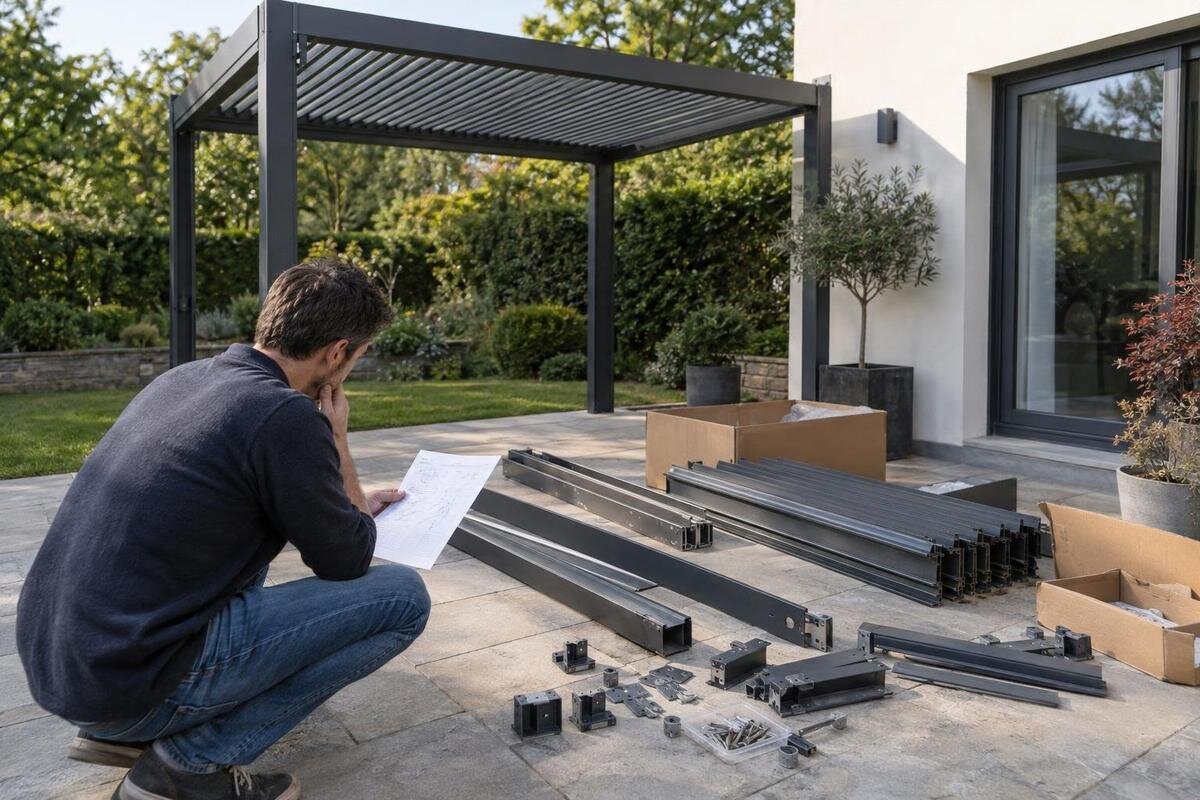
Use the original parts schedule to make a countable inventory before agreeing the sale. Record quantities and any stamped or labelled identifiers for posts, beams, braces, rafters or roof members, connecting plates, brackets, end caps, trims, panels, seals and fasteners, as relevant to that design. Add gutters, outlets, controls, remotes, screens or other accessories only if the seller says they are included. Separate pergola components from site-specific material, such as old anchors, packers or sealant. Ask the seller to lay out smaller pieces together, and mark each item as present, damaged, absent or unidentified; do not turn an ambiguous pile into a complete-kit claim.
Confirm the inventory in person or through clear photos of every package, including labels and quantities. Compare each category with the parts list and record substitutions separately; a different-looking bolt or bracket should not be accepted as equivalent without confirmation. For a mechanism-dependent or adjustable design, capture exact identifiers rather than assuming similar shapes indicate the same part. Ask who identified any replacement item and request the supporting reference. If comparing the offer with a new Bloomcabin Bioclimatic Pergola, keep the two inventories separate and record exactly what each seller includes, rather than assuming both offers cover the same components.
Condition before dismantling
Inspect the structure while it is still assembled, if access and the seller allow it, and photograph each joint before dismantling. Look at posts, beams, joints and connections for bends, cracks, impact damage, distorted holes, loose or mismatched fasteners, missing caps and signs of repair. Check for material-specific deterioration without guessing what the frame is made from: corrosion on metal, splitting, softness or rot on timber, and peeling or blistering finishes where present. Mark each concern on a sketch and ask what caused it. A visual inspection can flag questions, but cannot verify hidden condition or structural capacity; have questionable damage assessed by a qualified professional.
Ask how long the pergola has been installed, whether it has been dismantled before and whether repairs or replacements were made. Variations in finish or connector style may indicate mixed parts; treat them as a reason to verify the model, not proof of a defect. The Bloomcabin Pergola listing gives an area range of 9 to 24 m², but that does not identify the dimensions, condition or completeness of a second-hand structure. Measure its actual length, projection, height and post positions against a drawing instead of relying on a rounded area. Photograph repairs close up and note whether the seller has records of the work.

Second-hand pergola buyer check 3
Moving parts, controls and drainage
Keep the condition of moving equipment separate from that of the static frame. If the used pergola has adjustable or retractable elements, a motor, controller, remote, sensor or lighting, ask for exact labels, manuals, accessories and repair history. A demonstration before dismantling shows only that the item appeared to operate at that time; it does not confirm what happened during removal or whether it will work after reconnection. Do not energise unidentified equipment or improvise wiring. Have a qualified electrician or installer assess the controls and advise on testing or commissioning. Confirm parts and interface requirements against the exact model, not a similar-looking control.
If gutters, water channels, seals or outlets form part of the assembly, list each separately and ask where water was directed at the former site. Look for stains, residue, blockage or signs of leakage, but treat them as clues rather than a diagnosis; request any repair history. Check whether the old outlet direction suits the new layout and ask the installer what changes may be needed. When comparing a new option through the bioclimatic pergola listing, request drainage details for the proposed configuration so that you can compare the site work involved. For the used kit, account for accessories and seals separately from the visible roof.
Dismantling, packing and storage
Agree who will dismantle the pergola before collection and ask for photographs of the structure and each connection beforehand. Where possible, label pieces by position and orientation as they come down, keep fasteners with the corresponding assembly and retain maker’s labels, manuals and sketches. Ask the person doing the work to flag any seized, damaged or altered connection rather than forcing it or substituting a part without agreement. If the seller arranges dismantling, state whether you can inspect the kit before it is packed. These records help distinguish a missing component from one concealed in a bundle after the original structure is gone.
Collection and storage need their own plan. Confirm the longest-piece dimensions from the actual kit, loading access at both properties, suitable transport and where the parts can be kept until reinstallation; do not estimate dimensions from a photograph. Protect surfaces and labels from impact, moisture and abrasion, and keep small fittings, controls and paperwork together. If a component is bent, cut, drilled or otherwise altered for transport, have the proposed change reviewed before accepting it as reusable. Arrange handling through people equipped for the job: the seller’s ability to dismantle the structure does not by itself show that it can be transported or rebuilt intact.
Second-hand pergola buyer check 4
Fit and fixing at the new site
Measure the new site against the actual drawing and physical dimensions, not the old property’s layout. Record the footprint, overall height, post centres, wall connections, clearances to doors and windows, roof edges, paths and overhead obstructions. Note the ground surface, changes in level, drainage routes and services that may be near proposed fixing points. Check that there is room for any opening or moving elements described in the manual, and that access for assembly and future maintenance is available. A drawing should show orientation and key dimensions; a single area figure or the seller’s estimate will not locate supports accurately.
The fixing arrangement is a separate suitability question. A wall-mounted unit, a structure supported on posts and one intended for another base may need different interfaces; visible old brackets are not proof that a new wall, slab or footing is suitable. Ask a qualified installer or structural professional to assess the actual substrate and specify any required fixings or site work. If considering a new alternative from the Wall-Mounted Pergola page, include the wall assessment in that proposal too. If the proposed location is a roof, balcony or raised deck, do not infer that a garden installation is roof-rated; obtain a site-specific professional assessment.
Property approval and insurance checks
Check the property’s approval process before spending money on collection or changing the site. Depending on ownership and location, relevant people may include the owner or landlord, property manager, body corporate, homeowners’ association or local authority. Ask which plans and details they need, such as dimensions, appearance, fixing proposal, water discharge and work access, and obtain the answer in writing. Do not rely on permission, plans or an earlier installation at the seller’s address; those circumstances do not settle what is acceptable at yours. Requirements are specific to the property and locality, so verify them with the responsible parties rather than applying a general rule.
Contact your insurer or broker directly about how the proposed installation, changes to the property and any dismantling or reinstallation should be described for cover; do not assume the seller’s policy or statements apply to you. If the pergola will be near shared access, drains or common property, clarify who can authorise work and arrange access, protection and maintenance. Agree responsibilities with contractors and neighbours where relevant before booking work. Keep approvals, questions and responses with the drawings, so the installer is working from the same proposal that was reviewed.

Second-hand pergola buyer check 5
Replacement parts and installation support
Do not assume missing parts can be sourced simply because the pergola has a recognisable name. If the manufacturer or original supplier can be identified, send the model, version, serial or label, drawings, photographs and itemised list of missing pieces. Ask whether each part can be identified, whether it is available, which part number applies and whether any proposed substitute is confirmed for that exact system. Request written answers before using parts availability to justify the purchase. Also ask whether support is offered for a second-hand unit, without assuming that the supplier can identify an incomplete or modified kit. Generic fasteners are not proof of compatibility.
Have an installer price the work once the parts, site and access are understood. Ask the written scope to separate inspection, dismantling, transport or handling, replacement components, site preparation, reassembly and any controls work, with exclusions and assumptions clear. If considering a new configuration from the Bloomcabin Pergola page as a fallback, request its own specification and site-specific installation quote. Keep that offer separate from the estimate for rebuilding the used kit, so that you can compare the work included in each. Confirm directly with the seller or manufacturer whether any warranty or support is transferable; do not build the comparison on assumed cover.
Written handover and the purchase decision
At handover, put the sale details and physical inventory in writing. Record each included structural component, accessory, fastener pack, remote or control, manual, drawing, known defect, missing part and agreed substitute. State whether the structure is still assembled, who dismantles it, what will be ready for collection and whether you may check the packed kit. Photograph its condition and labelled bundles at collection, and keep a copy of the final list. This creates a shared record of what was supplied, rather than relying on an advert that may have used broad terms such as complete or ready to reinstall.
Proceed when the identity, inventory, visible condition, site assessment and likely reinstallation costs are clear enough for an informed decision. Pause if labels and drawings conflict, key connections are damaged, controls cannot be identified, parts availability is unconfirmed or the seller will not allow a reasonable inspection. Missing paperwork need not automatically rule out a purchase, but the cost of replacing it and verifying the kit should be explicit. If the uncertainty outweighs the saving, compare a separate new option such as the Bloomcabin wall-mounted option on its own configuration and site requirements before committing to collection or dismantling.
Frequently asked questions
Can I judge whether the pergola is complete from listing photos?
No. Photos may show visible pieces but cannot confirm hidden brackets, fastener quantities, part labels, internal damage or whether controls and manuals are included. Ask for the original parts schedule, a count, close-ups of each pack and an inspection before collection. Treat anything not accounted for as unverified.
Can I reuse the old anchors and fixings?
Do not assume so. The old fixings were used with a different base and installation, and may be damaged or unsuitable for the new layout. Ask a qualified installer or structural professional to assess the proposed fixing arrangement and specify what can be reused, if anything.
Can the original supplier provide missing parts?
Possibly, but availability and compatibility depend on the exact make, model, version and part. Send labels, drawings and photos to the original supplier or manufacturer and ask for written identification before buying. A generic-looking replacement or similar product name does not confirm that parts are interchangeable.
Will the same footprint fit my new site?
Not necessarily. The same floor area does not confirm post positions, height, clearances, wall or footing suitability, drainage, access or property approval. Compare measured dimensions with an actual drawing, then have the fixing arrangement and proposed location assessed by the relevant qualified professional.
Which documents should I ask the seller for?
Ask for the invoice or order confirmation, model or serial details, original drawings, assembly manual, parts schedule, installation and repair history, and records of controls or accessories. Get a dated inventory, photos of defects and written confirmation of what is included. Verify approvals or insurance questions for your property separately.
The best basis for valuing a second-hand pergola is evidence that answers three separate questions: what the kit is, what survived dismantling and whether the new site can support the chosen fixing arrangement. If one answer is missing, keep that uncertainty visible in the price and handover record. If it cannot be resolved, do not let a complete-looking frame substitute for confirmation. A documented kit can be assessed on its actual costs and constraints; an unidentified one should be treated as an incomplete project.
