
Pergola Privacy Panels: Sliding or Fixed Screens?
Pergola planning
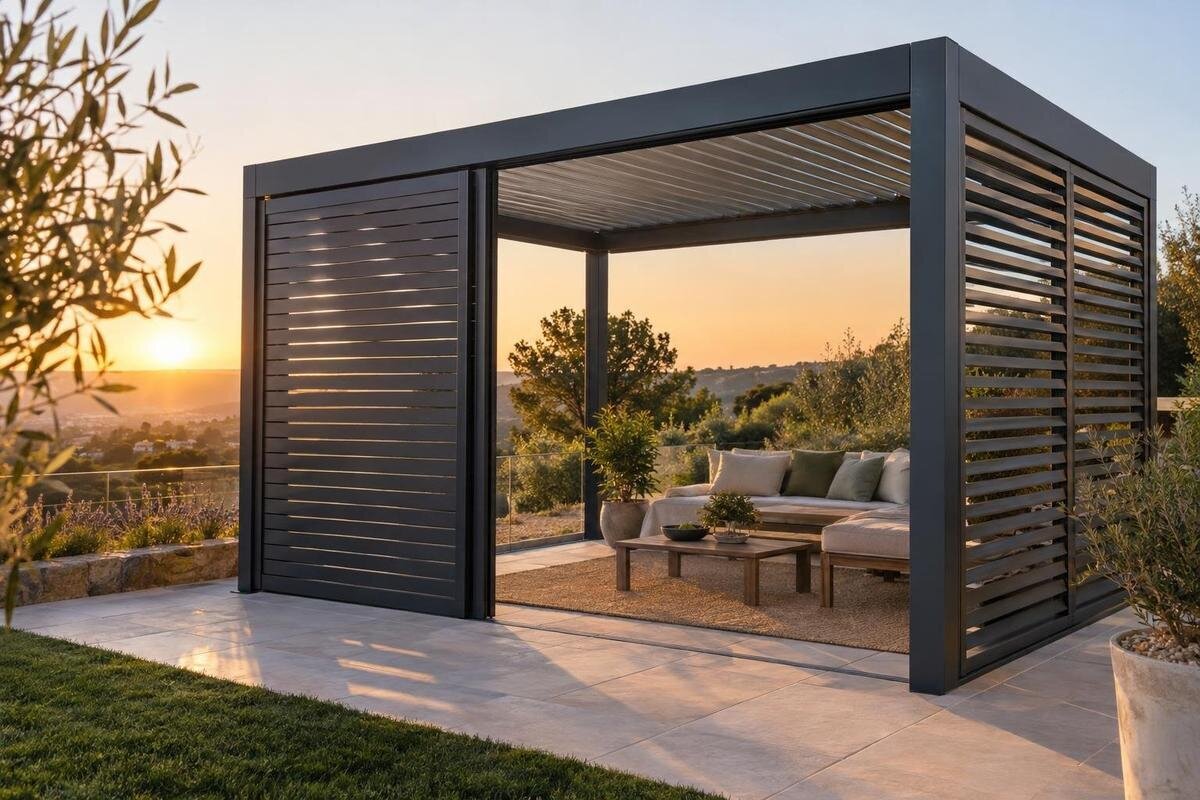
Privacy around a pergola is rarely the same on every side. One boundary may need a steady visual screen, while another also serves as a walkway, a view you sometimes want, or an edge you prefer to leave open. A fixed opaque screen stays in one position; a sliding panel lets you change which area is covered, but needs room to move and a place to sit when open. The right choice comes from mapping sightlines, routes and panel positions for your actual layout. Confirm accessory compatibility for the exact pergola model before treating any screen as part of the configuration.

Before choosing 1
What fixed and sliding privacy panels do differently
Fixed and sliding privacy panels answer different needs. A fixed opaque screen creates a visual boundary in one chosen position, blocking a direct view through the area it covers without anyone having to operate it. Its effect stops where the screen stops: an uncovered end, doorway, gap or view from another angle can remain exposed. It does not provide sound privacy or enclose the whole pergola. Fixed describes whether the panel moves, not its height, material or exact coverage; those details need to be specified. If you are selecting the main structure at the same time, include your screening requirements in an enquiry about the Bloomcabin Wall-Mounted Pergola, rather than choosing the structure and considering privacy only afterwards.
A sliding panel gives you a choice of positions, not privacy everywhere at once. It can cover a selected section when needed and move away from a route or view at another time, provided the proposed system travels far enough and has a place for the panel when open. Some arrangements may leave part of the opening occupied; the details vary, so do not assume the panel disappears completely or follows a particular mechanism simply because it is described as sliding. Ask how far it moves, what remains covered in each position and how it is operated. The useful comparison is dependable fixed coverage against adjustable coverage that you will actually use.
Map the sightlines that need screening
Start with a simple plan of the pergola, its boundaries and the places where people sit, stand, enter or pass. From each relevant spot, draw a line towards the view you want to screen: a neighbour’s patio, a street-facing edge or an adjoining service area, for example. Mark whether the line crosses the proposed panel or an uncovered opening. A photograph from the actual seat or standing position can reveal a gap that is easy to miss on a top-down plan. Check more than one normal position; a screen that blocks the view from a dining chair may leave it clear from the entrance. Include the usual furniture placement rather than planning around an empty patio.
Separate views you genuinely want to block from those you want to retain. A side screen addresses only sightlines that cross its covered area; it cannot close openings elsewhere or solve every elevated or diagonal view. Mark each required panel on the sketch, and note whether the view changes as people move around. Look in both directions: consider what someone outside can see into the pergola and what the screen will hide from people inside. A fixed panel suits a view that stays a concern from the same direction. A slider is relevant when its range of movement reaches the different lines you have marked.
Before choosing 2
Keep entrances and walking routes clear
Access is often what makes a movable screen worthwhile. Mark the door from the house, the route to the garden, the way people approach the seating and any path that needs to remain usable while the pergola is occupied. If a fixed screen sits across a regular route, you may need a permanent opening elsewhere or a detour around it. A sliding panel can offer a temporary clear passage, but only if its movement and open position leave that passage where people need it. Think about carrying food, chairs or outdoor items too; a route that works only when the pergola is empty may be frustrating in ordinary use.
On the plan, draw the panel in its privacy position and again in its open position. Show its travel and final parking place, along with any doorway, chair, table or other nearby feature. Do not assume the panel moves out of sight or that an adjacent doorway will remain unobstructed. Ask for the operating arrangement for the selected system, rather than relying on a generic picture. If you are considering the model shown on the Bloomcabin Pergola product page, include the access route in your enquiry so the proposed screen layout accounts for how people enter and leave. Check the route with furniture in its usual place and in both directions.
Check the usable opening in each position
Compare clear access, not just panel dimensions. A screen’s overall width is not the same as the space left for walking through when it is open. A fixed panel will continue to occupy the part of the boundary where it is placed, so the entrance has to be planned around that position. With a sliding panel, the opening depends on how that particular system moves. It may leave a portion or frame at the edge, or require space for the panel when open. Ask what remains across the passage in each position and request the actual usable opening, not simply the panel size shown on a product page.
Consider the movement you expect in real life: one person passing, two people crossing, or carrying something from the house to the table. Request the supplier’s stated clear opening for the exact configuration and compare it with your plan instead of estimating from a photograph. If a door or narrow passage is nearby, distinguish the space needed to operate the panel from the space available to walk through once it is open. When enquiring about the model on the Wall-Mounted Pergola model page, ask for both measurements on the same drawing. This lets you assess the passage itself, rather than judging access by the overall width of the pergola.

Before choosing 3
Balance visual privacy with an open feel
Privacy has a visual effect as well as a practical one. A broad, opaque surface interrupts a direct view more than an open boundary, but it also makes that side feel more enclosed and can hide part of the garden or patio beyond it. It does not turn the whole pergola into a private room if the ends or other sides remain open. Before choosing the extent of the screen, decide whether you need to conceal a particular view, screen a seating area or establish a boundary along a longer edge. Those are different requirements. Consider the screen from inside and outside, so the coverage works for the view you need without unnecessarily hiding one you value.
Think about the openness you want to retain. A continuous opaque screen can interrupt a direct path for air and reduce the view through that side; the effect depends on the panel design and on what remains open around the pergola. If airflow or an outward view matters, avoid closing every side by default. In an enquiry about the Bloomcabin Bioclimatic Pergola, identify which sides you want screened and which openings you want to retain. Keep this assessment separate from the roof: the question here is how much of the surrounding view and open space the proposed side panels would cover.
Consider how often the panel will move
The right mechanism also depends on how often the screen will change position. If the exposed view is a concern every time you use the pergola, a fixed panel avoids a recurring decision and keeps the boundary consistent. If you want an open view at some times and privacy at others, a sliding panel offers a choice, but only if someone is willing and able to make that adjustment. Consider who will operate it, whether it is easy to reach and whether the action feels straightforward when furniture or people are nearby. If you need a clear route every time you enter, weigh that repeated adjustment against a layout with a permanent access point.
Ask the supplier to explain the exact movement, how the panel is used in each offered position and what care its moving parts need. The operating method, effort and maintenance cannot be inferred from a product category or image. For a proposed sliding-screen arrangement around the Bloomcabin Pergola model, ask to see how the panel moves between the positions you expect to use. Consider the full action, not just the finished appearance: can the intended user reach and operate it with the furniture in place? Fixed screens still need an appropriate cleaning routine, so compare ongoing care rather than assuming that stationary means maintenance-free.
Before choosing 4
Use different screen types on different sides
You do not have to make every side match. A fixed screen can deal with a persistent sightline on one edge, while a sliding panel can serve a side that doubles as a route or has views you prefer to uncover. A third side may be better left open if privacy is not needed there. This selective approach avoids creating a more enclosed feeling than the use requires and makes the reason for each panel clear. Note whether the fixed screen needs to cover the whole side or only the part that blocks the view from a particular seat. Then give each side a purpose: steady screening, adjustable access or an open outlook.
A mixed layout is useful only if the pieces can be combined as a supported arrangement. Check how the screen ends meet at corners, whether the chosen panel covers the sightline you marked and whether an open panel conflicts with a neighbouring fixed section. Also consider whether the fixed part leaves a natural entrance while the moving part can cover the exposed area when required. Ask for one drawing showing all the sides together, rather than approving separate images that may not represent the proposed configuration. For an enquiry based on the wall-mounted pergola listing, label each side as fixed, sliding or open so the supplier can assess the complete combination.
Verify compatibility and what the quote includes
Confirm compatibility and supply status before settling on a screen. Ask whether the proposed panel is an accessory approved for the exact pergola model, a separate product from the same supplier or a third-party addition. These are not interchangeable descriptions: each affects who confirms the fit and what the quote covers. Have the specification name the screen type, number of sections, sides covered and intended fixed or sliding positions. It should also describe the proposed coverage clearly enough for you to compare with your sightline sketch. A phrase such as privacy screen available is too broad to tell you what is included in the configuration.
Ask what installation or mounting arrangement is intended and who is responsible for confirming that it suits the structure. Do not choose a screen solely because its advertised width looks close to the opening; fit and attachment need checking for the exact system by the supplier or an appropriately qualified installer. If the Bioclimatic Pergola product page is the model you are considering, ask for written confirmation of any compatible side accessories and whether each is included or separately specified. A screen should not be presented as part of the standard pergola configuration unless the offer says so.

Before choosing 5
Compare like-for-like quotes and ongoing care
Compare quotations against the same annotated plan. Each should identify the pergola model, which sides are screened, how much of each side is covered, whether the screens are fixed or sliding and what clear opening remains. Separate the pergola structure from screens and related components so the scope is visible; ask which items are included in the quoted configuration and which are optional or supplied separately. If you are comparing the regular pergola listing, use its exact model name in the enquiry, then request the same panel schedule and drawing for each proposal. This makes differences easier to understand without treating unlike layouts as equivalent.
Include practical upkeep in the comparison. Ask for care instructions for the actual screen surface and, for a sliding system, its moving components; the answer will depend on the chosen design. Find out how each face can be reached for routine cleaning and whom to ask if a part needs adjustment or replacement, rather than assuming the mechanism is maintenance-free. A fixed screen avoids a regular opening action, but its exposed surfaces still need care. Consider whether the proposed arrangement leaves enough practical access to clean it, particularly if a screen sits beside furniture or a tight boundary.
Test the layout in three everyday situations
Sketch three states for every screened side: ordinary day-to-day use, the moment privacy matters most and the moment you need the clearest route or outlook. Draw the fixed layout once, then show the sliding panel in each position confirmed by the supplier. If one unchanging position works in all three states, a fixed screen may be enough. If moving it resolves a genuine conflict and the panel has somewhere to go, sliding may justify the extra operation. If only one section needs to move, a mixed layout may be more logical than screening the full perimeter. Use the actual seating and access points in your sketch.
Compare the three drawings side by side and note what each adjustment achieves. A panel that moves but leaves the troublesome sightline exposed does not resolve the privacy need; one that uncovers a useful entrance or restores a valued outlook has a clear purpose. Check whether you would need to move it whenever someone passes, or only when changing how you use the space. You do not need to predict every future occasion. Focus on the recurring situations you can already name, and use the comparison to decide which sides genuinely benefit from movement and which can remain fixed or open.
Frequently asked questions
Which is better: a fixed screen or a sliding panel?
Neither is automatically better. Fixed screening suits a sightline that needs covering every time, provided the route can be planned around it. Sliding screening is useful when you want to change the coverage, as long as the panel can move to a practical position and has somewhere to sit when open.
Does an opaque screen make a pergola completely private?
No. It blocks a direct view only through the area it covers. Open ends, doorways, uncovered sections and views from other angles can remain exposed, and an opaque panel does not provide sound privacy. Sketch the actual sightlines from the places people use before deciding how much to screen.
How much room does a sliding panel need?
That depends on the proposed system and layout. Allow for its travel and the space it occupies when open, as well as nearby doors, furniture and walking routes. Ask for a drawing showing both positions and the usable opening; a product image is not enough to confirm clearance.
Can fixed and sliding screens be combined?
A combination can make sense when different sides have different needs, such as steady screening on one side and adjustable access on another. Availability and compatibility depend on the exact pergola model. Ask for confirmation and a drawing of the complete arrangement before assuming the two types can be combined.
Are privacy screens included with a pergola?
Do not assume so. Ask whether each screen is included, separately specified, an approved accessory for the exact model or a third-party product. The pergola’s model name alone does not confirm that side panels are available or suitable; have the supplier identify the supported configuration and what the quote covers.
Fixed and sliding screens are not competing answers for the whole pergola; they are ways of handling different edges. Use a fixed opaque panel where the same view needs blocking every time, and a sliding one where changing the coverage makes a route or outlook work better. If the plan shows distinct needs, a supported mixed layout may make sense. What matters is which view each panel screens and how much usable space remains in each position—not simply whether the panel moves.
