
Spider mites in the greenhouse.
Greenhouse note 41 · Diagnosis & crop care
Spider mites in the greenhouse.
Identification, prevention and control start with a close look at a leaf. The first sign is rarely obvious webbing. More often it is fine pale stippling, a stressed plant and a small population gaining ground in a sheltered, dry microclimate.
First inspection
Diagnose more than the damage.
Spider mites do not chew holes or leave one clearly defined wound. They pierce leaf cells and remove their contents. Early damage therefore appears as tiny pale or yellowish dots: typical stippling. In a greenhouse, this pattern can first resemble dust, nutrient problems, ageing leaves, sun stress or thrips. Rather than treating everything in haste, assess three levels calmly: the whole plant, the leaf surface and living activity.
Start with the whole plant. Spider mites often begin as a local hotspot: at the warm end of a cucumber row, on a thirsty container plant, beside sun-warmed glazing or in older foliage that is hard to reach. Note whether stippling occurs along veins, on lower leaves, on one side of a plant or already across neighbouring pots. Then turn over several leaves. Two-spotted spider mites commonly favour undersides, where mites, eggs, cast skins and fine silk threads are easiest to find.
Use a hand lens where possible. Alternatively, hold white paper beneath a suspect leaf and tap it gently. Tiny moving dots on the paper are not a certain species identification, but they are a good reason for closer inspection. Check leaves from different heights and climate zones. A sound early diagnosis avoids treating the entire greenhouse for one old damaged leaf when the active hotspot remains local.
Greenhouse design matters too. Paths, plant spacing and working height should let you lift leaves, clean beneath benches and reach dense foliage without pushing plants together. A Classic aluminium greenhouse provides a considered basis for plant care, climate management and regular pest checks.
01 · Plant pattern
Read the distribution.
02 · Leaf surface
Read the pattern.
03 · Living signs
Read the colony.
Plant pattern. Look for a tired grey-green appearance, stippled lower leaves and isolated stressed plants as possible starting points. Mark the location instead of relying on memory.
Leaf surface. Pale punctures can merge into uneven mottling and later dull bronze areas. Compare upper and lower surfaces on several leaves, not only the most striking specimen.
Living signs. Look for moving dots, round eggs, pale cast skins and very fine threads along veins or in leaf axils. Only these signs show whether visible damage is still actively progressing.
Damage atlas
From stippling to bronzing.
The severity of visible damage helps set priorities, but does not reliably show the current population size. A heavily bronzed leaf may record an older infestation after mites have declined. Conversely, fresh eggs and active colonies can be present on a plant that still looks surprisingly green. Always assess both: lasting damage and current activity beneath leaves.
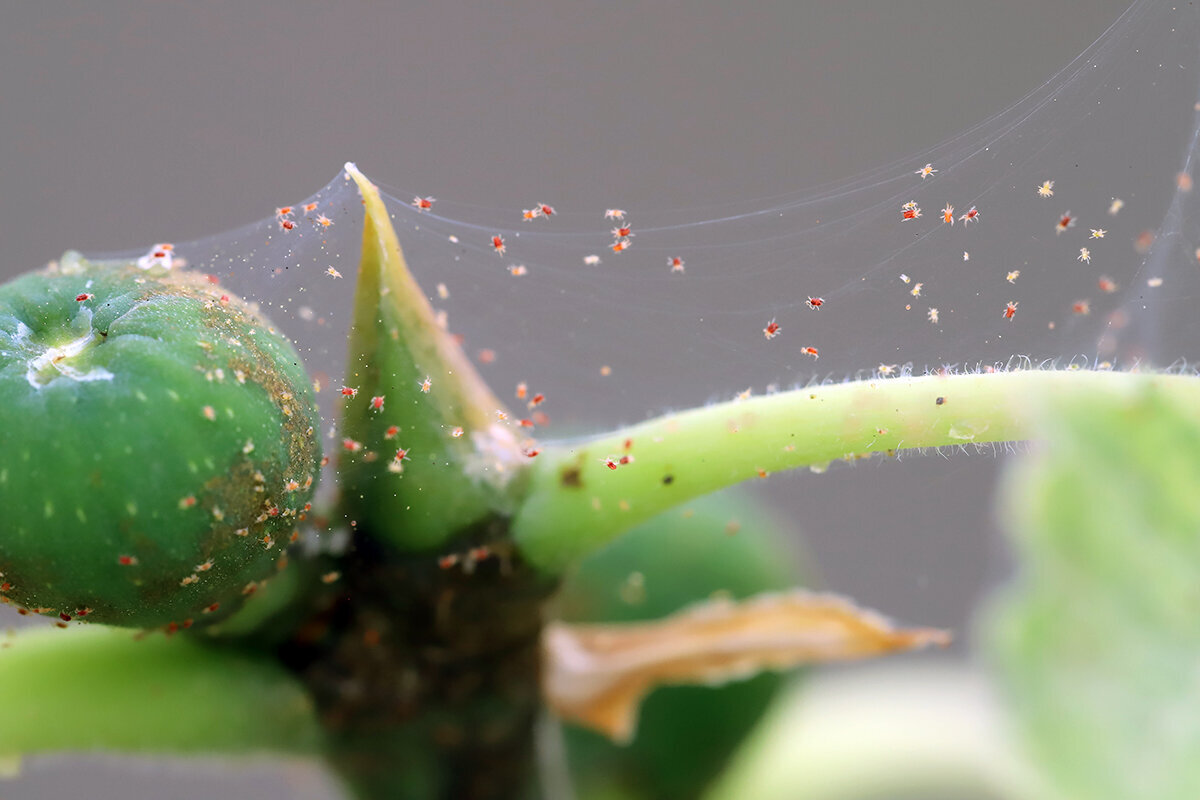
Spider mites are arachnids, not insects. Adults are very small and often appear as moving dots without magnification. Depending on life stage and colour, they may look greenish, yellowish or reddish. One species to recognise is the two-spotted spider mite, Tetranychus urticae; two dark dorsal spots are typical. Decisions should still rest on the actual evidence on the plant, not colour alone.
Fine stippling
Dense mottling
Bronzing
Silk appears
Leaf exhausted
Evidence, not worry
Spider mites and common lookalikes.
Stippling deserves attention, but does not belong only to spider mites. A reliable diagnosis answers two questions: does the damage fit sap-feeding mites, and can the animals or direct evidence of activity be found? Check leaf undersides, young and older growth, symptom distribution, dark droppings and surface texture. Also consider whether changes followed a hot spell, irregular watering or a spray application.
Thrips can cause pale to silvery, often streaked scraping scars that resemble mite stippling. Clues include small dark droppings and slender moving insects in flowers, tight leaf folds or on the surface. Lime deposits and spray residue sit on the leaf and can often be wiped away when damp; spider-mite damage is within the tissue and remains visible. Oedema is more likely to appear as corky, blistered or raised areas linked to uneven water balance. Normal ageing is generally more even: an older leaf loses vigour steadily rather than developing an expanding field of fresh punctures in a warm zone.
Water stress and physiological leaf changes also call for restraint. Soft, curled or irregularly developed leaves alone do not prove spider mites. If moving mites, eggs, silk and classic fine undersurface stippling are absent, first check the root zone, watering and climate pattern. For unclear or worsening damage, professional plant-protection advice is safer than treatment based on suspicion.
Why a small find becomes a greenhouse problem
Heat, drought stress and delay raise the pressure.
Spider-mite development and reproduction are strongly shaped by conditions. Heat can speed population growth, while drought-stressed plants are less resilient. Dusty leaves, crowded pots, inaccessible undersides and late detection compound the effect. There is no universal development time: temperature, host plant, mite species and microclimate interact. A consistent checking routine is therefore more dependable than a fixed number of days.
Zone oneWarm leaf surfaces
Zone twoDry root zone
Zone threeDense planting
Zone fourLate detection
Warm leaf surfaces: Leaves beside glazing, sun-facing containers and still air in the upper canopy can be much warmer than a thermometer near the door suggests.
Dry root zone: Repeated water shortage increases the loss of functional leaf area and reduces a plant’s ability to tolerate an initially limited infestation.
Dense planting: Plants touching one another create sheltered crossings. Overcrowding also makes undersides harder to inspect and mechanical or authorised treatment less even.
Late detection: Eggs, immature stages and adult mites can occur together. A measure that reaches only exposed animals can be followed by renewed activity without rechecking.
Prevention therefore does not mean forcing humidity as high as possible. More important are less avoidable plant stress, timely ventilation and shading, clean accessible crops and a checking rhythm that spots small colonies before dense foliage forms a sheltered, webbed microclimate.
Prevention through climate and access
A greenhouse you can inspect.
Check new plants thoroughly before they join an established crop and, where possible, observe them separately first. This is especially important for herbs, young vegetables, annual flowering plants and overwintered containers that may carry a light infestation without obvious damage. Keep a brief note of plant name, position, date, symptoms, living finds and measures taken. Such records reveal recurring hot zones and susceptible crops faster and more reliably than memory.
Water for steady growth rather than crisis management. Spider mites do not disappear if a dried rootball is then kept permanently wet; wet foliage is no substitute for thoughtful irrigation either. Check pot weight or substrate moisture and supply each crop according to its needs, as evenly as possible. A well-planned growing space such as the Classic aluminium greenhouse creates clear planting areas and reliable working routes for regular care.
Ventilate and shade with actual leaf temperature in mind. Roof vents, open doors and suitable shading can ease extreme heat pockets, but they do not replace observation. South Africa’s varied climates can bring intense sun and abrupt local weather changes, so judge conditions at the site. A resilient growing space needs not only an attractive shell, but enough room to reach every plant. The Classic aluminium greenhouse offers planning options; prioritise clear paths, suitable working heights and adequate spacing between plants.
Keep floors, bench undersides, pot rims and glazing clean. Dust can favour mite problems, while discarded plant material makes inspection harder. Remove badly damaged leaves where this does not unnecessarily defoliate the plant. Bag infested material hygienically and take it out of the greenhouse. Do not leave a heavily infested plant or prunings beside the structure on an open compost heap where mites could reach the crop again.
- New plants: separate first, inspect undersides and check again before moving them in.
- Plant spacing: Avoid continuously interlocking leaves that create bridges between neighbouring pots.
- Watering: Prevent recurring drought stress without correcting it with permanently waterlogged substrate.
- Heat: Assess stress in the leaf zone on bright afternoons, not only from the morning forecast.
- Checking routine: Inspect at least weekly, and much more often in heat, after plant purchases or during an active infestation.
Treatment is a question of reach
Reach undersides, then inspect again.
A targeted rinse with water can mechanically reduce mites and webbing, especially during an early local infestation on manageable plants. Work gently and not in direct midday sun. For plant-protection products, use only products registered in South Africa and expressly authorised for the crop, setting and user category. Many measures work only on direct contact. If they do not reach the protected colony under the leaf, they cannot reduce it sufficiently. The aim is careful coverage, not a stronger dose or a rushed spray cloud.
Incomplete approach
From above only
Methodical approach
Access before application
Excessive approach
More is not better
From above only. Leaf tops are wetted while the colony beneath remains largely protected. The plant looks treated, but active mites still occupy their preferred zone.
Access before application. Move pots apart, support dense foliage carefully and work section by section according to the product or beneficial-insect instructions. Inspect again rather than assuming one pass reached every life stage.
More is not better. Overdosing, applying products to heat-stressed plants or using an unsuitable product can damage leaves and harm beneficial organisms. Follow the label, safety requirements, temperature advice, withholding periods and all restrictions.
With a small isolated find, rinsing, removing heavily damaged leaves and close follow-up may be enough. For a larger infestation, combine isolation, hygiene, reduced stress and a suitable control strategy. Predatory mites such as Phytoseiulus persimilis are used deliberately against spider mites in greenhouses. Species, quantity and release method depend on infestation level, temperature, crop and products already used. Ask the supplier for advice and check compatibility with earlier or planned plant-protection measures. Broad-spectrum products can harm beneficials and disrupt biological control.
South African requirements: Use agricultural remedies only where they are registered locally and where the current authorised label covers the crop, pest, setting and user category. The label determines application, protective measures, withholding periods and restrictions. Overseas garden marketing does not establish local authorisation. Check the current registered product information and seek qualified local advice where needed.
Recovery follows observation
The next leaf matters, not the old scar.
A stippled or bronzed leaf will not become fully green again. Success is shown by less living activity, no new punctures, no increasing webbing and clean new growth that remains clear on repeated inspection. Initially leave a few cosmetically damaged but functioning leaves as a comparison on the plant. Removing every marked leaf immediately makes it harder later to distinguish old damage from fresh feeding.
Day 0Confirm and contain.Mark affected plants, isolate them where possible, check neighbours and record living mites, eggs or webbing.
First follow-upLook beneath the visible measure.Inspect undersides, leaf bases and dense plant centres again. Check whether rinsing or treatment actually reached the original colony zones.
Second follow-upSeparate old damage from fresh stippling.Compare marked leaves with new growth. Fresh punctures, moving mites, new eggs or new silk indicate continuing activity.
AfterwardsReturn to the normal checking routine.Keep records, correct recurring heat or water stress and maintain access around plants so a new hotspot is noticed early.
A well-planned structure supports this process. The Classic aluminium greenhouse can be arranged as an orderly growing space rather than a tightly packed storage area. Keep a clear inspection path, position vulnerable plants within reach and respond to site conditions with ventilation and shading. The options of the Classic aluminium greenhouse support long-term accessible, care-friendly planning.
Frequently asked questions
Clear answers for precise checks.
Can spider mites be present without webbing?
Yes. Fine silk often becomes clearly visible only with a larger population. Early colonies may show only pale stippling, round eggs, cast skins and tiny moving animals on leaf undersides. Webbing is a strong additional sign, but not a requirement for a sound diagnosis.
Must an infested greenhouse plant be discarded?
Not automatically. A valuable plant with a light infestation can often be isolated, gently rinsed or suitably treated, then monitored closely. But if a plant is badly damaged, very dense and no longer possible to inspect fully, it can become a persistent source for the whole crop. Hygienic removal may then be the sensible choice.
Does higher humidity eliminate spider mites completely?
No. A stable, crop-appropriate water balance reduces drought stress and is preferable to a hot, extremely dry microclimate. Humidity alone is not a control programme. Do not keep the greenhouse permanently damp or leaves constantly wet, because this can encourage other problems such as fungal diseases.
Can I release predatory mites after spraying?
Possibly, but compatibility depends on the product used and its residual activity. Some products affect beneficial organisms more strongly or for longer than expected. Check the label and local authorisation, then ask the beneficial-insect supplier about the waiting period, suitable predatory-mite species, release method and required climate conditions.
How often should I inspect during an infestation?
Inspect more often than during the normal weekly routine. The right interval depends on crop, temperature, infestation level and the measure chosen. The key is to revisit the same leaf undersides in time, before missed eggs or protected colonies lead to surprising new activity.
Are spider mites actually spiders?
Like spiders and ticks, they belong to the arachnids, but they are tiny plant-feeding mites. Their silk forms fine threads and, in heavy infestations, dense webbing on plants; it is not a large radial spider web.
Sources and further reading
A short, reliable reading list.
These sources support the diagnostic and integrated approach in this guide. For specific crops and applications, the current South African registration, product label and expert advice always take priority.
More from Bloomcabin: Greenhouse curtains and shading · Setting up a greenhouse · Weather and pest protection in an aluminium greenhouse
- North Rhine-Westphalia Chamber of Agriculture: Spider mites on greenhouse fruit vegetables
- North Rhine-Westphalia Chamber of Agriculture: Spider mites in biological plant protection
- North Rhine-Westphalia Chamber of Agriculture: Predatory mites as natural spider-mite enemies
- South African Government: Register an agricultural remedy
- German BVL: Safe plant-protection product use in home gardens
- Julius Kühn Institute and German Environment Agency: Beneficial organisms for purchase
- North Rhine-Westphalia Chamber of Agriculture: Diagnosis and control of spider mites
- North Rhine-Westphalia Chamber of Agriculture: Spider-mite biology and regulation
