
Pergola Louvres in Strong Wind: Open or Closed?
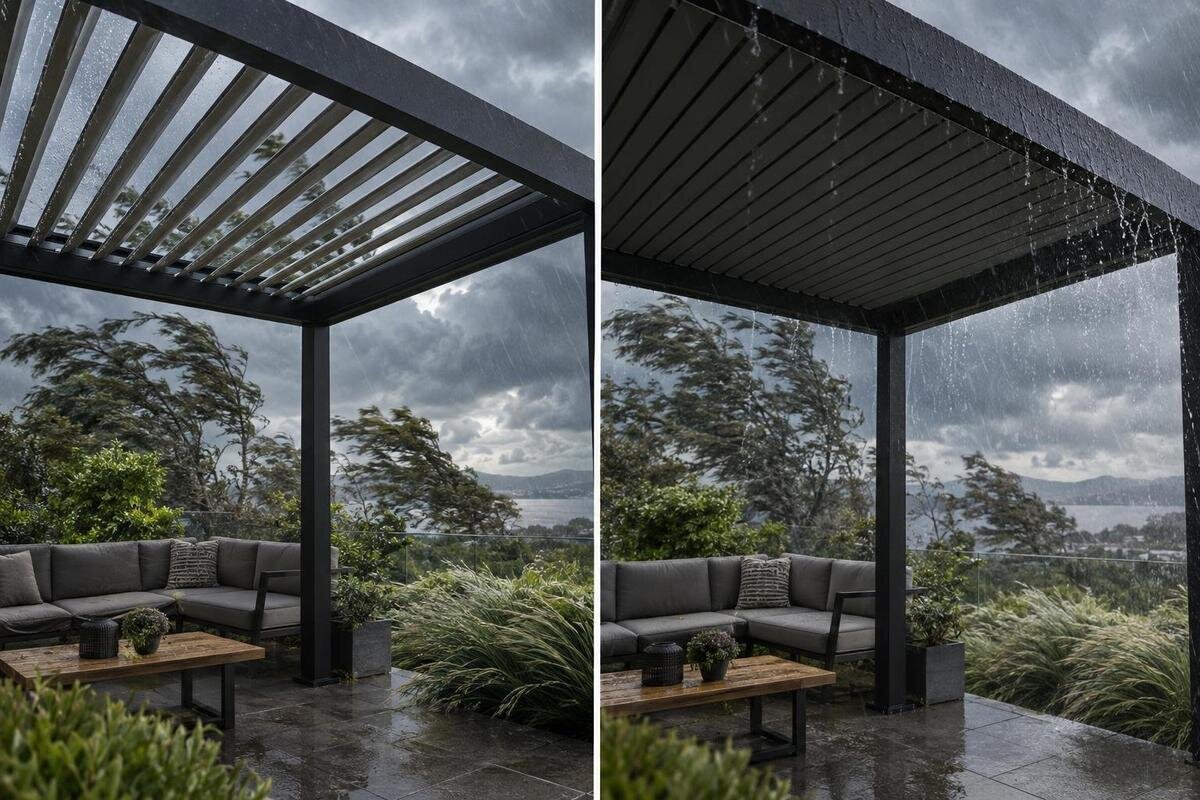
Pergola weather guidance
Should pergola louvres be open or closed when strong wind is forecast? There is no position that can be recommended for every model. Blade design, permitted movement, controls, stated wind limits and fitted side elements may all affect the manufacturer’s directions. A picture of a similar roof, a neighbour’s setting or a generic online rule cannot establish what applies to your pergola. The reliable answer is in the operating instructions for the exact model and configuration. This guide explains how to identify the relevant paperwork, interpret its wind wording and ask for missing information before trying to adjust the roof.
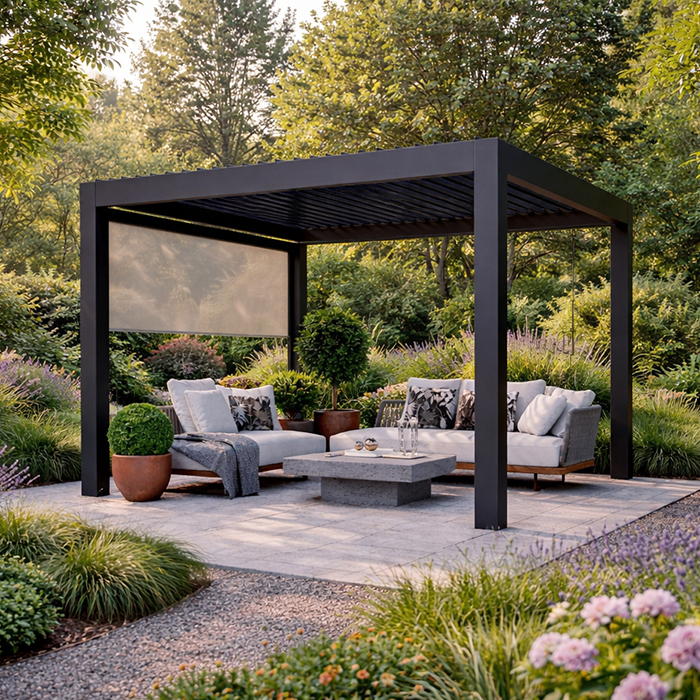
Buyer’s document checklist 1
There is no universal open-or-closed rule
Open or closed is not a universal safety rule. A closed roof can look more secure, and an open roof can look as though it lets air pass, but appearance does not show what the manufacturer assessed or which operating limits apply. Nor does a partly turned position automatically split the difference. A louvred roof is a moving assembly; the approved response depends on the instructions for that design and its stated configuration. Without that information, it is not possible to say responsibly that one position is safer for every pergola.
Do not borrow a rule from a different brand or from a neighbour whose roof only looks similar. The model, version and fitted side elements may not match. A photograph or video shows a roof in one moment; it does not establish that the position shown is the manufacturer’s wind setting. If the manual does not answer the question, treat the answer as unknown rather than labelling open or closed as safe. A general online recommendation is not a substitute for instructions that identify your exact model.
Why louvre position depends on the exact model
Louvred roofs can differ in blade shape and orientation, movement mechanism, frame arrangement, permitted travel and control method. A manufacturer may also distinguish between model versions or configurations. Those differences can affect which position is approved and under what conditions. The manual may give separate directions for ordinary operation and a response to wind, or it may set out a limit beyond which the roof should not be operated. Only the model-specific instructions can establish which of those directions applies.
When comparing models, distinguish the product description from the instructions for using the roof. For the Bloomcabin Pergola, for example, the listing provides a product name to use in your enquiry; it does not establish a wind rating or operating position. Ask which manual accompanies the model being quoted and where it explains the response to strong wind. A useful answer should distinguish between leaving the roof in a position and moving it into that position under the conditions described. Those are different operating questions, even when both refer to the same louvre setting. If a salesperson gives a simple rule such as always closing the roof, ask them to identify the relevant instruction rather than treating the statement as an additional specification. This also gives you a clearer basis for comparing products than a general claim that one roof handles wind better.
Buyer’s document checklist 2
Match the instructions to the pergola you have
Start with the records for the pergola as supplied: the quote, invoice, handover paperwork and any operating manual. Note the exact product name, model code and document revision if shown. If there is an identification label or serial number, check it only where it can be reached safely and in the way the supplier recommends. Do not climb onto the roof or remove covers just to look for a label. A broad product-family name may not be enough to identify the version covered by a particular instruction.
For a quote naming the Bloomcabin Bioclimatic Pergola, compare that name with the paperwork supplied for the unit on site. Keep the product details and manual reference together so that a later enquiry does not depend on remembering which version you bought. Where a document covers several models, find the part that identifies yours rather than assuming every diagram or instruction applies throughout the range. If the documents disagree, or the model code is missing, send the supplier the exact wording you have and ask them to confirm which manual applies. Explain whether you are identifying an existing installation or checking a proposed purchase: in the first case, the answer must match the supplied unit; in the second, it must match the specification in the quote. Do not choose between conflicting instructions merely because one document looks newer or is easier to find.
Read the wind limit as written
Look for wind guidance in the operating and safety instructions, then read its terms carefully. A document might state a limit, specify a position, or explain when the roof should not be operated. Check whether any stated figure is a gust or an average, what units and reference conditions it uses, and whether it concerns a moving roof or a roof already in a specified position. Do not add a threshold that the manual does not give, or assume that a figure applies to every arrangement of the pergola.
When enquiring about the Bloomcabin Wall-Mounted Pergola, ask for the wind guidance attached to that model rather than reading a performance limit into its name. If a document contains a wind-speed figure, read the surrounding sentence, table headings and notes together. Record the unit exactly as printed and retain any qualifications about roof position or configuration alongside the number. Copying only the largest figure into a comparison sheet can strip away the information needed to understand it. If the limit is unclear, ask the supplier or manufacturer to explain what it permits and what action the operator is expected to take. Keep that explanation with the manual, including the model reference. A useful clarification resolves the wording you actually have; a second unexplained number does not answer the operating question. Do not carry a limit across from another pergola or an unrelated document.
Buyer’s document checklist 3
Check what the manual means by open and closed
Use the manual’s own labels and diagrams to identify the required louvre position. Check whether it shows a fully open or closed position, an angle, or another named setting, and read the diagram legend and any arrows before interpreting it. Do not estimate an angle from a product image or assume that the blades should face a particular direction because that looks logical. Confirm whether the instructions describe the position of the blades, the state of the controls, or a sequence the operator must follow.
A halfway setting is not automatically a safe compromise; it is appropriate for wind only if the model’s instructions say so. If the manual specifies one position, do not substitute a nearby one. For a purchase such as the pergola shown in this product listing, ask to see how the required setting is identified in the operating instructions. Is there a labelled illustration, a named control setting or a written sequence? The answer should let you recognise the instructed position without estimating it from a promotional photograph. Check whether the procedure says to act before a stated condition is reached, and distinguish that timing requirement from the final blade position. If the wording and diagram seem inconsistent, ask which interpretation applies before operating the roof. Do not experiment during strong wind to discover what the author of the manual might have meant.
Include screens, doors and other enclosure options
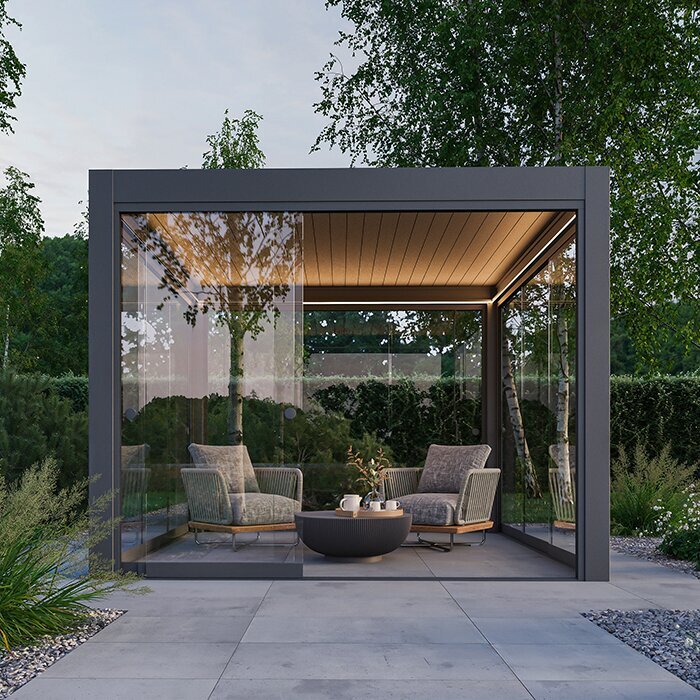
Wind instructions may be written for a particular configuration, so consider the whole pergola rather than the roof alone. Tell the supplier about any fitted or planned side screens, sliding panels, glazing, blinds or other enclosure elements. Do not assume that opening or closing a side element reduces the wind exposure, or that advice for an open-sided structure also applies when sides are enclosed. The manufacturer’s documentation needs to cover the arrangement you actually intend to use.
When requesting a quote for the Bioclimatic Pergola, describe the side elements you intend to include rather than asking about the roof in isolation. Make a simple record of which sides have screens or panels and how you expect to use them. This gives the supplier a specific arrangement to assess against the operating guidance, rather than an unspecified enclosed pergola. Ask whether the instructions cover that arrangement and whether they prescribe positions for the side elements as well as the louvres. Keep the answer with the agreed specification so that optional items are not left out of the discussion. If an element was added after the pergola was supplied, distinguish it from the original installation when requesting advice. The point is to establish which instructions apply to the complete setup, not to assume that opening every side, or closing every side, is the correct response.
Buyer’s document checklist 4
Separate wind instructions from weather claims
The operating manual answers the practical question of what to do with the louvres. Other weather-performance documents may give limits or describe controlled observations, but those are not interchangeable with an operating instruction. If a supplier cites an observation, ask which model and position were involved, what configuration was tested and what conditions were recorded. An observed result relates to the setup and conditions described; it should not be treated as a guarantee for every site or every storm.
A drainage diagram explains the intended route for water; it does not tell you whether the louvres should be open or closed in wind. Nor does it, by itself, establish that a roof is watertight in all conditions. When comparing information for the wall-mounted pergola model, separate three questions: what the operator must do, what weather performance is described, and how water is intended to drain. Use the operating instructions for the first question and read the other documents for their stated purposes. If a sales explanation moves between these subjects, ask which document supports each part of the answer. For example, an explanation of where water goes does not resolve an unclear wind-setting instruction. Keeping the questions separate helps you identify the actual gap in the information without treating every weather-related drawing or statement as evidence for the same claim.
Compare forecast information with the manual’s terms
A weather forecast may show gusts, averages or other wind figures, while the pergola manual may define its limit differently. Before comparing them, check the unit, measurement description and conditions the manufacturer uses. Do not assume that a number on a weather app corresponds directly to a product limit, and do not convert or reinterpret figures by guesswork. If the terms do not match, ask the supplier how the instruction should be applied rather than deciding that a forecast is below or above the limit.
Resolve the terminology before strong wind is forecast, rather than trying to interpret an unfamiliar limit as conditions deteriorate. If the regular pergola model is on your shortlist, include this question in the buying discussion: how should the wind information available to the owner be read alongside the manual’s wording? Give the supplier the exact model details and quote the passage you need explained. If necessary, include the labels and units used by the forecast you normally consult, without assuming they are equivalent to the manual’s terms. Ask for an explanation of the comparison, not simply a yes-or-no answer about whether one particular day is safe. Keep the response with the instructions so that the same uncertainty does not recur with the next forecast. Do not wait for gusts to arrive before testing the roof or trying to work out an unclear setting.

Buyer’s document checklist 5
If strong wind arrives before you have an answer
If wind is already building and the manual is unavailable, do not choose a position from a general rule, forum post or visual guess. Do not go onto the roof, climb a ladder or reach into an exposed area to adjust it. Follow any emergency directions supplied for the exact model, and do not force the controls or repeatedly move the louvres to find a position that seems more secure. An adjustment is not worth attempting from an unsafe place.
If the roof moves unexpectedly, jams or appears damaged, keep people clear and avoid investigating the mechanism while conditions are unsafe. Contact the supplier or an appropriately qualified professional when it is safe to do so. For an enquiry about the Bloomcabin bioclimatic model, provide the product identification details from your records and describe what happened in plain terms. Separate what you observed from what you suspect: note the roof’s visible position, whether you attempted to operate it, and any fitted side elements, without approaching it in hazardous conditions. If you do not know a detail, say so rather than recreating the event by operating the roof again. A product page can help identify the name, but it cannot diagnose the problem. Keep the enquiry focused on obtaining appropriate guidance for that unit; do not force a repair or treat a position reached during a fault as a recommended wind setting.
Documents to request before buying
Ask for a document pack tied to the exact model and proposed configuration. It should include the operating manual and its revision or date; confirmation of the model and relevant options; the wind limit and an explanation of its terms; and a labelled diagram or clear instruction showing the louvre position and any required sequence. Also request any restrictions for side screens, panels or other enclosure elements. If controlled observations are cited, ask for the model, position, configuration and conditions behind them. A drainage diagram is a separate useful reference, not a wind-position instruction. Organise the pack so that each document answers an identifiable question, and note any unresolved wording alongside the relevant passage. This makes it easier to see whether you have an operating answer or merely a collection of general product information.
Before relying on the pack, check that the model and configuration match the quote and what will be supplied. A product photograph, brochure headline or general statement about wind does not replace operating instructions. If a key point is missing, ask the supplier to answer in writing for the specific model and to identify the document or instruction the answer follows. If the intended setup is not covered, do not treat an assumption as a specification; seek clarification before deciding whether that pergola is appropriate for the site.
Frequently asked questions
In strong wind, is it safer to leave the louvres open or closed?
Neither position is a universal rule. Use the operating instructions for the exact pergola model and configuration. If they do not state what to do in wind, get model-specific guidance rather than relying on appearance or advice for another roof.
Is a partly open position a safe compromise?
Not automatically. Use an intermediate angle only if the instructions explicitly allow it for the relevant wind conditions and show how to set it. A position between open and closed is not inherently safer.
Can I use a wind-speed figure from a brochure?
Only if the figure applies to your exact model and the document explains how it is defined and which roof position and configuration it covers. A number without that context does not tell you how to operate the louvres.
Do side screens or panels affect the advice?
They may change the configuration covered by the manufacturer's guidance. Give the supplier a clear list of fitted or planned side elements and ask whether the wind-position instructions apply to that exact arrangement.
What if strong wind arrives before I find the instructions?
Do not guess or try to adjust the roof from an exposed or unsafe position. Follow any emergency directions supplied for the model, keep clear if the roof behaves unexpectedly, and request specific guidance when conditions allow.
An open roof and a closed roof are not universal wind settings. The right answer depends on the exact model, its documented limits and the configuration the instructions cover. Match the product identity, wind terminology, louvre diagram and any enclosure notes; treat photographs and general advice as insufficient. If the paperwork does not state what to do, do not infer a position from another pergola. A model-specific written answer is the information that should guide any adjustment.
