
When Does a Squeaking Pergola Need Maintenance?
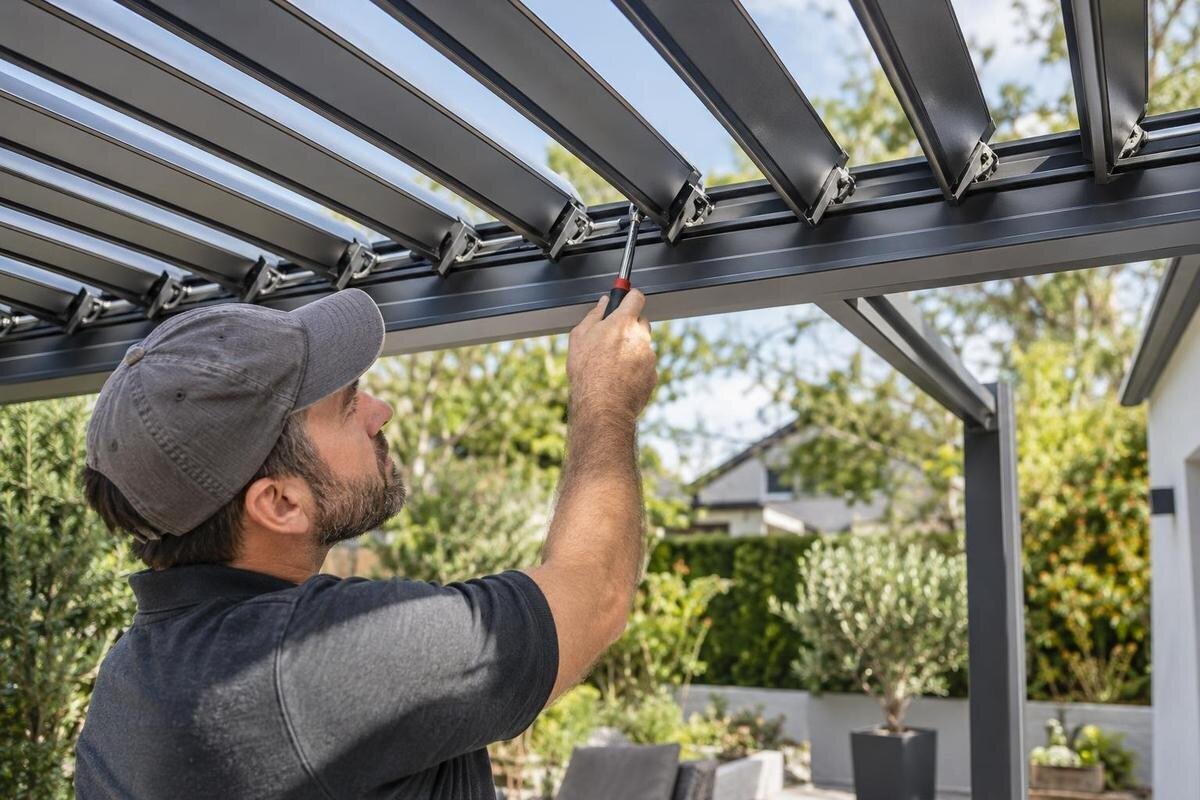
Pergola care
A squeaking pergola is worth investigating when the sound is new, recurring or getting louder, especially if movement has become rough or uneven. Timing and location can help a service provider narrow down where to look, but the noise alone cannot identify a failed part. Record what happens, avoid improvised lubricants or adjustments, and follow the maintenance guidance for the exact model.

Before arranging maintenance 1
What a squeak can and cannot tell you
A squeak is a symptom, not an identification of a faulty part. It may come from rubbing surfaces, debris at a contact point, a joint needing the model-specific care described in its manual, a loose or worn component, or vibration elsewhere in the frame. On a pergola with adjustable louvres, the noise may occur during movement; on another design, it may come from a different moving assembly. Sound can travel along structural members, so hearing it near one post does not prove that the post or its fixings are responsible. Pitch alone cannot identify a hidden part, and a recording can preserve the symptom without proving its cause. Treat each possibility as a reason to observe further, not as a diagnosis.
A single brief squeak and a recurring squeak provide different evidence, but neither should be called harmless solely by ear. Note whether it is new, whether it happens on each operation or only at one point, and whether movement remains smooth and consistent. If your paperwork names a Bloomcabin Pergola, record that identity alongside the symptom rather than assuming advice for another pergola applies. An online clip with a similar pitch cannot confirm that your assembly has the same fault or maintenance needs. Describe what you hear without guessing the cause: for example, a short squeak at the start of movement is more informative than simply saying the mechanism sounds faulty.
When does the squeak occur?
Describe the event as precisely as possible: does the squeak begin as movement starts, at one part of its travel, as it stops, or only when the structure is still and wind is moving something? If the system is manually operated or motorised, say which, and identify the action or control used without opening control equipment. For a Bloomcabin Bioclimatic Pergola, the product name alone does not identify the source; note whether the sound coincides with a moving feature identified in your own model's manual. Record the direction of movement and the approximate point where the noise starts. Do not repeatedly run a mechanism that is catching or sounding strained just to improve a recording.
Note the date and approximate time, whether there was wind or rain, whether the pergola had just been cleaned or serviced, and the position of any adjustable element if the manual lets you identify it. Compare only situations you have observed naturally; do not create a test in unsafe conditions. A short mobile-phone recording taken from a safe position can capture pitch, duration and timing, while a wider view may show which area was moving. Keep the recording brief and stay clear of moving components. Never put a phone, hand or camera inside an assembly, or ask someone to operate it while you reach in; a written note is better than an unsafe clip.
Before arranging maintenance 2
Locate the sound without touching the mechanism
Listen from a normal, safe standing position and note the area where the sound seems loudest. Depending on the design, useful landmarks may include a pivot, the end of a louvre, a track, a drive cover, a frame joint, a post connection or the side attached to a wall. These are locations to describe, not a universal list of parts or a reason to remove a cover. A beam or wall can carry vibration, making a distant source seem close. Some mechanisms have no owner-accessible inspection points, so stop where visibility ends. If your product is a Bloomcabin Wall-Mounted Pergola, give that exact model name when contacting support, but do not assume that noise near the wall proves a fixing is loose.
Use a broad description, such as left end during opening, and, if useful, take a photo from a position the manual regards as safe. Do not poke, tap, push, lift or shake a component to reproduce a noise; doing so can introduce risk and may not reveal its source. Keep clear of louvres, linkages and any powered movement. Do not remove guards, panels or covers to listen more closely. If the sound appears to come from inside an enclosure or powered component, arrange qualified service rather than trying to inspect it. Sound location is evidence to share, not a verdict about which part needs repair.
Signs that call for maintenance
Arrange maintenance when a squeak recurs, grows louder, lasts longer, or appears with a change in how the pergola moves. Examples include a louvre or other moving element that hesitates, shudders, travels unevenly, stops short or needs unusual force. A new rattle or grinding noise, visible misalignment, a part that looks loose, or a component that has shifted adds concern. A sound by itself may not show the level of urgency, so describe any movement change separately. Stop operating the mechanism if it binds, jerks, moves unpredictably or appears damaged; do not force it through an obstruction. Contact the manufacturer or a qualified service provider rather than continuing to test it.
If the squeak is brief and occasional, movement remains as described in the manual, and there is no visible change, log it and consult the model-specific maintenance instructions. These observations can help a service provider advise whether to monitor it during ordinary use or arrange an inspection; they do not prove that maintenance is unnecessary. If the sound returns after permitted cleaning or approved maintenance, explain what was done and when. For an enquiry about the standard Bloomcabin Pergola, use the product name and version in your own records. Mention whether the noise began after installation, adjustment or a service visit, as this gives the provider a useful point of comparison.

Before arranging maintenance 3
How weather and cleaning may affect the noise
Weather and surrounding conditions may change when a noise appears or disappears. Wind can set a loose accessory or component vibrating, while temperature changes may alter clearances between materials; moisture, dust or plant debris may affect a contact area. These are possibilities, not diagnoses, and the same sound may have another cause. Record conditions instead of attributing the squeak to a season or assuming rain has washed away its source. Note whether it coincides with gusts, dampness, recent rain, a temperature change or a particular position, and whether the pergola is moving differently at the same time. Changes after assembly or adjustment are also worth reporting.
Cleaning or maintenance can affect when a sound is noticed, so add the date and method to your record. If the squeak started after a wash, check whether the exact cleaning method and products were allowed by the manual; do not repeat it or add a spray as a trial. A noise during wind while the mechanism is stationary may point to vibration in a different area from a squeak heard during movement, but that difference still needs confirmation. Where the manual specifies inspection or care, follow its timing and method for your model instead of borrowing an annual schedule from another pergola. If the instructions are unclear, ask the manufacturer or service provider before repeating the work.
Use only approved cleaning and lubrication methods
Do not apply household oil, grease, silicone spray, penetrating fluid or a lubricant simply because a joint squeaks. A product can be unsuitable for a seal, coating, bearing, plastic part or finish, and an oily film may hold grit; even a suitable product can be wrong if applied at the wrong point, in the wrong quantity or at the wrong time. Some pergola mechanisms require no user-applied lubricant, while others may have specified maintenance points. Only use a maintenance product when the manufacturer names it for that model and explains where and how to apply it. If instructions are missing or unclear, ask before using anything.
The same rule applies to cleaning, adjustment and tightening: use the stated method, not a generic video or advice for a different product. When consulting the listing for this Bloomcabin bioclimatic model, distinguish the product description from the maintenance instructions for your installed version. The exact manual should identify cleaning limits, permitted products and any tasks owners may carry out. Leave procedures involving powered components or dismantling a mechanism to qualified service. Do not mix maintenance products or try a second one on a hidden surface to see whether it works. Keep the instructions and container for any approved product used, so its identity is available if a problem develops.
Before arranging maintenance 4
Safe owner checks and work for a professional
Owner-level checks should stay visual and follow the manual. From a safe position, look for an obvious obstruction, fresh debris, a component sitting differently from its usual position, or a fresh mark near the apparent source of the noise. Do not touch a moving or load-bearing part to see whether it is loose. Remove loose surface debris only if the manufacturer's instructions allow it and only from a safe, accessible area. Do not climb onto the frame or use a ladder to reach a hidden or moving assembly. If a point cannot be inspected without dismantling something or working at height, leave it to a service professional.
A squeak alone is not a reason to adjust alignment, tension, fasteners, stops or drive components. The correct procedure can depend on the model and how its parts are assembled. Do not bridge a sensor, bypass an interlock or open a motor or control enclosure to locate a squeak. If you own a wall-mounted Bloomcabin pergola, report that the noise seems close to the wall, but do not treat this as evidence of a fixing fault or an instruction to tighten it. A technician can assess alignment and attachment using the correct procedure for that system. If a visible part is loose or displaced, stop operating the mechanism and arrange qualified inspection.
What to include in a service enquiry
A useful service enquiry describes what happened without presenting a guessed diagnosis as fact. Include the exact product name and version from a label, manual, invoice or installation record; any serial or batch identifier shown; when the noise first appeared; how often it occurs; and whether it coincides with movement or wind. Mention changes in smoothness, alignment or stopping position, and list cleaning or maintenance already carried out, including the product used. A short sound recording and context photo can help if obtained safely. If the mechanism sticks or shifts, say so clearly and do not operate it again for the sake of another clip. If safe reproduction is not possible, say so rather than implying that it happens on demand.
Ask the provider which inspection and maintenance procedure applies, which parts or consumables are compatible, and whether the work requires qualified service. If your paperwork says Bloomcabin Pergola, the Bloomcabin product listing can help identify the range, but supply the version and label details from your own records too. A public page may not distinguish the mechanism installed on your pergola. Ask for any proposed replacement part to be matched to those details rather than selected by appearance. Check your paperwork for service details and warranty terms before arranging work that has not been approved. Keep written advice and service reports with the manual so a later technician can see what was inspected, changed and authorised.

Before arranging maintenance 5
How to match replacement parts
Match a replacement component to the actual model, revision and mechanism, not to a part that merely looks similar or fits loosely. Pergola systems can use components specific to an assembly; visual similarity does not establish dimensions, material, electrical compatibility or safe operation. Ask the manufacturer or service provider to confirm the part number and compatibility against the label and records before ordering or fitting anything. This matters if a squeak returns after approved maintenance: the source may still be unresolved, and changing a part at random can conceal a symptom without correcting it. Ask what inspection supports the proposed part and whether that finding can be documented.
If a matched part is unavailable or repair is not practical, ask whether an approved upgrade or replacement option exists for the exact installation. A listing for the Bloomcabin Bioclimatic Pergola cannot establish whether a component or newer model will work with an existing frame, control system or mounting arrangement. Have the provider check the full configuration and explain compatibility limits in writing. Replacing the whole assembly is not automatically the right response to one squeak; establish the cause and compare approved repair options first. Avoid adapting generic hardware or mixing parts from different systems unless the manufacturer explicitly approves the combination and a qualified installer confirms the work.
Keep a pergola maintenance record
A simple maintenance log makes repeat noise easier to assess. For each event, record the date, location, movement or action occurring, weather, duration and whether operation felt unchanged. Add a photo or recording only if it can be made safely; do not risk reproducing a fault. Keep the manual, model and serial details, purchase or installation paperwork, service reports and a list of approved products used together. Write down whether a service visit cleaned, lubricated, adjusted or replaced anything, and ask the provider to name the approved product and interval, if applicable. Record when the sound last occurred and whether it returned rather than writing 'fixed' after one quiet cycle.
Use the inspection and maintenance schedule in the exact manual instead of a universal calendar. The absence of a squeak does not prove that every moving or structural component is sound, so continue the stated checks and report new movement, visible damage or recurring noise promptly. Keep observations separate from the technician's findings: what you heard, what was inspected, what work was completed and what happened afterwards. This makes the record useful even if different people handle later service visits. Where you carried out an owner-level task, note the manual instruction followed rather than recording only that the pergola was maintained.
Frequently asked questions
Does every squeak mean the pergola needs lubrication?
No. A squeak can have several causes and does not identify the part involved. Check the manual for your exact model. Apply lubricant only if the manufacturer specifies the product, application point and method; do not use a general-purpose spray as a test.
Can I use WD-40, silicone spray or household oil?
Only if the manufacturer explicitly approves that product for the exact component and explains how to use it. A product suitable for one material or mechanism may not suit another, and the wrong application can hold grit or affect seals and finishes. Ask before applying it.
Should I stop using the pergola if it squeaks?
Stop operating the mechanism and arrange service if it binds, jerks, moves unevenly or unpredictably, looks displaced, or makes a new grinding noise. If the sound is brief and movement seems unchanged, record the conditions and consult the manual rather than repeatedly testing it.
Can I tighten the noisy hinge or screw myself?
Not based on sound alone. The source may be elsewhere, and adjustment or tightening can affect alignment or a moving assembly. Follow the exact manual; leave work involving hidden components, powered mechanisms, structural connections or unclear procedures to qualified service.
What should I include in a maintenance enquiry?
Give the model and any serial details, when and where the noise occurs, what was moving, and any change in movement. Add a safe video or photo and note recent cleaning or service. Do not dismantle the pergola to obtain more evidence.
Judge a squeak by when it occurs, whether it recurs and whether movement has changed—not just by how loud it sounds. A clear account of the noise and any recent maintenance helps a service provider decide where to investigate. Use the exact model's maintenance instructions, and arrange qualified service when symptoms recur or operation changes. If the mechanism binds, jerks or appears damaged, stop operating it rather than trying a lubricant or adjustment to silence it.
