
Whiteflies in the greenhouse: how to get rid of them
Greenhouse care · Integrated pest management
Whiteflies in the greenhouse: how to get rid of them
The pale cloud is not the whole problem. Effective control starts beneath leaves, where eggs and larvae are already forming the next generation.
01 / The visible warning
The white cloud shows only the leading edge of an infestation.
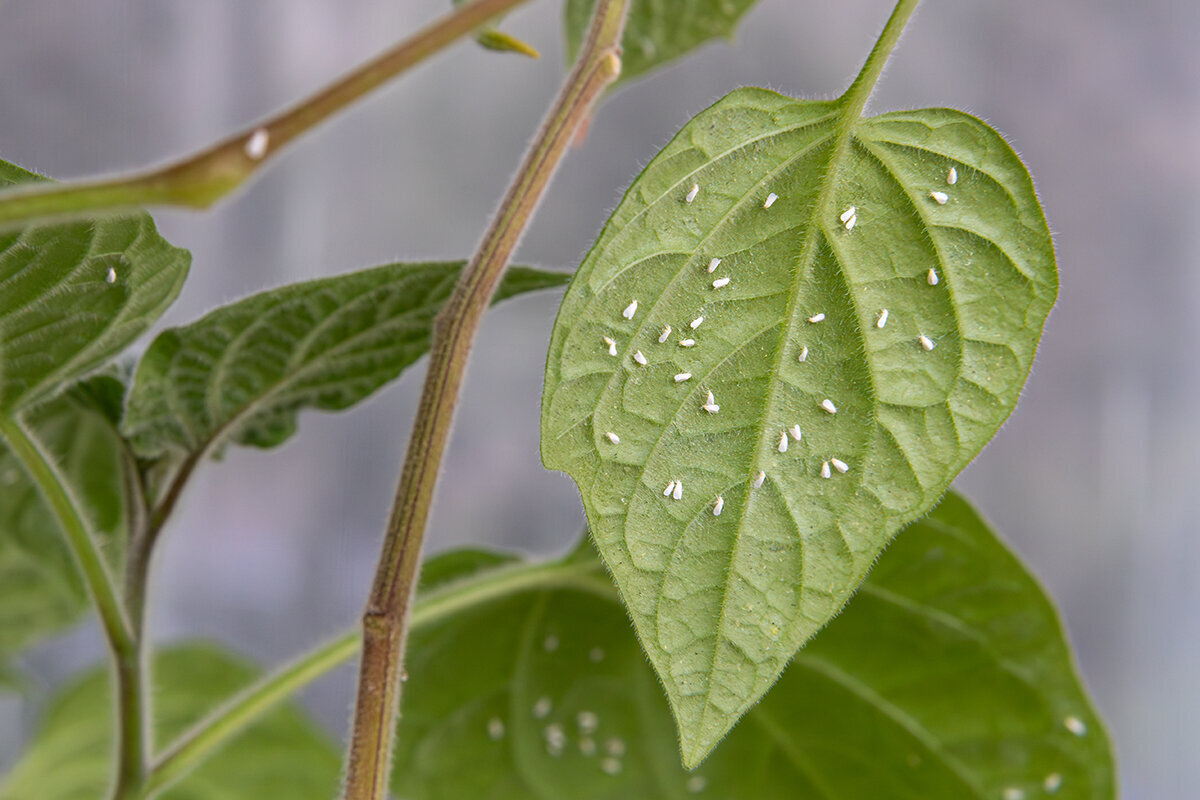
Brush a tomato, cucumber, pepper, aubergine or fuchsia and a small white cloud may suddenly rise from the foliage. The sign is clear, but adults are only the mobile part of the population. Eggs, newly hatched mobile crawlers and later fixed stages remain on leaf undersides. These inconspicuous stages explain why adults can take flight again days or weeks after an apparently successful intervention.
Whiteflies feed on plant sap. Under heavy or persistent pressure, plants lose vigour and productive leaf area. Their honeydew is especially noticeable: it leaves sticky deposits on leaves, fruit, pots and benches, encouraging dark sooty mould. Greenhouse whitefly is common in protected growing spaces, while Bemisia tabaci may arrive on introduced plants. The right response depends on crop, species, infestation level, climate and any planned biological control.
A clearly organised greenhouse is an advantage: plants, paths, ventilation areas and work zones can be checked and kept clean systematically. In a lasting structure such as the Classic Aluminium Greenhouse leaf inspection should become as routine as watering, pruning, ventilation and shading.
02 / Diagnose before acting
Read the underside of the leaf.
A hand lens turns a vague pest issue into a decision based on life stage. Appearance and development speed vary with species, crop, temperature and greenhouse conditions, but the inspection logic remains reliable.
Inspect several plants and leaves, not only the most accessible specimen. Look along veins, at tender new growth, in the middle canopy and on older leaves under dense foliage. Whiteflies are rarely spread evenly: one sheltered plant may already be a breeding centre while its neighbour carries only a few adults or fresh eggs.
Eggs
Pale, tiny and often arranged near veins.
Mobile crawler
Briefly mobile after hatching.
Fixed immature stages
Flat, scale-like and easily missed.
Adult insects
White and powdery; fly up when disturbed.
One leaf, four observations: use this pattern for orientation, then confirm the finding on several plants and across different crop zones.
The pattern supports monitoring, but does not replace a reliable diagnosis. Eggs are very small and can change during development. The first immature stage moves across its birth leaf only briefly before choosing a feeding site. Later stages are largely fixed and resemble flat, pale scales. Adults are conspicuous, but represent only the flying share of the population.
Look beyond the insects themselves for fresh honeydew, sooty mould, pale feeding damage, empty cases and increasing numbers of fixed stages. Exact appearance depends on species, host plant, temperature and age. Greenhouse whitefly and Bemisia tabaci cannot always be distinguished reliably from individual field marks. In a home garden, recognising the life stages is often enough. For valuable collections, unusual symptoms or a planned specialist biological-control programme, seek identification from a supplier, plant-health adviser or suitable diagnostic service.
03 / Do not treat the wrong visitor
Telling whiteflies from other small flying insects
Whiteflies
When disturbed: A small, powdery white cloud rises from the foliage.
Confirm the finding: Check leaf undersides and young shoots for eggs and flat, fixed immature stages.
Typical clue: Honeydew and dark sooty mould increase with infestation.
Fungus gnats
Dark, gnat-like insects remain mainly above damp growing medium. Their larvae live in the soil rather than appearing as flat scales beneath leaves.
Thrips
Slim, elongated insects more often associated with silvery feeding marks, distorted growth and tiny dark droppings than a white cloud.
Winged aphids
Usually clearly pear-shaped; wingless colonies are often visible on soft shoots and stems. Aphids can also produce sticky honeydew.
Diagnosis changes the approach. A yellow sticky trap may catch all these groups, but only a look beneath the leaf reveals whitefly eggs and fixed stages. Never assume a measure selected for fungus gnats, aphids or thrips will automatically control whiteflies safely and effectively.
04 / Make monitoring repeatable
Follow the same inspection route every week.
Random pest finds are better than no checks, but they do not show whether a population is spreading, concentrating or declining. Set a short, fixed route through the greenhouse: entrance and vents, newly introduced plants, dense crop blocks, shoot tips, older leaves, then weeds and plant debris beneath benches. Take a hand lens and a simple notebook or maintained digital record.
1
Entrance zone
Check the door, vents and newcomers.
2
Infestation hotspots
Mark plants where adults take flight.
3
Upper canopy
Check shoot tips and fresh eggs.
4
Lower canopy
Check older leaves and immature stages.
5
Ground area
Remove weeds and plant debris.
In a small collection, inspect several representative plants of every crop rather than always checking the specimen by the door. Divide larger houses into fixed crop zones and inspect the same number of plants in each. Record date, crop, position, adult flight activity, immature stages, honeydew, removed leaves, treatments and released beneficials. A consistently applied method is more useful than an invented universal threshold.
Give lush, sheltered or difficult-to-reach plants extra attention. A population can multiply unnoticed for a long time in a quiet corner or beneath dense foliage. Mark a few infestation hotspots discreetly so they become comparison plants on the next round. If possible, mark an unaffected specimen too. This helps show whether the infestation is actually spreading or only older damage remains visible.
05 / Read yellow sticky traps systematically
Yellow sticky traps monitor flight – they do not cure an infestation.
Interpreting the signal
TrendAdults are recorded; leaf stages remain hidden.
Keep every inspection consistent
- Number every yellow sticky trap.
- Keep its location unchanged.
- Count the same area each time.
- Record the date and result.
Adult whiteflies are attracted to yellow sticky traps. Used consistently, they reveal new arrivals, relative flight activity and changes after an intervention. They cannot prove that eggs, mobile crawlers or fixed stages have disappeared from the crop. Treat every trap as a measuring tool within a monitoring programme, never as the sole answer to an established infestation.
Place traps in the same zones at each inspection, as close to the canopy as practical, and adjust their height as plants grow. Count either the whole card or the same marked section every time. If the counting area changes during the season, results are no longer cleanly comparable. Replace traps once dust, condensation, debris or heavy catches make the surface unreadable, and compare the new card only with the previous result from that location.
In a private greenhouse, one trap near the entrance and further traps in distinct crop zones usually provide better information than a single randomly hung card. Pair every count with a leaf inspection. Fewer adults are encouraging, but fresh crawlers or many living fixed stages show that the population is still active. Do not place traps where they interfere with beneficial releases or become unusable through spray drift, direct heat or frequent plant contact.
06 / Time is the hidden structure
Why one intervention rarely reaches every whitefly
Greenhouse populations do not pass through their stages in a neat, synchronised cycle. Adults continue laying eggs while older immature stages are already fixed and another group is hatching. Warm, protected conditions can speed development and intensify overlapping generations. A measure against exposed adults or mobile crawlers may therefore leave eggs and other stages behind.
The answer is not to apply products more often or more strongly at random. Plan follow-up checks with the first decision: reduce infestation sources, identify remaining stages and combine hygienic, biological or direct measures where suitable and permitted. Return to the same plants before the next wave gains momentum unnoticed.
Overlapping population waves
Adults lay eggs.
Crawlers hatch, move and feed.
Fixed stages remain; new adults emerge.
These staggered development curves remind us that several stages are usually present at one inspection. Follow-up checks therefore belong in the plan from the start. Repeat timings should not come from a generic internet schedule, but match the observed infestation, crop, climate and, for plant-protection products, the full current label.
07 / Reduce infestation sources
Isolate newcomers, remove selectively and limit entry routes
Isolate plants
Keep new young plants, container plants and gifts separate at first. Move foliage gently, turn over several leaves and check all stages before a plant enters the main collection.
Remove heavily infested leaves
At a local hotspot, densely colonised leaves can be removed if the plant can tolerate leaf loss. Bag the material before carrying it through the greenhouse.
Remove hidden host plants
Weeds, seedlings, forgotten spare plants and old crop debris can maintain populations between crops. Inspect and clean beneath benches, along walls and around pots.
Remove selectively, not radically. Excessive leaf loss can weaken a plant, slow recovery and leave fruit or delicate tissue exposed. Prioritise leaves carrying dense clusters of eggs and immature stages. A dispensable, severely infested individual plant may need complete removal if it is a major source of flying adults. Seal the material in a bag and dispose of it with household waste, not openly in the greenhouse or on compost.
Preventive exclusion works best before insects establish. Fine insect screens at openings can reduce entry, but must not restrict essential airflow in a hot greenhouse. Daily practice matters too: close doors promptly, do not store infested plants at the entrance and avoid creating an unchecked holding area for new arrivals. The Classic Aluminium Greenhouse supports clear paths, accessible plants and a manageable ventilation and work routine.
Clean glazing, free paths and orderly benches are not merely visual details in integrated pest management. They make honeydew easier to spot, improve access to leaf undersides and provide fixed, comparable positions for yellow sticky traps. Anyone planning a permanently orderly growing space for a demanding plant collection will find suitable options among Aluminium Greenhouses for good access, clear crop zones and regular care.
08 / Start biological control early
Beneficial insects depend on timing, not magic.
Parasitic wasps and predators
Against greenhouse whitefly, the parasitic wasp Encarsia formosa is an established biological antagonist. It is especially useful early in an infestation, while the population remains manageable and incompatible residues from previous plant-protection measures will not affect release. Where Bemisia tabaci is involved, a different, professionally matched strategy may be needed, potentially including suitable Eretmocerusspecies. Beneficial-insect suppliers or plant-health advisers can match the choice to whitefly, crop, temperature, light, crop size and previous measures.
Predatory species may also form part of a programme. In glasshouse fruiting vegetables, for example, the mirid bug Macrolophus pygmaeus can be considered, but it is not a universal answer for small mixed collections. Do not ask for the supposedly best beneficial; ask which organism suits the pest, crop, infestation density, climate and treatment history. Beneficial species are neither freely interchangeable nor equally suitable for every greenhouse.
Check for signs of parasitism before removing every dark-coloured immature stage. Pupae of greenhouse whitefly parasitised by Encarsia formosa may darken. A hand lens and reliable identification guidance help prevent you from accidentally removing working beneficials together with infested foliage.
Biological control is a programme, not a decorative release. It requires repeat monitoring, reliable diagnosis, suitable climate conditions and time to establish. Access is a practical advantage: a bench-and-path layout that permits leaf checks, movement between crop zones and even distribution of beneficials is more valuable than an impressive but inaccessible dense canopy. A suitable framework is provided by a Classic Aluminium Greenhouse with clear paths and easily reached growing areas.
09 / Match the tool to the stage
Control uses several steps, not one product.
Hygiene
Removes hotspots and colonised plant material.
Yellow sticky traps
Record activity of flying adult insects.
Beneficials
Build biological control pressure over time.
Contact measures
Require complete coverage of leaf undersides.
Hygiene and removal reduce clusters of eggs and fixed stages when heavily colonised leaves, weeds, crop debris or individual hotspots are removed. They do not reach insects remaining on other plants.Yellow sticky traps show relative adult flight activity, but not all offspring beneath leaves.Parasitic wasps and predators can build sustained suppression when used early and correctly. They need the right match, suitable conditions, protection from incompatible products and sufficient time.Contact products work only on insects and stages they actually hit. A glossy upper leaf surface does not prove underside coverage.
Contact action needs real contact
Soaps, oils and other contact products work only where they reach the target organism. Because whiteflies mostly sit beneath leaves, application technique, crop tolerance, temperature, water stress and manufacturer instructions are decisive. Carry out an intended test treatment where sensitive crops or mixed collections are involved. Do not improvise mixtures or substitute household washing-up liquid for an approved product. Tender leaves can react badly in a warm greenhouse.
For edible crops, check immediately before each application whether the product is currently registered for the specific crop, pest, greenhouse use and user category in South Africa. Follow dosage, application technique, maximum applications, withholding periods, safety directions and beneficial-insect advice in full. The current South African registration and complete product label are authoritative, not an older online recommendation.
10 / Chemical decisions remain conditional
Use registered plant-protection products cautiously and with records
There is no responsible universal spray sequence for small South African greenhouses. Registration, crop, pest, location, user category, plant condition and existing beneficials all change the decision. Before every application, check the current South African Registrar information and read the complete label. The specific crop and greenhouse use must be covered; dosage, maximum number of applications, withholding periods, safety requirements and other restrictions must be followed precisely.
Where a registered product is professionally justified, do not repeat the same mode of action over several generations simply because the brand name changes. Repeated use can favour resistant populations. A sound resistance strategy requires attention to registration, product information and competent advice. Some Bemisiapopulations can be difficult to control. Keep a complete application record so later choices remain traceable and planned beneficial releases are not endangered by unknown residues.
Seek regional plant-health advice early for persistent, increasing or unclear infestations. Do the same for unusual plant symptoms, uncertainty about the species or questions about registered uses. An integrated programme uses chemical measures selectively and with justification, never as a substitute for diagnosis, hygiene, careful coverage and stage-based follow-up.
11 / Evidence comes after the measure
Judge recovery by new findings, not one quiet afternoon.
After removing infested leaves, applying a direct measure or releasing beneficials, the greenhouse may seem calmer immediately. That is positive, but not the end. Progress appears only when comparable yellow traps on the same route hold fewer adults, young leaves show fewer fresh eggs and crawlers, living fixed stages decline and new honeydew appears less often. Old sooty mould, feeding damage and empty cases remain visible at first. Look for new signs of infestation rather than expecting perfectly clean plants overnight.
A
First follow-up check
Return to marked hotspots and turn over several leaves. Record remaining stages and remove newly heavily colonised leaves only if the plant can tolerate the loss.
B
Compare the trend
Compare every numbered yellow sticky trap only with earlier counts from the same location, and link the result to leaf findings. A lower catch is encouraging, but is not proof on its own.
C
Adjust the strategy
If new immature stages continue increasing, review diagnosis, hygiene, coverage, beneficial compatibility and renewed entry through plants, weeds, doors or vents.
Continue the routine when infestation pressure declines. A resiliently managed greenhouse is not completely free of every insect; it makes a small introduction visible before it becomes a population throughout the canopy. Clear paths, a fixed place for hand lens and notebook, suitable ventilation and shading, and access to rear plant areas turn good intentions into lasting practice.
FAQ / Small greenhouses
Clear answers to whitefly questions
Do yellow sticky traps eliminate whiteflies completely from my greenhouse?
No. Yellow sticky traps monitor flight activity and catch individual adults. Eggs and most mobile and fixed immature stages on leaf undersides remain untouched. Use traps as an early-warning and comparison tool, and pair every assessment with systematic leaf inspection.
Must I dispose of every infested plant completely?
Not necessarily. Isolate the plant, assess infestation level and life stages, and remove only heavily colonised leaves where enough healthy leaf area remains. Disposing of one severely infested, dispensable plant can make sense when it is a major breeding and spread source for the remaining collection.
Why do whiteflies return after treatment?
Several life stages were usually present at once. A measure against visible adults can miss eggs or fixed immature stages; with contact products, poorly reached leaf undersides allow further insects to survive. Introduced plants, host plants in the greenhouse or insects entering through openings can also restart an infestation.
Can I still release beneficials after treatment?
Possibly. Compatibility depends on the specific product, active ingredient, application date, residue behaviour, crop and intended beneficial. Keep all application records and ask the beneficial supplier, specialist retailer or plant-health adviser before release. Incompatible contact products can seriously impair a biological programme.
Are whiteflies problematic on tomatoes, cucumbers, peppers and herbs?
Yes. Persistent infestations can reduce vigour and productive leaf area. Honeydew soils leaves and fruit and encourages sooty mould. On edible crops, use only methods and products suitable or currently registered for the precise crop and application, and observe every withholding and safety direction.
How often should I look for whiteflies?
Inspect at least weekly during active growth. Shorter intervals are useful in warm weather, around known hotspots, after new plants arrive or when trap catches rise. What matters is a route that can be repeated and compared reliably. An inspection rhythm never replaces label conditions or professional advice.
Sources and further reading
Work with current, dependable information.
Species, beneficial-insect programmes and registered plant-protection uses can differ or change. South African official guidance and the clearly attributed German specialist sources below support the life-stage approach and help place current recommendations in context.
More from Bloomcabin: Setting up a greenhouse: layout, plants and care · Summer greenhouse care · Bloomcabin greenhouse overview
- North Rhine-Westphalia Chamber of Agriculture – whitefly on vegetables
- North Rhine-Westphalia Chamber of Agriculture – biological whitefly control
- North Rhine-Westphalia Chamber of Agriculture – parasitic wasps against whiteflies
- Bavarian Garden Academy – notes on whiteflies and their control
- Julius Kühn Institute – fact sheet on tobacco whitefly Bemisia tabaci
- Federal Environment Agency – plant protection and beneficial insects in vegetable gardens
- South African Government – register an agricultural remedy
- North Rhine-Westphalia Chamber of Agriculture – recognising whitefly in home gardens
