
ZIP Screens or Outdoor Curtains for a Pergola?
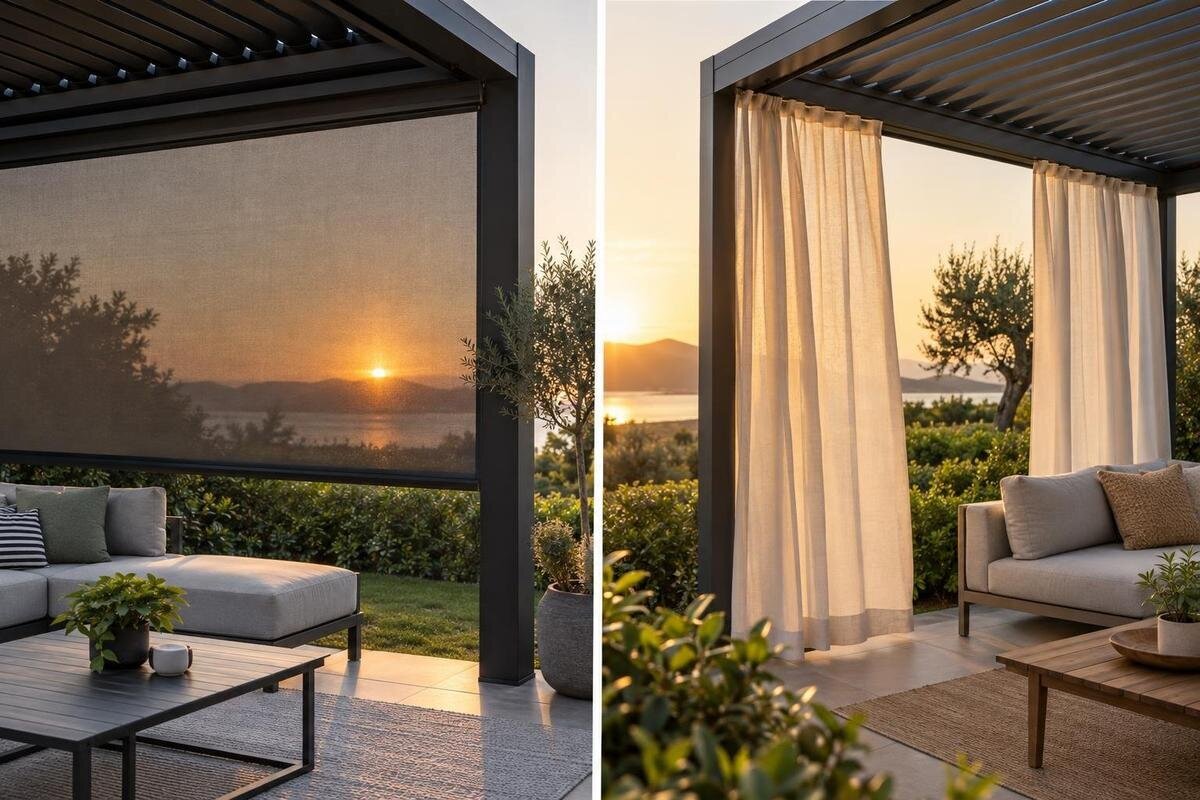
Pergola side options
ZIP screens and outdoor curtains can both soften the open sides of a pergola, but they behave differently when deployed. A screen is guided at its edges; a curtain hangs and can be drawn or gathered. Compare how each opens, the airflow and privacy of its actual fabric, the care it needs and the written wind guidance for the complete configuration. Do not assume an accessory is included with the pergola or compatible with every model.

How ZIP screens and outdoor curtains are constructed
A ZIP screen is a fabric panel whose edges engage in side guides as it moves, usually keeping the panel aligned in a defined plane. The precise edge, guide and control arrangement varies, so ZIP is a system description rather than a complete specification. Outdoor curtains are fabric panels carried on a rail or track and drawn across an opening; depending on the design, they may be gathered, tied back or parked at one side. Their edges are not retained in the same way as a guided screen and can move more freely. Some systems use one panel per bay, while others divide the opening, so ask to see the proposed layout.
That construction changes appearance and handling, but it does not by itself prove that one option is more private, more weather-resistant or safer in wind. Mesh may still allow a view; a curtain may have gaps or need a particular way of securing it. Ask for a drawing or photograph of the exact side option, including its top fixing and how it finishes at the posts and lower edge. Keep the structure separate from the accessory: the Bloomcabin Bioclimatic Pergola listing identifies a base model, not an included screen or curtain. The quotation should name any side treatment supplied separately. This matters when a staged image shows a finished, enclosed installation.
Opening, closing and storing each option
Think about how often the side will move, not only how it looks when closed. A ZIP screen is generally raised or lowered as a panel, but the exact mechanism may be manual or motorised and its stopping positions depend on the product. Do not assume a powered control, a remote or the ability to leave it partly open from the term ZIP. Ask where the control is, whether you can reach it from the places where you sit or enter, and whether normal operation requires access to one particular side. If several screens are planned, ask how each is operated and whether the controls are separate.
Curtains are usually pulled along a rail and gathered at one side or divided between panels; confirm whether tie-backs or another hold-open method are supplied. The gathered fabric takes up space and may narrow the clear opening, while drawing it closed involves handling the panels. Compare the travel direction, number of panels and gathered position with your entrance and furniture, especially if people will pass through often. When enquiring about the Bloomcabin Wall-Mounted Pergola, describe which opening you intend to use for access. Ask how the proposed curtain or screen opens, where it rests when fully open and whether you can reach its controls without moving furniture.
Airflow through mesh and curtain fabric
Airflow cannot be judged from the words screen or curtain alone. A mesh ZIP screen may pass some air, but the weave, openness, colour, size of the covered bay and number of deployed sides all affect how open the pergola feels. A denser fabric may alter both shade and air movement; a photograph will not tell you the difference reliably. Ask for the fabric description or openness data, if supplied, and whether the seller has airflow information for the exact material. If ventilation is a priority, inspect a sample against the open bay rather than assuming every mesh behaves alike.
With curtains, pulling the panels completely aside leaves more of the bay open; drawing them across it reduces the exposed area, with the result also shaped by fullness, textile weight and gaps. Loose fabric can move beside a doorway or seating area in a breeze, so consider where each panel will hang when partly open. For an enquiry about the Bloomcabin Pergola, describe how many sides you expect to close at once and which openings you want to leave clear. This gives the supplier a specific arrangement to discuss, rather than an isolated fabric choice that may not reflect how you will use the space.
Shade and privacy depend on the fabric
Sun control and privacy are related but separate requirements. A mesh screen may reduce direct glare while still allowing light and a view through it; how much depends on its openness, colour and viewing angle. A denser curtain can give a more complete visual barrier when closed, but coverage depends on panel width, overlap and gaps at the edges. Ask for samples of the actual fabrics and look through them from both sides. If a sample is not available, request an accurate fabric description and a drawing of panel overlaps; a styled image is a poor guide to transparency.
Check sightlines from the places you use: seated at the table, standing near the entrance and, if relevant, the point from which a neighbour can see in. Mesh that limits a view in bright daylight may offer less privacy after dark when the pergola is lit and outside is darker. Do not treat daytime screening as night-time privacy without checking the actual material and lighting. Note when sun reaches the opening and whether the aim is glare control, privacy or both. If you are considering the Bioclimatic Pergola model, include those priorities in your accessory enquiry so the supplier can address the proposed fabric’s light transmission and privacy.

Ask for wind guidance for the exact assembly
Neither a ZIP edge nor a curtain tie-back supplies a universal wind limit. A screen retained in guides can still have a product-specific operating limit, while a curtain may move or billow and may need to be secured or withdrawn according to its instructions. Closing a side can change how wind interacts with the overall structure, so a pergola-frame or roof rating does not automatically establish the limit for a particular side accessory. Do not compare options using a generic wind speed from another brand, size or arrangement. A calm-looking mesh or heavy cloth is not a substitute for documented guidance.
Request written guidance for the exact pergola model, side accessory, panel dimensions and mounting arrangement. It should state the operating wind limit, the conditions covered and what the user should do when those conditions are approached or exceeded, such as raising or withdrawing a screen or drawing back curtains if the instructions require it. Ask whether guidance changes when a panel is partly open or several sides are deployed. For the Wall-Mounted Pergola model, identify the intended side configuration in that request. If the supplier cannot provide a clear, model-specific answer, ask the manufacturer or a suitably qualified installer before choosing.
Cleaning and routine care
Care follows the material and mechanism. Mesh and outdoor fabric can collect dust, pollen, leaves and insects; side guides and curtain rails can also gather grit. Ask for the cleaning instructions for the precise fabric and hardware, including permitted methods and products. Check whether a curtain is removable or washable before taking it down, and whether a screen can be cleaned in place; do not assume machine washing, pressure washing or strong detergent is suitable. A method approved for one fabric may not suit another, so follow the supplier’s directions rather than a generic outdoor-textile tip.
Include moving parts in a simple inspection: check accessible guides for debris and note whether the panel travels smoothly, or whether ties are loose and fabric sits unevenly. Do not force a stiff screen or pull hard on a snagged curtain; ask the supplier how to deal with it and whether any part needs service. If the site is dusty or close to trees, you may need to check for debris more often. Ask whether fabric should be dry before retraction after cleaning or rain, and how it should be stored if removed. The useful comparison is whether care for the actual material and mechanism suits how often you plan to use it.
Plan for movement, access and sightlines
Fit is about the clear opening as well as the pergola’s outer dimensions. Screen guides, a housing or other components need their specified positions; a curtain needs room for its gathered stack and unobstructed travel along the rail. Details differ by system, so ask for a drawing of the exact bay and accessory rather than sizing from a general pergola sketch. Note doors, steps, furniture, taps, lights and other items near the side, then mark the entrance width with the panel fully open and fully closed. Check the route people use, not only the clear view from a distance.
Also identify the main seating position and the direction from which privacy matters. A treatment can shade one chair while leaving the next exposed; gathered curtain fabric may obscure part of the view, and screen guides may affect sightlines at the edges. Sketch the side view from seated and standing positions, and mark where the panel sits when fully open. If you are considering the Bloomcabin Pergola model, use it as the reference for a measured layout showing the proposed accessory and attachment positions. Label each opening separately so that the drawing and quotation identify the same side, especially where several bays look alike.
Confirm compatibility with the exact pergola
Compatibility is product-specific; do not infer it from a similar-looking pergola, a matching colour or a screen’s advertised width. Confirm that the side accessory is approved for the exact model, opening and attachment arrangement. Ask whether it is available only when ordering the structure or may be retrofitted, whether the selected material and panel size match that bay, and whether other side options affect its operation. If you want screens on one side and curtains on another, request confirmation of the combination, not just of each accessory separately. Approval of one option does not automatically cover a different brand or configuration.
Ask the supplier to identify the accessory by model or product name and to provide the compatible-pergola list, relevant dimensions and operating instructions. A simple elevation or quotation drawing should show which opening receives it and how it sits when deployed and fully open. Use the name on the Bloomcabin Bioclimatic Pergola page in your enquiry to avoid confusion between pergola models. If components are sold separately, ask for each one to be named against the opening it serves. Keep the agreed accessory description with the drawing and quotation, so that any later change in fabric, control or panel arrangement can be checked against the configuration you selected.

Check what is offered and currently available
Availability has two parts: whether a side option is offered for the exact pergola and whether it can currently be ordered. A generic page for outdoor curtains or ZIP screens may describe an accessory that is not compatible with every model. Before paying, ask for an itemised quotation naming the pergola, side option, number of panels, fabric or finish, operating method and included components. It should distinguish the base structure from extras and identify any installation or service that is part of the quote. A staged image of a fully enclosed pergola does not prove the pictured sides are included.
Ask the seller to confirm current stock or order availability and any relevant lead time; do not infer either from an older image or a product page. If your enquiry concerns the Bloomcabin Wall-Mounted Pergola page, distinguish availability of the structure from availability of the selected side accessory. Check that the side, bay, colour and operating arrangement in the quote match what you discussed. If the seller proposes a different accessory, clarify exactly what has changed before treating it as a replacement for your original choice.
Choosing for everyday use
Let the main use of the side guide your shortlist. If you value a vertically moving panel with edges held in guides, investigate a ZIP screen and verify its fabric, view through it and operating instructions. If you want fabric that can be drawn aside and gathered, investigate curtains and check their stack space, method of holding them open and care instructions. These are starting points, not promises about every model: fabric, opacity, operation and supplied hardware differ. A sample and drawing of the exact accessory will tell you more than the category name or a catalogue photograph.
Before choosing, check three things together: can you operate it on an ordinary day, does it give the airflow, shade or privacy you need when closed, and can you follow its documented wind and care guidance? Have unanswered points resolved before accepting the quotation rather than filling gaps with assumptions. A wide opening used for daily access may call for a different arrangement from a side closed mainly while you sit outside. If different sides have different uses, assess each bay separately, but ask the supplier to confirm any mixed configuration. The choice should suit how you use that side of the pergola, both open and closed.
Frequently asked questions
Do ZIP screens provide more privacy than outdoor curtains?
Not automatically. A screen’s mesh, colour, viewing angle and the light on each side all affect what people can see. A closed, opaque curtain may provide more visual cover, but gaps and panel overlap matter. Check the actual fabric from both sides, in the lighting you expect to use.
Can I leave a ZIP screen down in windy weather?
There is no universal wind limit for ZIP screens. The fabric, panel size, guides, fixings and pergola configuration can all matter. Follow written guidance for the exact accessory and ask what to do when conditions exceed its stated operating limit.
Do outdoor curtains allow more airflow than screens?
Not in every arrangement. Curtains gathered fully aside leave more of the bay open, but drawn fabric reduces that opening. Mesh screens vary with their weave and the number of sides deployed. Compare the actual fabric and configuration rather than relying on the category name.
Can I add a ZIP screen to any pergola?
No. Confirm that the exact accessory is approved for your pergola model, side and mounting arrangement. Similar dimensions or an online listing for a screen do not establish compatibility, and a third-party option needs separate confirmation.
Are outdoor curtains easier to clean than screens?
It depends on the fabric and construction. A removable curtain is not necessarily machine-washable, while screen guides may need attention. Ask for care instructions for the exact accessory and compare the permitted cleaning methods before ordering.
The best choice depends on how the panel moves, what it does to the view and airflow at your site, and whether its care and wind instructions are workable. A ZIP screen’s guided edge and a curtain’s gathered fabric offer different ways to manage a side, but neither label guarantees the result. Confirm the accessory and pergola model together, then assess the final drawing and written guidance before you commit.
