
Buying a Bioclimatic Pergola: How to Assess the Adjustable Roof
Pergola buying guide
Planning to buy a bioclimatic pergola? The adjustable pergola roof is the feature that separates this choice from a fixed cover, but a product label alone does not explain how the roof behaves in everyday use. Before comparing options, check how the louvres move, what the controls require, where rainwater goes and which limits apply to the exact configuration. A useful bioclimatic pergola buying guide turns those points into questions you can verify in a drawing, demonstration and written quote. It also helps you distinguish a roof that suits your routine from one that simply looks right in a product photo.

Set expectations for the adjustable roof
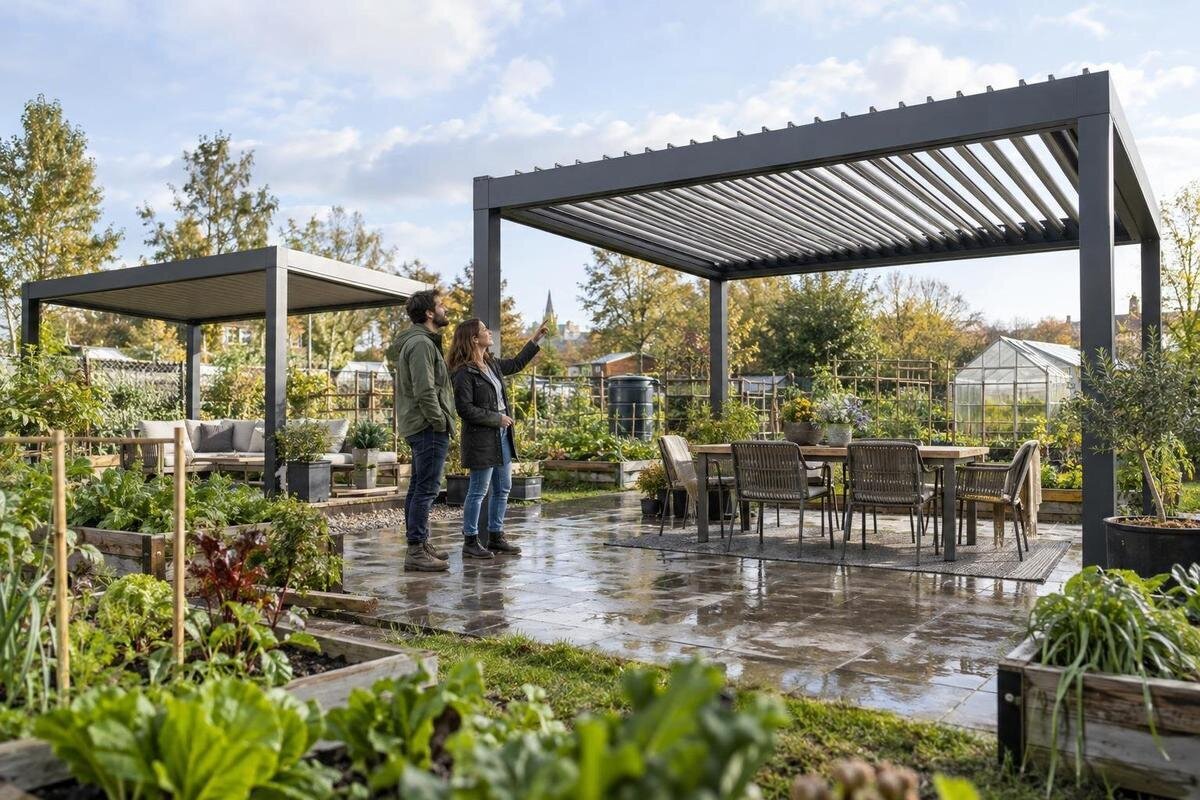
Before comparing roof mechanisms, define what you want to change from a fixed cover. You might want to reduce direct sun at a particular time, open the roof to see more sky, or leave it partly open for air movement. Those aims call for different louvre positions. Note when you expect to use the space and which seating areas, doors or windows matter. The word bioclimatic is a category label, not a promise that every model will produce the same shade, airflow or rain protection on every site. A product image captures one moment, so it cannot show the usable range or what the roof does between positions. Make a short list of your priorities and identify any that must work at the same time, such as shading an outdoor table while maintaining access through a nearby door.
Ask the seller to identify the exact roof design and show its positions in a drawing or demonstration: closed, open and any intermediate settings. Check which way the louvres turn and whether the stated covered area includes beams or posts. If your shortlist also includes the general pergola listing, read its roof description separately; the word pergola does not establish that the roof is adjustable. This gives you a fair comparison point without assuming features from a name, URL or photograph. Record any gaps between what you want the roof to do and what the available documents actually describe.
Check how the louvres move
Do not stop at whether the roof opens and closes. Ask for the stated movement range, whether louvres can pause at useful intermediate angles, whether they move together, and whether separate roof sections can be adjusted independently. An illustration with only fully open and closed positions leaves important questions unanswered. Ask for a diagram or demonstration that shows the positions actually offered. If you view a display model, operate the controls as intended and observe the motion without forcing any part. The aim is to understand normal operation, not to judge hidden construction from a quick hands-on test. Note whether a partly open position gives the effect you expect, rather than assuming that every intermediate angle offers the same balance of light, ventilation and cover.
Also check how the louvres move in relation to the frame. Ask what clearance is required, whether the opening path changes with the roof position, and whether fittings such as lights or fans would interfere if you plan to add them. Do not assume all louvres or sections behave as one unit. For the exact candidate, compare the bioclimatic pergola product page with current drawings or a written specification; the product label itself does not establish the movement range, stopping positions or clearance.
Choose controls that suit everyday use
Controls shape whether you will adjust the roof often or leave it in one position. Find out how the louvres are operated: by a hand mechanism, switch, remote, app or another control, if offered. Treat each as a question rather than a standard feature; a photograph does not show what is supplied. Ask whether one control operates the whole roof or separate sections, whether an additional controller is needed, and whether you can operate it from the usual seating area. If several people will use the pergola, consider whether the operation is straightforward for each of them. Also consider where controls will be stored or mounted and whether their location remains convenient when furniture, outdoor dining or seasonal items change the arrangement beneath the roof.
For a powered system, get the electrical requirements in writing and have a qualified electrician or installer confirm the work and suitability for your site. Ask how the system is operated if power is unavailable, what the user should do if a control stops responding, and whether sensors or automation are optional extras. Automation does not replace understanding the manual controls and the stated weather limits. Keep the control decision separate from roof capacity: a remote or app does not establish the louvres’ range, drainage or exposure performance.
Evaluate the roof’s drainage route
When evaluating pergola roof drainage, do not equate closed louvres with a guaranteed dry area. Ask for a roof section or drainage diagram showing where water travels from the louvres, whether channels or gutters are part of the supply, and where any outlet discharges. Consider that outlet against the site plan: runoff near a doorway, path or furniture may matter as much as the roof above. Ask whether the product image shows all drainage components installed. For a specific candidate, use the listing labelled as a bioclimatic pergola as an identifier, then verify the route from product-specific drawings or written details.
Clarify what happens in different roof positions. Ask about partly open louvres, movement during a shower and rain driven from the side; do not assume a particular level of cover. Find out whether the supplier specifies an operating position for rain and what limits apply to water management. Ask how the outlet connects to the planned site and whether extra drainage work sits outside the quoted package. A clear answer should describe the intended route and its limits, rather than use broad words such as weather-resistant without explaining the roof configuration. It should also distinguish the roof’s drainage path from any site drainage needed after water leaves the pergola, as these may involve different work and responsibilities.

Match shade and airflow to your routine
Shade depends on more than the pergola’s footprint. The sun’s angle changes through the day and across the seasons, while nearby buildings, fences or trees can alter the light reaching the space. Note when you expect to use the area and which seats or glazed doors you want to shade. Ask for the louvre direction on a plan and an explanation of how different positions affect light. A single midday photograph cannot show morning or late-afternoon conditions, and a general promise of shade cannot tell you how the roof will perform in your orientation. Compare the documented layout with your intended use. Taking photographs of the proposed location at several times of day can help you explain your priorities clearly when discussing the layout with a supplier.
Airflow is also affected by the space around the roof, not just the opening between louvres. If ventilation is a priority, ask how the available positions change the amount of open sky and whether nearby walls or proposed side screens alter the effect. Confirm compatibility before treating screens, fans, heaters or lighting as part of the same package; they may be separate choices and can affect clearances. Decide which matters more at different times—shade, airflow, a view of the sky or rain cover—then check whether the offered positions let you make that trade-off.
Check dimensions, clearance and mounting layout
Compare the overall dimensions with the usable space beneath the roof. Ask for a dimensioned plan showing the clear area, beam and post positions, roof height and louvre direction; an outside measurement alone may not show how much room remains for furniture and walkways. Check how the roof sits beside eaves, gutters, windows and doors, and whether moving louvres need any clearance above or around the frame. The roof’s projected area and the area that feels sheltered are not necessarily the same, so assess both against the layout you plan to use. Mark door swings, window openings and regular circulation routes on the plan so that structural elements and furniture do not make everyday access awkward.
Mounting format is a separate question from louvre operation. If you are weighing a wall-supported design, the wall-mounted pergola listing is a distinct option to assess, not evidence of a particular adjustable roof. Ask for the exact mounting and support requirements, as well as roof-clearance details near the house. Have the supplier or installer assess the relevant structure and site conditions. Keep the mounting information alongside the roof drawings so you do not infer that a format label answers questions about louvre movement, drainage or controls.
Plan for cleaning and maintenance
Ask what routine care the adjustable roof needs before you focus on its colour or finish. Request written instructions covering the louvre surfaces, any drainage channels and the moving components used in that particular design. Find out how often the supplier recommends clearing debris, which cleaning methods are suitable and whether any part needs access from above or specialist attention. Do not assume every model has the same seals, bearings or service points. If nearby trees shed leaves or pollen, consider how easily you can reach the roof and keep the water route clear without damaging a finish. Consider who will carry out that routine work and whether the proposed position allows safe access, especially where the roof is close to a boundary or another structure.
Also ask which parts are considered routine maintenance, which issues need a service call and whether replacement components are available for the roof mechanism and controls. Read the warranty conditions for maintenance obligations, exclusions and who arranges support; do not infer coverage from a general product description. The Bloomcabin pergola page can help identify the listing you are considering, but it cannot replace care instructions for the exact roof and controls. Keep those instructions with the quote so they remain tied to the model and package you order.
Verify weather performance for your site
Assess site exposure with evidence, not phrases such as all-weather. Wind, intense sun, dust, salt in the air and wind-driven rain can affect which requirements matter at a particular property. Ask for performance information and operating limitations for the exact roof configuration, including any conditions that differ when louvres are open or closed. If the supplier refers to a rating or test, request its scope and the installation conditions it assumes. A value without context may not apply to your layout, accessories or fixing arrangement, so avoid comparing headlines alone. Describe the site accurately when requesting information, including its openness, surrounding structures and any conditions that regularly affect the proposed location, so the discussion relates to the actual configuration.
Ask the supplier or a qualified installer to confirm which documented limits matter for your location and configuration. Check whether the guidance changes with louvre position, roof orientation or added accessories, and what the supplier recommends doing in conditions outside the stated operating range. The bioclimatic product listing identifies a candidate, but the name itself does not establish a wind, rain or other performance rating. If a claim is important to your decision, ask for supporting information that applies to the exact product and proposed setup.
Confirm the quote covers the roof you want
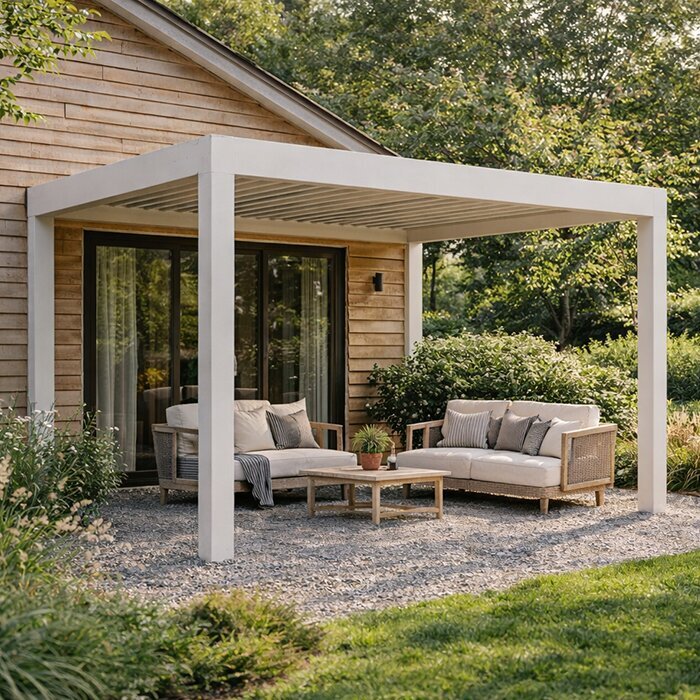
A product page helps identify a candidate, but an order should describe the package you are actually buying. Ask the quote to state the exact model and roof type, dimensions, louvre configuration, control system, drainage components and any selected accessories. It should also show what the supplier or installer is responsible for, rather than leave you to infer it from a display image. If the wall-mounted product page is on your shortlist, name that listing accurately and ask for the matching roof and installation details; the format label alone is not a complete specification.
Review line items for delivery, access, preparation, assembly, power-related work if relevant, and any base or attachment work; these may be included, excluded or quoted separately. Ask about order changes, expected timing and handover materials in writing, without assuming a standard package. Compare warranty documents and care instructions for the exact product. If an installer is involved, ask them to identify any site assumptions and confirm what must be ready before work begins; leave technical installation decisions to the appropriate professional. Keep versioned copies of the drawing and quote together, so a later variation can be checked against the roof configuration, controls and drainage arrangement originally discussed.
Compare options on the same basis
A comparison sheet prevents the most attractive product image from becoming the deciding factor. Give each option a row for roof type, movement range, intermediate positions, control method, drainage route, documented exposure limits, maintenance and included components. Note the exact model or page that each quote refers to; the general pergola product page can be recorded as a separate candidate only if its own roof details are confirmed. Mark unanswered items as pending rather than filling gaps with assumptions. This makes it easier to see whether two quotes describe comparable roof systems and scopes.
Then rank the details that matter at your site. If adjustable positions, a defined drainage route or a particular control arrangement is essential, treat missing information on that point as a reason to clarify, not as a feature you can presume. Compare the full quoted scope after optional controls, drainage parts and installation responsibilities are clear. The better choice is the one whose documented operation, limits and ongoing care match the way you plan to use the space—not simply the one with the longest list of marketing claims. Before deciding, revisit your original priorities and check that the selected configuration answers them without relying on an accessory, service or performance feature that has not been specified in writing.
Frequently asked questions
Does a closed louvre roof make a pergola waterproof?
Not necessarily. The term bioclimatic and the closed position do not, by themselves, establish a waterproof rating or explain how runoff is managed. Ask for product-specific information about water ingress, louvre positions, drainage channels and where water discharges. Check what the supplier says about wind-driven rain and partly open louvres, too. Use the stated limits rather than assuming the roof will keep the area completely dry.
Can the louvres stop at any angle?
That depends on the mechanism. Ask for the stated movement range and whether the roof can pause at intermediate positions. Check whether all louvres move together or separate sections can be adjusted independently. A drawing or demonstration is more useful than a photo showing only one position.
Are electric controls, remotes or sensors included?
Do not assume they are. Check the quote for the control method, the number of controls supplied and whether sensors or automation are optional extras. If the system is powered, get its electrical requirements in writing and have a qualified electrician or installer confirm the work and suitability for your site.
How can I assess drainage before ordering?
Request a drawing that shows the route from the louvres through any channels or gutters to the outlet. Ask which components are included and where water discharges. Confirm what happens when the roof is partly open or moving, and check whether the supplier states any operating limits for rain.
What should be confirmed in the quote?
Confirm the exact model and roof configuration, dimensions, louvre operation, controls, drainage components and any accessories. Check what delivery, preparation, installation and power-related work are included or excluded. Ask for the relevant operating limits, care instructions and warranty documents for the exact package, rather than relying on general product descriptions.
When you buy a bioclimatic pergola, judge the adjustable roof by evidence about how it moves, how you operate it and where water goes—not by the category label alone. Match those answers to the sun, clearances and exposure at your site, then keep the specification, included controls, drainage scope and limits with your quote. If an essential point remains vague, clarify it before placing the order. That gives you a more dependable basis for comparing options than choosing on appearance alone.
