
Buying a pergola for a snowy climate: what to consider
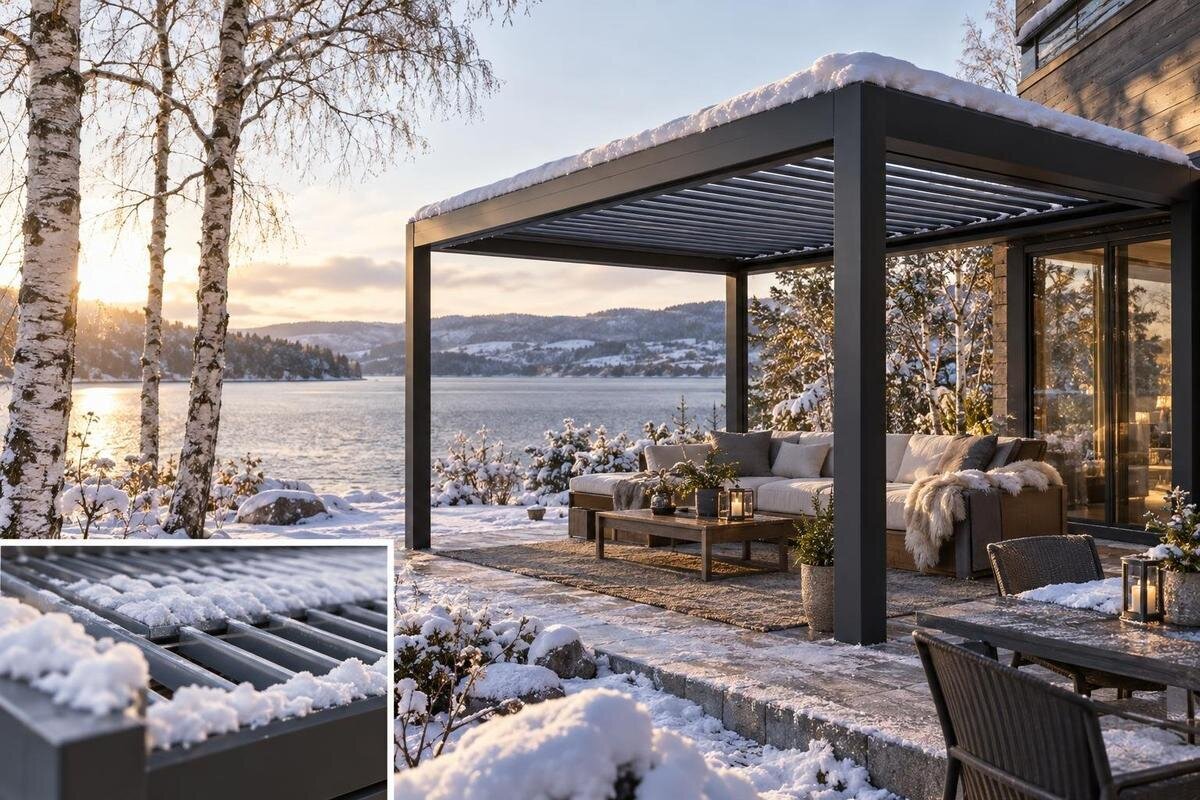
Pergola buying guide
Buying a pergola for a snowy climate is as much a structural and installation decision as a style choice. Snow can build up unevenly, remain on a roof or arrive from a higher roof nearby, so a broad claim about strength is not enough. Before comparing finishes or layouts, find out whether the exact pergola configuration has documented snow-load capacity and whether its support and installation can suit your site. This guide explains the evidence to request and the practical questions to resolve before ordering.

Ask for a documented snow-load capacity
For a pergola intended for a property that receives snow, start by asking whether the supplier can provide written snow-load capacity for the exact model and configuration. Ask for a numerical design value, its units and a document explaining what it covers; phrases such as winter-ready or heavy-duty are not enough. Find out whether it applies to the complete installed assembly or only the roof or frame, and whether it includes posts, brackets, connections, bases and any movable sections. The Bloomcabin pergola listing can identify a product, but its name and images do not establish a snow rating.
A stated figure is useful only if its assumptions match the site. Ask the supplier to define whether it describes roof snow load or another measure, which conditions it covers, and any limits on roof position or accessories. Find out whether the figure assumes snow distributed evenly or also accounts for uneven deposits; drifting can concentrate it in one area. Ground snow depth and a pergola's structural capacity are not interchangeable, so do not turn a forecast or yard measurement into a capacity estimate. Give the location and site details to a structural engineer or other qualified building professional and ask them to assess the appropriate design basis. If the rating cannot be explained, treat suitability as unconfirmed.
Describe the snow conditions at your site
Snow conditions cannot be captured by a single depth. Wet snow, dry snow, compacted layers and snow that melts then refreezes can place different demands on a roof; repeated falls can also leave more snow in place than one event. Drifting may load one part of a structure more heavily than another. Tell the supplier or design professional whether snow is occasional or recurring at your property, whether it tends to remain, and what you have observed on nearby roofs. Avoid treating an average depth as a design answer: it may not represent the conditions the pergola needs to be assessed for.
Immediate surroundings matter too. A pergola beside a higher wall, building, tree line or sloping roof may experience local accumulation or drifting that a broad regional description misses. Photograph the proposed position from several angles and note nearby roof edges, walls and obstacles; share those details with the person assessing the design. If you have seen snow linger or collect in particular spots, mark them as observations, not as a capacity estimate. Do not use a general climate map or a neighbour's structure as proof that a particular model suits your site. The aim is to match the stated snow assumptions to the actual location.
Check roof behaviour and moving parts
Roof shape affects where snow settles and how it may move, but no style is automatically suitable. An open or slatted top does not guarantee snow will pass through without building up; a more enclosed roof can retain it, while a slope may release it in a sudden fall. Ask how the proposed roof behaves under the conditions expected at your property, whether drifting or uneven deposits are included in the stated capacity, and where any shed snow would land. Moving snow away from the roof can create a hazard beside doors, paths or neighbouring areas, so that destination belongs in the layout review.
For an adjustable roof, find out which position, if any, is permitted during snowfall and whether the stated load applies in that position. Request the operating and winter instructions in writing, including whether the roof must be left in a specified position and whether it must be unloaded before movement. Do not assume that a louvre, sliding panel or motorised mechanism should be opened, closed or operated to deal with snow. The bioclimatic pergola page identifies a product category; that label alone does not confirm a snow rating or an operating rule. Check the instructions for the exact model and fitted parts.
Assess the frame, connections and supports together
Ask for evidence about the complete load path, not just a statement about roof panels. Snow load is carried from the roof structure through beams, posts, connections and bases to the supporting ground or building. A rating for one component may not cover the assembled pergola or the way it is fixed at your property. Request the technical drawing and the supplier's description of the configuration the rating covers; have a qualified professional assess how it matches the chosen model, supports and installation. A catalogue image cannot show whether each connection has been designed for the stated conditions.
Material names are not substitutes for that evidence. Aluminium, steel, timber and other materials differ by grade, section, condition and connection, so recognising a material does not tell you the strength of the finished structure. Ask for material specifications, fastener details and maintenance requirements, including how exposed joints are protected. A robust appearance or finish cannot replace a load statement. Use the general pergola product page to identify a candidate, then request drawings and written load information for that exact configuration. Do not compare figures unless both documents describe the same parts and design assumptions.

Check wall attachments and foundations
A wall-mounted pergola and a freestanding one transfer loads in different ways, so the installation type needs to be part of your decision. For a wall-mounted design, ask which part of the building it must connect to and what evidence is needed about that wall and its construction. Brick appearance, cladding or a sturdy-looking façade does not establish that a surface can carry the design loads. The building structure, attachment details and the effect of the house roof above need to be assessed. A wall-mounted pergola listing identifies the arrangement, not whether a particular house is a suitable support.
With a freestanding design, ask how the posts and bases are supported and whether the installation details cover the soil, slope and drainage at your location. Ground conditions can affect foundation design; in cold locations, ask the professional whether frost-related movement needs consideration rather than assuming a standard footing suits every site. Confirm which work is included in the product package and which parts must be specified or supplied separately. Do not alter a footing or attachment detail to make an order fit: have any change reviewed by the person responsible for the structure's design.
Account for snow falling from nearby roofs
Snow falling from a house or nearby roof can be a more immediate concern than snow settling from the sky. A higher roof may release snow onto the pergola, create a local pile or send it towards an entrance; eaves and roof valleys can also affect where snow and meltwater travel. Ask a building professional to review the whole roof arrangement, not only the pergola footprint. A structure designed for its own roof load may still be exposed to extra accumulation or falling snow from above, so the surrounding building needs to be part of the site review.
Before ordering, mark the intended position on a site plan and include nearby roof edges, downpipes, fences, trees, doors and walking routes. Note where cleared snow and meltwater could go, and whether the proposed location would put drifting or falling snow over a place people use. If the safest position is constrained, ask whether the pergola could be located elsewhere or needs a site-specific solution. Avoid assuming that a gutter, canopy or small change in position will control snow movement; have the complete layout checked.
Plan winter access and snow clearing
Think through what happens around the pergola after a snowfall, not just how it looks in warmer weather. You may need space to use a path, reach an entrance, open a gate or clear access to services; snow storage can quickly compete with that space. Plan where cleared snow could be placed without blocking drains or routes, damaging garden areas or building up against supports. Do not assume that the pergola can be used to retain a pile or that a nearby surface can safely accept snow sliding from the roof. Include the winter layout in your site plan before fixing the position.
Ask the supplier what routine inspection and snow-removal method, if any, is specified, and who is responsible for carrying it out. Written instructions should explain relevant limits on access, tools, roof operation and clearance; if they do not, request guidance before purchase. Avoid relying on an improvised method such as climbing onto the structure or pushing snow from an unsafe position. Where clearing is required, plan safe access and confirm whether a suitably qualified service provider is needed. The bioclimatic pergola listing identifies a product, but it is not a substitute for winter-care instructions. Request the manual for the exact installed arrangement.
Review installation instructions and approvals
Read the installation guide before ordering and compare its requirements with the design evidence. Ask what fixings, supports and site preparation are included, what must be supplied separately, and whether the snow-load information assumes a specific foundation or attachment detail. Confirm who is expected to install the pergola and whether the supplier requires a particular installer or professional review; do not infer these points from photographs or a short catalogue description. If your site needs a non-standard wall connection, footing or layout, have the change assessed before buying rather than relying on an installer to improvise it. Request revised drawings if the configuration changes.
Building approvals and property permissions are another pre-order check. Requirements can depend on the location and proposed structure, so ask the local building authority or an appropriately qualified professional what applies to your site; a supplier's product page does not settle that question. If the property is rented or subject to shared-property rules, confirm any necessary permission before committing. Keep the answer and supporting drawings with your purchase documents, and check who is responsible for submitting documents if they are required. The wall-mounted model's product page can identify the candidate, but cannot assess your building or replace installation drawings and site-specific advice.
Compare pergola quotes on equal terms
Request the same evidence from every supplier so the comparison is meaningful. Record the exact model and roof configuration, stated snow-load capacity and assumptions, included supports, installation requirements, winter operating instructions and maintenance conditions. Ask whether any stated figure applies to the complete assembled pergola at the proposed size and attachment, or only to a component. The general pergola product entry helps identify a candidate; use matching technical documents, not its title or image, to fill in your comparison. Written answers make gaps easier to spot before a deposit or order.
Compare the scope of each quote as well as its headline amount. A lower figure may exclude design review, foundations, installation or site-specific changes, so request an itemised description rather than assuming the work is included. Check any warranty or maintenance terms offered for exclusions that mention snow, installation or failure to follow instructions; do not presume coverage from a product label. Treat phrases such as snow-resistant as a prompt to ask for evidence, not as a substitute for a load value and its conditions. If a supplier cannot provide the information, keep that option off the shortlist until the gap is resolved.
Match the final order to a written site brief
Before choosing a model, put the site facts and requirements into a short written brief: where the pergola will stand, whether it attaches to a building, the roof configuration, nearby roof edges, observed snow accumulation and intended winter access. Ask a qualified local professional to compare that brief with the supplier's written capacity and installation details. The review should cover the whole arrangement—roof, frame, connections, supports and foundations—not simply the advertised snow-load number. This gives you a clear basis for deciding whether a product matches your intended location and whether further design work is needed.
Make the order specific enough to avoid a substitution being treated as equivalent. Identify the exact model, size and roof arrangement in the quote, then attach or reference the documents on which the snow-suitability decision relies. For example, the product entry for a bioclimatic pergola is an identifier; the order should state the configuration and refer to the supplier documents separately. If evidence for the site, support or operating conditions is missing, pause the purchase or pursue an alternative designed for the location. A change to the roof, fixing or foundation can change the basis of the assessment, so request a fresh review before accepting it.
Frequently asked questions
Can I buy any pergola for a snowy climate?
No. A general product description or material name does not show that the complete structure has been assessed for the snow at your site. Look for written capacity information for the exact configuration, then ask a qualified local building professional to check that its design and installation assumptions match your location. Without that evidence, suitability is unconfirmed.
Is a snow-load rating the same as a maximum snow depth?
No. Snow depth alone does not describe the load on a roof: density, accumulation and the shape of the roof all matter. Ask what the stated rating measures and which conditions it covers. Do not convert a weather forecast or a depth you have observed into a structural capacity estimate.
Will an open or louvred roof keep snow from loading the pergola?
Not necessarily. Gaps do not guarantee that snow will pass through without accumulating, and a roof that moves may have different limits in different positions. Ask for the instructions and load information for the exact configuration, including what the supplier recommends during snowfall. Do not assume that opening or closing a roof makes it safe.
Can a wall-mounted pergola be fixed to any masonry wall?
No. The visible wall surface does not establish whether the building structure can support the required attachment. The construction, connection details, pergola loads and any snow falling from the house roof need to be assessed for the actual site. Have a qualified professional review the building and the proposed installation before ordering.
What should I get in writing before ordering?
Request the snow-load information and its assumptions for the exact model and configuration, plus the relevant drawings, installation instructions and winter-care guidance. Clarify how the structure is to be supported and attached, what the installation includes, and which professional should check the design for your site. Keep any limitations or required roof positions with the purchase documents.
For a snowy site, the key buying distinction is between documented suitability and assumption. Keep a pergola on your shortlist only when the load information and installation details cover the exact configuration and a qualified local professional can relate them to your site. Once that is clear, you can compare appearance and layout with a firmer understanding of what the structure requires in winter.
