
Buying a Pergola for Your Outdoor Kitchen
Pergola buying guide
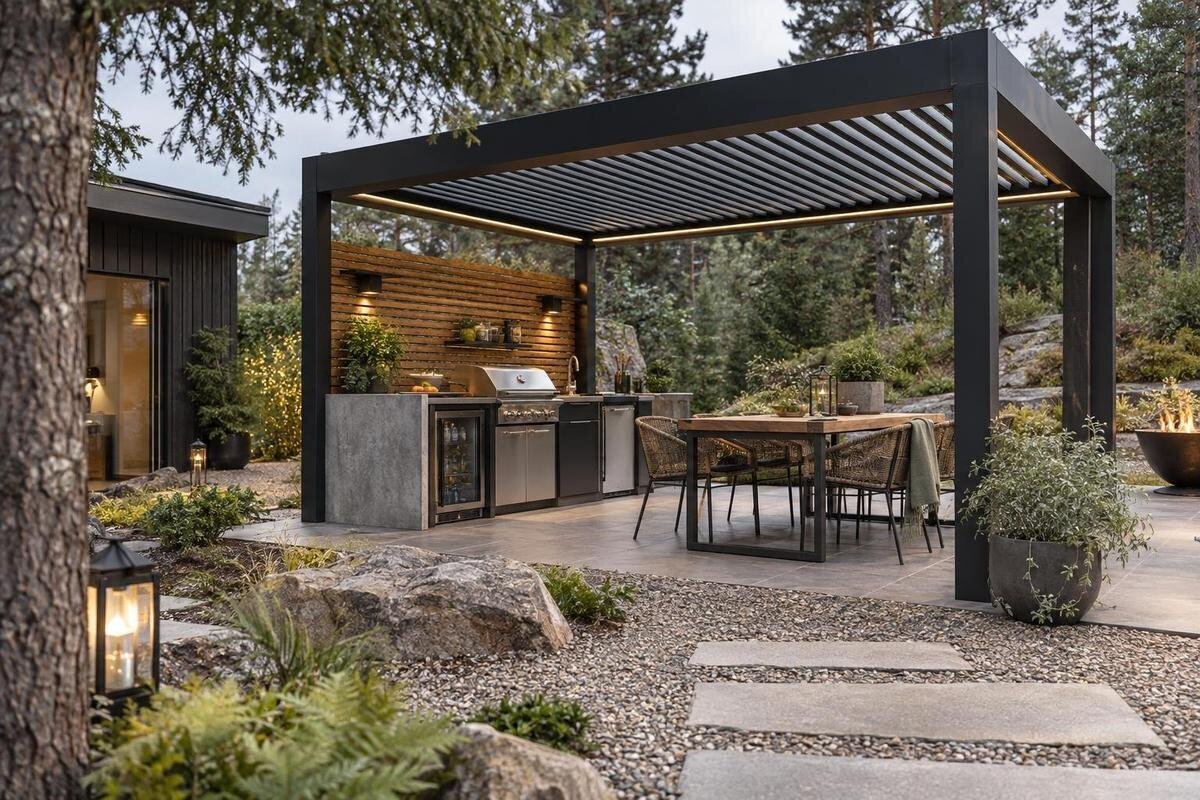
An outdoor kitchen makes the pergola decision more specific than choosing a shaded patch of patio: cooking, preparation, serving and dining each need usable space, and the appliance setup can affect roof and airflow choices. Before comparing listings, map those activities and identify what must be confirmed about dimensions, shade, ventilation, attachment and installation. That turns a style preference into a shortlist that can be checked against the actual site.

Before you buy 1
Map the cooking and dining zones
Draw the outdoor kitchen as it will actually be used, rather than measuring only the barbecue. Mark each fixed appliance, the prep bench, any planned sink or storage, and the route between them. Add the serving point and dining setting; those areas may need different amounts of shade from the cooking zone. Show walls, doors, steps, garden beds and anything else that limits placement. A rough plan is useful at first, provided the main items and their positions are shown clearly. It helps reveal whether one pergola needs to cover both cooking and dining, or whether you need to prioritise one area. Include the direction of access from the house and the places where rubbish, groceries or serving dishes will enter the space. These everyday routes can influence where a kitchen is most convenient and whether a support position will become an obstacle.
Think through a typical meal, from preparing ingredients to serving and clearing away. If people will pass between the kitchen and table, show that route rather than letting it disappear beneath furniture on the plan. Decide whether the main aim is to shade the cook, the diners, or both; that choice can change the size and position you need. Add Bloomcabin’s pergola listing to a shortlist only as a candidate to compare against your plan. Its name does not tell you the covered area or where its supports would sit, so use the dimensions and other details provided for the specific option.
Measure the area that needs cover
A pergola’s overall footprint and the area it covers are not always the same measurement. When comparing options, look for stated dimensions for the structure as a whole, the roofed or shaded area, and the positions of any supports. Check whether the measurements describe the assembled product and how projections or components affect the usable space. If the listing does not make a detail clear, ask before choosing. A plan that fits the advertised outside dimensions may still leave part of the cooking or dining area exposed, or place a support where it interrupts a route.
Measure with the actual kitchen layout in mind, including appliance doors, drawers and storage that need to open. Mark the places where people stand to cook and prepare food, rather than treating benchtops as the only space that matters. If you have a table, account for chairs when they are in use, not just the table’s outline. These checks help distinguish a pergola that fits the patio from one that works for the activities underneath it. Keep your measurements together with the product dimensions so you can compare each option consistently. Measure from fixed edges such as walls or paving lines, and note any uneven boundaries that make a simple rectangular footprint misleading. Returning to the same reference points also makes it easier to test an alternative pergola position without redrawing the whole site.
Before you buy 2
Choose shade for the times you cook
Consider when the outdoor kitchen will see the most use. The position of the sun changes through the day and across the year, so a shaded spot at lunchtime may receive direct sun later on. Note where sunlight falls during the hours you expect to cook and eat, and whether nearby buildings or trees change that pattern. The aim is not to predict every sunny day, but to understand which parts of the layout most need shade and when. This gives you a more useful basis for judging roof coverage than choosing by appearance alone. Observe the site at more than one time if possible, particularly if the kitchen will be used for weekend lunches as well as evening meals. Note glare on the food-preparation area and on the dining table, since comfortable shade is not only about the amount of direct sun.
Compare the roof arrangement and shade claims described for each option. Don’t assume a product name or photograph explains how the roof works, how much shade it provides, or whether it can be adjusted. For example, Bloomcabin’s bioclimatic pergola listing is a page to investigate, not evidence of any particular roof mechanism or performance. Check the product information for the details that matter to your plan, and ask for clarification if the description does not explain the coverage or operation. Also consider whether the dining area needs the same shade as the cook’s working area.
Plan for airflow and appliance clearances
A cooking area needs to be considered differently from a simple seating area. Heat and smoke from appliances can interact with the roof and the surrounding walls, fences or other structures. Look at how open or enclosed the proposed location is and consider where smoke may travel in the conditions you commonly use the space. An open perimeter does not, by itself, prove that a particular appliance has enough ventilation. Similarly, the presence of a roof does not establish that it is suitable above every type of cooking equipment. Consider how the space may feel when several people are present, as diners and guests can change the way air moves through a compact layout. Keep the cooking position distinct on the plan so it can be assessed against the appliance documentation, rather than assuming the whole pergola area has the same conditions.
Before choosing a layout, check the appliance manufacturer’s instructions for required overhead clearances and ventilation, and compare them with the pergola’s documented design. If those requirements are unclear, ask the appliance supplier or a qualified installer to assess the arrangement. The name on the Bloomcabin bioclimatic pergola page does not establish appliance compatibility, airflow or clearance distances. Treat those as separate questions to resolve for the actual products and site. Avoid relying on a product image or a general description to settle a safety-critical detail.
Before you buy 3
Check utilities and appliance requirements
Make a list of the equipment you plan to use, including any appliances that need power, water or fuel. The type and position of those services can affect where the kitchen can sit and how easily people can move around it. If you have not settled on every appliance, note what is still undecided instead of assuming a future choice will fit the pergola arrangement. Share the plan with the relevant appliance supplier or tradesperson so they can identify requirements that affect placement before you commit to a purchase. Also identify which equipment must remain readily accessible for ordinary use, cleaning or servicing. Planning this early can prevent a pergola support, cabinet or dining setting from making a necessary connection or access point difficult to reach.
A pergola and an outdoor kitchen often involve separate product and installation decisions. Confirm what the pergola listing actually documents, and keep appliance requirements, service planning and site conditions in view as you compare options. For example, use the Bloomcabin pergola product page to check the information supplied for that item; don’t infer that it suits a particular appliance or service setup from its name. If your kitchen may change later, allow for that possibility in the layout and ask a qualified professional how the proposed arrangement should be assessed.
Choose between wall-side and freestanding siting
A pergola positioned beside the house may fit naturally with a kitchen or dining area, while a freestanding placement can give you different choices about where to create a sheltered zone. Neither arrangement is automatically better for an outdoor kitchen. Compare the site with the actual product dimensions and installation details, including doors, windows, roof edges, downpipes and routes through the yard. Consider whether a wall-side location would shade the area you care about without making access awkward, or whether a separate position would suit the layout more comfortably. A freestanding structure may also change how guests approach the kitchen from other parts of the yard. Mark these approaches on the plan, especially where the space connects to a lawn, pool area or another entertaining zone.
A product described as wall-mounted is not proof that an existing wall is suitable or that a particular attachment method will work at your home. Check the installation requirements and have the proposed fixing assessed by a qualified building professional. Bloomcabin’s wall-mounted pergola listing can be included in your comparison, but the name alone cannot confirm the structure, connection or suitability for your site. For any option, make sure the planned position leaves room for the kitchen, the people using it and the access needed to reach the space.
Before you buy 4
Allow space for diners and movement
The area under a pergola can serve several purposes, but each one takes up usable space. Sketch the kitchen, prep area and dining setting together, then show how people will move between them. Include chairs in both pulled-out and occupied positions, and check that access to appliance doors and storage is not blocked. If guests are likely to gather near the cook, decide where they can stand without interrupting food preparation. This practical plan helps you see whether the pergola should cover the whole arrangement or just the part where shade matters most.
Think about movement in both directions: carrying food to the table, bringing dishes back and entering or leaving the yard. Keep the route visible on your drawing rather than assuming people will move around furniture in whatever space is left. A table may need shade while the cooking station benefits from a more open position, depending on the site and appliance requirements. You can compare those priorities before you buy, instead of discovering that a well-sized structure does not cover the areas you actually use. Recheck the plan whenever you change the position or size of a kitchen component. Consider how the space will work when guests arrive at once, rather than only when one person is cooking. A layout that preserves a clear route can make serving safer and more relaxed without requiring the cooking area to become a thoroughfare.
Compare upkeep and weather exposure
An outdoor cooking area can expose nearby surfaces to food splashes, grease and smoke, as well as ordinary dust and leaves. Ask what materials and finishes are specified for each pergola and what care they require. Check whether the product information explains how to clean the relevant surfaces and whether access to the roof or other components will be practical once the kitchen is in place. Avoid assuming that a particular material is low-maintenance or suited to your conditions unless the product details say so. Think about where smoke and cooking residue are likely to settle, including nearby walls, furniture and hard-to-reach parts of the structure. A position that is easy to inspect and clean is generally easier to maintain than one where the kitchen blocks access to the relevant surfaces.
Consider the weather the proposed position is exposed to, including sun, wind and rain, and look for product information that addresses those conditions. A pergola may provide overhead shade without preventing rain from reaching the kitchen from the sides, and drainage details can matter near appliances and dining furniture. For the listing for Bloomcabin’s bioclimatic pergola, check the stated materials, finish, care instructions and any exposure limitations rather than inferring them from the name. If the information is incomplete, ask the supplier what is documented for the specific product.

Before you buy 5
Check installation and delivery before ordering
Read the installation information before you order, not after the structure arrives. Confirm what components are included, what base or support is required, and whether the stated dimensions match the planned position. These details can affect the layout and the work needed to prepare the site. If installation is not fully described, ask who can assess the surface and the proposed fixing or support arrangement. A qualified professional can advise on the requirements for the actual product and site; avoid treating a general illustration as an installation plan. Check whether preparation work could temporarily affect the use of the patio, nearby garden areas or access to the home. Scheduling the kitchen and pergola work in a sensible order may avoid having to move completed elements to make room for later installation.
Consider delivery access as well as the space where the pergola will stand. Check whether the route to the site has gates, narrow passages or steps that could affect handling, and confirm the delivery terms and any installation arrangements in writing. Apply the same questions to the wall-mounted pergola product page: its label does not confirm that your wall, delivery route or installation plan is suitable. Before placing an order, make sure you understand what is included and what needs to be arranged separately, so the total project is clear.
Compare the shortlist on the same criteria
Use one set of questions for every pergola you are considering: what are the overall dimensions, what area is described as covered, how is the roof arranged, and what does the listing say about materials, care and installation? Add the support or attachment requirements, delivery terms and any information you still need from the supplier. This makes differences easier to see and prevents a persuasive product title or attractive image from standing in for practical details. Record unknowns as unknowns rather than filling gaps with assumptions.
Then compare each option with your site plan and appliance requirements. A useful shortlist is one where the layout, shade priorities, airflow questions and installation needs have been checked, not simply one where the structure looks the right size. You can record this Bloomcabin pergola option alongside other candidates, using only its stated product information for comparison. If an important detail remains unclear, ask about it before ordering; if the site or appliance setup needs assessment, get advice from the relevant qualified professional. The right choice is the one that can be checked against the way your outdoor kitchen will actually work.
Frequently asked questions
How large should an outdoor kitchen pergola be?
Base the size on the areas you want covered, then include the space needed to use appliances, prepare and serve food, move around and sit down. Check the listed overall dimensions and covered area separately, and account for support positions and furniture.
Can any pergola go over a barbecue?
No universal answer applies. Check the barbecue manufacturer’s instructions for overhead clearances and ventilation, then confirm that the pergola’s documented design suits those requirements. Ask the appliance supplier or a qualified installer if anything is unclear.
Will a pergola keep rain off an outdoor kitchen?
That depends on the specific roof design, coverage and site exposure. Check what the product information says about rain protection and runoff; a roof does not necessarily prevent rain blowing in from the sides.
Should I choose a wall-mounted or freestanding pergola?
Compare the placement each would allow, the space taken up by supports and the requirements of the actual site. A wall-mounted label does not confirm that your wall is suitable, so have the proposed attachment checked by a qualified professional.
What should I confirm before ordering?
Check the overall and covered dimensions, roof details, support and attachment requirements, included components, delivery arrangements and installation needs. Confirm appliance clearances and site suitability before committing to a layout.
Choose the pergola by matching its documented dimensions and design to the areas you use, the shade you want and the requirements of your cooking equipment. Confirm installation and site details before ordering, especially where the proposed position or appliance setup needs professional assessment. A clear plan makes it easier to compare options on what matters for your outdoor kitchen, rather than on a product name or image alone.
