
Buying a Pergola for Rain Protection: Roof and Drainage Limits
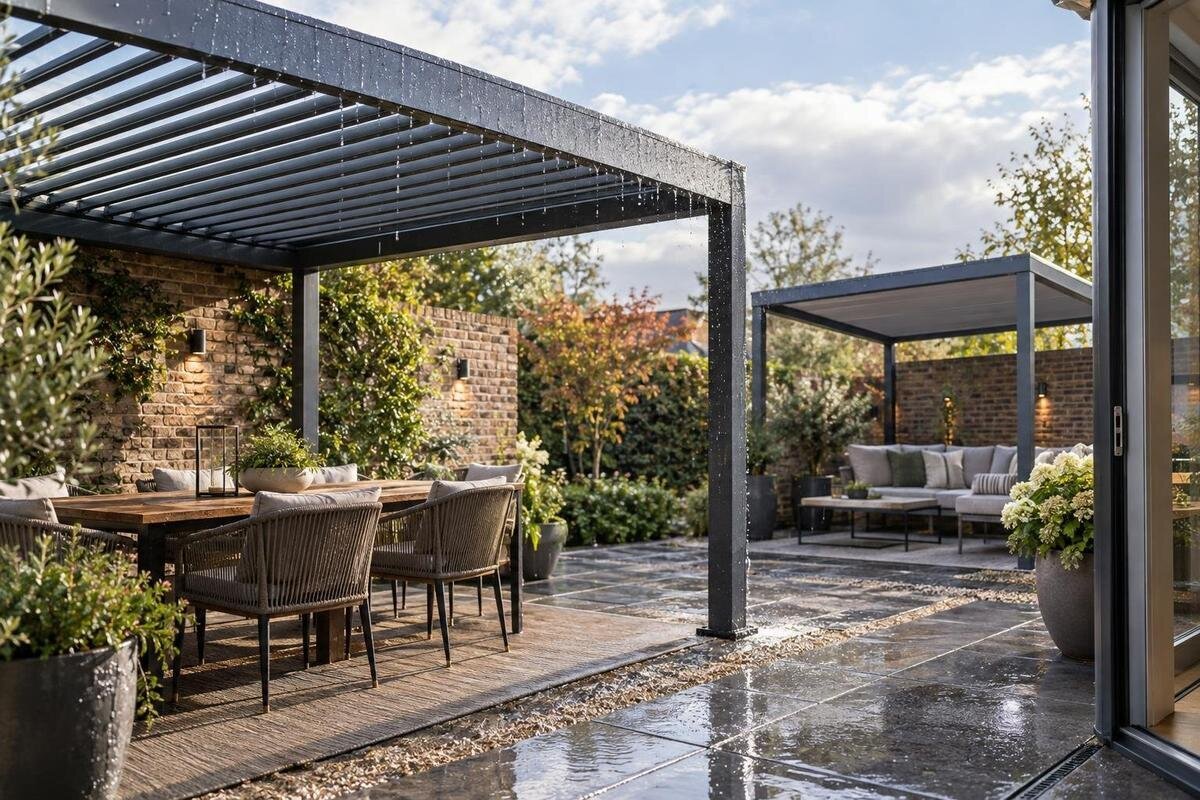
Pergola buying guide
Buying a pergola for rain protection means assessing the whole path water takes: through the roof, around its edges, along any gutters and down to the ground. Open slats, adjustable panels and fixed covers behave differently, and a product name or image cannot establish how much shelter a particular model provides. Wind-driven rain and the connection to a house can also affect the result. Before comparing quotes or placing an order, decide what needs to stay dry, then check the exact roof configuration, drainage provisions and stated limits in the product documents.

01
What rain protection can a pergola provide?
Before comparing models, separate overhead cover from a promise that the space will stay dry. An open-beam design admits rain, and a roof with slats may do the same when its gaps are open; neither is a substitute for a continuous roof where dry shelter is essential. A fixed or adjustable cover may intercept more water, but its joins, perimeter and way of directing runoff still determine the result. Product names and photographs cannot settle those details. Decide whether you want a place to sit during a brief shower, somewhere to keep cushions dry between uses, or protection at a doorway. Those are different expectations, and each needs a different level of evidence. For dining, consider the space people need when chairs are pulled out, not just the table footprint.
Sketch the area you actually want protected, not just the pergola's overall footprint. Mark the table, chairs, walking route and doors, then consider how close they sit to the roof edge and which sides remain open. Rain carried sideways can reach beneath a roof that blocks direct fall, and an overhang does not cover the surrounding patio. When you review the pergola product listing, use it to identify the option, then check its documents for roof type, roofed area and stated rain limitations. A lifestyle image can show an arrangement, but it cannot establish that the roof is sealed or that the floor stays dry. A roof edge over the table may also leave chair backs or a walking lane exposed.
How open, fixed and adjustable roofs handle rain
An open roof is straightforward: gaps let rain through, so its shelter is partial. A fixed cover can channel water across its surface, but the word fixed does not tell you whether seams and edges are sealed or where the water ends up. An adjustable roof introduces positions to compare: ask what the closed position is designed to do, how joints are treated, and whether the roof has to be left in a particular position in certain weather. An intermediate position may still leave openings, so check which positions are intended for use in rain. Details vary by design. Do not assume that terms such as louvred, retractable or bioclimatic mean waterproof; request a model-specific description of performance and limits.
Compare roof types using drawings and documents for the exact configuration quoted. Useful views show the roof fully open and closed, its perimeter and the route rain follows; ask what the guidance says about changing its position when rain begins, if that matters to your use. The bioclimatic pergola listing identifies a named option, not a performance rating. Check that the drawing corresponds to the model and accessories in the quote, then confirm the roof construction and any stated conditions before weighing it against a fixed-cover design. If the documents leave a basic rain question unanswered, record it as an unresolved purchase point rather than filling the gap with an assumption.
02
Check the roof area and drainage route together
Roof coverage and drainage should be assessed as one system. The roof outline tells you what sits overhead; channels and outlets show how collected water is managed. A wider covered area can send more water towards an edge, so a frame footprint alone is a poor guide to where runoff will land. Ask for a plan or drawing that marks the actual roofed area, any overhang, gutters or channels, outlet positions, and components included in the offer. The drawing should distinguish the roof perimeter from the supporting frame and indicate the direction water is meant to travel. If the listing gives only the structure's overall dimensions, request the roof dimensions too. This helps show whether the seating or access area lies within the intended cover.
On a wall-attached design, include the roof-to-wall junction in the same review. A close-looking connection does not prove that flashing, sealing or drainage has been allowed for, and the wall construction at your home may matter. Ask who supplies and specifies that detail and whether the proposed installation addresses your type of wall. The wall-mounted pergola listing helps identify the product being considered, but its name alone does not establish compatibility with a particular house. If transition or sealing components are needed, establish whether they are included. Keep the roof, junction and outlet route together in any comparison; otherwise, an attractive footprint may omit the parts that determine how water is handled.
Wind can carry rain under an open roof
A roof can limit rain falling from above without making an open-sided area dry. In calm conditions, rain generally falls more vertically; wind can angle it through the sides or underneath an edge. The result depends on exposure at the site, the orientation of the roof and nearby walls or screens, so a covered area may behave differently from a display setting. A wall on one side only shields that side; other openings remain exposed. Note which sides you want protected and the position of doors and furniture. If you need a reliably dry threshold or floor, treat open sides as a real limit and ask for evidence that addresses wind-driven rain, not only roof coverage.
Ask whether stated rain performance applies to vertical rainfall only or also to rain carried by wind, and which roof position and installation the statement assumes. For the bioclimatic pergola product page, do not read the category label as an answer: check the documents for the conditions actually covered. If no wind-related guidance is available, decide whether occasional splash at the sides is acceptable for your planned use. A roof extension may help with overhead coverage, but it cannot close an exposed perimeter by itself. Consider the site's exposure and the position where you will sit, rather than relying on a single coverage figure.
03
Plan where collected rainwater will go
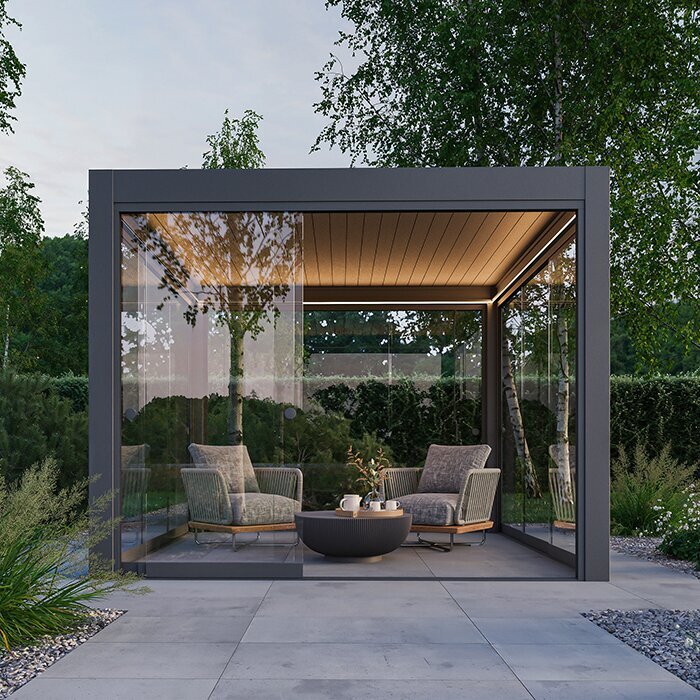
Gutters and channels are useful only if the outlet has a sensible destination. Ask whether gutters, channels and downpipes are part of the quoted configuration or optional items, where outlets can be placed, and how water is meant to leave the pergola. A gutter can collect runoff without defining what happens after its outlet, so ask for the route beyond the roof too. Do not assume that a gutter is included because it appears in a diagram, or that a downpipe can connect to an existing drain without assessment. Request a drawing of the proposed route and a written list of included parts. When considering the pergola listing, use the product page as a reference point, then confirm drainage components and arrangements for the exact order.
Walk the expected water path from roof to ground: where will it fall, could it cross a step or walking route, and might it collect beside a wall or on a surface that already drains poorly? These are site questions, not details to solve by guessing at pipe sizes. If practical, look for existing low points after rain and note whether another outlet would send additional water there. Ask the installer or a suitably qualified drainage professional to assess any arrangement that needs a connection to existing drainage or affects other building elements. Also consider access for removing leaves and debris from any channel. A planned outlet helps avoid shifting the nuisance from overhead dripping to an awkward puddle below.
What pergola documents should say about rain
Before committing to a purchase, look for information that names the exact model and roof configuration rather than relying on broad category language. It should explain what the roof does in rain, which joints or edges are treated as part of the cover, how water is collected or released, and what the stated limits are. Drawings should distinguish frame size from actual roof coverage and indicate relevant outlets. Ask whether the information applies to the options in your quote, not merely to a similar image or another model. A useful document explains exclusions as clearly as claimed capabilities. If a supplier describes a roof as waterproof, ask exactly what that statement covers and what conditions or installation details it assumes.
Keep answers together with your quote: product code or name, selected roof configuration, drainage parts, wall junction if relevant, site assumptions and maintenance instructions. With the option listed as bioclimatic, confirm the exact configuration and written rain guidance rather than inferring function from the word bioclimatic. Ask whether stated protection excludes open sides, particular wind conditions or periods when panels are moving, if those factors matter to you. The point is not to demand a universal guarantee for every storm; it is to understand what the seller is offering, what the manufacturer expects, and where your site needs professional review. Save the drawing or written response with the order confirmation.
04
Check the site and wall connection before ordering
Measure the usable space and note features that may affect fit and water flow: eaves, doors, windows, nearby paths, existing downpipes, paving falls and access for installation. Take photos and note any unknowns, but do not use a rough measurement to settle structural or drainage questions. Check whether a planned outlet or support could conflict with a doorway or walking route. Ask the seller what site information is needed before confirming an order and whether the quoted arrangement assumes a particular wall, clearance or installation surface. A review before ordering is easier than discovering that an outlet, roof edge or fixing location conflicts with something already on the house.
A wall-mounted pergola raises a specific question: is the house connection included in the design and suitable for the actual wall and roof junction? The phrase wall-mounted does not prove that every wall can carry an installation or that water will be kept out where the structures meet. For the wall-mounted product page, request the installation requirements and have a qualified installer assess site-specific attachment and weatherproofing details. If the fit depends on a site visit, clarify before ordering what may change and whether extra work or components could be needed. Avoid modifying a wall or improvising a seal to make a product fit.
Compare the full pergola quote, not just the roof
Compare quotations line by line rather than looking only at the roof description or total price. Check the named model and options, roof coverage, gutters, outlets, downpipes, wall-interface components if relevant, and any installation work that has been included or excluded. Ask who supplies each item, whether drainage accessories are optional, and whether the drawing matches the written quote. Align the scope before deciding which option offers better value. A broad phrase such as rain cover can hide differences in what is provided. If the pergola option shown here is under consideration, compare its documented inclusions with the other quote, not with assumptions based on product images or a short label.
Before you confirm, ask for the final configuration and water route to be recorded in writing, including where runoff leaves the roof and who is responsible for any connection beyond the pergola. Clarify site access, delivery arrangements, installation scope, and what needs to be ready before the work starts; no package automatically includes every site task. If the design changes after a site visit, get revised drawings and an updated list of inclusions rather than relying on a verbal summary. Check that the final drawing and written schedule agree, especially if a wall junction, separate gutter or outlet arrangement has changed.

05
Maintenance can affect how water drains
Debris and wear can affect rain handling, so ask what routine care the chosen design needs. If the roof has gutters or channels, find out how to access and clear them safely, and whether leaves may collect at a particular point. For moving parts or seals, follow the maker's maintenance instructions; do not assume every system uses the same checks. Ask how to recognise a blocked outlet or a change in the way water runs off. Factor maintenance access into placement, especially where the roof sits beside a wall or above a regularly used area. A channel that is difficult to reach may make routine cleaning less practical.
Ask what repair or replacement process applies if a seal, joint, louvre or drainage component needs attention, and whether maintenance affects the stated rain performance. This is a question about the product's own documentation, not a reason to assume a fault will occur. Find out which routine tasks are intended for the owner and which need a service professional, rather than planning to dismantle components yourself. Identify who can answer future servicing questions. A roof that manages water well when new still needs its intended outlets kept clear, so consider ongoing care alongside appearance and purchase cost.
Choose the level of shelter that suits your use
Make the decision around the outcome you need. If you mainly want a sheltered place for occasional use, some splash at the perimeter may be acceptable; if you need to protect a doorway, keep stored items dry, or maintain a dry floor, the same compromise may not work. Put these priorities in order and state which one cannot be compromised. Set your tolerance for exposed edges or occasional splash before discussing options with a seller. That makes it easier to reject a roof whose documentation does not meet your needs, even if its appearance and footprint suit the patio. Do not equate more coverage with guaranteed all-weather protection; wind, edges and discharge still matter.
Before committing, picture one ordinary rain event from start to finish: where does rain hit, which areas remain exposed, where does water leave the roof, and where does it land? Compare the answers with the exact roof and drainage shown in the quote. A simple sketch can keep the discussion specific if the same pergola is shown in several layouts. If an important part is unclear, such as the wall junction, outlet destination or closed-roof behaviour, resolve it before ordering or choose an option with clearer documentation. That final check ties the purchase to the experience you want, rather than to a broad promise of rain protection.
Frequently asked questions
Will any pergola keep my patio dry?
No. An open roof admits rain through its gaps, and an overhead cover may still let wind-driven rain in at the sides. The result depends on the roof, its joints and edges, installation and drainage. Check documentation for the specific model instead of relying on the category name.
Is a closed louvred roof waterproof?
Do not assume so. Designs differ, and a closed position does not by itself explain how joints, edges or runoff are managed. Ask what the manufacturer says about the exact model and roof position, including wind-driven rain and any operating limits.
Do I need gutters and downpipes?
Not in every arrangement, but you do need to know where roof runoff will go. Ask which channels, gutters and outlets are included, where they can discharge, and whether a connection to existing drainage is part of the quote. Site conditions may need professional assessment.
Does a wall-mounted pergola offer better rain protection?
Not automatically. Rain performance depends on the roof and edges, the roof-to-wall junction, the house wall and the runoff route. Ask for installation information for your site and have a qualified installer assess attachment and weatherproofing details; the mounting style alone proves neither.
What should I confirm before ordering?
Confirm the exact roof configuration, covered area, stated rain limits, drainage parts, wall junction if relevant, outlet destination and included installation work. Get the configuration and responsibilities recorded with the quote. Resolve any crucial gaps before placing the order.
A pergola's useful rain shelter is defined by what passes through the roof, what enters at the sides and where runoff is taken. The right choice is the configuration that fits your intended use, with its limits and drainage route understood before ordering. An open design may suit a need for partial cover; someone who expects a dry doorway or floor needs clearer, model-specific evidence and a resolved plan for water discharge. Judging those points together is more reliable than choosing by roof style or product description alone.
