
Buying a Pergola on a Fixed Budget: Which Features Come First?
Pergola buying guide
Buying a pergola on a fixed budget is less about finding the lowest listed price than deciding which parts of the project earn their place. A smaller structure with a suitable layout and the right kind of cover may be a better fit than a larger package whose extras push the total beyond your limit. The fairest comparison is between complete options that meet your main need, not a feature list detached from the site. Set a spending ceiling, identify non-negotiables, then check product details, site work and delivery together. This guide shows how to protect essentials and spot costs or requirements a headline price may leave out.

01
Set a budget for the whole project
Before comparing styles, decide the maximum you can spend on the complete project. A product price is only one line: delivery, site preparation, assembly or professional installation, mounting materials and optional components can change the total. Depending on the property, groundwork or alterations may also be needed. Write the ceiling as a firm total, and keep a separate reserve for costs you cannot confirm until the site has been assessed. That makes it easier to judge an apparently affordable option fairly. A low initial figure is not useful if necessary work has no place in the budget or leaves too little for the feature that makes the pergola worthwhile.
Separate costs into confirmed, to be quoted and optional. Put the pergola and clearly stated inclusions in the first group only after checking a current written price for the exact configuration. Ask for freight, access, assembly, site work, taxes and required professional services to be itemised rather than assumed to be included. Keep lighting, screens or other enhancements in the optional group until you know their compatibility and cost. Set aside a reserve for uncertainties based on site advice, not a generic percentage. If a quote leaves major items blank, treat them as unknown—not as zero—and allow time to resolve them before ordering.
Choose the pergola’s main job
Choose the main job before the design. Is the pergola meant to create a defined place for outdoor meals, provide shade beside a seating area or organise an otherwise underused part of the yard? Write down when you expect to use it, how many people or pieces of furniture it should accommodate, and what problem the existing space has. A clear purpose helps distinguish a must-have from a visual extra. If several uses matter, rank them instead of expecting every feature to solve every problem. The top priority should guide the selection; secondary uses can shape the next trade-off.
Turn that purpose into questions for each listing: does the stated covered area suit the activity, what protection is described, and what is supplied in the price? Avoid paying for a feature because it sounds advanced if you cannot explain how it improves your intended use. Conversely, do not cut something central to your plans just to lower the initial figure. Add this Bloomcabin pergola listing to your notes only as a candidate to assess against your written needs; its name and photographs do not establish dimensions, inclusions or suitability. Confirm those details in the listing or with the seller.
02
Measure the space you can actually use
Measure the area you can use, not simply the patch of ground that looks available. Mark the intended post positions and outer footprint on a plan, then account for doors, windows, paths, steps, garden beds and existing outdoor furniture. Leave the routes people need to move through the space. A pergola can fit on paper yet make a table hard to reach or block a doorway once chairs are in place. Include the room needed to arrange and use furniture, not only the furniture’s dimensions when it is pushed in.
Compare your measurements with the footprint and clear height stated in the product information. Ask whether the listed dimensions describe the posts, roof edge or overall projection; overhangs and support positions can affect usable space. A width-by-length figure may not answer every layout question. Sketch the shape to scale if the yard has an irregular boundary, or ask an installer to confirm the fit. If a smaller option would make movement awkward, do not count it as a saving until you have checked the real layout. A compromise that makes the space difficult to use may not suit your priorities.
Compare freestanding and wall-mounted designs
Decide whether your project needs a freestanding structure or one intended to attach to a building. The choice affects where supports can sit, how the pergola relates to a door or patio, and what needs to be assessed on site. A wall-mounted design can suit some layouts where positioning against the house is wanted; a freestanding arrangement may offer more choice over placement. Neither is automatically the lower-cost or easier option. Compare the usable floor area and routes around the structure, then ask what work the chosen mounting method requires. A design that fits the yard but cannot be fixed appropriately is not a practical bargain.
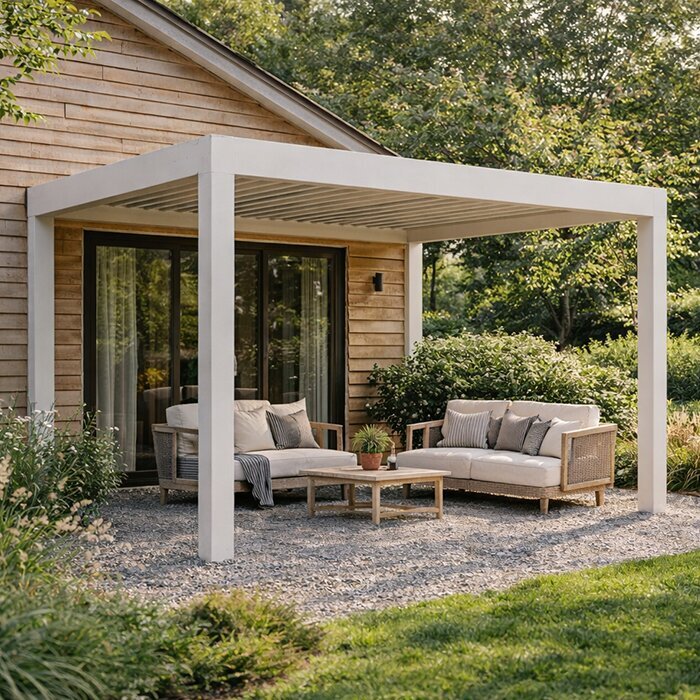
Where a listing is described as wall-mounted, including the wall-mounted Bloomcabin pergola listing, check its stated installation and fixing requirements against the actual building and layout. The label alone does not establish that your wall, cladding, eaves or intended location can take the proposed connection. Get an appropriately qualified installer to assess the attachment and identify any work that affects the quote. For a freestanding option, similarly confirm what the site needs to support it; do not assume an existing paved or decked surface is suitable. Put the assessment cost and any required changes into the total before comparing.

03
Match the roof and shade to how you will use the pergola
Make the roof or shade arrangement a priority only to the extent that it matches your plans. An open top can preserve light and airflow, while fixed or adjustable coverings—where a design offers them—can change how the space is shaded or shielded. These are different functions, not a simple ladder from basic to best. Decide whether you want shade at particular times, a brighter area or a degree of rain cover, then check the exact product description. Do not assume the word pergola means full weather protection; descriptions of coverage and limits matter. If sun or rain exposure is a concern, ask for specifics relevant to your location.
Check whether the covering is fixed, movable or optional, how it is operated, and what components are included in the quoted version. Ask what the product information says about rain handling, wind exposure, maintenance and any limits on use; do not infer these from a product name or image. For example, read the Bloomcabin bioclimatic pergola page for the details it actually supplies, and ask the retailer about anything unclear before treating a requirement as met. If a mechanism or cover is essential to your decision, confirm that the chosen configuration—not just a general product family—includes it. Focus on what the specified model offers for your site.
Compare materials, finishes and ongoing care
Frame material, finish and upkeep are worth comparing once the footprint, mounting and shade needs are clear. These choices affect appearance and the care a structure may need, but do not assume a material is maintenance-free or suited to every setting without product information. Ask what the main frame and roof components are made from, how the finish is described, and what cleaning or ongoing care the supplier recommends. If colour matters, confirm the available finish and whether it changes the quoted price. Photographs can help you picture a style; they cannot confirm composition, coating or durability.
Think about the conditions where the pergola will sit: moisture, airborne salt, dust, strong sun and falling leaves may matter differently from one property to another. Ask the supplier or installer whether the specified materials and finish are appropriate, and compare care instructions and warranty terms instead of relying on assumptions about timber, steel or aluminium. Use the Bloomcabin pergola product page in that comparison only if its written details answer your questions; if they do not, request clarification. A finish upgrade is a good use of limited funds only if it matters more to you than an unmet functional need.
04
Keep optional extras in their place
Accessories can make a pergola more useful, but they can also push an affordable base configuration beyond your ceiling. Depending on the design, people may consider privacy screens, side panels, lighting, fans, heating or drainage components. Treat each as a separate decision: what job will it do, is it needed at installation, and is it available for the exact model? A decorative addition may be pleasant, but it should not displace essentials such as a suitable footprint or mounting approach. If an electrical feature is on your list, price the equipment and professional installation separately, and ask a qualified tradesperson to advise on the work.
Do not assume a pictured accessory is included or that an item can be fitted later. Check the written inclusions and compatibility for the precise product version, along with any installation requirements and extra cost. A listing such as the bioclimatic pergola listing should be compared on confirmed components, not on what you imagine its product category may include. Mark each add-on as essential now, useful later if confirmed compatible, or unnecessary. Delaying an accessory can protect the immediate budget, but only if the supplier confirms that future availability and fitting are realistic; otherwise, treat a later upgrade as uncertain.
Compare quotes on a like-for-like basis
Compare complete quotes in the same format. Record the selected size and configuration, frame and covering details, supplied components, delivery, assembly or installation, site preparation, and any taxes or service charges. Note what is excluded as carefully as what is included. If one seller gives a kit price and another quotes an installed project, they are not directly comparable until you account for the missing parts of each total. Use the Bloomcabin pergola page as one row in the comparison if it meets your shortlist, and enter only the price and specifications confirmed for the version you are considering.
Ask for written clarification on items that affect the final cost or how the pergola will be used: delivery access, handling a difficult site, who assembles it, whether fixing hardware is included, and whether any work is outside the supplier’s scope. Check payment, cancellation, return, warranty and parts-support terms before ordering; different sellers may set different conditions. Keep quotes and answers with the exact model name and chosen options. A low total that excludes essential work is not necessarily the least expensive project. Equally, a longer list of inclusions matters only if you need those items and their value fits your ceiling.
05
Check the site and installation costs
The site itself can introduce costs a product comparison will not reveal. Look at ground levels, existing paving or decking, drainage paths, access for delivery and installation, nearby doors and windows, overhead obstructions, and the position of services. These are prompts for an on-site assessment, not a basis for designing footings or fixing details yourself. Ask a qualified installer what needs to be checked and whether the surface or building needs work before the pergola can be fitted. A quote based on a quick photograph may leave more uncertainty than one made after an inspection, so understand the assumptions behind each figure.
Before placing an order, ask whether any council, building, strata or landlord requirements apply to your property, and who is responsible for confirming them. The answer can depend on location and circumstances, so seek advice from the relevant authority or an appropriately qualified professional rather than guessing from a general web page. A product description, including this wall-mounted pergola listing, cannot establish that a particular site is approved or ready for installation. Ask the installer to list site work and exclusions in writing. If these checks could materially change the total, leave room in the budget to respond before committing.
Use a short list to make the final trade-off
Turn your research into a short scorecard, not a long wish list. Make three headings—essential, helpful and optional—and place each feature under one. Essentials might include a footprint that fits, a mounting approach your site can support, and the type of shade or cover needed for your main use. Helpful features can improve comfort, while optional extras can wait or be dropped. Compare each shortlisted product using the same evidence: confirmed dimensions, inclusions, material and finish, installation assumptions, and total cost. You can assess the Bloomcabin bioclimatic pergola listing in the same way as any alternative, without giving points for claims you have not verified.
Give every non-negotiable a pass-or-fail check before ranking price and appearance. Remove an option if it misses a required dimension, relies on unconfirmed site work, or exceeds the complete ceiling once necessary costs are counted. For the remaining choices, decide which trade-off you would actually accept: less space, a simpler finish, fewer accessories or a different roof arrangement. Do not cut a feature tied to your main use simply because another option has more appealing extras. Before ordering, confirm the exact configuration, measurements, included parts, colour, delivery terms and installation responsibilities in writing. That review helps prevent last-minute compromises.
Frequently asked questions
Should I prioritise size or shade?
Base the choice on how you plan to use the space. Check that the footprint works for furniture and movement, then confirm that the stated roof or shade arrangement addresses your main need. Neither a larger area nor a more complex cover is automatically the better buy.
Is the pergola product price the full project cost?
Usually, it is only one part of the comparison. Check whether delivery, assembly, site preparation, installation, hardware and selected extras are included. Ask for a written total that separates included items from costs that still need a quote.
Can I add screens or lighting later?
Possibly, but do not assume an accessory will fit a particular model or remain available. Ask the supplier to confirm compatibility, installation requirements and likely costs before leaving it out of your first order.
Is a wall-mounted pergola always cheaper?
No. The total depends on the site, installation needs and the work required to make the proposed attachment suitable. Compare a complete quote for the actual property with other options, rather than judging by the product price alone.
What should I confirm before ordering?
Check the exact configuration, dimensions, roof details, included components, finish, delivery terms and who is responsible for installation. Resolve any site, permission or cost questions with the relevant supplier or qualified professional before committing.
On a fixed budget, choose the pergola that addresses the most important outdoor-space need and can fit the real site within your complete spending limit. Confirm fit, mounting and the cover you need before spending on finishes or extras. Then compare written configurations and full costs, and resolve uncertain site items with appropriate professional advice. This order makes the trade-offs visible: you can simplify a finish or postpone an accessory without sacrificing the function or fit that made a pergola worth buying.
