
Buying a Replacement Pergola: Can You Reuse Existing Footings?
Pergola buying guide
If you plan to buy a replacement pergola, do not assume the old footings can stay—or that all of them need replacing. Reuse is a compatibility question with two parts: are the existing foundations still sound, and do they suit the exact replacement’s post layout and support requirements? A similar-looking frame or unchanged patio footprint does not answer either question. Gather what is known about the old foundations, obtain the replacement’s technical information and have the fit assessed where needed before committing to a model.

Can existing pergola footings be reused?
Existing pergola footings may be reusable, but the fact that a previous structure stood there does not prove they suit its replacement. Start with three separate questions: are the foundations still in serviceable condition; do the new posts align with them; and can they meet the replacement’s support requirements at this site? Each question needs evidence. A base can look intact while its construction below ground is unknown, and a pergola with a familiar footprint can transfer forces differently. Reuse is a decision about the entire support arrangement, not simply a visual match between two frames. A good result on one point cannot cancel a problem in another.
Treat retaining footings as one possible part of the project scope, rather than as a saving already secured. A suitably qualified professional may find them suitable, require specific remedial work or recommend new supports; do not assume alterations are possible before the exact product and site have been assessed. The supplier can provide details about the new pergola, but cannot infer the condition of foundations at your home from a product choice. If a key fact remains unknown, call the decision unresolved and include that uncertainty when comparing replacement options and quotes. That prevents you choosing a model solely to avoid extra groundwork. If there are several supports, one uncertain position can affect the recommendation for the whole arrangement.
Identify the foundations before comparing options
Look for the original installation plan, purchase paperwork, builder’s notes, photographs taken during construction and any later repair or inspection records. If the previous owner or installer can identify what was fitted, ask for the precise model and any changes made after installation. These records can help explain the original layout and connection, but a brochure or receipt alone may not describe buried footings. The age of the structure, the brand name and the fact it remained standing are not substitutes for actual foundation information. Keep the documents together so the replacement’s installer or assessor can review the same history, and note which details are confirmed versus remembered. Photos taken before paving or landscaping may help show the work, but match them with written dimensions where possible.
Record what can be seen at each post position, including its location, visible size, surface condition and the type of post-to-foundation connection, if identifiable. Below-ground depth, width, material or reinforcement should come from reliable drawings or an assessment, not a guess based on the exposed top. If those details are missing, ask a structural engineer or suitably qualified building professional what investigation is needed before you expose or alter anything. Avoid drilling, digging or removing anchors just to discover how the footing is built; an unplanned inspection can create a new problem and still leave the important question unanswered. Describe each footing separately if the set has repairs or visibly different conditions. If a record conflicts with what is visible, ask the assessor to resolve the discrepancy rather than relying on whichever detail seems more reassuring.
Assess the footings and why the pergola is being replaced
Walk around the existing structure, if it is still in place, and photograph any visible cracking, movement, chipped or crumbling edges, water pooling, gaps around posts, leaning supports or exposed metal showing corrosion. Note whether marks appear on one footing or several and whether they have changed; a dated photo and short note are more useful than a vague description such as ‘looks fine’. These signs are reasons to seek an assessment, not a diagnosis. A clean surface cannot show the full condition below ground, and a repaired crack does not by itself confirm that the foundation is suitable for a different pergola. Also note any changes to drainage, irrigation or landscaping nearby that may be relevant to the site assessment.
Find out why the old pergola is being replaced. A damaged roof or frame, an impact, long-term movement and a planned style change raise different questions; replacing the frame alone will not address a site or foundation issue that caused movement. Ask the former owner or installer what happened and whether any repairs were made, then have unexplained movement or damage considered as part of the assessment. Even when the next choice is identified on the Bloomcabin pergola listing, that page cannot explain why the previous structure needed replacing or whether a site problem remains. Damage in one area may have a different cause from a problem affecting the whole set, so do not assume every footing is in identical condition.
Match the post layout to the existing footings
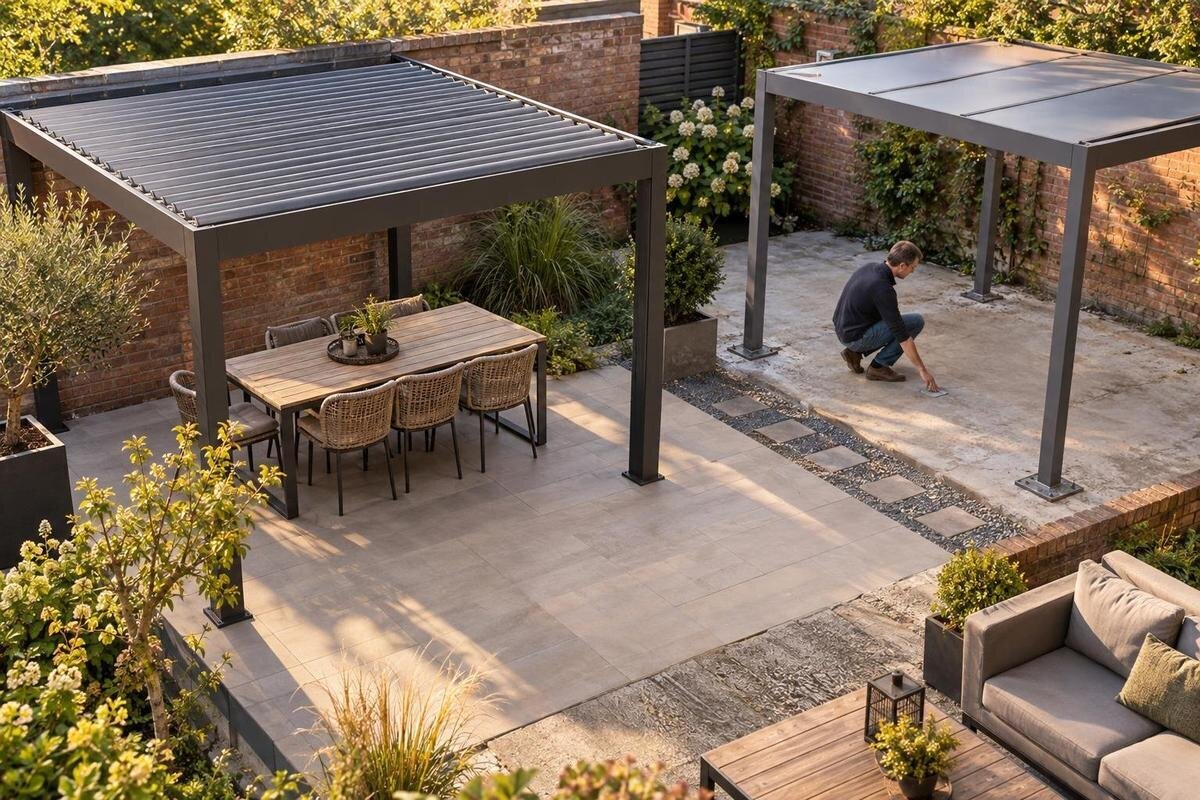
Compare the old footing positions with the replacement’s actual support plan, not just its advertised overall width and length. The useful comparison is where each post centre sits, how many supports are required and whether the pattern matches the measured positions on site. Check the plan orientation as well: turning a rectangle around can alter which post lands beside a wall, path, drain or paved edge. Nearby doors, eaves, garden beds and access routes may also constrain the new layout. A pergola can fit within the same patio outline yet still require different footing locations. Check practical access and finished ground levels too, rather than assuming every post position is clear.
Use a dimensioned drawing for the exact model and configuration. If you are reviewing this Bloomcabin pergola page, ask for the post-layout information needed to compare it with your measured site; do not infer post centres from a product photograph. Have a professional resolve any mismatch, including uncertainty about levels or the positions of existing anchors. Do not plan to shift a post, drill new fixing points or alter a base as a workaround unless the supplier’s technical information and an appropriately qualified person confirm the proposed arrangement. Record the measurements in a simple site sketch with fixed reference points so the supplier, assessor and installer are discussing the same positions.
Check the replacement’s support requirements
Position is only one part of footing compatibility. The new pergola’s span, frame arrangement, roof or cover type, post configuration and connection details can change the way forces reach its supports. The site matters too: wind exposure, rain, nearby buildings and the direction in which the structure is attached may differ from the conditions under which the former pergola was assessed. A replacement that looks similar, or has the same advertised area, should not be assumed to have identical support requirements. Do not estimate those requirements from appearance or from how the old structure performed. Weather exposure and shelter around the site may also have changed since the original pergola was installed.
Ask for the exact model’s support and load information and check that it applies to the selected configuration, rather than relying on a broad category description. When considering the listed pergola option, request the documents or guidance needed to explain its support arrangement and the assumptions behind it. A suitably qualified professional can compare that information with the existing foundations and site; a supplier’s general statement about the product is not a site assessment. If the technical requirements are unavailable or unclear, pause the footing decision instead of treating the old installation as proof of capacity. If there is more than one configuration, ask whether the information covers the specific one you intend to buy.
A wall-attached design changes the support question
If the replacement is designed to attach to a house, the wall and its connections raise a separate support question. The wall may carry part of the load path, while the existing footings may no longer sit under the proposed posts, may serve only some supports or may not be needed for that layout. None of those outcomes can be assumed from the old pergola’s arrangement. The wall’s construction and condition, the attachment points and the way the replacement is designed all need consideration by people qualified to assess them. Do not treat an existing footing as a substitute for checking the building connection. If the attached design also uses ground supports, those need to be considered as part of the complete arrangement.
When asking about a candidate on this Bloomcabin pergola product page, confirm the exact mounting arrangement and request its installation requirements; the listing identity alone does not show whether your wall or old foundations are suitable. Ask for a complete explanation of any wall and ground support requirements rather than making assumptions about each connection separately. Have the relevant structure assessed before choosing between an attached and freestanding replacement. If the new arrangement uses different supports, compare the full project scope, including what happens to the old footings; do not order on the assumption that a wall connection makes site checks unnecessary.
Request technical documents for the exact model
Before settling on a model, request the current technical documents for its exact size and configuration. Useful information can include a dimensioned post plan, connection details, installation instructions, any stated footing or anchor requirements, and the product’s support or load criteria. Ask which parts are supplied and which are not, rather than assuming that a drawing or fixing shown in an image is included. For the model shown on the Bloomcabin product page, check whether the information you need is available for the precise option being considered. Product images and general descriptions help identify a style; they cannot establish how your existing foundations should be reused.
Check document versions and model identifiers before using a plan in a comparison. A drawing for a different size, roof configuration or mounting arrangement may not answer the question for the pergola you intend to buy. If a detail is missing, ask the supplier for it in writing and keep the reply with the quote; do not fill gaps using assumptions from a similar product. Compare the information with records of the existing footings and note any differences for the assessor. This makes it clear whether a decision relates to the exact item you are ordering, not a lookalike or an earlier version. Save the relevant files and dated correspondence so a later quote revision can be checked against the same model.
Clarify who can assess compatibility
Different people can answer different parts of the question. The supplier or manufacturer can clarify the selected pergola’s documented dimensions, support requirements and available installation information. A structural engineer or other suitably qualified building professional can assess whether the existing foundations and site are appropriate for that exact arrangement. An installer can explain what work is included in a quote and flag practical access or sequencing issues, but a quote alone is not a footing assessment. Be clear about who is responsible for each conclusion; a general assurance about the product does not automatically cover the foundations already in your yard. If responsibilities overlap, ask who will coordinate the assessment and pass any changes on to the installer.
When you contact the supplier about this product listing, give the exact model and configuration, then ask for the drawings and written support requirements. For the person assessing the site, provide those documents alongside any records and photographs of the existing installation. Ask whether the advice covers the actual footing positions and condition, what assumptions remain, and what work or further investigation is needed. A written response helps keep the purchase, assessment and installation quote aligned, but its value depends on the question it answers. A response about dimensions alone is not confirmation that old footings can be reused. If an installer is referred to you, confirm whether they are assessing the foundations or only pricing the work.

Include foundation work in the quote and order
Build the foundation decision into your budget and quote comparison. Allow for professional assessment or further investigation, and compare the costed scope for reuse against a replacement foundation plan if one is recommended. Quotes should make clear whether removal of the old frame, work around paving, disposal, reinstatement and any footing alterations are included or excluded. These items depend on your site and the agreed scope, so there is no reliable standard allowance to apply to every pergola. Keeping the old foundations is not automatically the cheaper option if their condition or layout remains uncertain. If a quote includes a provisional allowance, check what it covers rather than treating an unpriced exclusion as included work.
Before placing an order, confirm the exact model, configuration and technical documents against the assessment, and ask how a change in footing decision would affect the installation scope. If you are reviewing the product page for your chosen option, clarify whether the old ground supports are part of the proposal or outside it. Check who will arrange and complete any foundation work, what the quote excludes and how the site will be left. Confirm delivery and installation coordination with the relevant providers rather than assuming they are bundled with the pergola purchase. Keep the order and quote consistent with the product information used for the compatibility assessment.
Make a go-or-no-go decision before committing
Use three outcomes rather than forcing an early yes or no. Reuse is a reasonable basis for the purchase only when the condition, post layout and support requirements have all been checked for the exact replacement. If there is a visible problem, a layout conflict or a professional recommendation against reuse, compare a different configuration or new foundations instead. If records or an assessment are missing, mark the decision as unresolved and obtain the missing information before treating a quote as final. Uncertainty is not evidence that the old footings will fail, but it is not approval to rely on them either.
Before committing, keep a short record of the proposed pergola identifier, the footing information available, the documents reviewed, the person who assessed compatibility and any work included in the quote. Use the exact item name from the listed Bloomcabin pergola so there is no confusion if options change. Then compare the confirmed reuse route with a plan that includes new supports, where relevant, using the same product scope. This makes the buying decision about the complete installed arrangement rather than a frame-only price. If the model or post plan changes, revisit the comparison even if an earlier assessment was positive.
Pergola footing FAQs
Can I reuse footings if the replacement pergola is the same size?
Not necessarily. Matching outer dimensions does not establish that the post positions, connections or support requirements are the same, and the existing foundations may have changed over time. Compare the exact layout and product information, then have the footings assessed for the site before treating them as reusable.
Can the old bolts or brackets be reused as well?
Only if their condition and compatibility with the exact replacement are confirmed. A fixing that looks intact may not match the new connection, and appearance alone cannot establish its suitability. Ask for the product’s connection details and have the existing fixings assessed by a suitably qualified professional.
What if I do not know how deep or wide the footings are?
Do not guess from the concrete visible at the surface. Ask the previous owner or installer for drawings and construction photographs, then obtain the replacement’s support information. If records are incomplete, a qualified professional can advise what investigation is needed before you rely on the existing foundations.
Who can confirm whether old footings suit a replacement?
A supplier or manufacturer can clarify the replacement pergola’s documented requirements. A suitably qualified structural engineer or building professional can assess those requirements against the existing footings and site. A product answer or installation quote alone is not necessarily a site-specific compatibility assessment.
Should I order the replacement before checking the footings?
Choose the exact pergola and obtain its relevant information first, but resolve compatibility before committing to an order that depends on reusing the footings. If an assessment is still needed, clarify ordering and installation terms with the relevant providers and allow for the possibility that foundation work may be recommended.
Existing footings are a possible part of a replacement pergola project, not a benefit to assume when comparing prices. Their condition, positions and compatibility need to be checked against the exact replacement and the site. If all three are confirmed, retaining them can be included in the agreed scope; if not, compare the pergola with the necessary foundation work accounted for. That keeps the purchase decision grounded in the complete support arrangement rather than the appearance of the old one.
