
Is a Ceiling Fan Compatible with Your Pergola?
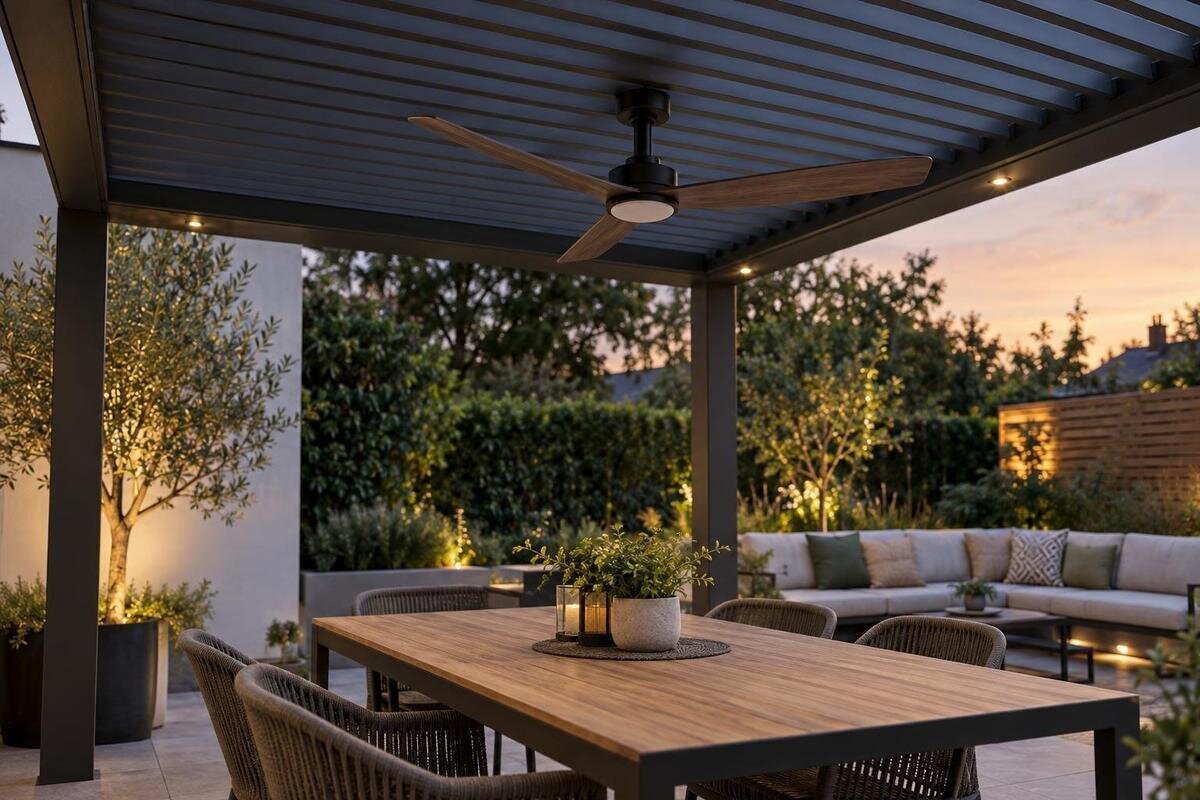
Pergola electrical planning
A ceiling fan can work under a pergola only when the structure, mounting point, fan and electrical plan are approved for that exact combination. A beam that looks solid, a roof that offers shade or a fan sold for outdoor use is not enough on its own. The key checks are dynamic load, documented support, blade and head clearance, roof movement, weather exposure and power. Treat the pergola and fan manuals as a matched pair before you buy.

01
Dynamic loads and structural support
Ceiling-fan compatibility is a structural question as well as a layout choice. A fan is a suspended assembly with moving blades; it starts and stops, and can transmit vibration to its support. Assessing only the fan’s static weight is not enough. The frame, proposed support member, bracket and fixings must form a load path assessed for the appliance in operation. The fan’s speed settings and repeated starts are part of that assessment, not just its weight when stationary. A beam that looks deep or feels rigid when touched does not establish whether it can support an operating fan.
Identify the exact pergola configuration and fan before asking for approval. Request written confirmation from the pergola manufacturer or installer, and a structural professional where needed, that the proposed position and mounting method suit that fan’s weight, blade span and dynamic loads. Ask which member is approved, what documentation supports the decision, and whether any operating conditions apply. The Bloomcabin Pergola listing identifies the regular model and gives an area range of 9–24 m²; an area figure is not a fan-load rating. Keep the response with both product manuals so the installer can check the approved combination.
Get approval for the exact pergola configuration
Pergola names and broad descriptions do not approve accessories. Span, member locations, connection details, roof type, wall or post support, and site-specific changes can affect where a load is carried. Ask for documentation for the installed model and size, along with its installation manual and any accessory guidance. It also matters whether the structure is freestanding or attached to a building; the support route differs between layouts. A published limit for another part of the frame or a different purpose is not permission to hang a rotating appliance.
Ask the supplier or installer to identify a specific fan-mounting point and state whether it is approved for a ceiling fan, not merely for a light or another fixed accessory. If the documentation is silent, have a structural engineer assess the exact arrangement rather than extrapolating from a general frame rating. If you are considering the Bloomcabin Bioclimatic Pergola, specify the configuration in your enquiry rather than referring only to the product page. Ask whether approval covers the intended fan, its mounting method and its operating loads. Distinguish an answer about the standard structure from one that covers your selected size, accessories and any proposed changes. Record any exclusions so they remain clear when comparing configurations.
02
Use only an approved mounting point
A convenient cross-member is not automatically suitable. Do not choose a fixing point simply because it is central, easy to reach or close to an existing light. Nor should a fan be attached to roof panels, louvres, trim, screens, decorative battens or a moving motor assembly unless the exact pergola instructions expressly allow it. The bracket and fixings must match the approved support; a general-purpose adapter cannot create structural approval where none exists. If a mounting block, extension or reinforcing member is proposed, make sure it is part of the confirmed design rather than a workaround.
With a wall-mounted design, check whether the proposed point belongs to the wall connection, an outer beam or a separate support; do not assume these elements are interchangeable. When considering the Bloomcabin Wall-Mounted Pergola, ask the manufacturer or installer to identify the permitted location and mounting method for your proposed fan. A connection designed to support a pergola does not automatically permit an additional rotating load. Mark the proposed point on a photograph or drawing so everyone is assessing the same member, rather than using an ambiguous description such as ‘the front beam’. Do not drill, clamp or add a plate to the frame as a trial. Refer any proposed change for approval first, including any change to the previously agreed position.
Measure the blade sweep and the space below it
Clearance means more than checking that the fan body fits beneath the roof. Use the fan maker’s stated dimensions to map the full blade sweep, the drop from the mounting surface to the lowest part, and the distance from each blade tip to posts, beams, walls, screens, lights and other equipment. Include any extension or mounting kit in the finished dimensions. Check the blade path against people standing, reaching or carrying items, as well as doors and screens that move. Do not substitute the advertised fan diameter for the complete assembly measurements.
Check floor-level space too: walking routes, entry points, chairs pulled back from a table and the positions where people sit or stand. Mark the fan centre and swept circle on a measured layout, then compare it with furniture in its usual position and when moved. Show the routes between the house, seating and garden rather than checking only the area directly over the table. If furniture is regularly rearranged, include those layouts so the clearance assessment does not depend on everything staying in one place. Measure from the finished floor and installed roof, not an assumed drawing scale; raised thresholds or uneven paving can affect usable headroom. Record the mounting height, overall fan drop and resulting clearance separately, making it easier to see which dimension needs clarification. The 9–24 m² area range on the Bloomcabin Pergola page does not tell you roof height, beam positions or blade clearance. Confirm minimum clearances in the fan manual and get help if measurements are uncertain.
03
Check every position of a moving roof
If your pergola roof has louvres or other moving sections, check the fan against the full operating range, not just the setting used on installation day. The blades, bracket or downrod may enter a roof part’s movement path as it opens, closes or sits at an intermediate position. A fan that appears clear with the roof fully open may not be clear when it closes. Compare the manuals for both products and confirm the required separation in each roof position, rather than relying on a single visual check.
Keep the roof mechanism, access panels, drainage routes and service areas in view when choosing a position. The fan must not obstruct a control, restrict roof movement or make routine access impractical. If a proposal depends on limiting roof movement, flag that condition for explicit assessment rather than assuming everyone will remember to avoid certain settings. Include any permitted operating limits in the compatibility record. Do not assume that a product described as bioclimatic has a particular louvre arrangement or a fan-ready fixing point. For the Bloomcabin Bioclimatic Pergola configuration you are considering, confirm the exact roof arrangement and approved accessory details before assessing the available space.
Match the fan’s outdoor rating to the site
Outdoor suitability is separate from structural support. Confirm that the exact fan model is approved by its manufacturer for the intended pergola location, and follow the manual’s limits for exposure and installation. A roof can reduce direct rain without making the space dry: wind can carry rain beneath an open structure, while humidity, condensation, dust and strong sun may still affect equipment. Ask whether the fan suits a semi-open area exposed to weather from the sides, rather than assuming that any product labelled for outdoor use fits every sheltered space.
Check the rating and instructions for the complete fan, not just the motor housing. Blades, canopy, controls, receiver, finish and accessories may have different constraints; also check permitted orientation, cleaning and maintenance. Describe the exposure at the proposed spot, including wind-driven rain, splashing, coastal salt, dust and heat, then ask the fan maker whether its stated use covers those conditions. A useful enquiry explains which sides of the pergola are open and where the fan would sit beneath the roof, rather than simply calling the location ‘under cover’. Include the intended control location so it is considered alongside the fan itself. Keep any conditions in the response with the model details; a broad outdoor label is less useful than an answer about the actual installation. Follow the maker’s care guidance, and do not treat ‘weather-resistant’ as a universal promise or assume that shelter removes the need for a suitable rating.
04
Plan the electrical work with an electrician
Give an electrician the exact fan model and installation manual, along with the pergola’s electrical information and the intended position. The electrician can assess the available supply, the fan’s requirements, suitable outdoor wiring and protective arrangements, and whether the proposed controls can work alongside existing lighting or a motorised roof. They will also need to know what other appliances use the supply and how the roof controls are configured; a photo of a switch is not enough to confirm compatibility. Do not assume that a connection serving a roof motor or light is spare capacity for another appliance.
Plan switch or remote locations, cable routes and service access before the structure is closed in, where that is still possible. Explain how you want to use the fan: where you expect to operate it, whether lighting should be controlled separately, and which existing controls need to remain accessible. This gives the electrician a practical brief without prescribing the wiring solution. Keep the fan’s controls separate from roof movement unless both manufacturers and the electrician confirm compatible operation. If you are comparing options on the regular pergola product page, ask separately what electrical provision is included; the listing does not establish a fan supply or wiring arrangement. Tell the electrician about equipment you may add later, distinguishing definite plans from possibilities. That makes the intended use clear without treating every future accessory as already approved. Electrical work should be designed and completed by a qualified professional, not improvised at the frame.
Fan brackets, mounting requirements and service access
Fan manuals specify the support, bracket, ceiling angle, extension and assembly approved by the manufacturer. Read those details alongside the pergola instructions. A kit intended for a conventional building ceiling does not, by itself, explain how to attach the fan to an open frame. Check the finished height, support interface, fixing method and restrictions on the fan’s orientation or mounting surface. Confirm that the proposed mount type is permitted rather than choosing one for convenience. If the manuals conflict or exclude the proposed structure, pause and request written clarification before adapting the bracket.
Ask about service access as well: can a technician reach the relevant parts without removing roof components or interfering with pergola controls? Identify which parts need access according to the fan manual, and show their positions on the layout used for the mounting assessment. This separates a fan that fits into the available space from an arrangement that can also be maintained as intended. For a wall-mounted pergola configuration, have the exact frame, fan kit and approved connection considered together. Check that the manual and model number correspond to the fan being supplied, not a visually similar version. Include any separately selected bracket or extension in that comparison. If an item is substituted during ordering, flag the difference rather than carrying forward the earlier assessment without checking it. Keep the relevant manuals and approved mounting details together so the installer can compare the delivered equipment with the assessed arrangement.

05
Prepare a compatibility brief before ordering
Put one concise pack together for the pergola supplier or installer, structural professional and electrician. Include the pergola’s exact model and configuration; structural and electrical manuals; a measured sketch or photos of the proposed position; details of roof movement; and the fan’s model, total mass, blade diameter, overall drop, bracket and outdoor-use instructions. Record the intended location in relation to posts, roof members and nearby lights, heaters, screens or furniture. Label measurements clearly and distinguish dimensions taken on site from information copied from a product drawing. For an existing pergola, note any known changes from its original configuration; for a planned installation, identify details that are still undecided. Note likely exposure to rain, dust or salt. Use the bioclimatic pergola product details to identify the catalogue model, but name the exact configuration in your request so the assessment is not based on a general category.
Ask specific questions: which support member and fixing are approved for this fan; what limits or conditions apply to its operating load; what clearances are required in every roof position; and whether the outdoor exposure and power or control arrangement are acceptable. Request written answers and identify who has assessed each part. Structural approval, the fan maker’s approval and an electrical assessment address different issues; a verbal yes from one party should not be treated as confirmation of all three. If a document or answer is missing, resolve that point before purchase.
When to proceed with a pergola fan
Proceed only when the pergola documentation or a competent structural assessment approves the exact mounting arrangement, the fan manufacturer permits the intended location, and the clearance checks work through the whole roof cycle. An electrician must also confirm an appropriate supply and control plan. Keep a simple record of each issue, its supporting evidence, the person responsible for confirming it and any conditions, so unanswered points are not lost between design and installation. If one part remains uncertain, defer the fan rather than relying on a strong-looking beam, a generic diagram or another owner’s setup.
Before work begins, check that the approved fan, bracket, fixing method and position match the paperwork; a change in model or location can alter the answer. Have the installation completed by the relevant qualified professionals and retain manuals and written approvals with the pergola records. If the fan or roof arrangement is later changed, check whether the approval still applies. Seek professional advice if there is unexpected contact, persistent vibration or movement at the support. Compatibility is a documented match between structure, fan, space and electrical plan.
Frequently asked questions
Can I attach a ceiling fan to any pergola beam?
No. A beam’s appearance or a general load rating does not approve it for a moving fan. The pergola documentation needs to identify an approved support and mounting method for that fan, or a structural professional must assess the specific frame, fixings and intended use.
Will a bioclimatic pergola support a ceiling fan?
Not by category alone. Approval depends on the exact model and configuration, and any moving roof parts may affect clearance. Check the relevant manuals for a documented mounting point, then confirm that the blades remain clear through every roof position.
Is an outdoor-rated fan automatically suitable under a pergola?
No. The manufacturer’s rating must cover the exposure at your particular site, including how open the structure is to rain and other weather. Structural approval, mounting, clearances and electrical planning are separate checks.
How much clearance does a pergola fan need?
Use the exact fan manual’s minimums and assembled dimensions. Check the blade sweep, headroom, nearby structures and furniture, and every position of a moving roof. There is no single clearance figure that suits every fan and pergola combination.
Can an electrician confirm structural compatibility?
An electrician can assess the power supply, controls and electrical aspects, but structural capacity and mounting approval need input from the pergola manufacturer, installer or a structural professional. Share the exact product details and get each part confirmed in writing.
Treat compatibility as a match between one pergola configuration and one fan model. The support needs documented approval for the fan’s dynamic loads; the complete blade sweep must clear people and roof movement; and the fan’s outdoor rating and electrical requirements must suit the site. A missing approval is not a detail to resolve by guesswork on installation day. Confirm it before ordering, or choose a cooling option that does not rely on an unapproved frame attachment.
