
Manual or Motorised Pergola Louvres for Daily Use
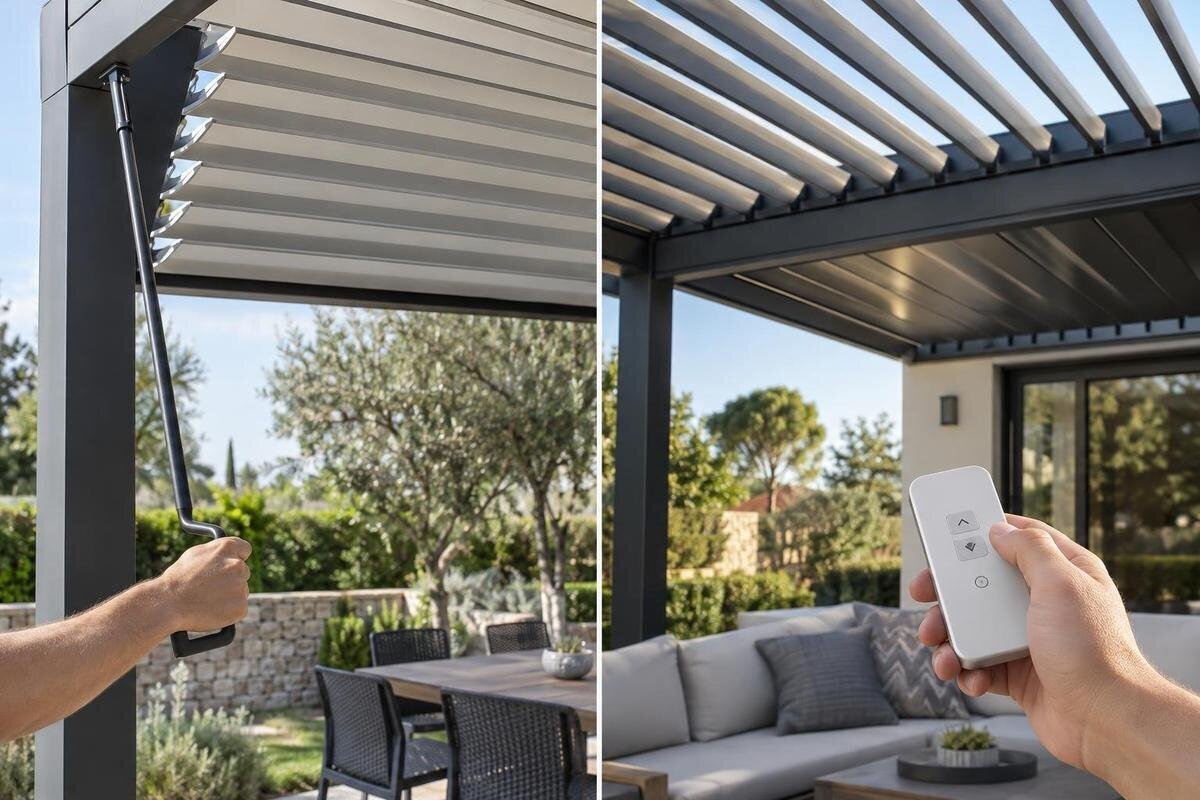
Pergola louvre operating guide
Choosing manual or motorised pergola louvres is mainly a question of how the roof fits into an ordinary day. If you adjust it occasionally and can comfortably reach its control, manual operation may suit. If you expect frequent changes or the mechanism would be awkward to operate by hand, powered movement may be more convenient, provided the control and power arrangements work at your site. Neither label tells you whether a particular model has a remote, sensors or a manual override; those details must be confirmed for the exact configuration.

How often will you adjust the louvres?
Think about a typical week rather than an idealised afternoon. Do you set the louvres once when you sit down and leave them, or adjust them as the sun moves, clouds pass, people come and go, or the use of the patio changes? The first pattern involves few operations; the second can turn a small adjustment into a repeated task. Write down when you expect to move the roof and who is likely to do it. This is more useful than assuming that a pergola will be adjusted simply because it is used every day. If the louvres usually stay in one position, accessibility and straightforward operation may matter more than speed. If they change throughout a session, convenience can have a larger effect on how the space is used.
Count actual changes, not just days outside: opening, adjusting and returning to a preferred position may mean several operations in one session. Include ordinary weeknight use as well as occasional entertaining, and separate predictable adjustments from reactions to changing weather. Motorised movement can reduce the effort at the control, but someone still has to decide when and how to adjust unless a specific automatic function is included. When considering the Bloomcabin Bioclimatic Pergola listing, use this record of likely adjustments to frame your questions about operation. Establish which mechanism the exact configuration offers before comparing how well it would fit a quiet evening, a family meal or a longer afternoon outside.
Manual operation depends on reach and effort
Manual operation means moving the roof through a hand-operated mechanism, but the control might be a handle, crank or another arrangement; do not assume its form from a product name or photograph. Stand where you would normally operate it and consider whether you can reach it without shifting furniture, leaning across a table or stepping into another area. Ask how many movements are involved and whether the control has room to move through its full path. The actual effort and reach depend on the mechanism, so the word manual does not tell you how light or comfortable it will feel. Check the model’s mechanism diagram or instructions and, if a demonstration is available, try that specific control.
Consider everyone who will use the patio, not only the person choosing the pergola. Differences in height, strength or mobility can make the same control feel quite different, especially if it must be operated repeatedly. If one person can reach it but another cannot, the household may find that only one person adjusts the roof. When comparing an option on the Bloomcabin Pergola listing, establish whether the selected configuration is hand-operated or powered. For a manual mechanism, use any available demonstration to assess the whole movement, not just the first turn or pull. Each regular user should be comfortable completing an adjustment from the position in which the control will actually be used.
When motorised control can make adjustments easier
Motorised operation is worth considering when changes are frequent, the operating point is awkward to reach or the manual action would be inconvenient for the people using the patio. A motor moves the mechanism without requiring the user to work it by hand, which can make repeated changes easier. But it does not choose the louvre angle on its own unless automatic controls are separately documented. Ask whether powered movement solves a practical difficulty: adjustments repeated several times during a meal, a user who cannot comfortably reach the mechanism, or a position that is difficult to operate from the usual standing area. If the roof is usually left as set and manual reach is easy, powered movement may add little to ordinary use.
Identify exactly how the motor is operated. A switch, handheld remote, phone app, timed setting and weather sensor are different features, and none follows automatically from the word motorised. Ask which control is included, where it will be, and whether it needs a connection or pairing. For a configuration considered through the bioclimatic pergola product page, distinguish the equipment included in that configuration from any separately offered options. This makes the comparison more useful than simply recording that a motor is available. You need to know what the selected arrangement lets you do, how you give the command and whether that matches the convenience you are seeking.
Check power access and outage behaviour
A motorised mechanism needs the power arrangement specified for that model; do not assume whether it uses a fixed electrical supply, a battery or another arrangement. Ask for the manufacturer’s requirements rather than relying on a general note that the roof is motorised. If the documentation specifies a fixed supply, have a qualified electrician assess whether the proposed location can be served and what work is appropriate. Raise this question early, because the intended power arrangement can affect whether the chosen control location is practical. A nearby power point is not, by itself, proof that the pergola’s requirements are met.
Ask how the system behaves when its usual power source is unavailable. A model may have a backup or manual release, but neither feature should be assumed, and the position in which the louvres stop is not something to guess. Find out whether the roof can still be moved, what the documented procedure is and whether operating limits change. The answer matters if people expect to adjust the roof during an outage. If you are considering the Bloomcabin Wall-Mounted Pergola listing, include power-loss behaviour in your configuration questions. Distinguish a documented way to move the roof without its normal supply from simply waiting for power to return; these are different practical outcomes for daily use.

Controls for shared household use
A control that suits the main user may be less convenient for the rest of the household. With a manual mechanism, everyone needs to know where the control is and how to operate it. With a powered system, the same applies to the switch, controller or other supplied interface. Consider whether regular users can adjust the roof independently and understand which part will move. Familiarity matters as well as reach: someone who uses the pergola only occasionally should not have to rely on another person to explain it each time. Clear operating instructions are more useful here than a long list of features that few people will use.
If the chosen configuration uses a handheld remote, agree where it will be kept so it can be found when needed. If it uses an app, consider whether access would depend on one household member being available. Neither arrangement should be assumed from the product name. When enquiring about the Bloomcabin Pergola product page, ask how the supplied controls would work for several users, rather than considering only the purchaser’s preferences. Think about visitors too: decide whether they will operate the roof or ask a household member to do it. A straightforward shared routine can matter more than having several ways to issue the same command.
Weather limits and automatic controls
An adjustable louvre roof is not, by itself, a promise of rainproof shelter or a guarantee that every position is appropriate in wind. Protection and operating limits depend on the exact design and configuration. Ask what the manufacturer says about rain, wind and other weather, including whether there are positions or conditions in which operation should stop. Do not use the roof’s appearance or broad product category as a substitute for those details. This matters to both manual and motorised systems: the method used to move the louvres does not change the roof’s stated limitations.
Consider what happens when the weather changes while nobody is on the patio. A motor may move the louvres when someone operates it, but that does not mean it detects a change or responds on its own. Sensors, scheduling and other automatic features only count if they are specified for the chosen system. Manual operation likewise depends on someone being present and able to use the control. If weather response matters to your routine, establish what the instructions require and who will be responsible for adjusting the roof; do not base that plan on an assumed automatic function.
Compare upkeep, sound and service support
Ask what routine care applies to the exact mechanism. Both manual and motorised systems have moving parts, but the components and the manufacturer’s maintenance instructions can differ. A motorised configuration may also include a motor and controls that have their own requirements. That does not establish that one type needs more maintenance than the other; it means the instructions are the right basis for comparison. Find out what cleaning is recommended, whether any part requires scheduled attention, and which issues a user can check. Do not guess at lubricants or adjustment methods when the manufacturer has not specified them.
Sound and support are practical details worth checking before the pergola is in regular use. If a demonstration is available, listen to the actual mechanism in operation; otherwise, ask whether product documentation describes its sound. This may matter if the patio is close to a living area or neighbouring homes, but do not assume that all motors or manual mechanisms sound alike. For an option on the Bloomcabin Bioclimatic Pergola model page, ask how faults are reported and what troubleshooting help is available. Establish whether parts or service can be obtained for the selected configuration, and read its applicable warranty terms. Keep these support questions separate from routine care so you can compare both clearly.
Plan control locations and service access
Use a plan of the furnished patio to check the proposed control location. Include the dining table, chairs and commonly used doorways, then mark where the operator would stand and how they would get there. This brings together the reach requirements of the mechanism and the space available around it. Check any clearance needed for a manual control’s full movement, rather than marking only its attachment point. For a powered option, mark the proposed interface location instead. A wall-mounted and a freestanding arrangement may place controls in different parts of the patio, so assess the actual configuration rather than assuming a location from the model name.
Raise power access and provision for maintenance while the site is being planned, rather than after the layout is settled. Ask the relevant qualified professional to assess site-specific electrical or fixing arrangements; a photograph or catalogue label cannot establish them. For a product considered through the wall-mounted pergola model page, discuss the proposed layout alongside the selected configuration’s requirements. Check that furniture will not block access needed to follow the manufacturer’s care instructions. Resolve the relationship between the control location, any required power supply and maintenance access before finalising the patio layout, rather than considering each in isolation.

Read the model documents, not just the product name
Compare the exact model and configuration, not just a category label such as pergola or bioclimatic. Look for the mechanism diagram and operating instructions, then check whether they describe hand operation or a motor, how the louvres move, what controls are supplied and what power arrangement applies. Also look for stated operating limits, outage behaviour, maintenance instructions and service information. If a detail is absent, mark it as unconfirmed rather than filling the gap with an assumption about what similar products usually include. A clear comparison sheet with the same questions for each option makes omissions easier to spot.
The Bloomcabin product facts identify the Bloomcabin Pergola, Bloomcabin Bioclimatic Pergola and Bloomcabin Wall-Mounted Pergola; each is listed with an area range from 9 to 24 m². Those details identify the models and their stated size range, but do not establish whether a particular louvre configuration is manual or motorised. Use the Bloomcabin Pergola model listing as a product reference, then match the operating information to the exact configuration being offered. Keep confirmed features separate from unanswered questions in your comparison. This avoids mistaking a category name, an optional feature or information about another configuration for equipment included with your chosen product.
Match the mechanism to your ordinary routine
Manual operation is a reasonable fit to investigate if you expect only occasional changes, the control is easy to reach and the effort feels comfortable for everyone who will use it. Motorised operation is worth comparing if you expect repeated adjustments, if hand operation would be awkward, or if reaching the mechanism is a persistent obstacle. These are starting points rather than guarantees: the control, movement and effort vary by model. A motor does not automatically make the system more convenient if its power arrangement is difficult to provide or its controls do not suit the people using the patio.
Before deciding, write down four things: how often you expect to adjust the roof, who will operate it, where they will stand, and what power or backup arrangements the selected system documents. Then compare the same model-specific information for both options. If manual effort or reach is uncertain, try the exact mechanism when a demonstration is available. If power, controls or outage behaviour are unclear for a motorised model, get those details before relying on it in your routine. The better choice is the one whose documented operation fits ordinary use, not the one whose label sounds more advanced.
Frequently asked questions
Does motorised operation mean the louvres adjust automatically?
No. Motorised means a motor moves the louvres when operated; it does not, by itself, confirm a remote, schedule or weather sensor. Check which controls and automatic functions are included for the exact model.
Can motorised louvres be operated during a power outage?
That depends on the specified power source and whether the model has a documented backup or manual override. Do not assume the louvres will move, or remain in a particular position, without checking the instructions.
Is manual operation difficult?
It depends on the mechanism, its position and how often you use it. Check the model instructions and, if possible, try the actual control. Consider whether everyone who will use the pergola can reach and operate it comfortably.
Will closed louvres keep rain out?
Do not assume that a closed position makes a louvre roof waterproof. Rain protection and operating limits depend on the exact design and configuration. Check the manufacturer’s documentation rather than relying on the roof’s appearance or control type.
Do the Bloomcabin model listings specify manual or motorised operation?
The product facts available here identify the models and their stated area range, but do not specify a louvre control mechanism. Check the documentation for the exact configuration before deciding which operating method it offers.
Manual and motorised operation are both only as convenient as their actual mechanism, placement and support. A simple record of how often you adjust the louvres, a check of who will use the control and a review of the exact model documents usually reveal where each option fits. Choose the system that will remain practical in an ordinary week, not merely the one that sounds simplest in a product description.
