
Can You Grow Climbing Plants on an Aluminium Pergola?
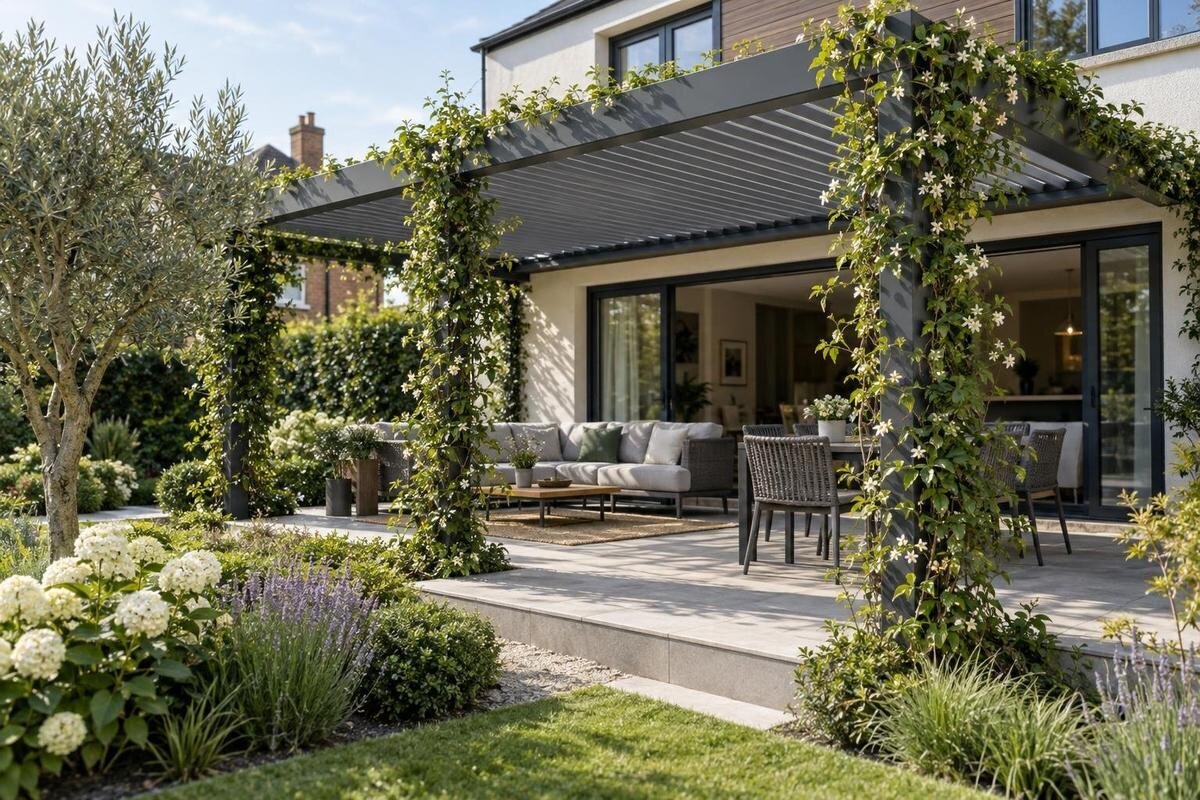
Pergola planting guide
An aluminium pergola can sit beside climbing plants without carrying them, or it can become part of the plant’s support system. Those are different designs. Before tying a vine to the frame, confirm that the exact model and fixing points are approved for its expected mature growth, and that the plant will not interfere with any moving roof. If neither the added load nor the required clearance can be confirmed, a separate, independently supported trellis is the clearer option.

Growing climbers on the frame or a separate trellis
Growing climbing plants on a pergola can mean training them on the frame or placing a separate trellis beside it. With direct training, stems, ties or wires transfer some of the plant’s load to the pergola. With an independent trellis, that support carries the load and the pergola provides a backdrop. Decide which arrangement you want before choosing a climber or buying brackets: a sparsely leafed vine at planting time may develop dense foliage and woody stems. Even a separate trellis can cease to be independent if the plant spreads over and grips the pergola, so its growth needs managing. Material and appearance alone do not establish load capacity.
Treat each product as a model-specific question, not a general yes-or-no about aluminium. Ask for the manual or written advice covering the exact structure, intended attachments and plant-support arrangement; check whether a separate wire or trellis is allowed as well. A product name or lifestyle image shows the model’s identity, not whether it has plant-rated fixing points. If comparing the Bloomcabin Bioclimatic Pergola, ask its supplier for relevant documentation rather than assuming its name or appearance approves a vine. The response should distinguish permitted attachment locations from components that must remain unobstructed, and state any conditions on the planting plan. Seek that answer before buying the plant, not after it has grown.
Which approvals to check before adding a climber
Approval can mean several things. First, does the pergola supplier allow plant support on the exact model and configuration? Second, does an owner, landlord, body corporate or owners corporation need to agree to added fixings or a changed appearance? Third, does any local planning or building sign-off apply to the structure or proposed modification? These decisions are separate. Acceptance by one party does not automatically settle the others, and approval for the pergola itself may not answer a later question about vines or attachments. A change that uses no new holes can still affect appearance, maintenance access or roof operation, so do not assume it is outside the approval process.
Before work starts, describe the actual proposal to the relevant people: where the plant will grow, whether wires or a trellis will be fixed, how far the growth is expected to spread and whether it could affect a moving roof. Ask the local council or relevant building authority whether any approval is needed for the change. For a rented or shared property, ask the landlord or property or strata manager what consent is required, and keep replies with the drawings. If considering a Bloomcabin Wall-Mounted Pergola, include both the wall attachment and proposed plant support in those enquiries; the product listing cannot determine permissions for a particular site.
How a mature plant changes the load
Plant load is not fixed on the day of installation. Stems thicken, branches lengthen and foliage fills gaps; a dense canopy may also retain water and weigh more when wet. Wind pressing against leaves and branches can pull on supports, particularly when growth projects beyond the frame or is tied at only a few points. The effect depends on the plant, its mature size, how it is trained and the site. A general weight estimate for a different pergola, or the size of a young nursery plant, is not a sound basis for approval. Exposure and the position of the canopy also affect how forces reach the fixing points, so a neighbour’s established vine does not confirm that your model is suitable.
Document the intended plant, or its growth characteristics, before asking for an assessment. Include mature height and spread, whether stems twine, cling or need ties, and where the main growth will sit. Show any extra wires or trellis, because these add weight and transfer loads through their own fixings. A planter resting on the ground has a different support route from a pot hung off the frame; do not treat them as equivalent. For a Bloomcabin Pergola, as for any named model, request guidance for the specific configuration. If the additional load cannot be confirmed, seek advice from a qualified structural professional rather than estimating a safe limit yourself.
Clearance around a moving pergola roof
If a roof opens, closes or adjusts, clearance is part of the planting plan. Vines can grow across moving joints, tracks, pivots, louvres or drainage areas; leaves and stems may be caught as components change position or may obstruct access for cleaning and servicing. Check the complete movement envelope in every operating position, including space around the edges and mechanisms. A gap visible with the roof in one position does not prove that mature growth will stay clear throughout its movement. Nor is it enough to check only the route the roof takes when it is new: stems can spread into that space later.
Ask the supplier to mark prohibited zones and permitted attachment locations on a drawing for the exact model. Confirm that the stated clearances allow for the plant’s expected spread, not just its current size, and ask whether they also allow access for servicing. Where a product is described as bioclimatic, check the exact documentation to establish what moves and where growth must be kept clear. When considering the bioclimatic pergola model, compare those clearances with the proposed canopy and support positions on your planting plan. If reliable clearances cannot be documented, keep the vine on a trellis positioned outside the roof’s movement and service areas.

Fixing points and independent trellis supports
Direct attachment can create an integrated look, but it needs approved connection points and a clear route for growth. Do not assume that a convenient beam, post, roof slat or gutter is suitable for a screw, clamp or tie. Unapproved drilling or strapping may damage a coating, interfere with drainage or put force on a component not intended to support a plant. Ask the supplier to identify permitted fixings and any conditions for using them. If direct attachment is not approved, do not improvise with a heavier cable or extra brackets; choose a different support arrangement. Also check whether any proposed fixing would make cleaning or inspection more difficult.
A genuinely independent trellis keeps the main plant-support load off the pergola, provided it is designed and secured as its own structure and is not braced to the pergola. Allow a gap so stems cannot creep into roof joints and the structure can still be operated, inspected and cleaned. That gap needs managing as the plant grows; otherwise, an initially separate support can become linked by stems. The trellis itself must suit the mature plant and site exposure, since freestanding does not automatically mean stable. When planning beside a wall-mounted pergola option, resolve the trellis base and wall separately, and seek professional advice about support where needed.
What to ask the pergola supplier
Ask precise questions and request answers in writing. Does the exact model allow a climber to be supported directly, or only on a specified accessory? Which parts of the frame and attachment methods are allowed? What plant size and growth pattern did the advice consider, including wet foliage and wind exposure? Are any components, clearances, drainage routes or service points excluded? Would adding wires or a trellis affect applicable warranty or maintenance conditions? Ask whether the answer changes if an accessory is added after installation. A useful response names the product and configuration rather than making a general statement about aluminium pergolas.
Send a dimensioned landscape drawing rather than a vague description. Mark the pergola posts and roof boundaries, the plant’s base, its proposed route, the mature canopy, trellis or wire fixings, doors and access routes. Include documented planting requirements and site photographs if requested. This helps the supplier or a qualified professional assess the actual layout, but it is not a substitute for an engineer where structural capacity needs assessment. Keep any written advice with the product documents and make sure it matches the arrangement that will be built. If the design changes, ask whether the original response still applies before relying on it.
Match the planting plan to mature growth
Choose a plant for its mature habit, not the small pot it comes in. Check likely height and spread, how it climbs, how quickly it fills a support, whether it becomes woody and how much pruning it needs. These traits influence the support design and the room needed around moving components. Consider whether the site suits the plant’s sunlight, water and climate requirements, as well as its proximity to windows, gutters, lights and neighbouring spaces. Check the exact variety’s mature growth rather than relying on a common name or a nursery photograph. A visually appealing plant may be a poor fit if it reaches roof mechanisms or cannot be maintained from the planned access points.
Put the plant information on the same drawing as the pergola. Show the planting position, the route of the stems, the expected outer edge of the mature canopy and any independent trellis. That lets the supplier comment on the actual layout rather than a product in isolation. When comparing the Bloomcabin Pergola with your planting plan, keep the model’s permitted support arrangements and the climber’s growth requirements distinct: both need to suit the proposed layout. If the plant’s likely spread exceeds the available space, reconsider the species or support before planting; do not rely on pruning alone to keep an unsuitable layout clear.
Access for operation, pruning and maintenance
Growth changes access as well as load. A mature canopy can cover fixings, collect leaves around joints or obstruct the route needed to clean and service a roof. Plan room to reach the structure and prune the plant without leaning across moving components or removing parts. Keep controls, drainage paths and any manufacturer-designated access zones clear. Consider how the plant will be reached as it grows and whether service work could require the vine to be cut back. If access depends on a narrow gap that the plant is likely to fill, adjust the planting position or use a separate support before growth becomes established.
Ask what routine care is recommended for the structure and the climber, and who can carry it out once the plant is mature. Pruning can manage spread, but it should not compensate for an unapproved load or inadequate roof clearance. Use the available operating and maintenance documents alongside the plant plan, and check the clearance again whenever growth is trained along a new section. If you are considering the Bioclimatic Pergola, include access for its specified maintenance in the layout before settling on the plant’s position. This makes maintenance access part of the design rather than a problem to resolve after the vine has grown.

Extra checks for a wall-mounted pergola
With a wall-mounted pergola, plant loads need attention at the frame and at its connection to the building. A vine trained onto a beam can pull through the pergola towards its wall fixings; the wall material and existing attachment have not automatically been assessed for extra plant forces. Do not attach wires to the façade or pergola without confirmation that the proposed points and loads are suitable. Ask the supplier to clarify what its guidance covers, and have a qualified building professional assess anything outside that scope. This is particularly important if the wall construction or existing fixings are undocumented.
Give the supplier the installed model, proposed plant and trellis, wall location and expected mature spread. Ask whether any response covers the wall interface as well as the pergola frame. When considering Bloomcabin’s wall-mounted model, distinguish advice about the product from an assessment of your particular house wall and plant arrangement. If you prefer a separate trellis, plan its support independently rather than bracing it to the pergola. Record any required property consent before adding attachments, and check whether a change to the wall or its appearance raises a separate approval question.
Document the approved plant layout
Before buying a climber, bring the key information together: the exact pergola model and configuration, a dimensioned plan, the plant’s mature size and growth habit, any wire or trellis details, the roof’s full movement and service clearance, and written supplier advice. Send the proposal to the relevant local authority and property decision-maker to ask whether separate consent is needed. Keep replies, drawings and product documents together. If the advice depends on a particular plant, support route or clearance, record that condition so a gardener or future owner does not unknowingly change the arrangement.
If the structure and location are confirmed for the planned plant, keep growth within the documented arrangement and leave the clear zones unobstructed. If no one can verify the load, fixing method or roof clearance, do not test the structure by tying on a vine and watching what happens. Use a separately supported trellis or revise the planting plan. If an independent support could affect a wall, boundary or shared area, check those matters too. The practical choice is to approve a defined plant-and-support layout, or keep the plant’s load separate from the pergola.
Frequently asked questions
Can I attach a trellis to the pergola posts?
Only if the supplier confirms that the exact model and fixing method can support it. A trellis attached to the posts still transfers its load to the pergola. If that arrangement is not approved, choose a trellis with its own suitable support rather than improvising with extra ties or brackets.
Can vines grow over a pergola with a moving roof?
Only if the mature growth stays outside the roof’s full movement and service areas. Ask the supplier for the clearances and permitted planting locations for the exact model. A gap that looks adequate with the roof in one position may not be clear throughout its movement.
Does an aluminium frame automatically make a pergola suitable for climbers?
No. The material alone does not show whether the frame or its fixings can carry a particular plant. Mature size, foliage, wind exposure, attachment points and roof movement all matter. Check the product-specific guidance before training a vine onto the structure.
Who should I ask about approval?
Ask the pergola supplier about plant loads, attachments and roof clearance. Separately, ask the relevant local authority and any landlord, property manager or owners corporation whether consent is needed for your site and proposed changes. One party’s response does not settle the others’ requirements.
Can regular pruning make an unapproved climber safe?
Pruning can help manage a plant’s spread, but it does not confirm that the pergola can carry the load or that a moving roof will remain clear. Use pruning as part of a documented maintenance plan, not as a substitute for approved support and clearance.
Climbing plants can work with an aluminium pergola when the support, mature growth and any roof movement have all been considered for the exact model and site. Treat supplier guidance, property consent and local approval as separate questions, and document the arrangement before planting. Where the load or clearance cannot be confirmed, an independently supported trellis keeps the plant’s main support separate from the pergola and makes the design easier to assess.
