
Fabric Roof or Aluminium Louvres for a Pergola?
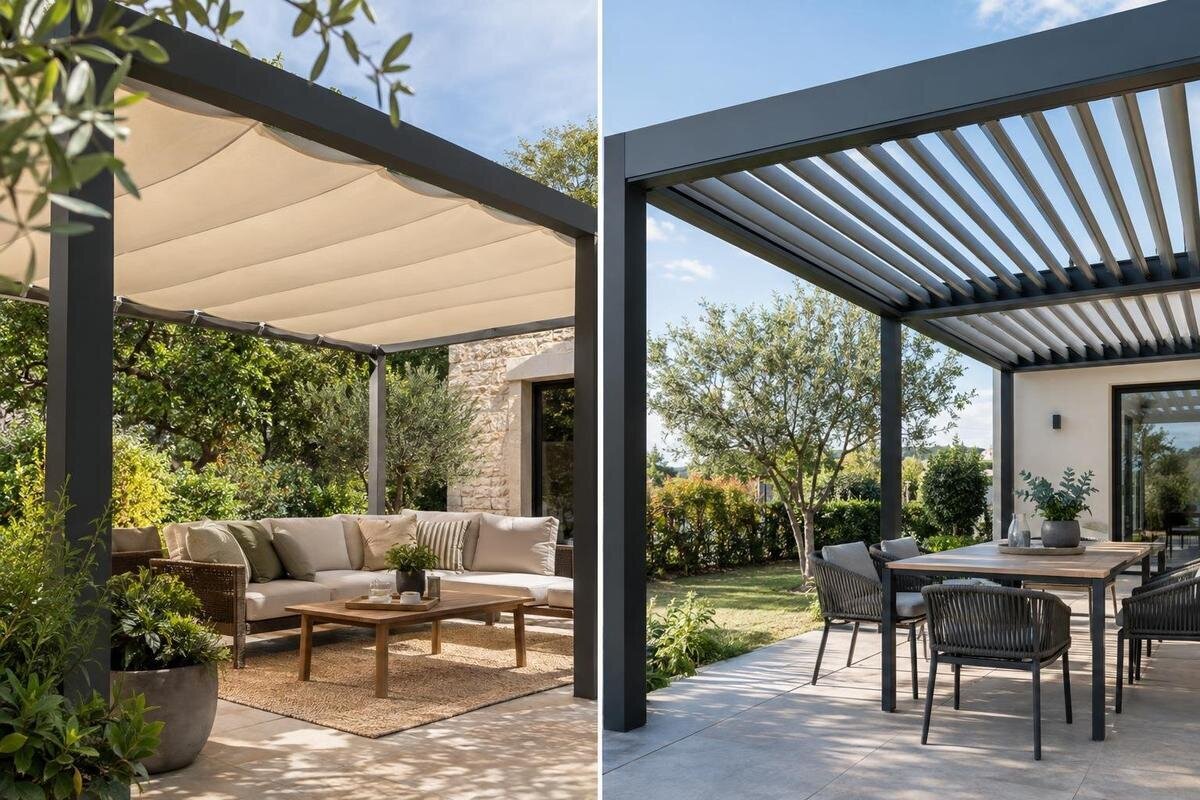
Pergola roof guide
Choosing a pergola roof is less about finding a universal winner than understanding how you want to change the cover, what upkeep you will accept and what weather instructions apply to the exact model. Fabric can be fixed or movable; aluminium louvres can be fixed or adjustable. Compare documented versions on the same covered area, not just the words on a product page.

How fabric roofs and aluminium louvres differ
A fabric-roof pergola has a textile covering above its frame. The phrase alone does not say whether the canopy is fixed, tensioned, retractable, removable or made from several panels, nor whether it is water-resistant. Ask for the exact roof drawing and operating instructions: how is the fabric held, which positions are allowed, and is removal intended for regular use, seasonal storage or service? Note whether the diagram shows one span or multiple pieces, how the edges are finished and whether the same covering extends across the full frame. These details affect how much open sky is available and what you must do when conditions change. Treat a broad label as a starting point rather than a full specification.
An aluminium louvred roof uses slats or blades set across the overhead frame. On an adjustable design, the blades change angle; other configurations may not offer that movement. Confirm whether the shortlisted roof is fixed or adjustable, how it is operated and what positions the manufacturer permits. Aluminium alone does not establish motorisation, sensors, an app, a manual override, complete closure or rain performance. An operating diagram should show the range of movement and, where provided, the drainage path. If it does not, ask for a separate mechanism drawing or manual. This distinction matters because a photograph may show only one position, not the roof’s normal operating range.
How each roof is operated
Day-to-day operation depends on the mechanism. A retractable fabric system may move between covered and open positions; a fixed canopy does not, and some models use another arrangement. Adjustable louvres change the overhead opening by tilting the blades rather than moving a sheet away. Some mechanisms allow intermediate positions and some do not. The type of movement does not automatically tell you how quickly, quietly or easily the roof operates. Compare the controls and the actions needed to open, close and return it to your preferred position. When considering the Bloomcabin Bioclimatic Pergola, establish the operating method for the selected configuration rather than relying on the product name.
Think about the person who will use it, not only the roof’s appearance. Can the control be reached from where people sit? Does operation require a handle, a particular clearance, an electrical connection or another person? If you expect to adjust the roof often, ease of operation and access may matter more than a small difference in appearance; if you rarely change it, a fixed cover may be sufficient. Check whether furniture or a screen could obstruct movement and whether controls remain accessible when the roof is partly open. Establish whether stopping midway is permitted, and confirm that the quoted configuration includes every component needed for the stated operation.
Shade, daylight and airflow
Both systems provide overhead shade, but their coverage differs. A fixed fabric canopy gives a set covered area; a retractable version can expose part or all of its opening only if designed to travel that way. Adjustable louvres can alter blade angle, while fixed blades cannot. Actual shade depends on fabric coverage, blade spacing, roof dimensions and chosen position, as well as the sun’s path and nearby buildings or trees. A diagram can establish the roof’s footprint, but not shade at every hour. Compare roof positions against the sun at the times you use the terrace; a single overhead view cannot show those changes. For an option on the Bloomcabin Pergola product page, establish the roof configuration before comparing its coverage with another system.
Consider light inside the house as well as on the paving. A roof position that shades a table may also reduce daylight through an adjacent window, while opening the roof may restore sky exposure. An open louvre setting creates gaps overhead; retracting fabric may uncover a larger area, depending on its travel. Neither guarantees a particular breeze: side walls, screens, nearby buildings and local conditions affect air movement. Look at the terrace and adjoining rooms at the times you actually use them, and compare roof positions rather than relying on a single illustration. If daylight is a priority, ask for a site-specific drawing showing the proposed placement. Take the same view from inside and from the seats beneath the pergola; the trade-off may not be identical.
Rain protection depends on the whole system
Rain performance needs a model-specific answer. With louvres, find out whether the blades close, how their edges meet, and whether the design routes water to an outlet; ask what rain, wind and roof positions the manufacturer allows. With fabric, check the stated water performance, seams, tension requirements and conditions for retracting or leaving it deployed. A closed-looking roof is not proof of a sealed roof, and a material label is not a rain rating. If performance figures are quoted, ask which roof position and installation conditions they cover. For a model on the Bioclimatic Pergola product page, use the selected configuration’s rain instructions rather than treating the family name as a performance claim.
Check what happens beyond the roof surface. Where does runoff go, and are gutters, downpipes or drainage components included, optional or absent? Is the perimeter open, and can rain enter from the sides? The answer matters for furniture, doorways and any items you plan to leave below the pergola. A roofed outdoor area is not automatically a weatherproof room. Compare the manufacturer’s drawing and installation guidance with the way water can move across your terrace; ask a qualified installer about site-specific drainage and the discharge point. For a like-for-like comparison, check whether both systems are described for similar roof states and exposure, not just whether a brochure mentions rain cover. Ask whether quoted protection applies only to rain falling vertically or also addresses wind-driven rain.

Wind and seasonal weather limits
Wind limits are not interchangeable between fabric roofs and louvres. A fabric canopy’s instructions may specify a required position, retraction or removal procedure; a louvred system may state permitted blade positions or other precautions. These depend on the exact construction and installation, so neither a retractable mechanism nor aluminium proves that the roof can remain in any position during strong wind. A position used for ordinary shade adjustment may not be the prescribed one when the structure is unattended. Read the stated limits and required actions, and ask who can advise on the proposed installation. If you are considering the Bloomcabin Wall-Mounted Pergola, include its wind and storm procedures in the comparison.
Plan for absence and sudden changes as well as ordinary afternoons. Ask whether a fabric cover is meant to remain fitted when unused, whether the manufacturer calls for a particular position or storage, and whether guidance changes for prolonged periods. For adjustable louvres, find out whether a specified unattended position is required and whether movement is permitted in the conditions you might face. Do not invent a safe setting from the roof type; follow the supplied instructions and get clarification if they do not cover your site or expected weather. A routine that is awkward to follow may affect how often you use the cover, so discuss it before purchase rather than after a storm warning.
Routine care for fabric and louvres
Fabric care starts with the actual textile and its handling instructions. Ask how to remove loose leaves and dust, which cleaning method is approved, whether the cover must be dry before it is retracted or stored, and how stains should be treated. Do not apply generic fabric-cleaning or pressure-washing advice to a product whose coating, seams or construction you have not identified. If the roof can be removed, confirm who is expected to do that and how it is refitted; a removable cover is not necessarily designed for frequent handling. Use the inspection interval specified in the manual rather than inventing a schedule. Before applying fabric-care advice to an option in the Bloomcabin Pergola range, establish which covering is supplied.
Louvres need a different check: leaves and dust can collect around blade edges, pivots or drainage paths where those features exist. Use the manufacturer’s cleaning and inspection routine, including any limits on access, water pressure or cleaning agents. Ask whether joints and drains are accessible without taking the roof apart, and what to do if a blade does not move freely. Avoid forcing a mechanism or improvising repairs. If the pergola is high, difficult to reach or has powered components, establish a safe maintenance arrangement with the supplier or a qualified service person rather than treating routine cleaning as a simple ground-level task. If the site has nearby trees or persistent dust, ask whether that changes the recommended schedule.
Repairs, replacement parts and service
Long-term ownership depends on which components can be serviced, not just the main covering material. For fabric, ask whether a replacement panel can be ordered, how it is matched to the frame and who fits it. For louvres, ask whether an individual blade, pivot or operating part can be replaced and how the system is accessed for service. These are questions, not promises that parts are replaceable. Check the warranty scope and any care conditions; neither fabric nor aluminium establishes a service life or future parts availability. When seeking service details for the Bloomcabin Bioclimatic Pergola range, identify the exact option so the answers apply to the model you are considering.
Ask whether wear items are covered by a routine service, what signs mean the roof needs attention, and whether the frame and covering can be maintained without removing other parts. If the answer differs by size or options, request the document for that configuration rather than relying on a general brochure. Check how replacement parts are identified, who performs a repair and whether the roof must be made inaccessible during service. Ask how compatible parts will be identified if model options change, and keep the model information with your purchase documents. That makes it easier to describe a fault accurately and avoids assuming that a fabric panel, blade, motor or control from another range will fit.
How to compare models on equal terms
A like-for-like comparison begins with the chosen footprint and roofed area, not the advertised family name. The listings describe the Bloomcabin Bioclimatic Pergola, Bloomcabin Wall-Mounted Pergola and Bloomcabin Pergola ranges as running from 9 to 24 m²; that range alone does not identify the dimensions, roof material or movement of a particular option. Confirm that the selected configuration belongs in a fabric-versus-louvre comparison. Check how the area is defined, then compare the model’s drawing, clear covered area and any opening path. For an option on the Wall-Mounted Pergola model page, record the selected size and roof configuration rather than using the whole range as a single comparison.
Then compare the mechanism and what is included: fixed or adjustable, fabric or blades, opening positions, control method, drainage parts, side components, and any operation or maintenance requirements. Record the same questions for every contender so you do not compare one model’s base configuration with another’s optional features. Separate confirmed facts from items still unanswered; a blank product page is not proof that a feature is absent. Also distinguish the overall frame footprint from the useful shaded area and any space needed for movement. Ask for drawings and product documentation for the precise model variant, not only a family brochure.

Space, access and attachment to the house
An otherwise suitable roof can still be awkward if it conflicts with the house or patio. Check the proposed position against doors, windows, lights, gutters, outdoor furniture and the routes people use. A wall-mounted pergola also raises a different site question from a freestanding structure: the fixing arrangement and condition of the supporting building need assessment for the specific installation. The Bloomcabin Wall-Mounted Pergola is identified as a wall-mounted model, but that identity is not an assessment of your wall. Ask a qualified installer to assess attachment, clearances and any applicable requirements before treating a product drawing as a final site plan.
Think about how the chosen cover affects this exact layout. A retractable textile roof needs its designed travel area kept clear; adjustable louvres need clearance for their specified movement. Consider where a user stands to operate the roof, access for cleaning and where rainwater is directed. Mark chair backs and table extensions on the plan, as they may affect access to a moving edge or control. If a motor or electrical connection is proposed, confirm the included equipment and installation scope from product documents and a suitably qualified installer; neither is a feature to infer from the word pergola. A layout that blocks movement, drainage or maintenance access will be inconvenient whatever roof type is selected.
Which roof suits your everyday use?
The useful distinction is what you want to change during an ordinary afternoon. If you want to uncover the terrace, compare how much of the opening a retractable fabric design exposes. If you want to change the gaps overhead by adjusting blade angle, compare an adjustable louvred design. If you rarely intend to change the cover, consider whether a fixed arrangement meets your needs. These preferences narrow the comparison without making one material the automatic winner. Include who will operate the roof and how often: a control or handling routine that looks acceptable on paper may not suit the person expected to use it.
Describe your expectations for sunny afternoons, rain, wind and periods when nobody is home. Then compare those expectations with the permitted operation and required care of each shortlisted roof. Distinguish what you would like the system to do from what the selected configuration is documented to do. For example, wanting to leave the area covered while away is different from being prepared to retract or remove a canopy whenever its instructions require it. If a product page and operating instructions use different language, ask for the distinction in writing. Choose the arrangement whose everyday routine you are prepared to follow, rather than relying on the broad appeal of fabric or aluminium.
Frequently asked questions
Is a fabric roof better than aluminium louvres?
Neither is automatically better. A fabric roof’s usefulness depends on whether the selected canopy is fixed or movable and what cover it provides. Adjustable louvres offer a different kind of overhead control only when the blades move. Compare operation, care and documented weather limits for the exact models.
Do all fabric pergola roofs retract?
No. Fabric describes the covering, not how it opens. Some roofs are fixed; others may be retractable or removable. Check the operating diagram, permitted positions and whether removal is intended for everyday use, seasonal storage or servicing before assuming the roof can open.
Are closed aluminium louvres waterproof?
Not necessarily. Confirm whether the selected design is intended to manage rain when closed, how water is routed and what limitations apply to wind-driven rain and installation conditions. A photograph of closed blades or the word louvred does not establish a weather rating.
Which pergola roof is easier to maintain?
There is no automatic winner; the care tasks differ. Fabric instructions may cover cleaning, drying, storage or replacement. Louvre instructions may cover blade surfaces, joints and drainage paths. Ask for the maintenance guidance and safe access requirements for each exact model.
Can either roof stay in place during strong wind or storms?
There is no reliable category-wide answer. Follow the exact model’s wind and storm instructions, including any permitted position, retraction or removal requirements, and limits on operation. If the guidance does not cover your site or expected weather, get clarification before relying on the roof for protection.
The better pergola roof is the one that provides the cover you want with an operating and care routine that suits you. Fabric and aluminium louvres offer different arrangements, but material alone does not settle the choice. Compare the selected configurations on the same covered area, with their permitted roof positions and weather limits in view. That makes appearance one part of a practical choice, rather than the only basis for it.
