
Frozen Pergola Louvres: When Not to Operate the Roof
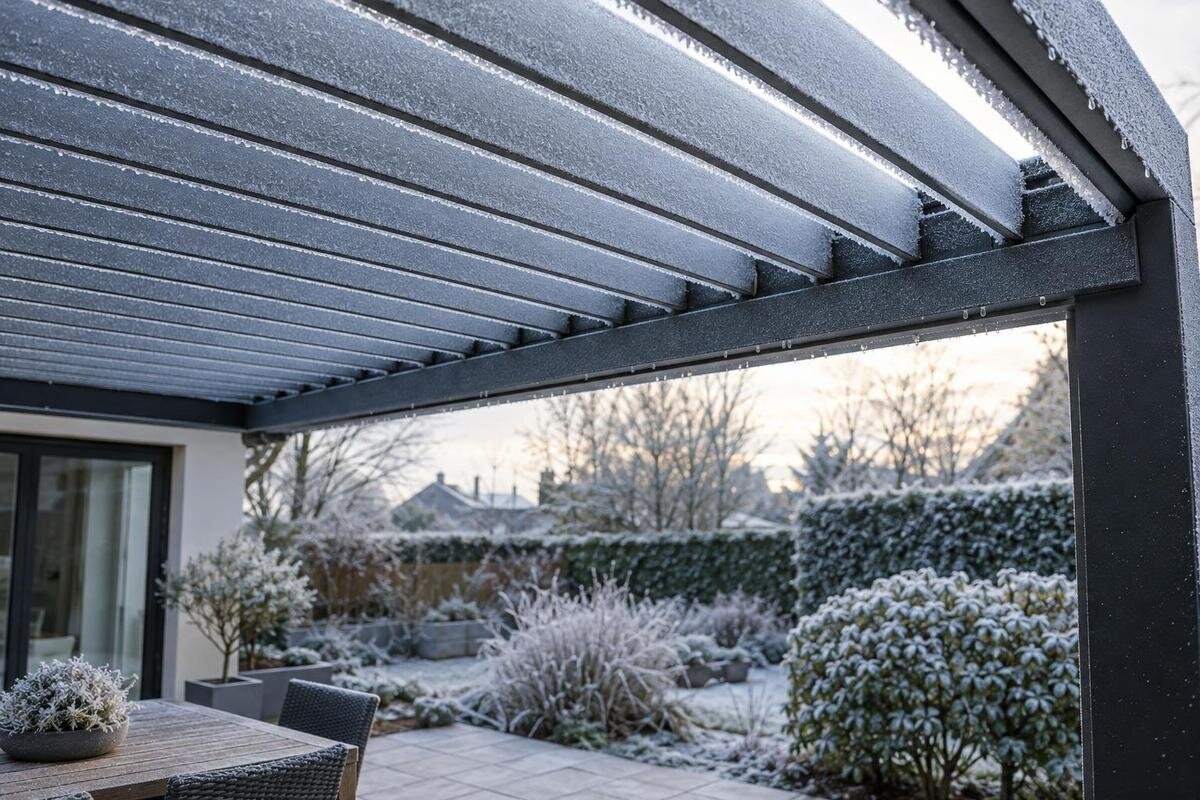
Pergola operation in cold weather
Frost does not need to cover an entire roof to stop its louvres moving. A thin film of ice at a pivot, linkage, blade edge or water channel may add enough resistance to stall the mechanism, even when most of the visible surface looks clear. Repeatedly trying the control or levering a stuck blade can turn a temporary weather-related stoppage into a mechanical fault. Whether the roof is motorised or operated by hand, do not force seized parts. The safe position, cold-weather operating limit and thaw procedure are model-specific, so use the manufacturer's instructions rather than guesswork.

01
How frost can stop louvres moving
Frost can immobilise a roof even when only a small area is affected. A louvred assembly has moving interfaces, and water left after rain, mist or a thaw may sit around a blade end, pivot, seal, linkage, drainage channel or drive connection, depending on the design. When that moisture freezes, it can bond surfaces or obstruct a narrow clearance. One frozen point may make movement uneven or stop the assembly; pushing from another point can load connected parts rather than free the ice. A clear-looking underside does not prove that every moving joint is clear, and a local ice bond can hold a much larger assembly.
Freeze-thaw conditions make this harder to judge. Water can soften during a warmer spell, run into a colder recess and freeze there later; shade and exposure can keep parts of the roof colder than the air you feel at ground level. A weather-app reading cannot confirm the temperature or condition at every joint. Nor is there one universal outdoor temperature at which all pergola louvres can or cannot operate: designs and instructions differ. When considering the Bloomcabin Bioclimatic Pergola, distinguish the product name from its operating limits. The name alone does not establish a frost limit or safe operating position.
Signs the roof should stay still
Treat visible ice near moving parts, a blade that starts and stops, one side moving ahead of another, unusual resistance on a hand-operated roof, or a motor that strains, hums, clicks or stops as reasons to pause. These clues can appear before there is a thick coating of ice. If the control reports a fault or the roof no longer responds as usual, stop sending commands rather than trying different sequences. A stalled mechanism is a warning to investigate, not an invitation to push harder or see whether a stronger command will work. Movement earlier in the day does not guarantee that the joints are clear now.
Not every stoppage proves there is ice. A control, power, sensor or mechanical fault can produce similar symptoms, and there may be no visible frost at the moving point. From below, you may not be able to distinguish ice in a joint from a separate fault. That uncertainty is a reason to leave the roof still, not to diagnose it by force. Note what happened and check the instructions for that specific model; if the cause or approved next move is not clear, contact the manufacturer or installer. The absence of snow or a thick layer of frost is not proof that the mechanism is free.
02
What to do when movement stops
If movement stops or resistance appears, release the control and stop operating the roof. Do not make repeated attempts, alternate between controls, pull on a blade or try to shift the louvres by hand. Keep people clear of the area beneath the roof if ice may fall, and avoid standing on a slippery surface to inspect it. Do not climb onto the structure or reach into a joint. If the louvres stopped part-way, note their position; do not move them to a position you think is safer unless the maker's instructions specifically permit that action while frozen.
Use the manual or the supplier's support service to find the approved response; avoid improvising a reset, release or override. If you are unsure which unit is installed, record its label and installation details from a safe, accessible location. You can refer to the Bloomcabin Wall-Mounted Pergola page when identifying the product, then use the installed unit's details to request the right instructions. Where the label cannot be reached safely, do not climb to find it; give the installer the information you already have. Note which control you used and what happened when movement stopped so they can understand the sequence.
Avoid force and unapproved thawing methods
Do not lever a blade with a bar, wrench or long handle, and do not strike, scrape or chip at ice around the louvres. Force applied at one blade can be transmitted through linked parts, and sharp tools can mark surfaces or damage seals and finishes. Trying to lift one blade while its neighbours remain stuck can put extra load on the connected assembly. A manual drive is not a safe workaround for a frozen roof: it still applies force to the same blocked mechanism. Avoid removing a cover or trying to reach the drive, linkage or wiring. Do not dismantle or adjust a seized unit unless the manufacturer gives that exact procedure and it is within your competence.
Do not pour hot or boiling water over the roof, aim a heat gun or heater at it, use an open flame, or apply salt, de-icer, solvent, lubricant or a pressure washer unless the manufacturer explicitly approves the specific method. Rapid heating or an unapproved substance may harm coatings, seals or components; water can also run into a colder gap and freeze again. A method suitable for a car windscreen or window is not automatically suitable for a pergola mechanism. Follow the maker's instructions if they allow a particular thawing method, including any limits on where and how it may be used.

03
Prepare before freezing weather arrives
Prepare while the roof is dry, moving normally and not affected by ice, rather than waiting until a cold morning to find out how it behaves. Read the operating and maintenance instructions before the season changes. If the manufacturer specifies a recommended position for periods of freezing weather, set it only when conditions and roof movement allow, following the stated procedure. Do not assume that fully open, fully closed or partly open is the right winter position for every system. Once frost or ice has seized the mechanism, do not operate it simply to reach a preferred position.
Plan any routine maintenance before freezing weather arrives. Check the approved maintenance notes for accessible drainage points and remove leaves or debris only by the method described and when the parts are safe to approach. A clear drain does not guarantee that the louvres will remain free of ice, but trapped water can complicate a freeze. Keep the manual, model or serial details and support contact together. If you are comparing the Bloomcabin Pergola with another model, keep each set of instructions clearly identified. Make sure household members and anyone using the roof while you are away know where to find them and not to test a stuck roof.
Find the instructions for the exact model
Find guidance for the exact model and configuration, not a general article about pergolas. Look for the operating manual, installation documentation and any manufacturer-issued cold-weather or maintenance instructions. Check whether an operating temperature is stated, and whether it refers to moving the louvres, storing the unit or something else; one limit cannot be substituted for another. Check for an explicit instruction about frost, ice, a winter parking position, manual release, thawing and conditions for restarting. If a document says only to avoid operating the roof when iced, do not infer a temperature threshold or a method for clearing it. The roof's ability to stay in a position is not the same as permission to operate it in the cold.
Match the document to the installed roof, its control system and any options or enclosure components; a similar-looking model may use different instructions. If you are considering the Bioclimatic Pergola model, ask which operating manual applies to the configuration you intend to buy. For an existing roof, use the details from the installed unit rather than appearance alone. Ask the supplier or installer to identify the current document and clarify any missing instruction in writing. Useful questions include whether the roof needs a specified position before frost, what to do if it stops, how to tell when thawing is complete, and who should inspect a persistent fault.
04
Drainage checks before and after a freeze
Consider the roof's water path as well as the moving blades. Some louvred designs direct rain through channels and outlets, but the route and its connection to moving parts are model-specific. Water in a channel or outlet can freeze and obstruct drainage; that is not proof that a pivot or actuator is iced, and a frozen pivot may not be visible in the drain. Use the drainage diagram for the installed model to locate the relevant parts and understand what is meant by an accessible outlet. Do not assume that a product name or a roof's appearance tells you how water is routed. Meltwater can also refreeze as conditions change.
Before frost arrives, deal with ordinary leaves and dirt only as the maintenance instructions allow, in conditions where you can work from the ground or another safe access point. When discussing drainage for the Wall-Mounted Pergola model, request the drawing for the precise configuration rather than inferring the outlet arrangement from its product image. Once an outlet is icy, do not poke wire, a tool or a hose into it, or try to clear a frozen channel by force. If water is backing up, ice is forming overhead or you cannot reach the outlet safely, leave it alone and ask the installer what inspection is appropriate.
When it may be safe to try again
A warmer afternoon does not guarantee that all hidden ice has melted, and a clear-looking blade edge is not proof that a pivot or linkage is free. Follow the manufacturer's thawing instructions and any stated restart conditions; if no method is provided, ask before applying heat or trying the control. Avoid setting your own waiting period or temperature threshold, because the roof's shaded joints may thaw later than the visible surface. Natural warming may be preferable to improvised heating, but do not treat that as permission to operate until the maker's conditions are met.
When the instructions permit a restart, make only the controlled check they describe and stay clear of moving parts. Stop at the first sign of resistance, uneven movement, abnormal noise, renewed stalling or a fault indication; do not cycle the roof to see if it will eventually free up. For a roof identified as the Bloomcabin Pergola model, check that the restart procedure matches the installed unit and its controls. If the roof still behaves differently after the thaw, keep it out of operation. Tell the installer which symptom remains rather than making further attempts to reproduce it.

05
When to call the manufacturer or installer
Contact the manufacturer, supplier or installer if the louvres remain stuck after the approved thaw, stop again when conditions are no longer freezing, move unevenly, make a new noise or show visible damage. Seek advice as well when ice repeatedly forms around the same mechanism, the control displays an unexplained fault, or the manual does not cover what has happened. A roof that moves again is not automatically free of damage; if it is still noisy or resistant, stop and have it assessed. Do not open the drive housing or attempt an adjustment to decide whether a repair is needed.
Make the conversation useful by noting the model and serial number, control type, the louvre position when movement stopped, recent weather, what the control did and what you heard or saw. Record whether the roof had been moving normally, whether ice was visible and what, if anything, you tried. If your purchase details identify a Bloomcabin Bioclimatic Pergola model, include that information alongside the installed unit's label details so the technician can identify the mechanism. Photos can help if taken from a safe place on the ground; do not climb or stand under loose ice to get a closer view.
Questions to ask before buying for a frosty site
If you are choosing a louvred pergola for a frost-prone site, ask for the cold-weather operating information before deciding. Request any stated minimum operating temperature and check exactly what it applies to; ask whether louvres may be moved when frost is present, what position the maker recommends before freezing weather, and what to do if the roof is already seized. Ask about the approved thawing and restart procedure, maintenance of drainage paths, and whom to contact for an inspection. Do not assume that a general weather-performance statement answers questions about operating a frozen mechanism. Ask how any stated limit applies to the conditions at your site.
Ask whether any sensor, stop function or manual release is part of the chosen configuration, what it is designed to do, and whether its instructions address ice. Do not assume a feature is included or that it can make frozen louvres safe to move. For the Bloomcabin Wall-Mounted Pergola, as for any model under consideration, request guidance covering the exact options you intend to order. This lets you compare the stated operating restrictions and maintenance requirements before purchase, rather than relying on an image or a broad description of winter suitability. Clarify any unanswered cold-weather questions with the supplier.
Frequently asked questions
Is there a temperature at which all pergola louvres are safe to operate?
No universal temperature applies to every model. Use the operating limits in the instructions for your exact roof, and do not operate it if ice may be restricting a moving part. A general weather forecast cannot confirm that the mechanism itself is clear.
Should I leave the louvres open or closed before frost?
There is no position that is right for every system. Check whether the manufacturer specifies a winter or freezing-weather position, and set it only while the roof is moving normally and conditions allow. Do not move a frozen roof just to reach a preferred position.
Can I thaw frozen louvres with hot water or a heat gun?
Do not use hot water, a heat gun, de-icer or another improvised method unless the manufacturer explicitly approves that method for your model. An unapproved treatment may damage components, and water can run into a colder gap and freeze again.
Is a manual override safer if the motor will not move?
Not when parts may be seized. A manual control can still apply force to a blocked mechanism. Do not use an override to push through ice; follow the specific instructions for your roof and ask the supplier or installer if they do not cover the situation.
What if the louvres move again after a thaw?
Follow the manufacturer's restart instructions before trying the roof. Stop if movement is uneven, noisy or resistant, or if the mechanism stalls again. If the problem recurs or something still seems wrong, leave the roof alone and contact the installer or manufacturer.
Leave a suspected frozen louvre mechanism still, even if most of the roof looks clear. Ice can remain hidden where moving parts meet, and the correct stationary position, permitted operating conditions and restart procedure depend on the installed model. Avoid force and improvised thawing, and follow the manufacturer's instructions. If those instructions do not address the situation, or movement remains abnormal after the approved thawing procedure, keep the roof out of operation and ask the supplier or installer to assess it.
