
Planning Screens or Lighting for an Existing Pergola
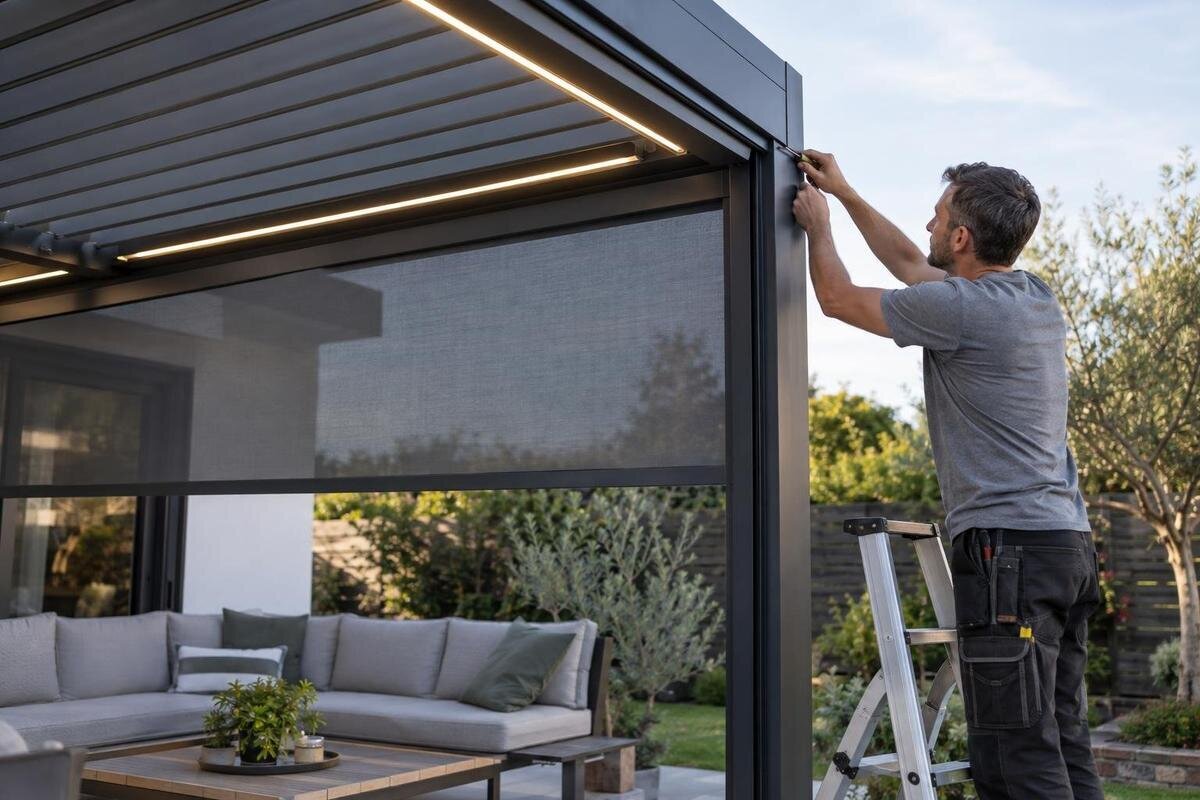
Pergola upgrades
Retrofitting a screen or lighting sounds like a simple add-on, but the visible frame does not reveal all the details that determine compatibility. A pergola may have no approved fixing points for a screen, no suitable cable route, or controls and spare parts tied to an older generation. Start by identifying the structure and the job you want the accessory to do. Then check frame provision, movement, wiring, controls and component availability against documents for that exact installation. This guide helps you gather the evidence and recognise when a supplier or qualified professional needs to assess it.

Identify the pergola's exact model and generation
Before looking at brackets or cable routes, identify the pergola as it was supplied. Find the order confirmation, invoice, installation paperwork and any model or serial label. Note the approximate installation date, installer, and any repairs or changes made since. A model-family name may cover different production runs, while two structures can look similar but use different parts. Treat a recollection or a close visual match as a clue, not a compatibility check. Record the original roof, post and beam arrangement, especially if anything has been replaced, moved or altered. Check paperwork against the label: a later invoice might describe a replacement component rather than the original frame.
Ask for the installation manual and technical drawing that match the model reference, as well as instructions for any proposed accessory. If documents are missing, take a whole-structure photo and clear close-ups of labels, beam ends, corners, visible slots and existing controls; do not dismantle the frame to expose a label. Record label text exactly, including any suffixes, and keep images that show the structure and its surroundings. The Bloomcabin Pergola product listing provides a catalogue name to compare with your records, but it cannot establish the age, options or construction details of your installed pergola. Those particulars are what a supplier needs before confirming fit.
Define what the screen or lighting must do
Translate the idea into a clear brief before searching for accessories. For a screen, note which side needs coverage and whether the aim is privacy, filtered daylight or a more defined edge to the area. Decide whether you have a fixed panel, retractable outdoor blind or another form in mind; each has different mounting and operating requirements. Record whether one side or several need screening, how much of each opening should be covered, and what access or view must remain clear. Note how often you expect to move it. A useful brief gives a supplier something specific to assess and makes different quotes easier to compare.
For lighting, identify what needs to be illuminated, the preferred location and whether you want a permanent fitting, a movable option or lighting linked to an existing control system. A fitting on a post, one along a beam and a portable lamp raise different mounting, wiring and maintenance questions. For a Bloomcabin Bioclimatic Pergola upgrade involving both screens and lighting, describe both in the same brief. Mark their proposed positions together so a screen housing, guide or moving panel does not obstruct a fitting or its service access. Include any preferred control arrangement, but leave equipment selection until compatibility is established.
Check approved mounting points and frame support
Screen mounting is a structural question, not just a matter of finding a flat edge. A bracket may need a specified section, factory provision or particular fixing position; the exterior appearance does not reveal internal cavities, reinforcement or acceptable fasteners. A screen can also change how wind acts on the pergola, so do not treat a seemingly light panel as a harmless decoration. Use the matching manual or written manufacturer guidance to identify approved mounting points and any stated limits. Do not drill, clamp, bond or screw into a beam or post simply because the spot is accessible. An existing hole or groove may have another purpose, and an unapproved fixing can damage the frame or make future servicing harder.
If the pergola meets a house wall, check the complete attachment path, not just the proposed screen bracket. The approved detail needs to apply to your frame and its installed setting; do not assume the wall or an existing connection can accept a new load. Have uncertainty assessed by the supplier and a suitably qualified professional who can consider the actual site. For an existing Bloomcabin Wall-Mounted Pergola, request the drawing for the installed version and identify where you want the screen attached. Keep photos of the proposed fixing points so the person checking compatibility can see their location and condition.
Measure the opening and operating clearance
Measure the opening the screen must actually cover rather than relying on the pergola's advertised footprint or an old plan. Record the clear width and height between the proposed fixing surfaces, the post and beam positions, and any changes in those dimensions along the span. Note nearby walls, downpipes, eaves, lights, doors, windows, gates and furniture that could affect access. Keep inside-face and outside-face measurements distinct, and use the measurement points requested by the screen supplier before ordering. If the structure is not square or a surface is uneven, report that instead of compensating with a guess. Use safe, accessible measuring points; leave elevated or awkward measurements to an installer.
Consider the whole operating envelope. A retractable screen needs room for its housing and guides, while an opening panel or curtain needs its own movement and storage space. Check whether either would obstruct a door, walkway or furniture. Allow for access to handles and for servicing the accessory; if the pergola has moving parts, consider their full travel as well. Photograph the opening from inside and outside and mark obstructions on a simple sketch. If you are comparing your structure with the Bloomcabin Pergola catalogue page, keep catalogue dimensions separate from your site measurements. The clear opening still needs to be measured on the structure at your home.

Assess the electrical route and power supply
Map the visible electrical arrangement without opening enclosures or touching conductors. Note where existing lights, switches and controls are, whether a power point is nearby, and any cable route that can be seen safely from ground level. Keep the original electrical paperwork if you have it, and note whether lighting has been installed or changed since the pergola was built. A nearby power point does not confirm that a permanent fitting can use that supply or that a cable can reach the pergola by an appropriate route. Do not cut into beams, drill a channel or route a lead across a moving joint based on guesswork; hidden wiring and moving parts need a properly assessed solution.
Ask a qualified electrician to assess the actual supply, proposed fitting, cable route, control method and relevant local requirements. The assessment should cover how the installation will be accessed, protected from outdoor exposure and maintained, rather than only whether power is present. For lighting on a Bloomcabin Bioclimatic Pergola model, provide the installed version and manual reference so the electrician and supplier are discussing the same structure. Tell the electrician if screens or moving roof components are also planned, and ask the pergola supplier to confirm any approved cable path. Resolve the route before choosing a fitting that depends on concealed wiring.
Match controls and component generations
Check the controls separately from the physical fit. Existing screens, lights and roof mechanisms may use a switch, remote, receiver, app or other controller, and matching brand names do not establish that two generations work together. Record model numbers shown in manuals or on accessible control labels; do not open control boxes or assume a replacement remote can pair with an older receiver. Ask the supplier to confirm the exact accessory, controller version, power requirements and any required interface in writing. If a system relies on an app, hub or sensor, check whether the proposed accessory is supported by that particular system rather than assuming a newer feature carries across.
Decide whether the new item must operate independently or join an existing control, and who will configure and test it. A manually operated screen may avoid some control questions, but it still needs approved attachment and clearance; a motorised version adds controls and electrical compatibility to the check. An enquiry about controls for a Wall-Mounted Pergola should include both the installed pergola version and the accessible controller reference. Ask the supplier to identify the exact control generation checked and any additional components required. A reply that confirms only a brand match leaves an important part of the upgrade unresolved.
Check availability of compatible and replacement parts
A compatible concept can still be impractical if the required components are no longer available. Depending on the system, a screen may need particular brackets, guide rails, fabric dimensions or a motor; lighting may rely on matching fittings, drivers or control parts. Treat these as examples of items to verify, not as a list of parts your pergola necessarily uses. When enquiring about accessories for an existing Bloomcabin Pergola, ask whether the complete set of mounting and control components is available, or whether an approved successor exists. A replacement that looks similar can have a different interface, and a part that fits between posts may still lack documented compatibility.
Make the enquiry easy to answer. Provide the model or serial reference, purchase or installation record, relevant manual page, overview and close-up photographs, and a description of the accessory you want. Include existing control references and any known modifications. Take measurements only after checking which points the supplier needs, and ask for exact part references plus instructions or drawings for any proposed successor. If the original item is no longer listed, pause before buying a substitute based on colour, dimensions or a claim that it is universal. Seek written confirmation that the replacement suits the installed version and intended use.
Get a model-specific answer and a clear work scope
Before approving a quote, ask it to identify the pergola model or revision checked and the exact accessory kit proposed. It should state which approved fixing provision will be used, how clearances and moving parts were considered, and whether wiring or controls need separate work. Ask which components are included, what must be ordered separately, whether existing parts have to be removed, and who handles electrical assessment, installation and commissioning. A vague allowance for a screen and lighting can hide gaps between trades. Ask the installer to record any site assumptions and who is responsible if a part does not fit as expected. A written scope lets you compare like with like.
Check the pergola's existing warranty and maintenance documents before authorising changes; do not assume either that a retrofit is automatically covered or that it automatically cancels cover. Ask the supplier how the proposed work is treated and keep the reply with your records. A quote for upgrading a Bloomcabin Bioclimatic Pergola model should identify the precise installed version and accessory kit checked, rather than relying on the family name alone. Where advice conflicts, seek clarification before drilling or connecting equipment. Make sure the installer knows what has been confirmed, which documents apply and what remains outside the agreed scope.

Decide whether the upgrade is ready to proceed
Treat the result as green only when the documents match the installed model and revision, the proposed accessory is explicitly identified as compatible, mounting provision and movement clearances are addressed, and the necessary parts are available. Any electrical or control work should have a named professional and a defined scope. This is a basis for proceeding to a properly planned installation, not a substitute for checking the frame's condition on site. An amber result means one or more details remain unknown: perhaps there is no label, the manual is generic, the cable route is unclear, or a replacement controller has not been confirmed. Gather the missing evidence and ask for a definite answer before booking.
Make the result red for now if the frame is visibly damaged or altered in a way the documents do not cover, the proposed fixing has no approved detail, or the screen, wiring route or control plan relies on improvisation. Do not add a screen or cut into the pergola to test a theory. Ask the supplier or a suitably qualified professional to inspect the uncertain point first. Stop if two documents conflict or an installer cannot explain how the accessory matches your exact version. Reassess only when the missing information has been resolved; a verbal assurance should not replace a clear compatibility record.
Compare a retrofit with other options
Compare the whole job, not just the accessory. A retrofit quote may need to account for parts, a site assessment, installation, electrical work, control configuration and any changes to existing equipment. Ask what maintenance or future servicing the proposal involves, and compare that scope with the disruption and work involved in replacing the pergola. If you want both screens and lights, coordinate the layout and routes before either is installed so that one job does not obstruct or undo the other. Keep the written compatibility response, final scope, manuals and any updated drawings with the pergola records for future repairs or upgrades.
If a suitable part is unavailable or the frame has no approved provision, a non-fixed option may be worth considering. A portable outdoor-rated light that does not attach to the pergola avoids changing its frame, but its instructions, location and power arrangement still need to suit the setting. A freestanding screen has its own mounting, movement and site-suitability questions; do not assume it is suitable merely because it is separate from the pergola. If replacement is the better route, check accessory compatibility for the proposed structure before purchase and keep that evidence with its documentation.
Frequently asked questions
Can a screen be added to any pergola?
No. The frame needs an approved way to carry the screen and its fixings, and the screen must suit the opening and the pergola's configuration. Appearance alone is not enough to establish compatibility. Check the manual for the exact model and get confirmation before drilling or fitting anything.
Does a nearby power point mean I can add pergola lighting?
Not necessarily. It does not confirm that a permanent fitting can use that supply, or that there is an appropriate cable route and control arrangement. Ask a qualified electrician to assess the actual site, and check with the pergola supplier before making changes to the frame.
Can I use a manual for a similar-looking pergola?
Use it only as a clue while you identify the installed model. Similar-looking frames can belong to different production runs or use different components. Match the manual to the model or serial reference and revision, and ask the supplier if you cannot confirm that it applies.
What if the original screen or controller is discontinued?
Ask whether an approved successor is available and whether it is compatible with your exact pergola and control generation. Do not rely on appearance, measurements or a claim that a part is universal. If no match is confirmed, compare other documented options before ordering.
What should I include in an upgrade enquiry?
Send the model or serial reference, purchase or installation records, relevant manual details, clear photos of the whole structure and proposed fitting area, and a description of the screen or lighting you want. Include existing control references and any known alterations. Ask for a model-specific written compatibility answer.
A later screen or lighting upgrade is possible when the exact pergola version has documented mounting provision, a workable route for any wiring, compatible controls and obtainable parts. The quickest way to find out is to pair the right model records with a clear description of the intended upgrade, then resolve any gaps before work begins. If one key detail cannot be confirmed, pause and compare an approved alternative rather than relying on a visual match or an improvised fixing.
