
Are Louvred Pergolas Watertight in Heavy Rain?
Pergola weather guide
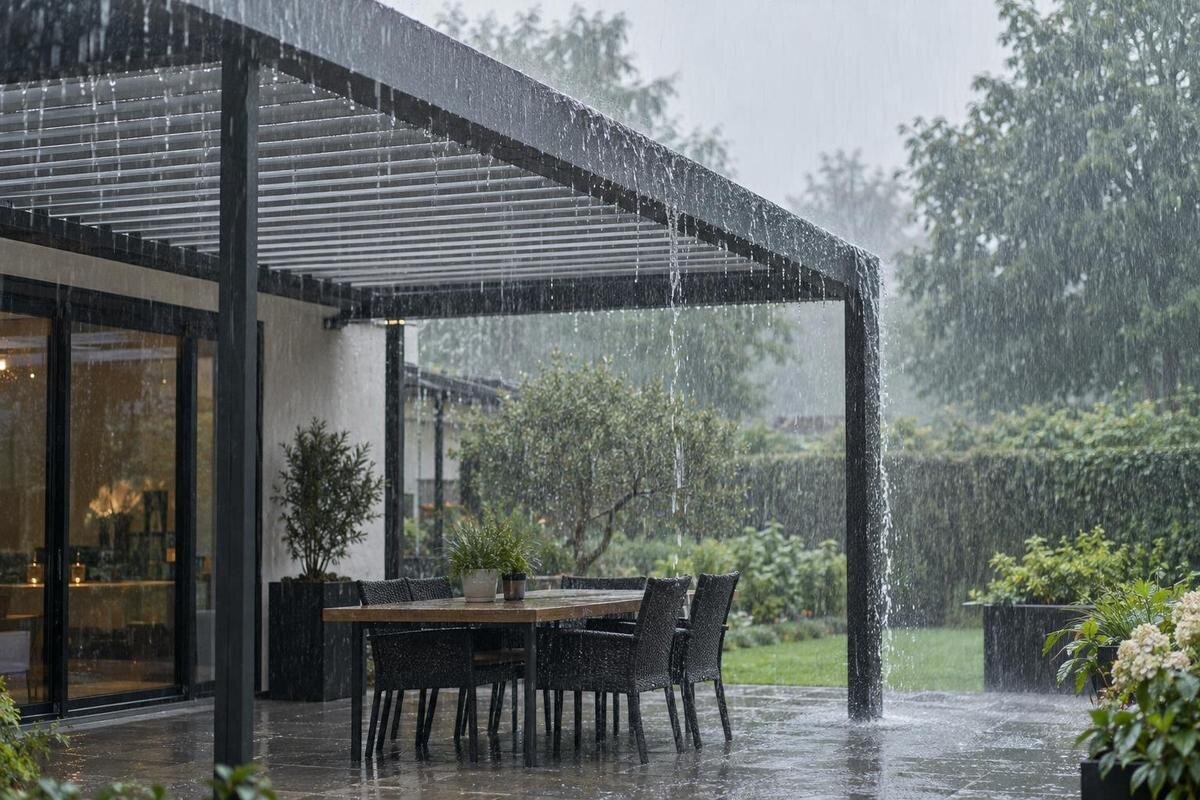
A louvred pergola designed to manage rain can collect water from its closed roof and direct it to drainage outlets, but it is not necessarily watertight in heavy rain. The result depends on the exact louvre design, how water is collected and discharged, the installation and whether wind drives rain under exposed edges. Judge the stated conditions for the particular model rather than treating “louvred” as a guarantee of a dry, enclosed room.

What “watertight” means for a louvred pergola
“Watertight” can describe two different expectations. One is that rain falling onto a closed roof is directed to its intended drainage route without passing through the roof surface under specified conditions. The other is that every part of the space below stays dry in any storm. An open-sided pergola cannot promise the second outcome just because its roof closes. The word on a brochure does not explain how the louvres meet, what happens at the perimeter or which weather conditions were assessed. Ask what the claim covers, which components are included and where its limits are stated. If the answer describes roof drainage only, treat it as roof-plane performance, not proof that the whole outdoor area is weatherproof.
Separate overhead shelter from enclosure protection. With louvres fully closed, a roof designed to manage rain can intercept water from above and guide it towards its channels or outlets. The sides remain a different matter: wind can carry droplets through open edges, and a gap caused by incomplete closure or misaligned parts may let water through the roof plane. The result may be a sheltered outdoor space rather than an indoor-like dry room. Before choosing, decide whether you need a dry tabletop in ordinary showers, protection for cushions between visits, or dependable cover for items that cannot get wet. Those expectations call for different evidence and may require different site arrangements.
How rain reaches the drainage outlets
Rain management needs a continuous route from the roof surface to a discharge point. In a system designed for this purpose, water runs from closed louvres into channels or a perimeter gutter and then through designated outlets; the exact arrangement differs by model. Some designs may use posts, downpipes or other routes, so do not assume water travels inside the frame or exits on a particular side. Request the model’s drainage diagram, with the flow direction, collection points and discharge locations marked. That allows you to see where water is expected to fall, whether an outlet sits near a doorway or path, and whether the intended drain connection is available at your site.
Confirm how the roof must be positioned for that route to work. A partly open roof is not the same condition as a fully closed one, and the controls may have a defined end position. Ask whether the rain claim applies to the roof size and configuration you plan to buy, and whether installation alignment affects the drainage path. When considering the Bloomcabin Bioclimatic Pergola, compare its drainage drawing with your site layout. A product photograph rarely reveals underside channels, outlet locations or how the roof meets its supports. The drawing should help you identify the complete water route, including where it leaves the structure, rather than leaving you to infer those details from the frame’s appearance.
Wind-driven rain at open edges
Wind-driven rain is one reason a roof can drain correctly while the area beneath it still gets wet. Gusts push droplets sideways, sometimes under a roof edge or towards a wall junction; the path depends on wind direction and on which sides remain open. A test using water falling vertically cannot, by itself, answer how the same roof behaves in blowing rain. For an exposed terrace, ask for separate information about wind and rain instead of assuming a roof claim covers both. Look for stated conditions and limitations, not a blanket promise about storms. Unless the evidence specifies wind-driven exposure, keep expectations to the conditions it actually describes.
Map the open edges at the intended site: which side faces the weather, whether a wall or eaves sit beside the roof, and whether nearby structures channel gusts across the space. If possible, note the direction rain tends to arrive from at the terrace; a sheltered patio and an exposed area may have different edge conditions. The Bloomcabin Wall-Mounted Pergola page identifies a wall-mounted model, but it cannot confirm the water seal at your building junction. Ask for an approved connection detail that suits the wall material and roof layout, then have the installer explain which edges remain open in the proposed configuration and where water could enter from the side.
What counts as heavy rain?
“Heavy rain” needs numbers before it can be useful. A short burst, prolonged rainfall and a downpour with strong gusts place different demands on roof joints, outlets and exposed edges. Ask whether the evidence records a rainfall rate or total, the duration, wind conditions, louvre position, roof size and whether the sides were open. Those details show what was observed and help you compare it with the conditions you want the space to handle. A general phrase such as “rain tested”, without a described set-up, offers little basis for deciding how much shelter to expect during a downpour.
Drainage has a design capacity, and water can back up if an inlet or outlet is obstructed or the conditions exceed the stated limits. Do not infer a safe flow rate from the number of channels or from a photograph; those features are not performance data. When comparing the Bloomcabin Pergola with your requirements, ask what the manufacturer says happens when rain is more intense than the tested condition. Check whether operating guidance applies during storms and what you should do if water is not draining normally. This separates the conditions covered by a rain claim from situations where the roof may no longer provide the level of shelter you expect.

How to read a rain-test claim
A useful test record identifies the precise roof system and conditions, not just the brand. Check whether it covers the louvre design and dimensions you plan to buy; whether the louvres were fully closed; how water was applied; how long the test ran; and which edges, walls or optional panels were present. If the test used a sample or controlled rig, ask how it represents the proposed installed arrangement. The point is not to demand a particular test label, but to know what was measured and what counts as a pass—for example, no water through the roof plane rather than no water anywhere inside an open-sided structure. A clear scope prevents a narrow roof test being read as a whole-area guarantee.
Ask for results, not only a sentence saying the pergola is suitable for rain. A useful response should explain where observers looked for leakage and what limitations remain. For Bloomcabin’s bioclimatic pergola model, establish whether the available results apply to the configuration being quoted, including any selected side enclosure. Keep that reply with the quote so the scope of the claim remains clear when you choose options. If the details are unavailable, plan around overhead shelter rather than a sealed room. The important distinction is between a result for the closed roof itself and a result that also accounts for rain entering around its edges.
The drainage route needs clear outlets
Even a well-designed drainage route can carry water only while it remains clear. Leaves, seed pods and fine debris may collect at roof channels, gutters or outlets, depending on the design and surroundings. Ask where routine access is needed, how the manufacturer says to inspect and clean the drainage points, and whether the louvres must be in a particular position during maintenance. Do not rely on a view from below: concealed collection points may be hard to see. The aim is to understand the maintenance the chosen system calls for, not to assume all pergolas use the same hidden gutter arrangement or require the same cleaning routine.
Follow the water after it leaves the roof. Find out whether it discharges at the perimeter, through a downpipe or into a connection, and where the outlet sits relative to paths, doors and existing drainage. For a layout using the Bloomcabin Wall-Mounted Pergola model, compare the proposed outlet positions with these features before work begins. A diagram can help an installer spot conflicts; a photograph cannot establish capacity or compatibility. Ask what the documentation says about overflow and which drainage points need checking after debris or severe weather. Make sure the proposed outlet route remains accessible for inspection, rather than considering only how neatly it fits into the finished layout.
Wall junctions and exposed sides
A wall-mounted layout adds a junction between the roof and the building, and that junction is a separate potential water path. Roof water may be managed while rain still tracks along a wall or enters at an interface that has not been detailed for the particular cladding, eaves or gutter arrangement. Do not assume a generic sealant or flashing detail will suit every surface. Ask for the approved connection drawing and have an experienced installer confirm how it meets the building, how existing roof drainage remains accessible, and where water from each edge will go. This is especially relevant where the pergola sits below or beside existing roof runoff.
A freestanding layout generally has more perimeter exposed to rain, though actual exposure depends on nearby walls, fences and screens. A windbreak may change where water reaches the space, but should not be treated as a tested roof enclosure. When reviewing the Bloomcabin Pergola listing, check which components are included in the proposed configuration rather than assuming that a wall junction, panel or perimeter seal forms part of it. Compare the roof, support and enclosure drawings to identify the open edges and the intended water discharge points. This makes the boundary of the sheltered area clearer than a product image alone.
What side enclosures can change
Side screens, sliding panels or other enclosures may reduce rain entering from the side when they are designed for use with the selected pergola, but they do not increase the roof’s drainage capacity or change a roof test automatically. A barrier can also redirect water towards joints, thresholds or adjacent walls. Check whether the enclosure is compatible with that exact model, whether it can be used in the weather conditions described, and whether the roof and enclosure were assessed together. An option shown beside a pergola is not proof that every combination is suitable for a downpour; the configuration and its limits matter.
Ask how rain is expected to leave the enclosed space, particularly around door tracks and at the base of panels; those areas may still be exposed to water from above or from the sides. Find out whether there are limitations on leaving panels closed in wind, and whether the roof must remain closed or be operated in particular conditions. If you are considering Bloomcabin’s wall-mounted pergola option, request written confirmation of the compatible enclosure configuration and its weather limitations rather than inferring them from product images. A screen reduces exposure only within the conditions for which that arrangement is intended.

Decide how dry the space needs to stay
Translate “keep us dry” into a practical acceptance test. Are you protecting people seated at a table, keeping cushions dry between visits, or shielding items that cannot tolerate any moisture? Note whether those items sit near a perimeter, doorway or wall, because sideways rain does not behave like water falling through the centre of a roof. Moveable furniture can be pulled back from the edges, but fixed cabinetry or equipment sets a higher expectation. A pergola may suit overhead shelter without being the right choice for a space that must behave like an indoor room. Decide whether occasional dampness at the perimeter is acceptable before comparing products.
Be clear about what you will accept in weather the supplier has not tested. It may be acceptable for the roof to intercept ordinary rain while a strong crosswind wets the outer strip; that is different from wanting an all-weather outdoor room. Sketch the part of the terrace that must stay dry, mark which sides remain open, and note where people or belongings will sit. Use that sketch when discussing Bloomcabin’s regular pergola so your expectations refer to a defined area rather than the whole space beneath the roof. Compare that area with the stated weather limits and proposed edge treatments before deciding whether the arrangement suits your intended use.
Questions to settle before you buy
Before ordering, put five answers in writing: which exact model and size configuration the test covers; whether the roof was fully closed; the rainfall and wind conditions; the route and discharge points for water; and what the stated limits exclude. Ask for the drainage diagram and any instructions for operation or inspection. If a claim is verbal or vague, request an explanation in plain language and ask who can confirm it. Check that the documents refer to the same model and configuration as the quote. You are checking whether the evidence applies to the weather exposure and layout at your home, not looking for a universal storm promise.
Give the installer a site plan or clear measurements showing the wall, eaves, existing gutters and planned outlet locations, then ask them to identify exposed edges and access points. Have structural, anchoring or building-interface questions assessed by a suitably qualified professional; do not make a rain decision from a roof diagram alone. Ask who will confirm that the drainage parts match the selected arrangement and where discharged water goes. Check that access to outlets will not be blocked by the way the area is furnished or used. A useful answer should make the likely wet zones and the model’s stated limits as clear as the parts expected to stay dry.
Frequently asked questions
Are louvred pergolas watertight when the roof is closed?
Not necessarily in every sense of “watertight”. A roof designed for rain can direct water into its drainage route under stated conditions, but that does not seal open sides or guarantee a dry area in wind-driven rain. Check what the exact model’s performance claim covers.
Can wind-driven rain get under closed louvres?
Yes. Wind can carry rain beneath exposed roof edges or towards gaps and wall junctions. How much enters depends on the wind, site and roof configuration. A test of rain falling vertically does not, by itself, show how the structure performs in gusty conditions.
Does a rain claim cover the whole area underneath?
Not automatically. A claim may refer only to water passing over the closed roof and into its drainage system. Ask whether the sides were open during testing, how leakage was assessed and whether the stated result applies to the full area beneath the pergola.
What should a drainage diagram show?
Look for the direction water travels across the roof, where it is collected, the outlet locations and where it is discharged. The diagram should relate to the model and configuration you plan to buy. It helps you check whether outlets are near doors, paths or existing drainage.
Do side screens guarantee a dry space?
No. Compatible screens may reduce rain entering from the sides, but they do not automatically increase roof drainage capacity or make an open structure equivalent to an enclosed room. Ask whether the roof and the chosen enclosure were assessed together and what weather limits apply.
Judge a louvred roof as a roof-and-drainage system under stated conditions, not as an all-weather seal. Closed louvres may manage rain from above, while wind exposure, perimeter details, wall junctions, outlets and any side enclosure determine what happens around them. For heavy-rain use, the key evidence is a model-specific test scope and drainage diagram matched to the proposed site. Overhead rain protection is one claim; a reliably dry outdoor room is a much broader one.
