
Pergola LED strips or spotlights: what to compare
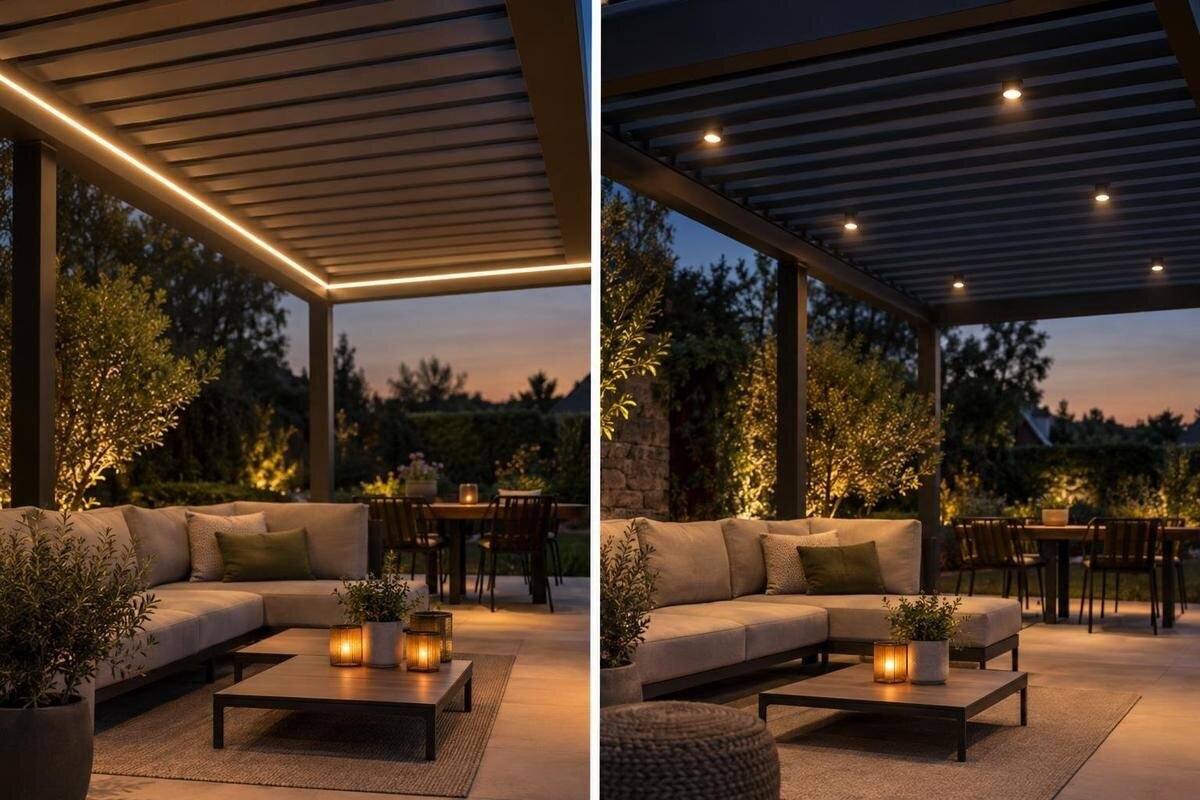
Pergola lighting comparison
Choosing between pergola LED strips and spotlights comes down to more than a continuous line versus separate pools of light. Compare whether the structure has approved mounting positions for each option, how light falls across the intended area, whether a source is visible from usual seating, and how it can be replaced later. Neither type is automatically brighter, less glaring or easier to maintain. Check the exact fixture information and available mounting points for the chosen configuration, then confirm outdoor suitability and electrical details against the relevant manuals with a qualified professional.

What to confirm before choosing 1
How strips and spotlights distribute light
An LED strip is a linear source. On a continuous mounting run approved for the pergola, it can create a line of light along that route. Spotlights are separate sources, each producing a beam or pool whose spread depends on the fixture’s optics, output and position. That distinction changes the pattern, not the guaranteed performance: a long strip will not necessarily illuminate the full area evenly, and a row of spots need not leave obvious dark gaps if their distributions overlap as intended. Treat strip versus spotlight as a comparison of source shape, not a shortcut to judging brightness.
Look at the intended surfaces and the distribution information for each exact fixture. The same fitting can appear different against a dark ceiling, pale wall or glossy tabletop, because nearby surfaces affect reflected light and perceived brightness. A rendered scene or product photograph may communicate atmosphere but cannot confirm how much light reaches the table or floor. Ask for the fixture reference and a layout showing its position and expected spread. If you can view samples, compare them in similar settings rather than choosing from pictures alone. Keep two questions separate: do you like the appearance of the light source, and does its distribution suit the area beneath it? An attractive outline around the roof does not, by itself, answer the second question.
Map the mounting positions the pergola supports
Before choosing a style, mark the locations the pergola manufacturer permits for lighting. Request a drawing or written confirmation for the configuration being considered: which frame or roof positions are approved, whether there is a continuous run for a strip, and where spotlights can be mounted. A plan may reveal a break at a beam, a line that ends before the desired area, or a spotlight point in an awkward position. Check that the proposal reflects the exact size and options you are comparing. Do not assume every beam, slat, panel or decorative edge can take a fitting.
Treat the product name as identification, not confirmation of a lighting package. If Bloomcabin Pergola is on your shortlist, ask which light positions and fixture options are confirmed for the configuration you are considering; the name alone does not establish that strips or spotlights are included or approved. Look for a plan that identifies each fitting and its mounting point, alongside the relevant product documentation. Keep that information with your configuration notes so the supplier, installer and qualified electrician can assess the same proposal rather than working from a general image.
What to confirm before choosing 2
Check how the roof layout affects fixture positions
Roof geometry can make a simple-looking layout difficult. A strip needs a continuous, approved mounting line, which may be interrupted by separate structural members. Spotlights can sit at individual supports, but roof members may affect where their beams land. If the selected pergola has adjustable or moving roof parts, ask how each proposed fitting relates to the positions the roof can take. The point is not to assume that either type will interfere; it is to have the product guidance show whether each position is allowed and whether the light distribution changes with the roof setting.
For Bloomcabin Bioclimatic Pergola, request the lighting information for the configuration you are considering and compare it with the relevant pergola and fixture manuals. Pay particular attention to roof movement, drainage, controls and service access. On the layout, distinguish the fixed mounting positions from any moving roof parts, then ask how the proposed strip run or spotlight positions relate to each roof setting you expect to use. This makes it easier to compare a continuous line with separate points without assuming either arrangement will work everywhere. A decorative image cannot establish an approved mounting position; where a preferred fitting has no confirmed location, compare a documented alternative rather than improvising an attachment.
Compare the light where people sit and move
Plot the furniture and the routes people use beneath the pergola before judging a lighting plan. Mark the table, lounge chairs and main access points, then ask where light from each proposed fitting will fall. A strip is useful where its supported mounting line allows light to reach those areas; a spotlight is useful only if its beam reaches the target without relying on an unconfirmed aiming feature. Check whether an edge strip leaves the central table short of light, or whether several spots concentrate light in one area while another receives little. Compare both options with the furniture in the same positions. If you regularly rearrange the seating, include that alternative layout too, so the comparison reflects how you use the space rather than just one presentation drawing.
If Bloomcabin Wall-Mounted Pergola is under consideration, include the wall and frame in the same drawing, rather than planning from a roof outline alone. Mark doors, windows and usual viewing directions alongside the furniture, so the proposed light can be reviewed from the places people sit and enter. Ask which frame or wall positions are approved for fittings. Then compare how each option relates to those positions: does the strip follow the edge you want lit, and do the spotlight beams reach the intended areas? Keep the location of the source separate from the area receiving light. A fitting beside a doorway and a fitting intended to illuminate that doorway are not necessarily the same proposal.

What to confirm before choosing 3
Compare coverage, not fixture count
Do not compare a number of spotlights directly with metres of strip, or assume more fittings always mean more useful light. The exact fixtures can differ in output, beam width and distribution; a strip’s length says how long the source is, not what area it adequately lights. Ask for the manufacturer-stated output and, where available, a distribution diagram for each model. Check whether the proposed layout covers the same target area and whether overlapping beams leave darker spaces. Wattage alone is not a reliable comparison of visible light, so consider electrical consumption and light output as separate pieces of information.
For a regular pergola configuration, compare strip and spotlight proposals against the same table or seating area and intended use. Record the fixture model, quantity or strip length, approved position, control method and any output information the manufacturer provides. Keep the descriptions comparable: if one proposal states output for a complete strip run, do not set that figure beside the output of a single spotlight without noting the difference. Likewise, distinguish the length of the illuminated line from the area it is intended to cover. This gives you a more useful comparison than a continuous line in one image and scattered points in another. Where information is missing, leave the entry open for clarification rather than treating words such as bright or powerful as a substitute.
Assess glare from the usual viewing positions
Glare depends on what people can see, not simply on whether the source is a strip or a spotlight. A bright strip can form a visible line in a seated sightline, while a spotlight may be uncomfortable if its source or beam is directed towards the viewer. Diffusers, shielding, source brightness and position all affect the result, so labels such as soft strip or focused spot are not enough. Put the usual seats and standing locations on a plan, then review the exact fixture from those viewpoints. If you can view a sample, look at the source itself as well as the surface it lights.
If the pergola has more than one roof position, assess glare in the settings people will actually use, not just in a staged position. For the bioclimatic pergola option, confirm the supported light locations, then consider whether the source is visible from seated positions as the roof changes position. Do not assume the roof will shield a fitting or reduce glare; that depends on its geometry and the chosen fixture. Record the particular seat, viewing direction and roof setting that raises a concern. This gives the supplier a specific question to address and helps you compare a visible strip with individual spotlights from the same viewpoint, rather than making a general judgement about either type.
What to confirm before choosing 4
Plan for future replacement access
Replacement access is easier to assess before the furniture and fittings are in place. Ask whether the chosen strip is a serviceable component or part of a larger assembly, whether a diffuser, driver or connection is separately replaceable, and what access the manufacturer’s instructions require. Do not assume a strip can be cut, rejoined or replaced in sections. For spotlights, find out whether one fitting can be changed independently and how a replacement is matched to the original. The answer varies by product, so check the exact fixture reference and parts information rather than relying on the general category.
With the wall-mounted pergola option, ask how a failed light would be reached and which approved parts could be removed for service. A spotlight may be an individual unit, but that does not prove it is accessible or that a compatible replacement is available; a strip may or may not be replaceable as a complete run. Request service information for the precise fittings, including any stated access requirements. For each option, note what would be replaced, what would need to be opened or removed, and how the replacement part would be identified. Keep access to the light itself separate from access to its driver or connections. This makes the maintenance comparison more specific than counting fittings: you are comparing the work involved in reaching and replacing the relevant component, not assuming one format will be simpler.
Check controls and compatible components
The shape of a light does not tell you how it is controlled. Confirm how the exact strip and spotlight options are switched, whether dimming is supported, and which driver or controller is specified. A strip and spots may use different components or control methods; do not assume two LED fittings can share an existing control because they use the same light source technology. If you want a separately controlled line and spots, state that requirement and ask for the manufacturer-confirmed combination. A qualified electrician can review the electrical design once the fixture references and approved locations are known.
Use Bloomcabin’s pergola product page to identify the structure you are considering, then request the lighting accessories and control information for its proposed configuration. Ask for references for both fittings and controls, and check that their manuals describe them as compatible. For a useful cost comparison, ask what each lighting proposal includes: the specified strip or spotlights, the relevant driver or controller, and the switching or dimming arrangement. Separate confirmed inclusions from optional items and installation work so you are comparing equivalent proposals. If you want the edge lighting on while the spots are off, describe that preference explicitly. Do not let a single description such as LED lighting stand in for the control functions you expect to use.

What to confirm before choosing 5
Confirm outdoor suitability and mounting approval
An outdoor appearance does not establish that a light is suitable for the conditions at your pergola. Check the exact fitting’s stated outdoor rating and any limits in its instructions for the intended exposure. Conditions can differ between a sheltered position and one more exposed to the weather, so do not substitute the appearance or rating of a similar-looking model. The pergola’s own documentation also matters: it should identify which mounting positions are supported. If either set of information leaves the proposed location unclear, ask the supplier or manufacturer before treating it as a viable option.
Keep the fixture reference, its manual and the proposed mounting position together for a qualified electrician to review. These details answer different questions: the fitting instructions describe its operating conditions, while the pergola documentation identifies approved attachment points. Approval for a similar-looking fitting or a different position does not establish approval for the proposed combination. Record any limits alongside the relevant location on the plan, rather than keeping a general note that the lights are for outdoor use. The electrician can then assess the electrical details against the specified components. This also keeps the comparison precise: each strip run or spotlight position should be assessed for its own intended location, not simply grouped under an outdoor-lighting label.
When a combination of strips and spotlights makes sense
A combination can be useful when a supported strip run and approved spotlight positions serve distinct purposes. For example, a continuous line may suit an edge while a directional beam reaches a particular area, provided the exact fixtures and locations are documented for the pergola. A mixed layout also means more components to control and maintain, so it is not automatically better than choosing one type. Compare the combined plan with strip-only and spotlight-only alternatives. Keep the combination only if it solves a clear coverage issue and its mounting, control and replacement details are confirmed.
For Bloomcabin’s bioclimatic model, request a configuration-specific drawing of both types together where each has a documented position. Compare it with single-type plans for the same areas, including exact fixtures, mounting approval, controls and replacement access. Identify what the second type adds: which area receives useful light that the simpler arrangement does not provide? If both types mainly illuminate the same area, ask whether that overlap is intentional and whether separate control is part of the proposal. Keep any unspecified accessory or unverified attachment clearly marked as unresolved. A combination is worth considering when its additional coverage has a clear purpose; the presence of two fixture types is not a benefit in itself. A single type may remain the clearer choice when it meets the intended use at supported positions.
Frequently asked questions
Are LED strips always more even than spotlights?
No. A strip can look continuous without lighting the whole area evenly, while spotlights can overlap when their beam patterns and positions are planned for that purpose. Compare the exact fixtures’ distribution information and a layout of where the light is expected to fall.
Are spotlights brighter than LED strips?
Not as a category. Output and spread depend on the specific fitting, so neither fixture count nor strip length tells you how much useful light will reach a table or seating area. Compare manufacturer information for the exact models.
Which type is less likely to cause glare?
There is no universal answer. A visible strip can sit in someone’s sightline, and a spotlight can be uncomfortable if its source or beam points towards a viewer. Assess the proposed fittings from the usual seated and standing positions.
Can I use strips and spotlights together?
Possibly, but only if both fixture types have documented mounting positions for the pergola configuration and their controls are compatible. Compare a combined layout with strip-only and spotlight-only plans, including replacement access.
What should I confirm before choosing a fixture?
Get the exact fixture references, supported mounting positions, outdoor ratings and relevant manuals. Also check controls, replacement access and documented mounting approval. A qualified electrician can review the electrical details once the proposed fittings and locations are known.
The better choice fits the available approved mounting positions and provides the distribution you need without placing a distracting source in the usual sightline. Strips suit a continuous supported run when that line benefits the intended area; spotlights suit approved points where their beams can reach a target. Compare the exact fittings, controls and replacement access, with outdoor suitability confirmed for their locations. Choose a combination only when each type adds something useful. The deciding question is not which light looks better on its own, but which supported arrangement works best across the space you use.
