
Should Pergola Louvres Be Open or Closed in Strong Winds?
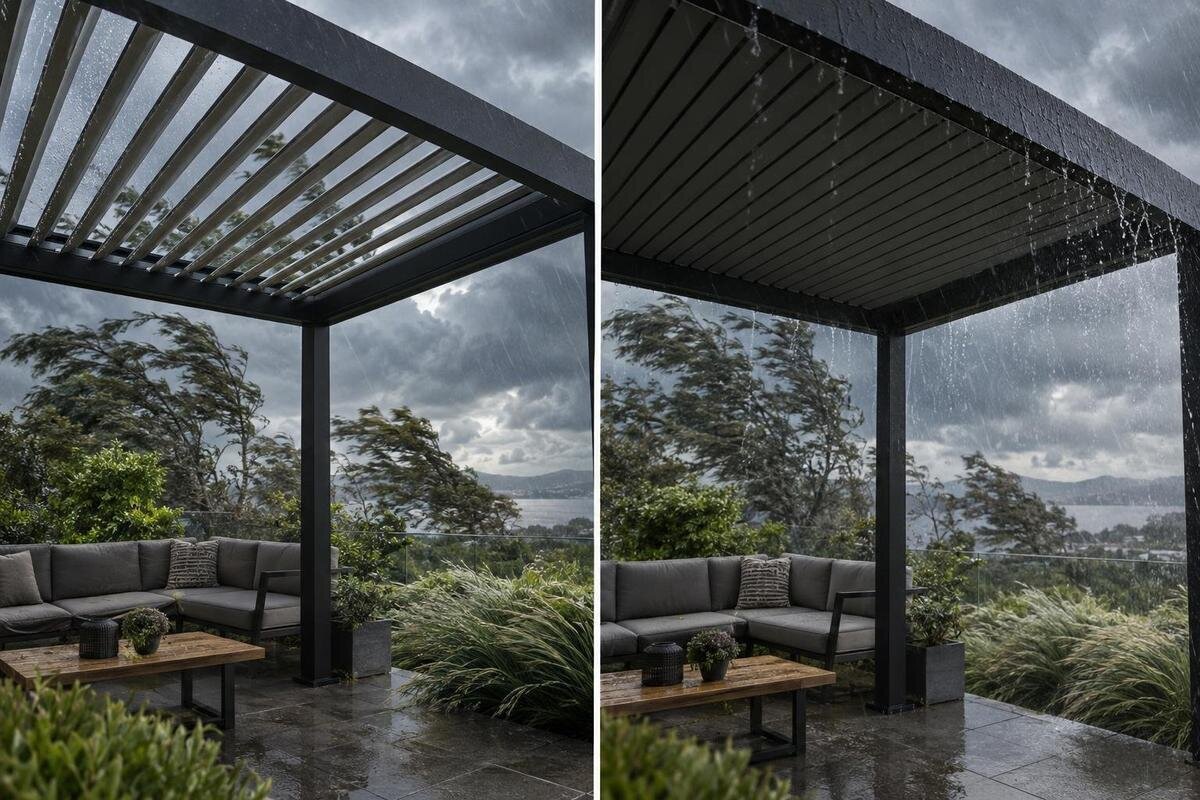
Pergola weather guide
An adjustable pergola roof does not have a universal “open in a gale” or “close it tight” setting. Louvre geometry, the drive system, the installation and any side enclosure all affect what has been assessed and what the operator may do. Before buying—or changing the roof ahead of a windy forecast—find the instructions for the exact model. Check how they define wind limits, which positions are permitted and what action is required. A product description or another owner’s experience cannot establish your roof’s safe setting.

Buyer document checklist 1
There is no universal louvre position for strong wind
There is no reliable rule that louvres should always be open or always closed when strong wind is expected. Pergola roofs differ in blade profile and spacing, rotation range, frame, fixings and drive mechanism; those details affect how wind reaches the roof and where forces act. Even products sold under the same broad label can have different permitted operating states. A manufacturer may specify a particular position, a limit for moving the blades, or instructions to stop operation under stated conditions. The guidance for that exact model—not a rule borrowed from another pergola—must determine the response. If a salesperson gives a simple answer, ask which manual or written instruction supports it.
Do not assume that closed means locked down or weather-tight, or that open means wind can pass through harmlessly. Those conclusions are valid only if the product documentation supports them. The required response may also depend on whether the roof is moving or stationary, which attachments are fitted, and how the pergola is installed. A showroom demonstration or a neighbour’s experience is not a substitute for instructions that apply to your unit. If the manual gives a clear wind procedure, follow its exact wording and limits; if it does not, ask the supplier or manufacturer for a written answer before relying on the roof in windy weather. Never invent a halfway position because it appears less exposed.
Check what the wind limit actually describes
‘Strong wind’ is a useful forecast description, but not necessarily the measurement used in a product manual. A document may refer to a maximum wind speed, a gust, an average over a period, or a measurement taken at a specified point. Those terms are not interchangeable. Check the units as well: a value in metres per second is not the same number as one in kilometres per hour. Do not compare a forecast figure with a limit until you know that both describe the same kind of wind and use compatible units. Ask whether a threshold means the roof must be parked before it is reached, or whether it describes conditions for operating the roof; the answer matters. If the definition is unclear, have the supplier explain it rather than choosing an interpretation yourself.
Your yard can experience wind differently from a general forecast. Direction, surrounding buildings, changes in level, open exposure and nearby obstacles can alter the flow and create gusts or turbulence around the structure. A fence or screen may affect exposure, but it should not be treated as a reliable wind shield unless the design assessment says so. A regional warning can be a reason to consult the manual early, but it is not the pergola’s operating threshold. Forecasts and site measurements do not automatically describe the same conditions. If exposure is unusual, the pergola will sit near a building corner, or you plan to add a substantial enclosure, ask a suitably qualified building or structural professional for a site-specific assessment rather than estimating loads from appearance.
Buyer document checklist 2
Why neither open nor closed is automatically safer
The louvre angle changes the roof’s openings and exposed surfaces, but the resulting wind behaviour is model-specific. In one design an open position may leave blades exposed to uplift or twisting; in another configuration, a closed position may present a broad surface to the wind. Air moving through gaps is not proof that pressure or movement has been reduced to a safe level. Edges, joints, the supporting frame and the direction of the gust matter too. Without a product test or instruction that names the position, there is no sound basis for picking one by intuition.
Also distinguish a position the mechanism can reach from a position approved for windy conditions. A control may allow gradual adjustment across its range, but that does not mean every angle is an acceptable storm setting. Do not hold a switch down, repeatedly cycle the roof, force a blade, or use a manual override unless the manufacturer’s directions specifically permit the action in the conditions present. The Bloomcabin Bioclimatic Pergola listing identifies a product; its name alone does not tell you which louvre state, wind threshold or operating procedure applies. Ask for the document that does.
Separate roof operation from structural performance
Three separate questions should be answered in the documents. In what wind conditions may the roof be moved? If it is already in a particular position, what conditions may it remain in, and which position is required? What wind performance is claimed for the complete installed structure? These may have different answers. A maximum operating wind speed is not automatically a structural design rating, and a structural figure does not automatically permit the motor to move the blades at that speed. Ask the supplier to label each number and instruction plainly.
Ask what the stated performance applies to: the louvres alone, the roof and frame, or the complete pergola with its specified supports and attachments. Fixing points and the supporting surface are part of the installed system; an instruction for one installation cannot be assumed to cover another. Do not treat a marketing phrase such as ‘wind resistant’ as a site-specific assessment. If the manual or proposal does not cover your intended installation, size or exposure, get the design checked by a qualified professional before you commit. Carry the exact name from the Bloomcabin Pergola product page into that request so the answer refers to the model being quoted.

Buyer document checklist 3
Identify the exact pergola and current instructions
Start with the model identification, not a broad category label. Record the product name and any model or size code on the quotation, plus the roof type, controls and proposed additions. The same supplier may sell several configurations; a manual for a visually similar roof can have different instructions. Ask for the current operating manual and any manufacturer-issued wind or weather guidance before you sign off on a purchase. Note its revision or date and who issued it. Keep the documents with the quote so you can later check that the delivered unit matches the product and configuration the advice covered.
Ask for the full wind section rather than a verbal summary. It should explain the terms used, any threshold for stopping operation, the position (if any) required before wind rises, and what to do if the roof is already in another position or power is unavailable. If the response says simply to ‘close it’ or ‘open it’, ask which exact position that means and whether the instruction applies while the roof is moving, during gusts and with your planned side configuration. Use the name shown for the Bloomcabin Bioclimatic Pergola model when requesting its current documents, rather than asking generically about bioclimatic roofs.
The wind-document checklist for a purchase
A useful document pack should identify the exact model and configuration, show the permitted positions, and state separate limits for movement and for leaving the roof parked, where the manufacturer has provided them. It should define whether a wind figure refers to gusts or sustained or averaged speed, give the units and measurement basis, and say what action the user is expected to take. Look for warnings about operating during high winds, loss of power, unusual sounds or movement, and instructions for restarting after a stop. Check whether the guidance assumes all sides are open, a particular screen arrangement or a specified mounting condition. If a figure appears without a definition, mark it as unresolved rather than filling in the gap yourself.
Also request drawings or technical documents that identify the tested configuration and installation conditions. A test report is useful only when it says what model, roof position, size, support arrangement and enclosure were assessed, and what the findings do—and do not—cover. Ask whether the information comes from a controlled test or a limited observation, and whether the proposed installation matches it. If a supplier is discussing the Bloomcabin Pergola range, ask which quoted configuration the evidence concerns; a product name on its own is not a wind rating. Keep any written clarification with the specific document version it refers to.
Buyer document checklist 4
Ask how controls and wind sensors behave
An automatic wind sensor can be helpful only when it is part of, or expressly approved for, the roof system and is set up as the manufacturer intends. Ask whether the unit includes one or requires a compatible accessory; what reading triggers a response; which movement it commands; and whether its behaviour differs when the roof is already moving. Do not assume the presence of a sensor, its threshold or a particular safe position from a control panel or sales description. The manual should explain the sensor’s role and the operator’s responsibilities.
Find out what happens if the sensor loses power, loses its connection or is obstructed, and what you need to do if the pergola has no automatic control. The response may depend on the system, so do not assume the roof will move to a safe position on its own. Ask about any user checks or maintenance the manufacturer requires, without opening electrical components or modifying the controls yourself. If a supplier proposes adding a controller to the Bloomcabin Bioclimatic Pergola, obtain written confirmation that the combination is approved and ask for its wind instructions; an aftermarket device is not a substitute for model-specific guidance.
Include screens and other enclosures in the assessment
Side screens, blinds, glazed panels, sliding doors or other additions can change how wind moves through a pergola and can change the forces on the overall structure. A configuration that is open on every side may not behave like one with a screen or panel fitted; a closed enclosure should not automatically be treated as protection for the roof. Ask for guidance that identifies the exact accessories and combinations, and says whether they must be opened, closed or secured before a windy period. Do not infer a safe combination from a photograph or from the fact that a component fits.
Check whether the roof and each enclosure have separate operating instructions and whether one limits use of the other. Wind can reach a screen or panel differently from the roof, so a shared appearance does not establish shared performance. For a wall-mounted design, the supporting wall and connection need to be covered by the installation plan; the product label alone cannot confirm the suitability of a particular building. The Bloomcabin Wall-Mounted Pergola listing helps identify that product category, but a qualified installer or design professional must address the actual attachment and site.

Buyer document checklist 5
Read drainage guidance alongside wind guidance
Wind and rain guidance should be read together when the forecast includes both, but the claims must stay distinct. A roof position that manages ordinary rainfall is not automatically its prescribed position for strong wind, and a wind limit does not promise a watertight enclosure. Ask whether the operating instructions address simultaneous wind and rain, and follow any separate direction for clearing or draining water. A drainage diagram can show the intended route from the roof to the outlet; it does not, by itself, demonstrate how the roof behaves under gusts or wind-driven rain.
Check that the documentation describes your actual outlet arrangement and any side screens or panels, because those can affect where water goes and what remains exposed. Do not block a marked outlet or add a cover, gutter or enclosure on the assumption that it improves weather performance; ask the supplier to confirm compatibility. If you are considering the wall-mounted Bloomcabin pergola, request drainage and weather documents for the precise configuration rather than applying a diagram for a different roof or mounting arrangement. Keep rainwater management separate from the manufacturer’s wind instructions.
Use a clear routine before and after windy weather
Before windy weather, check the local forecast early enough to consult the model instructions while it is safe to do so. Compare the forecast with the manual’s defined limit only if the terms match; then follow the prescribed action and stop condition. Do not wait until a gust arrives to test the motor or decide which position looks best. Keep the manual and the supplier’s written clarification accessible to whoever operates the roof, and make sure household members or staff know not to override an unclear instruction.
After a windy period, if the roof looks misaligned or damaged, a fixing appears loose, or the control behaves unusually, do not keep cycling it to see whether it recovers. Keep people clear of the affected area and ask the installer or manufacturer how to have it assessed; do not climb onto the structure or attempt a repair unless properly qualified. If a specification is still missing, ask for written clarification for your exact model and installation rather than relying on a generic response. The Bloomcabin Pergola listing can help identify the product name when following up, but it is not a substitute for the required instruction.
Frequently asked questions
Should I open or close pergola louvres before a storm?
Neither position is a universal safe choice. Follow the exact model’s written wind procedure, including any instruction about when to move the roof and which position to leave it in. If the manual does not say, ask the manufacturer or installer; don’t copy another pergola’s setting or make adjustments in unsafe conditions.
Does closing the louvres make a pergola safer in wind?
Not automatically. A closed roof may present a different surface to the wind, while open blades have their own exposure and movement. Only model-specific instructions and evidence can establish approved positions. Check that the guidance applies to your pergola’s size, installation and any fitted screens or other enclosures.
Can I rely on an automatic wind sensor?
Only if the sensor is part of, or approved for, the exact roof system and used as its manufacturer directs. Find out what triggers it, what movement it commands and what happens if it is unavailable. A sensor does not replace the operating instructions or establish the pergola’s wind rating.
Can I change the louvre position once gusts have started?
Check the manual first: some instructions may restrict operation above a stated wind condition. Don’t test the controls, force the roof or choose a position by guesswork when it is already windy. If the instructions are unclear, keep clear of unsafe operation and seek model-specific advice when conditions allow.
Does a severe weather forecast tell me which setting to use?
No. A forecast is not a pergola operating instruction, and its wind figure may not use the same measurement as the product manual. Compare figures only when their units and definitions match. Use the manual’s procedure and seek clarification if it does not explain what to do.
The practical answer is not a universal angle but a documented procedure for the exact pergola, installation and enclosure. Before purchase, obtain the wind section of the current manual and clarify any distinction between moving the roof and leaving it in position. When a forecast arrives, follow that instruction early rather than trying a setting in a gust. If the documents do not state what to do, pause and get model-specific advice instead of assuming open or closed is safer.
