
Can You Collect Pergola Rainwater in a Garden Tank?
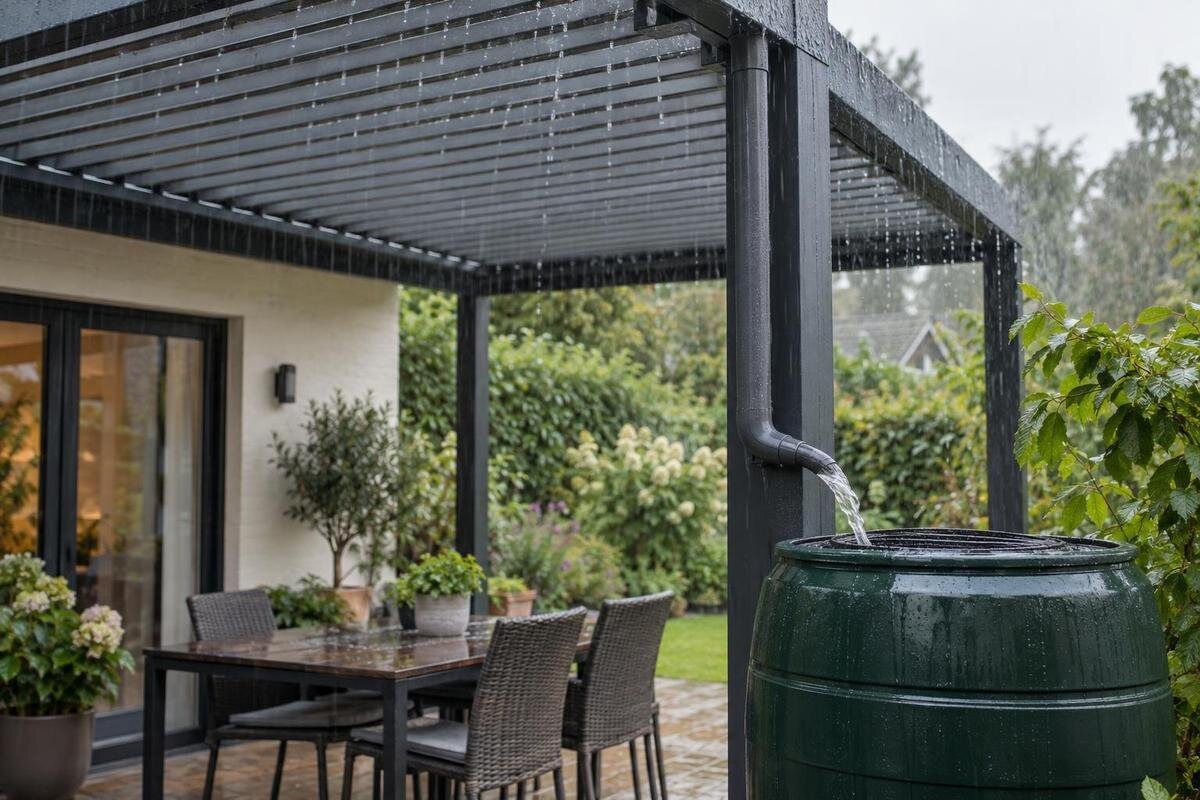
Pergola rainwater planning
A garden tank can collect rainwater from a pergola when the roof configuration gathers runoff and directs it to a defined outlet. The tank is only one part of the system: the outlet, connection, inlet screening, storage volume and overflow route all need to suit one another. A pergola's footprint is not automatically its catchment area, and a product image cannot establish outlet compatibility. Confirm the model-specific drainage information, estimate realistic inflow, and decide what the water will be used for before choosing a tank.

When pergola rainwater collection is practical
Rainwater collection is practical only when the chosen roof configuration gathers water and sends it to a defined outlet. Open structures, broad gaps or a roof that can sit in more than one position may send much of the rain outside the intended catchment. A pergola can provide some shelter without collecting a dependable volume; those are separate performance questions. Look for model-specific drainage information showing the roof area and route, not just a photograph or a general statement that the roof handles rain. If sides or an enclosure are planned, check that the drainage description applies to that complete setup. The important distinction is between rain falling near the structure and water being channelled to an outlet.
Before buying a tank, trace the whole route: roof, outlet, connection, tank inlet and overflow. Check where the tank can sit, whether a pipe can follow a practical path, and whether it would interfere with a doorway, walking area or access to the pergola. Route length and height can affect what connection is feasible, so do not assume a hose will work simply because the tank is nearby. If collection depends on cutting or changing a roof component, ask the supplier whether an approved arrangement exists. Storage cannot compensate for a catchment that does not direct water into it. If no suitable route exists, compare the effort with another roof catchment.
Measure the actual catchment area
Start with the effective catchment area, not the pergola's advertised floor area. Those measurements may not match: roof overhangs, open edges, gaps and movable parts alter how much rain reaches an outlet. Ask for a plan or drainage diagram showing the surface that feeds each outlet, the direction of flow and any roof position required for collection. Ask what an area figure actually measures and whether the whole surface drains to the same outlet. For the Bloomcabin Pergola, use the product page to identify the model, then request the drawing for the exact size and configuration being considered. A catalogue photo or floor-area figure is not a rainwater catchment rating.
Read the drawing as a route, not just a roof outline. It should make clear whether water is collected at one edge or several outlets, whether flow passes through a channel, and where each outlet terminates. If there are several exits, ask which can be connected to the tank and how any unused outlet is meant to discharge. A diagram should distinguish a drainage channel from an edge or trim that only looks like one. For an adjustable roof, confirm the documented position for collection. Mark the pergola, tank location and proposed pipe path on a simple site plan; this can reveal an obstruction, long run or crossing before you settle on storage.
Match the pergola outlet to the tank
Compatibility involves more than attaching a hose. Confirm the pergola outlet's shape, dimensions and direction, the tank inlet arrangement, the connection method and the route between them. Ask whether a named adaptor or other component is required, whether it is approved for the pergola, and who supplies it. Use manufacturer-provided dimensions rather than judging a fitting from a photo. A loose fit can leak or admit debris; an improvised restriction can interfere with drainage. If the wall-mounted Bloomcabin pergola is on your shortlist, use the model name when requesting details rather than assuming fittings from a different pergola will suit it.
Check the receiving side as carefully. A tank's lid, screened inlet or existing pipe connection may be intended for a particular arrangement, so do not assume every opening accepts a pergola downpipe. Ask whether a filter or first-flush diverter changes the joining components, how the connection can be removed for cleaning, and what happens if the inlet is temporarily obstructed. The tank and pergola outlets need to be considered as a pair, not bought as unrelated parts. Avoid cutting, drilling or enlarging a pergola component unless the manufacturer has approved the change. Written details for both sides are more useful than a test fit on delivery.
Estimate likely rainwater yield
An illustrative water-yield check is straightforward: 1 millimetre of rain over 1 square metre equals 1 litre before losses. Multiply a rainfall amount by the effective catchment area for an upper-bound volume in that event, then allow for rain that misses the outlet, is diverted or bypasses the tank. For example, 10 mm over 20 m² represents 200 litres before losses, not a guaranteed tank delivery. Use dimensions from the drainage drawing, not the pergola footprint. With the Bloomcabin Bioclimatic Pergola, ask for the exact area that drains to the outlet; the product name or listing is not a yield rating.
One shower does not predict yearly supply. Compare likely inflow with garden demand across the seasons, using reliable rainfall information for your location rather than a national annual total alone. A short heavy event may send more water to overflow than an almost-full tank can store, while a long dry spell can leave a large tank unused. If you water in particular months, assess supply and demand for those periods rather than relying only on yearly totals. Where catchment dimensions or rainfall patterns are uncertain, treat yield as uncertain too. This simple volume estimate cannot establish a pergola's storm performance or prove that every roof position drains into the tank.

Choose tank capacity around demand
Choose storage to match both likely supply and how quickly you can use it. A small tank may fill and spill during wetter periods; a large one can occupy valuable space while remaining partly empty if the catchment is modest or rain is seasonal. Think about the garden area you plan to water, how often you draw rainwater and whether demand continues during the drier periods when inflow is least reliable. A simple record of current watering needs is more useful than guessing from the pergola's footprint. The tank's stated capacity is storage volume, not a promise that the pergola will refill it. If you are considering the Bloomcabin Wall-Mounted Pergola, establish the selected configuration's catchment and outlet before comparing likely supply with demand.
Consider useful storage rather than volume alone. Check whether there is room for the tank, inlet, overflow and tap, and whether cleaning points will remain accessible. The tank should be close enough to the pergola for a practical connection, without obstructing a doorway or routine garden use. Ask the tank supplier how the stated capacity relates to usable storage, and what space is needed around the inlet and maintenance components. Think about how you will draw water and whether the tap can be reached without moving other equipment. If the tank will sit on a deck, elevated surface or beside a building, ask a qualified professional to confirm support and siting. A full tank is heavy, so do not guess at a base or elevated installation.
Screens and first-flush devices affect collection
Outdoor roof runoff can carry dust, pollen, leaves, insects and material left by birds; nearby trees and the time between inspections affect the debris load. A leaf guard or tank inlet screen can keep larger material out, while a first-flush diverter sends an initial portion of runoff elsewhere. Neither device makes water potable or replaces treatment, and both need maintenance. Ask whether the pergola outlet can connect to the selected equipment without restricting flow, and where diverted water will go. If considering the regular pergola model, request model-specific drainage details before choosing a screen or diverter; a generic fitting may not suit the route.
Choose filtration for the intended use and the system, rather than automatically fitting the finest mesh available. Fine screens may need more frequent attention, and a blocked component can reduce inflow or send water past the tank. Ask the tank supplier where screens are placed and how they are cleaned; ask the pergola supplier whether adding a component changes the approved outlet arrangement. If a first-flush device is proposed, confirm its maintenance method and the guidance used to select it, including where its discharge goes. Keep screens and diverted-water outlets accessible so routine care does not require dismantling the pergola.
Plan where tank overflow will go
Overflow is part of the collection system, not an optional extra. When the tank reaches capacity, incoming water still needs a controlled exit; it should not simply spill over the lid or return through a connection intended only as an inlet. Ask the tank supplier which overflow point and arrangement is designed for that tank, and whether a screen or first-flush unit affects it. The pergola outlet and the tank overflow do different jobs. If you are comparing the bioclimatic pergola model, consider its drainage plan alongside the tank's inlet and overflow specifications so the whole route is accounted for.
Choose a discharge destination that can carry excess water away without ponding against the house, undermining a path or running across a regularly used area. Keep the overflow visible and accessible, and never cap it when the tank is full. If the site slopes towards a building or the route is uncertain, ask a qualified drainage or tank professional to plan it. Do not guess pipe size or rely on a short hose placed at the last minute. Before connecting to existing site drainage, ask whether that arrangement is suitable and check any local requirements with the relevant authority.
Choose an appropriate use for collected water
Decide what the collected water is for before choosing filters or connecting it to anything. Rainwater used on lawns or ornamental plants is different from water intended for drinking, food preparation or other potable uses. Quality depends partly on the roof surface, coatings, sealants, accumulated debris and tank maintenance; these details cannot be established from a photograph or model name. If you are considering the wall-mounted pergola option, ask the supplier what materials contact runoff and what maintenance guidance applies to the exact configuration. Also consider how long water may sit in the tank between uses.
Do not treat clear-looking water as proof that it is safe to drink, cook with or use for any purpose requiring potable quality. Those uses need a properly designed treatment and testing plan based on local public-health guidance. If you plan to water edible crops, ask a relevant water-quality professional or local authority whether the catchment surface and proposed use are suitable, particularly for produce eaten raw. Clearly identify a non-potable supply and have a qualified plumber handle any connection near household drinking-water plumbing, so the systems are not accidentally cross-connected. Settle the intended use before choosing a treatment system.

Make the drainage route easy to inspect
Plan how you will inspect the catchment-to-tank route once installed. The outlet, pipe, screens, any first-flush device and tank overflow should be reachable without dismantling the pergola or climbing into an unsafe position. Keep the drainage diagram and tank instructions together so anyone maintaining the system knows which parts collect, divert or discharge water. If the regular Bloomcabin Pergola is under consideration, retain its exact model and configuration details with the paperwork; a generic drawing may not match the arrangement you have. Build access for routine checks into the layout rather than trying to create it later.
After rainfall, observe the system from a safe place: did water enter by the intended route, did some bypass the tank, and did overflow reach its planned destination? This checks the installed arrangement in that event; it does not prove performance in heavier weather or every roof position. Note any changes to roof settings, screens or diverters and follow the relevant maintenance instructions. If flow differs from the approved drawing, ask the installer to review the connection rather than improvising a repair or modifying the pergola. A short record of rainfall and roof position can help explain normal variation.
When to involve a qualified professional
Get qualified input when the outlet is undocumented, a connection would alter the pergola, or the proposed pipe route interacts with an existing roof gutter, wall or site drainage. The pergola supplier or installer can confirm the permitted catchment and outlet; a tank installer or plumber can check the tank inlet, overflow and plumbing arrangement. If work affects a building or involves a structural or drainage decision, have the appropriately qualified person assess it. These roles are different, so a product page or drawing for another model cannot settle every site-specific question. Ask the trades involved to work from the same site plan.
Make requests specific. Ask for the drainage diagram for the selected configuration, the roof position required for collection, outlet dimensions and approved connection details, relevant weather limits and maintenance advice. Ask the tank supplier for matching inlet and overflow instructions, then mark both routes on a simple site plan. If water is intended for drinking, include treatment, testing and plumbing questions from the outset; if it is for garden use, say that too. Check any applicable local requirements with the relevant authority. Bringing this information together lets you compare a tank with the actual catchment and discharge route before purchase.
Frequently asked questions
Can every pergola be connected to a rainwater tank?
No. The particular roof configuration needs to collect rain and direct it to a defined outlet, and the outlet must have a compatible connection to the tank. Some pergolas may shed rain without providing a useful collection route. Check the model-specific drainage information before choosing storage; a photograph or the pergola's floor area cannot confirm compatibility.
How much rainwater could a pergola supply?
As a simple estimate, 1 millimetre of rain over 1 square metre equals 1 litre before losses. Use the effective area that drains to the outlet, then allow for water that misses it or is diverted. This gives an indicative volume for an event, not a guaranteed yield or a measure of the pergola's weather performance.
What happens when the garden tank is full?
Excess water needs a planned overflow route to a suitable discharge point. Ask the tank supplier which overflow arrangement suits the tank, and have the route checked if it could affect a building, path or existing drainage. Do not rely on water spilling over the tank lid or cap the overflow when the tank is full.
Can pergola rainwater be used on vegetables or for drinking?
Do not assume it is potable, even if it looks clear. Water quality depends on the catchment surface, debris, storage and any treatment. For drinking or food preparation, get a suitable testing and treatment plan based on local public-health guidance. For edible crops, ask a water-quality professional or relevant local authority about the surface and proposed use.
Do adjustable or louvred pergolas collect water in every position?
That depends on the specific model and roof position. Ask for drainage information that identifies the configuration in which water is directed to the outlet. Do not assume a position that provides shelter also routes rain into a tank, or that every position has the same collection area.
A pergola-to-tank setup works as a complete route, from the roof catchment through a compatible connection to storage and a planned overflow. Confirm that route for the exact configuration, then choose capacity to match realistic supply and intended use. If the documents do not show where water is collected or how it exits, treat the likely yield as unknown rather than assuming the pergola can fill a garden tank.
