
Replacing Pergola Seals: How to Find the Right Profile
Pergola repairs
When a pergola seal has split, pulled free or stopped meeting its adjoining surface, the replacement needs to match the original profile and fit its particular channel. Shape, retention feature and location matter as much as visible width. A well-framed set of photos and a few careful measurements can help the manufacturer or parts supplier identify the right component. This guide explains what to record, what not to infer from a similar-looking strip, and when to request an approved alternative.

Why the profile matters
A pergola seal is a shaped component, not simply a strip of flexible material. Viewed from above, it may show its width but conceal the cross-section: a base, lip, fin, hollow section or retaining edge that engages with the adjoining frame. Two pieces can look alike in a cropped photo and still sit differently because their bases or engagement points differ. A seal may serve a fixed joint, a panel edge or another interface, so do not assume every seal around one pergola has the same shape. Its position and the surface it meets are part of identifying it. Colour and apparent softness alone are weak guides, particularly on an old or dirty part.
Profile also affects how the seal sits and is held. A replacement that is too bulky or too flat may not seat correctly; a different retaining edge may not stay in place. A general-purpose weather strip cut to length is therefore not a reliable match, even if its visible width looks close. It could leave a gap, sit too proud, interfere with a moving part or alter contact with the adjoining surface. Avoid filling the gap with silicone or adhesive unless the manufacturer specifies it. Ask for the original part number or an approved matched substitute instead; do not treat a convenient strip as a trial fit.
Locate the affected seal
Before measuring, identify the exact run that appears damaged. Describe it using fixed landmarks: which side, corner, frame, panel edge or joint it sits beside, and whether it meets a fixed frame or a part that moves. Use the wording in your manual if possible; otherwise make a simple labelled sketch. ‘The top seal’ is ambiguous if there is more than one edge or level. Note where the run begins and ends, and whether it appears continuous or interrupted at a corner. If more than one seal looks affected, label each location separately; a seam at a corner can be mistaken for a break. Do not climb or dismantle the pergola just to follow it; take notes from a safe, accessible position.
Also record visible condition: a split, flattened section, shrinkage, a seal that has come loose, or an uneven gap. A leak, daylight or rattle is a symptom, not proof that the seal is the cause; a joint, panel position or drainage path may also be involved. Photograph before cleaning or moving anything, and say whether the issue is localised or extends along the run. If available, include a nearby intact section for comparison, but do not pull at it. If your paperwork identifies the unit as Bloomcabin Wall-Mounted Pergola, copy that exact wording alongside the location; the family name does not identify the seal profile.
Record the pergola’s model details
Gather paperwork before contacting a parts supplier: the original order or invoice, product name, manual, installation record and any label on the frame. Copy the model, series, serial number, date or revision exactly as printed, including letters and suffixes. If a number is absent, say so rather than guessing. The installation date, installer’s details and any previous parts order may help trace the unit, but they are supporting clues, not a substitute for the model identifier. Photograph a readable label square-on and keep its full wording. Note any earlier repair or modification, since a previous replacement may not be the original part. Include any variant reference printed on the order rather than estimating from the pergola’s outside dimensions.
The Bloomcabin Pergola model page can help you recognise the product name in your records, but a visual resemblance to a current product is not enough to identify an installed component. Use the wording on your paperwork or label for the enquiry, and attach a readable label photo. If appearance is your only clue, say that the model is uncertain. The seal may vary by location or production revision, so keep the product name and any seal code separate in your notes.
Photograph the seal and its channel
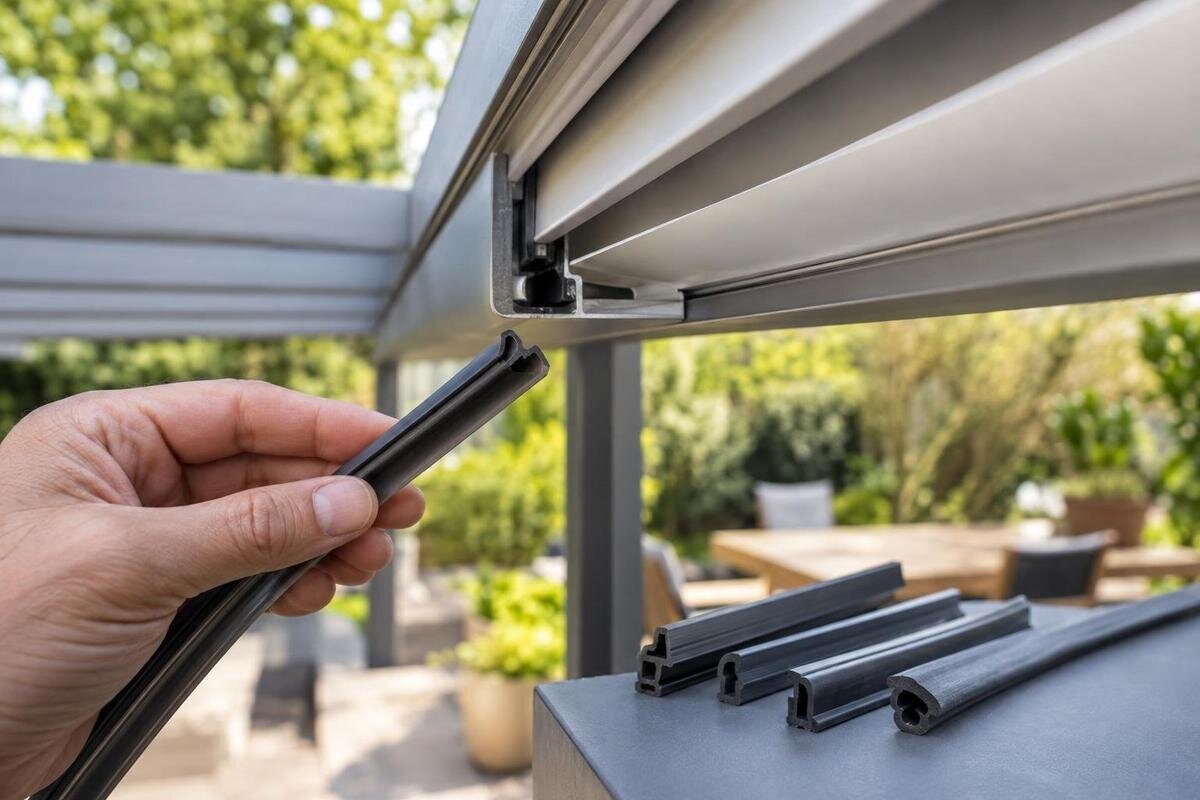
Take three photographs in even light: a wide view showing the pergola and affected area; a closer view placing the seal beside a recognisable corner, frame or panel; and a sharp close-up of the seal’s edge and the channel or mating surface. Hold the camera square to the profile where possible, rather than shooting along it, to reduce perspective distortion. Include a ruler beside the part for scale, keeping it in the same plane without covering it or pushing anything into the gap. Make sure the seal and adjoining component are in focus. If a close-up is blurry, take another rather than relying on digital zoom; avoid shadows across the profile and keep the original, unedited files.
If the seal has already come away, photograph its fitted location before handling it, then photograph the loose piece from the side and from its end so the cross-section is visible. Note which face pointed outwards, which end was at the corner and where it sat; use a copy of the photo for annotations so the original stays clear. Do not pull out an intact section just to improve the image. If your records use the family name Bloomcabin Bioclimatic Pergola, include it with the images, but rely on the close-up to show the actual seal and mating surface. Give each photo a short label, such as location and view, so a supplier can refer to it in a reply.

Measure the seal and the channel
Measurements help rule out obvious mismatches, but take them only where the part is accessible without pulling it out or compressing it. With a metric ruler or callipers, note the seal’s overall visible width and height; if the channel is exposed, record its opening width and depth as separate figures. Measure the base separately from a projecting lip or bulb if the shape allows. Write every figure in millimetres and state what you measured: the installed seal, a loose original sample or the empty channel. A flexible section can deform under pressure, so handle it lightly and flag any measurement that is approximate. If the profile changes along the run, record where each figure was taken.
Do not treat a single approximate width as a specification or use a product photo as a scale. For a unit identified in your records as a Bloomcabin wall-mounted pergola, send the measurements alongside the full model details rather than treating the catalogue name as a dimensional reference. An end-on photo of an intact visible edge may show the cross-section more clearly than several uncertain measurements. Mark each measurement on a sketch or image, and say if the old seal is stretched, flattened or damaged. Ask the supplier whether a technical drawing or part code is needed rather than rounding a measurement to match a guessed profile.
Note how the seal is retained
Look at how the seal is retained, without prising at it. From a visible end, note whether it appears to sit in a groove, hook over an edge, slide into a channel or meet a clip or carrier; use plain descriptions if the technical term is unknown. Record which way any lip or hollow section faces and what it touches. Do not assume the profile is symmetrical or reversible. A small barb, leg or ridge may be what holds it in the correct position, so a view from the front alone can miss the detail that distinguishes it from a similar-looking seal. If nothing is visible, mark it as unknown instead of inferring how it fits.
When enquiring about a seal for a Bloomcabin Pergola, describe the visible retaining features alongside the model details. Ask the supplier whether the seal is supplied with a separate carrier, clip or retainer, and have them confirm the arrangement from the relevant parts record. Do not force a sample out to inspect a hidden edge or prise apart adjoining panels. If the retention method cannot be seen safely, mark it as unknown and send the context photo; ask whether a drawing or an authorised inspection is needed before ordering.
Use the right manual or parts drawing
Search for the manual, assembly drawing, parts list or technical document for the exact model and revision, rather than relying on a general pergola diagram. Search terms may include seal, gasket, weather strip or profile; the part may be named differently in a component list. A drawing can provide a callout, location or orientation that is difficult to infer from a photo. If several seals appear in one illustration, match the callout to the exact edge and joint you recorded, rather than choosing the item that looks most familiar. Check the document date or revision where available, and save the page showing the relevant detail.
Use the exact wording from your records when looking for documents. If the recorded name matches the wall-mounted pergola listing, include that name and any serial or revision details when requesting the applicable manual. If your manual is missing, outdated or does not identify the part, ask the manufacturer, supplier or original installer for the relevant document and part reference. Do not assume that a diagram for a later or similar-looking model applies to your pergola. Include the label photo so the supplier can see the identifiers you are working from.
Make a precise parts enquiry
Make one concise parts enquiry with the evidence together: product and serial details, purchase or installation information, the seal’s precise location, wide and close-up photos, measurements and any visible code or marked end. State what is damaged and whether a sample has already come away. If you do not know the technical name, describe the profile and the surfaces it meets instead of guessing. Include the run length or quantity only if you can establish it accurately, and label any estimate. Identify photo files by location and view so the supplier can connect each image to your notes. Ask for the part number, intended position and compatible model or revision before ordering.
If your documents identify the unit as a Bloomcabin Pergola model, use that wording in the enquiry. Ask whether the seal is supplied as a full length, section or kit, and whether a separate carrier, joiner or corner piece is needed or included. Request a profile drawing or a clear end-on image if the proposed part is still unclear. If the original is unavailable, ask for an approved alternative or a recommendation for a larger assembly. Keep the supplier’s compatibility confirmation with your order records so the agreed replacement can be identified when it arrives.

Confirm compatibility before fitting
Before opening packaging or starting work, compare the supplied part’s label and part number with the confirmed enquiry. Check that the intended location, orientation, profile and length are stated, and that any separate carrier, joiner or corner item you were told to order is included. The pergola family name alone is not enough; fit can depend on version and the seal’s position. If the documentation or supplied profile differs from what was agreed, pause and resolve the mismatch before trying to fit anything. Keep the packaging and part reference until the replacement has been verified, so the supplier can identify it if something does not match.
For a unit recorded as a Bloomcabin Bioclimatic Pergola, include that name and the installed version’s details in any query about the supplied replacement. Follow the applicable service documentation for fitting. If access involves moving roof parts, removing panels, electrical components or working at height, use an appropriately qualified service professional rather than improvising. Do not trim the seal, add adhesive or alter a channel unless the manufacturer’s instructions specify it or an authorised technician advises it.
If the exact profile is still unclear
If no exact part number can be found, ask the manufacturer, supplier or original installer whether they can identify the seal from model data, documentation and photos. Explain which details remain uncertain and ask what further evidence they need. The original component may be listed under another name, supplied as part of a larger assembly or superseded, but those are possibilities to confirm rather than assume. Ask for any proposed replacement’s compatibility to be stated for your model and the specific location, and whether it is an approved substitute or a different repair approach. If a profile drawing or sample would help, ask how to obtain it. If the invoice and manual use different names, provide both rather than choosing one.
If a sample is requested, ask how it should be removed and whether this is suitable for you to do; do not send or discard a piece until you have clear instructions. If nobody can confirm the profile, do not buy a strip because it looks close or cut one to fit the exposed channel. An improvised seal may not sit securely or meet the adjoining surface as intended. Keep the part and records together, and seek service advice if further access involves moving mechanisms, glazing, water management, electrical equipment or a difficult position. Once a match is confirmed, retain its part number and photos for a future replacement enquiry.
Frequently asked questions
Can I identify a replacement by width alone?
No. Overall width does not show the cross-section, retaining edge, profile height or orientation. Two seals that look similar from above can seat differently. Use width as one measurement alongside channel dimensions, an end-on photo, the seal’s location and the pergola’s model details. Have the supplier confirm a part number or approved match before ordering.
Should I remove the old seal before contacting support?
Start with the seal in place; photos of it and its channel may be enough to begin identification. Removing a section can distort it or damage its seat, and access may be difficult. Ask the supplier whether a sample is needed, then follow the relevant manual or qualified service advice before removing anything.
What should the photos show?
Send a wide view of the pergola and affected area, a closer view showing where the seal sits, and a sharp close-up of its edge and the adjoining channel or surface. Include a ruler for scale without covering the part. If a piece has already come away, photograph its end so the cross-section is visible and note where it came from.
Can I use a universal weather seal and trim it to fit?
Do not assume a general-purpose strip will match. Its retaining edge, height or shape may not suit the channel or adjoining part, even if its width looks right. Use an alternative only when the manufacturer or parts supplier confirms it is approved for your model and location. Avoid trimming, adding adhesive or altering the channel without the relevant instructions.
What if no part number is available?
Send the exact model details you do have, the seal’s location, clear photos and any measurements. Ask the manufacturer, supplier or original installer what further information is needed to identify it, and whether an approved replacement or larger assembly is appropriate. Treat a similar-looking strip as unconfirmed until compatibility is established.
Reliable identification comes from tying the profile to the exact place it sits and to the pergola’s model or revision. Keep the context photo, close-up, measurements and any part code together, then ask for compatibility confirmation before ordering. If the profile remains uncertain, pause rather than trimming a generic strip and hoping it seals. A confirmed part number and a clear record will also make a later replacement enquiry easier to trace.
