
Choosing One or Multiple Pergola Roof Zones
Pergola planning guide
Choosing one pergola roof zone or several comes down to whether different parts of your outdoor area need different shade settings at the same time. A single zone gives the roof one shared setting. Independent zones can let one section be changed while another stays as it is—but only when the exact roof system is designed and documented for that operation. A wide roof, visible louvres or several controls do not prove zoning. Begin with the activities under the pergola and the times they happen, then check the layout and operating information for the model you are considering.

01
What counts as a pergola roof zone?
In this guide, a roof zone is a defined part of a controllable pergola roof that can be operated separately from another part. With one zone, a command to change the roof setting applies across the full controlled roof. With two or more independent zones, you can select one section and change its position or state without requiring another section to make the same change. That is a functional distinction, not simply a drawing label. Manufacturers may use different terms, so look for an explicit zone count and a control or mechanism diagram for the exact model. The description should explain what moves, not only how many sections are shown.
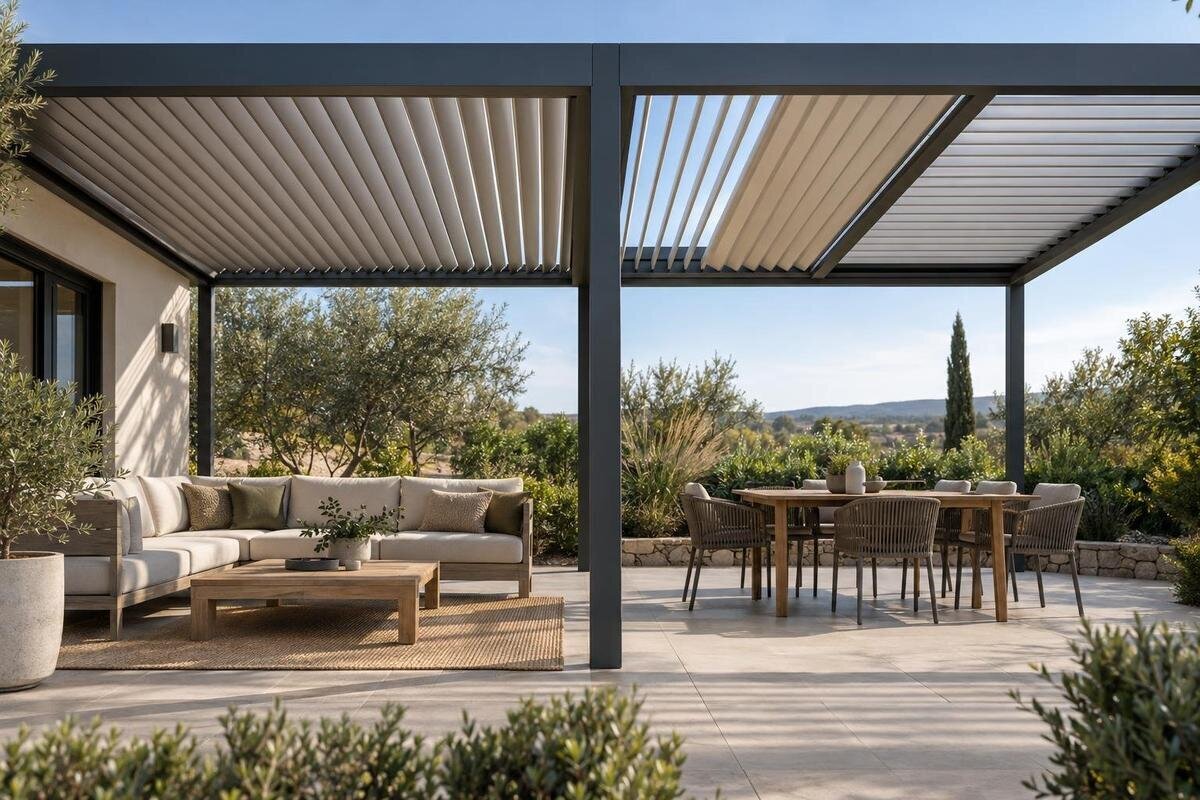
A roof can have multiple louvres, panels, bays or modules while still behaving as one zone if those parts move together. Conversely, a roof that looks continuous from below may contain separately operable groups. Neither appearance nor the phrase ‘adjustable roof’ proves independent operation. Treat ‘zone’ as a claim about what you can operate separately, and ask whether that applies to movement, angle, opening or another defined state. A visible seam or row of louvres can suggest flexibility that the mechanism does not provide. Use the model documentation, rather than a photograph, to confirm what the zones actually do.
When is one roof zone enough?
One zone is often a straightforward choice when the covered area works as one outdoor room. If a dining table and chairs fill most of the footprint and people generally want the same roof setting above them, splitting the control may add steps without solving a regular problem. A shared lounge or entertaining area can have the same pattern: the group wants more or less roof coverage together. Size alone does not decide this. A broad roof may still have one common shade requirement, while a smaller layout can contain two uses that pull in different directions.
Think about ordinary use, not just an unusually sunny afternoon or a rare gathering. If separate needs seldom coincide, one shared setting may work if the roof can be adjusted between activities. When considering the Bloomcabin Wall-Mounted Pergola, compare its operating arrangement with that everyday routine. Its listed area range of 9–24 m² does not establish whether its roof has independently controlled sections. Ask how the configuration you are considering would handle a change from dining to lounging, for example. A simpler control arrangement can also be easier for household members and visitors to understand without a lengthy explanation.
02
When do separate zones help?
Several zones can be useful when two parts of the covered area regularly need different roof settings at the same time. For example, people at a dining table may want a different setting from someone reading in an adjacent lounge, or one area may be in use while another is kept more open. The key is that the needs occur concurrently. If everyone can agree on one setting, or a change can wait until the next activity, separate controls may not improve day-to-day use. Write down the competing settings that actually recur rather than relying on a hypothetical situation.
Check that the proposed division matches where those activities sit. If the dining table straddles the boundary, or the section one person wants changed also covers the other group, the zones may not resolve the conflict. When comparing the Bloomcabin Pergola listing with your layout, ask for a roof plan that marks each independently operated part. Place the table and lounge on that plan, rather than assuming the division will fall conveniently between them. This lets you assess whether separate operation would serve both groups. The useful question is which occupied areas each zone covers, not simply how many zones are offered.
Map shade needs across the day
Shade changes as the sun moves, so base zone planning on when you use the outdoor area rather than on a static sketch. Mark the footprint and the activities that matter: breakfast, lunch, afternoon seating, cooking or play. Note which parts need shade at those times, and observe how shade falls where you live and sit. If the pergola will be used throughout the year, consider whether the pattern changes across the seasons as well. A brief record of typical use can help distinguish genuinely separate, simultaneous needs from one area that needs an adjustment at a different time.
Also note where glare comes from outside the roof. Adjusting a roof section may not address low-angle light from the side, and shade does not necessarily stop neatly at a table or zone boundary. Roof control should not be assumed to operate screens or other accessories as well; those are separate system questions. If you are considering the Bloomcabin Bioclimatic Pergola, compare your shade notes with the roof layout supplied for your proposed configuration. Ask which section would need adjusting at each relevant time and whether that change would affect the neighbouring seating area. This keeps the comparison focused on the shade you need.

03
Check that the roof layout supports the zones
Put the proposed boundaries on a clear roof layout for the exact model and configuration. Each zone should correspond to roof components the manufacturer says can be operated separately; a line drawn across a floor plan is not enough. Ask which louvres, panels or modules form each group, how the boundaries relate to the overall layout, and whether the manufacturer supports the arrangement you want. These are confirmation questions, not a prompt to alter the roof. Do not assume a standard model can be divided at any point simply because its footprint is wide or its roof has visible sections.
For the listed wall-mounted pergola, distinguish its attachment arrangement from how its roof operates: being wall-mounted does not tell you whether the roof has one or several control groups. Ask the supplier to label each proposed zone on the drawing and identify the control that operates it. The drawing and operating description should use matching labels, so you can follow which roof parts belong to each group. Also ask which combinations the system does not support. If the proposed boundary differs from the one on your seating plan, establish whether the available arrangement still separates the activities you want to accommodate.
What does independent control mean?
The word ‘independent’ needs a precise definition. On a louvred roof, it might refer to separate movement of a group of louvres; on another roof type, the relevant operation could be opening or retracting a section. Separate selectors, two remotes or a shared controller do not necessarily mean that each roof part moves independently. Ask which settings each zone can reach, whether one can remain still while another is adjusted, and whether a whole-roof command is also available. The answer should describe the operation itself, not just the interface or number of controls.
When reviewing the regular pergola model page, use the quote or manual to clarify exactly what independent operation would allow. Does ‘zone’ mean a separate mechanical group, a separately selected group, or simply a labelled part of the roof? Ask whether the zones can hold different positions at once and whether that applies in every operating mode. A useful test question is: what happens to section A when you change section B? Then ask how you would return both sections to a shared setting. These answers distinguish the ability to maintain different settings from the way commands are selected and carried out.
04
Selecting and operating each roof zone
Every added zone can create another choice when you adjust the roof. That may be worthwhile where people need different settings, but only if the controls make those choices easy to recognise. Ask how a user selects a zone, how the controls are labelled, and whether there is also a simple way to operate the whole roof together. Consider who will use it: household members, visitors or anyone who may not know which section is selected. A system can offer separate operation yet still be confusing if users cannot tell which part will respond to a command.
For the bioclimatic pergola listing, check which controls are included in the particular offer you are comparing. The model name alone does not establish motors, sensors, app operation or independently controlled zones. If a remote, app or automation is offered, ask how it selects an individual zone and how the user can recognise that selection. Also ask how a whole-roof command differs from a command for one section, if both are supported. Compare those steps with how your household expects to use the space. Extra control options are useful only when they make the required adjustments clear and manageable.
Costs, maintenance and ongoing support
Depending on the design, more zones may mean more moving groups, control components or configuration choices. Do not assume a fixed cost difference: request an itemised quote for the chosen model and number of zones, including any controls or setup the supplier treats as optional. Compare like with like, including the same roof type, footprint, accessories and scope of supply. A basic single-zone price is not a fair comparison with a multi-zone proposal that includes different items. If creating zones changes the roof layout, ask whether that configuration is supported for the exact model.
If you are evaluating the wall-mounted model page, ask for maintenance and service information that covers the configuration being quoted. Find out who can diagnose a control fault, whether any relevant parts are covered by the stated warranty, and what happens if one zone cannot be operated. In particular, ask whether a fault affecting one section also prevents the others from being used. If the roof uses powered operation, ask about the maker’s documented procedure during a power interruption rather than assuming there is a manual override. These questions help you understand the practical support requirements of the proposed arrangement.

05
What to confirm in the model documents
Request technical information that matches the exact model and configuration, not just a generic picture of a pergola roof. Look for a plan showing the number and position of zones, the roof parts assigned to each, and the movement or settings available. Check the control diagram or manual for how an individual zone is selected and whether whole-roof commands are possible. If the documents use terms such as section, bay, group or drive, ask how those map to the quoted zone count. Confirm that the information refers to the model and options in your quote, then keep the answer with your purchase records.
Use the Bloomcabin Pergola model page to identify the product, then make sure the quote and supporting information describe the same configuration. Record the agreed zone count and the answers to your operating questions alongside any relevant drawing. Check whether the controls needed for that arrangement are included or optional, and whether any stated compatibility limits affect the functions you want. If a written description and a diagram appear to show different groupings, ask the supplier to clarify which applies to your order. Treat any unanswered zoning question as unconfirmed rather than filling the gap with an assumption based on a photograph.
Choose the simplest arrangement that fits
A useful decision test is whether your shade map shows two recurring, simultaneous requests for different parts of the roof. If not, one zone may be easier to operate and may be all you need. If it does, compare the exact zone boundary and control behaviour with those requests. Independent zones help only when each group covers the right area and can remain at the required setting while another section is adjusted. If needs differ one after another rather than at the same time, consider whether changing a shared setting between activities is acceptable. The aim is to resolve a regular conflict, not to buy the highest zone count.
Before deciding, ask someone who will use the outdoor area to describe a normal adjustment: which section changes, what stays as it is, and how they know which control to use. If the answer is simple and repeatable, the arrangement is likely to be easier to understand in everyday use. If it depends on assumptions about zones, controls or future automation, return to the exact model documents and resolve those points first. One shared setting can be a deliberate, convenient choice; separate zones can be worthwhile when they correspond to real, simultaneous uses. Neither arrangement is automatically better.
Frequently asked questions
Does a roof with several louvres have several zones?
Not necessarily. Multiple louvres may move together as one group, so the whole roof still has one setting. A separate zone exists only if its roof section can be operated independently. Check the exact model’s control diagram or manual rather than counting visible louvres.
Can two zones be set differently at the same time?
Only if the specified system allows each zone to be operated independently and to remain in a different position or state. Holding different settings does not necessarily mean both sections can move at once. Ask the supplier to distinguish between selecting each section, moving it and leaving it at a different setting from the other.
Does a larger pergola need more roof zones?
No. Size alone does not show whether different parts need different shade settings. A large outdoor dining area may work well with one shared setting, while a smaller area with two separate uses may benefit from independent control. Base the decision on how you use the space.
Do separate buttons prove that the roof has separate zones?
No. Buttons may be duplicates, may select a group before a shared command, or may control functions other than separate roof sections. Ask what each control operates and whether changing one roof section leaves the other unchanged.
Can zones be added to a pergola later?
Do not assume so. The roof mechanism and control system need to support the proposed division, and any change should be approved for the exact model. Ask the manufacturer or a qualified installer whether the configuration is supported before planning a retrofit.
Choose the simplest documented control arrangement that meets your regular needs. If the whole covered area usually calls for the same setting, one zone avoids extra choices without sacrificing a benefit you would use. If separate areas repeatedly need different settings at once, independent zones may make sense—but only when the exact roof layout and controls support that use. A clear plan of your activities, matched against the model’s operating documents, is a more reliable guide than roof size, appearance or the number of buttons.
