
How to Assess Scratches on a Powder-Coated Pergola
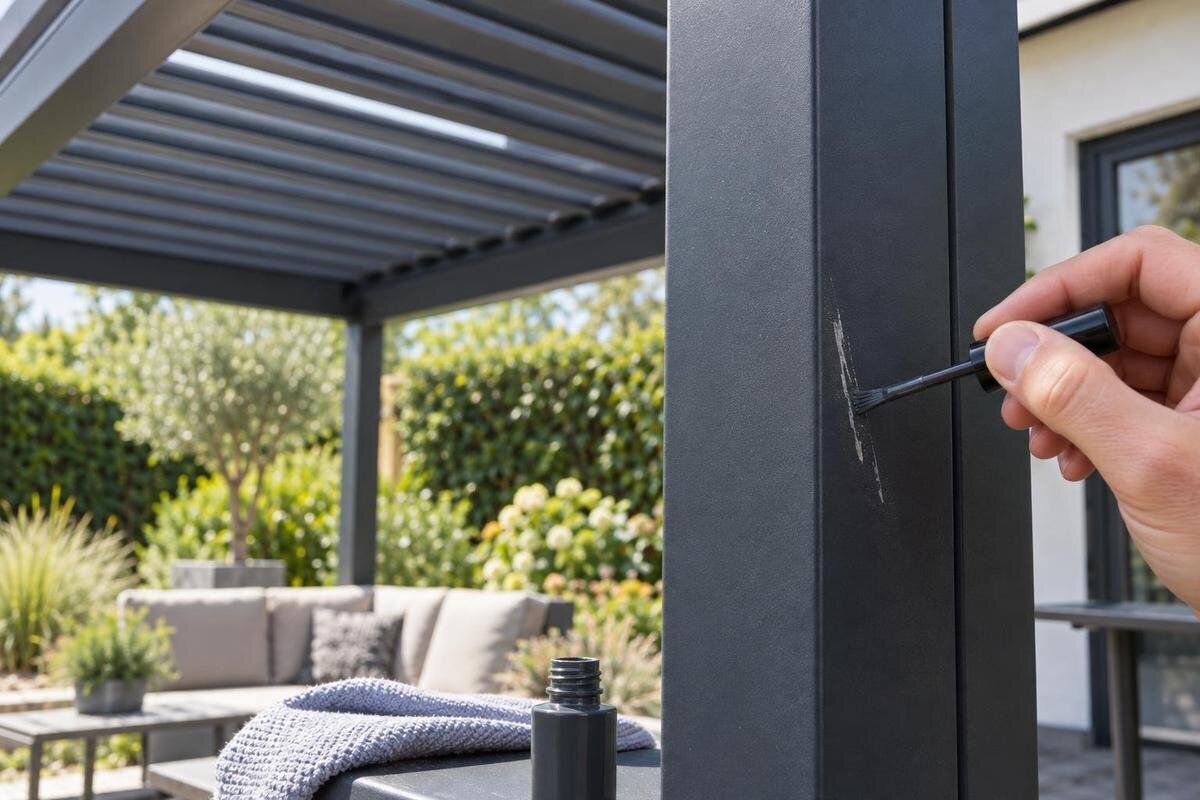
Pergola finish care
An apparent scratch on a powder-coated pergola may be a mark sitting on the surface, an abrasion that has changed the finish, or a breach through it. Those possibilities need different responses. Begin by observing, not rubbing or scraping: compare the mark in good light, record its location and photograph it before trying anything. Then use the pergola’s own records to identify the model and finish, and ask for a repair system approved for that exact coating. A photograph or product name alone cannot confirm a colour match or repair method.

01
Distinguishing a surface scuff from coating damage
A scuff often comes from material transferred during contact or from light rubbing; it can leave a streak without a clear break in the finish. A scratch is more concerning when the coating itself appears cut, interrupted or missing. The two can overlap: transferred material may sit beside a damaged line, so “scuff” is a first description rather than a diagnosis. A pale or dark line alone does not prove that the underlying material is exposed; dirt, reflection, shadow and surface sheen can all affect what you see. It helps to separate the mark’s appearance from your interpretation. “A pale line across the dark finish” records an observation; “a scratch down to bare material” makes a judgement that may need confirmation.
Look at the area dry, where possible, and use diffuse daylight rather than relying on a phone flash. View it straight on, then from a slight angle, and note whether the mark changes as the light moves. Photograph the first view before cleaning so the original appearance is recorded. A smear, transfer or reflection may soften or shift, while a cut can remain sharply defined, but neither clue is conclusive. Describe what you can actually see, such as a line, dull patch or raised edge, rather than deciding it is harmless or deep before the finish has been assessed.
Inspect the finish without adding damage
Check the pergola’s care instructions before cleaning the area. If they permit cleaning, use the stated method and let the surface dry before comparing it with your first photograph. Do not scrub hard to see whether a mark will come off. Scouring pads, steel wool, blades, abrasive compounds, solvents and polish can alter the finish or make it harder to tell what was there originally. If you do not have the relevant instructions, pause and ask the supplier which cleaning method is suitable.
You can change the viewing angle or use a small light held beside the surface to make texture and edges easier to see; neither method requires touching the mark. Avoid testing it with a fingernail, coin or tool, or trying to lift a loose edge. If the finish is already flaking, raised or sharp, do not handle it further. A mark that remains after an approved clean still needs assessment if its depth is uncertain; persistence alone does not prove that the coating has been breached.
02
Look for signs that the coating has been breached
A surface transfer may appear to sit above the finish, while a shallow abrasion can change its sheen or colour without an obvious break. A possible breach looks more like a cut, groove, chipped area or missing patch, and may show a different layer or the underlying material. A lifted edge, blister or flake is another reason to be cautious. These are visual clues, not a way to measure depth: do not scrape or peel the mark to find out what lies underneath.
If you can see exposed material, corrosion-like discolouration, bubbling or a loose edge, photograph it and report those details rather than calling it a cosmetic scuff. Keep uncertainty explicit: if a different-coloured layer is visible but you cannot identify it, describe it that way. Note whether the feature runs along the whole mark or appears only at one end, so the supplier knows which part of the photograph concerns you. For an enquiry about a pergola recorded under that name, use the Bloomcabin Pergola listing to check the model wording. Keep the product identification separate from your description of the damage; recognising the model does not establish how deeply its coating has been affected.
Record where the mark is and what may have caused it
Identify the particular frame member or attached component, then note which side it is on and whether it is near an edge, joint or fixing. Describe the location in plain terms, such as the outside face of a post or the underside of a beam, rather than relying on a close-up alone. Choose a viewpoint for your notes, such as looking towards the pergola from the garden, and use it consistently when referring to left and right. If there are several marks, give each a simple reference so its location, dimensions and photographs stay together. Use the model name from your records; the Bloomcabin Bioclimatic Pergola listing provides a comparison for the displayed name if your paperwork identifies that model.
For each mark, note an approximate length and width, whether it is a single line or a wider patch, and whether other marks appear nearby. A ruler held beside the area can help you estimate size without contacting the coating. Record a likely source, such as a moving object or recent impact, only if you know it; do not present a guess as fact. If contact may still be occurring, remove the immediate cause where that is safe and does not require changing or dismantling the pergola.

03
Photograph the scratch for a useful assessment
Take three views if possible: an overview that locates the mark on the pergola, a mid-range image showing the whole component, and a close-up that records the edge and surface. Keep the camera steady and use even daylight where you can. A second close-up from a slight angle may reveal a raised edge or texture that a straight-on photograph misses. Check each image before moving away: the mark should be in focus, not just the background or a reflection. Include some surrounding undamaged finish rather than filling every image with the line itself. Avoid glare from direct flash, and do not edit the original image to change colour, contrast or apparent depth. If you need an arrow to identify a small mark, add it to a separate copy and retain the unedited original.
For scale, hold a ruler beside the mark without letting it touch the finish; do not stick a label or tape next to the damaged area. Add a short note stating which component is shown, which way the camera is facing and when the photo was taken. Give the images clear filenames or references that connect the overview with its close-up. If your records identify the model as Wall-Mounted Pergola, include that wording with the images; the Bloomcabin Wall-Mounted Pergola page can help you check the product title. Use your project paperwork and any model label to confirm what is actually installed.
Find the pergola model and finish details
Gather the order confirmation, invoice, installation paperwork and any care or product documents you received. Look for the full model name and, if recorded, an identification or serial number, a finish description, a colour code and the installation date. Photograph a label if it is accessible without removing a cover or component. If the documents use the Bioclimatic Pergola name, the Bioclimatic Pergola product page can help you check the product title. Keep reference numbers exactly as written rather than trying to translate them into a paint name. If two records describe the finish differently, include both descriptions and identify where each came from. Ask the supplier to resolve the difference rather than choosing whichever description seems closest to the current appearance.
The model name and the coating reference answer different questions. A model listing can help you identify a product family, but it does not establish the exact finish on your pergola or confirm that a particular touch-up product is compatible. If you cannot find a finish code, say so; do not infer it from a photograph, a broad colour description or a sample viewed on a screen. Send the supplier the records you have and ask which additional identification, if any, is needed.
04
Request a repair system approved for the finish
Contact the supplier or support channel for the pergola and provide the model wording, any identification number, the finish reference if available, the mark’s location and approximate size, and your unedited photographs. Include a short account of how the damage may have happened, but separate confirmed details from guesses. For a pergola identified in your documents as Wall-Mounted Pergola, check the wording against the Wall-Mounted Pergola listing before sending the enquiry. State whether you are seeking an assessment only or also asking about repair options, so the supplier can address both questions. Request written guidance that applies to the finish on your particular pergola.
Ask whether the mark is suitable for a local touch-up or needs another response. Request the name or code of any approved repair product, confirmation that it is suitable for the relevant coating and underlying surface, and the instructions for preparation and application. Make clear that you need the complete repair method, not just a colour recommendation. If the response names a product but leaves the preparation unclear, ask for that missing guidance before proceeding. Also ask whether the work should be carried out by a qualified service provider and what result you should reasonably expect on the affected area. Keep the response with your original enquiry so the advice remains linked to the photographs and finish details supplied. If support cannot confirm a match from your records and images, wait for further identification rather than ordering the closest-looking product.
Colour, sheen and texture in a repair match
A broad colour description does not settle whether a repair product has the right finish, texture or compatibility. Ask the supplier to confirm the reference for your pergola, not merely a colour that looks similar in a photograph or on a screen. The existing finish may also look different under changing light or after weathering, so even a suitable repair product may not appear identical from every angle. Describe where the mark sits in normal view: a repair on an outward-facing post raises a different appearance concern from one on a less visible face. This does not determine which product is suitable, but it helps you discuss expectations before accepting a touch-up. Ask specifically about any likely visible difference rather than assuming that an approved colour match means an invisible repair.
Avoid choosing an automotive touch-up, household paint or general-purpose aerosol by eye, and do not mix or thin a product unless the supplied instructions explicitly call for it. When comparing repair advice with product information, remember that the Bloomcabin Pergola product page identifies the model rather than specifying a repair finish. A familiar model name or similar-looking colour is not a substitute for confirmation about the coating on your pergola. If an exact repair product is unavailable or cannot be confirmed, ask whether the supplier recommends an alternative assessment or a matched replacement component.

05
When to stop and arrange a professional assessment
Pause before any cosmetic repair if damage is widespread, the coating is lifting in several places, the underlying material is visible, or the affected area is near a joint or connection. Deformation, a cracked component or a sharp edge is not just a question of matching colour. Do not cover those signs with touch-up paint, dismantle the pergola or attempt a structural repair. Make these features prominent in your service enquiry rather than including them only in a general request for matching paint. For a pergola identified as that model in your records, include the Bloomcabin Bioclimatic Pergola product reference alongside the photographs and explain which component needs assessment.
Check the warranty documents and supplier instructions before making an alteration, and keep your original photographs and purchase records. Do not assume that a repair is covered, excluded or permitted without checking the terms that apply to your purchase. If electrical components or moving parts are involved, leave repairs to a qualified service provider and ask the supplier how the damaged area should be assessed. The same applies if you cannot inspect the mark safely or cannot tell whether it is confined to the coating.
Keep a repair record and prevent repeat contact
If the supplier approves a repair, keep its written instructions and note the product name or code, the date and the exact location treated. Follow the supplied method and any stated preparation or follow-up requirements; do not substitute steps from a different paint or coating product. Save before-and-after photographs alongside the correspondence, using similar views so the treated area can be recognised later. If another person carries out the work, ask them to record what system they used so a future service enquiry does not rely on guesswork. Distinguish between the repair that was recommended and the work actually completed. If the agreed approach changes, retain the updated guidance rather than leaving conflicting versions in your records.
Consider whether the same contact could happen again. Moving a loose object away from the frame may be straightforward; changing a component, adding a guard or making an adjustment may need supplier advice. Where the cause remains uncertain, record that uncertainty rather than making an alteration based on a guess. Keep the repair history with your model details; for an installation identified under that name, the Wall-Mounted Pergola product reference can be saved with the correspondence. During ordinary care, look for new marks without scrubbing the finish. If the treated area changes, photograph it and refer to the earlier repair record when requesting guidance.
Frequently asked questions
How can I tell whether a mark is only on the surface?
A mark that changes or lifts after cleaning by the pergola’s approved method may be transferred material, but that is not proof. A cut, loose edge or exposed underlying surface suggests coating damage. If you cannot tell, describe what you see and ask the supplier to assess it.
Can I use car touch-up paint or a general-purpose spray?
Not unless the supplier confirms that the product and method are approved for your exact pergola finish. A similar colour name does not confirm compatibility, sheen or texture. Avoid applying paint, polish or solvent while you are still assessing the mark.
What photos should I send with a repair enquiry?
Send an overview showing where the mark is, a closer view with the surrounding component, and a sharp detail photo. Include a ruler held beside the mark without touching the finish. Use natural light, keep the originals and add a note identifying the location.
Is a colour name enough to order a matching repair product?
Usually, a colour name alone does not establish an exact finish or a suitable repair method. Check your order records for a finish reference or code, then ask the supplier to confirm the approved product and any preparation requirements.
What should I do if the underlying surface is visible?
Photograph the area and avoid peeling, sanding or covering it with an unapproved product. Ask the supplier or a qualified service provider whether the damage needs a professional assessment and which repair system, if any, is suitable.
A useful assessment separates what you can observe from what still needs confirmation. Record the mark’s appearance and location, keep clear photographs and identify the pergola from its documents. If the coating may be breached, ask the supplier for a repair system approved for that finish before applying anything. When the damage is extensive, exposed or close to a connection, seek a professional assessment rather than treating it as a touch-up.
