
Rain or Condensation Under a Pergola? How to Tell
Pergola weather guide
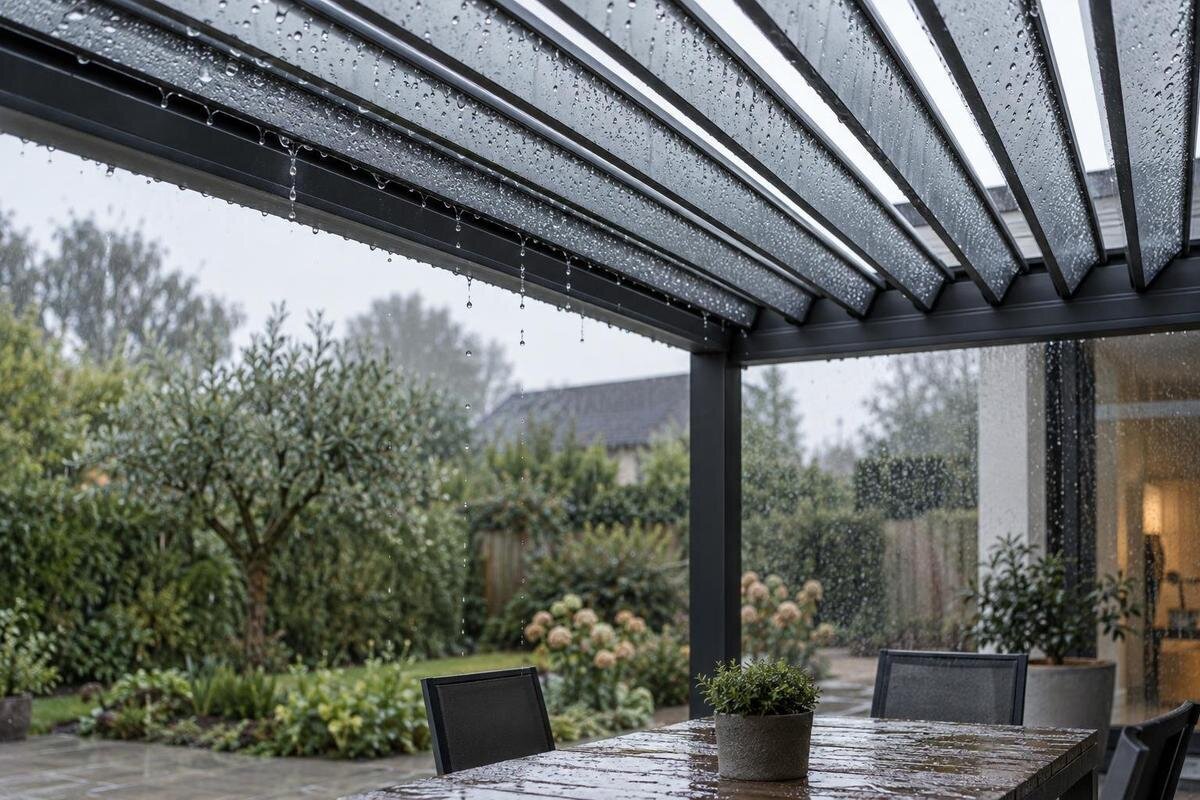
Water beneath a pergola is easy to misread: it may be rain finding a path through the roof, water draining after a shower or condensation forming on the underside. The most useful clues are when it appears, what the weather has been doing, and whether the moisture is spread across a surface or concentrated at a junction. A short record across both dry and wet conditions is more reliable than guessing from one damp patch.

01
A drip alone cannot identify the source
A wet chair or one falling drop tells you that water is present, not where it came from. Rain may enter at an edge, seam or wall connection, or be driven through an open side; some roof designs may also hold water briefly and release it later. Condensation is different: water vapour in the air turns to liquid when it meets a surface cold enough for that air’s moisture to condense. It can form on the underside without rain reaching the pergola. Since these routes can all end in a drip, its size and the fact that it falls from overhead do not identify the cause.
Timing, weather and location are useful when they point in the same direction. A drip that begins during a shower and recurs at one junction leans towards rain entry; beads or a damp film after a cool, humid night with no recent rain lean towards condensation. A delayed drip may instead be retained runoff, while wind-driven rain can come from the side. The causes can also overlap: rain may wet one area as condensation forms elsewhere. Treat each clue as evidence to compare, rather than deciding from a single episode or assuming every wet surface means a faulty roof.
Moisture timing and recent rainfall
Record when the moisture first appears, not only when you notice it. Note the start and finish of any shower, the delay before a drip or damp mark, and whether the same place was dry earlier. Condensation is often easiest to spot after overnight cooling, so droplets on a rain-free morning make it more plausible. Rain entry is more likely when wetting starts as rain arrives or changes with the shower, but timing is not decisive: water can travel along a frame before falling, and a roof may release water after rain stops. A short delay does not automatically mean condensation.
Include the conditions around the pergola: whether the evening cooled, whether the air felt humid, and whether wind direction shifted during rain. A weather app or nearby station can provide context, but it may miss a brief shower or differ from conditions at your property. Check the site itself rather than treating a forecast as proof. If no rain has fallen since the last dry observation, fresh rain entry becomes less likely; water retained from an earlier event remains possible. Compare several dry periods with natural rain events before deciding which pattern repeats.
02
Where moisture forms and how it spreads
Look at the overhead surface and frame rather than relying only on where a drop lands. Condensation often begins as a fine haze, beads or a broad damp film on a cooler underside; beads may join and eventually fall, so a drip does not rule it out. If several areas become damp in a similar way after a dry night, condensation becomes more plausible. Rain entry more often leaves a repeatable wet track, a narrow patch beside a joint or edge, or a mark aligned with a runoff route. These patterns are not conclusive: a drainage route can carry water away from its entry point, while wind can shift rain sideways.
Take photos from a safe position and note whether wetting starts on the underside, frame, perimeter or at a wall junction. A repeatable point after rain is more useful than a general report that the pergola drips. For a wall-mounted structure such as the Bloomcabin Wall-Mounted Pergola, include the wall connection in your observation record. Compare the first visible wet mark with any track that develops along the frame, rather than recording only the spot where water finally falls. A mark beside the wall does not by itself prove a failed seal; compare its location with the connection shown in the installation information.
How cool surfaces produce condensation
Condensation is a surface-temperature issue, not a sign that rain has passed through the roof. Air contains water vapour, and its dew point is the temperature at which that vapour begins to condense on a surface. If the underside is colder than the surrounding air’s dew point, moisture can appear there even when no rain has fallen. A cool night followed by warmer, moist air is one possible set of conditions, but conditions vary. The useful clue is the combination of humid air and a sufficiently cool surface, not a particular season or forecast. Drops may be tiny at first, then merge and run towards a low point.
A household humidity reading or weather app can add context, but neither tells you the exact temperature of every roof surface or proves the source of a drip. A nearby hygrometer can help compare air conditions over time; it does not directly measure the roof. Avoid climbing or reaching across the structure to take a reading. Record the reading alongside what you can see on the underside, including whether moisture is widespread or confined to one area. When considering the Bloomcabin Pergola, ask which roof details apply to your chosen configuration so you can relate these observations to the actual overhead surfaces rather than relying on air conditions alone.

03
Roof type and position affect the clues
Pergolas can have different overhead surfaces, including fixed covers, panels, fabric or adjustable elements. Their undersides, joints and water paths differ, so the same drip pattern may not mean the same thing on every design. If the roof moves, its position can change what is exposed to the air and where water runs. A damp patch observed in one position should not be compared with a different position as though the conditions were identical. Condensation can form on a cool surface regardless of the roof’s label, while rain may enter at openings or be redirected by the set-up. Do not assume that closed means watertight or that open means no water remains.
If your pergola has louvres or another adjustable roof, note their position before, during and after the weather event. Avoid changing settings just to provoke a drip. A change after rain may release water held in part of the roof or frame, which is different from moisture forming on a cold underside. When considering the Bloomcabin Bioclimatic Pergola, check the model-specific instructions for its roof mechanism, operating positions and rain limits. For an existing adjustable roof, distinguish observations made while it remained in one position from those made after movement. This keeps a delayed release of rainwater from being mistaken for new condensation.
Keeping a moisture observation log
Make comparisons under similar conditions wherever possible. Record the time, recent rainfall, whether the air feels humid, temperature changes, wind direction, roof position and the state of any existing side screens or panels. Note where moisture first appears, whether it spreads, and when dripping starts or stops. Keep the roof setting and enclosure arrangement unchanged between observations; if either changes, write that down rather than treating the results as a direct comparison. A phone note or simple sketch is enough. The aim is not to create laboratory conditions, but to see whether the same pattern follows dry, cool periods or occurs with rain.
You can place dry absorbent paper or small, stable trays beneath a few points to compare where moisture lands, provided they do not create a trip hazard or sit near equipment. Use the same positions for a dry-weather check and a natural rain event, and note which areas become wet and when. Photograph from ground level rather than climbing onto the roof or using a ladder to trace a mark. Label the record with the exact model, such as the Bloomcabin wall-mounted pergola, and its installed configuration so observations from different dates remain comparable. An improvised hose test may not reproduce natural rain or the maker’s recommended assessment.
04
What the drainage path shows after rain
After natural rainfall, observe the roof from a safe position and note where water appears to travel or leave the structure. If the design has channels or defined outlets, compare visible runoff with the drainage information for that exact model. A wet area beside an outlet may be part of the intended path, while a repeated drip from a joint may need closer investigation. Do not assume that every pergola has the same channel layout, or that water will fall directly below the point where rain first entered. Avoid inspecting the roof during a storm or dismantling components to follow a suspected route.
A drip that continues after a shower can be retained runoff rather than condensation, particularly if it follows a roof setting change or comes from a known drainage route. Record the delay and whether the drip stops once the structure has drained. If you are assessing the Bloomcabin Pergola model, request the corresponding drainage information and weather limits for the configuration you are considering. Use that information to distinguish intended water exits from the area you want to keep dry underneath. For an existing structure, compare repeated wetting with the documented route, noting where visible runoff and the unexplained drip occur. The apparent exit point alone does not identify where water first entered.
Airflow and side enclosures
The air beneath a pergola can behave differently from the open area around it. Existing screens, glazing or other side enclosures may reduce airflow and allow humid air to linger near a cool roof surface, making condensation more noticeable in some conditions. At the same time, an open side can allow wind-driven rain to reach the area below the roof. These effects can occur together, so the presence of side panels does not settle the question. When recording moisture, note which sides are open or enclosed and whether that arrangement changed between observations.
If you are considering an enclosure, check whether the exact combination is documented for the pergola rather than assuming that a screen or panel will solve moisture or rain entry. For the Bloomcabin bioclimatic pergola model, ask which enclosure options are suitable and how the relevant instructions address airflow, drainage and weather performance. Keep these as separate questions: protection from rain at an open side is not the same issue as moisture forming on the roof underside. For an existing structure, record the current enclosure arrangement and compare observations made with that arrangement unchanged. Avoid adding or closing panels as a test unless the product instructions allow it.

05
When to seek a closer inspection
A closer inspection is sensible when water repeatedly appears during rain at the same seam, edge or wall connection, or when you can follow a distinct wet track from a joint. Persistent staining, changes to nearby finishes or recurring dampness also deserve attention. These signs raise the case for checking rain entry, but they do not prove it: condensation and water travelling through a drainage route can also leave marks. Note whether the pattern appears only with rain from a particular direction, after any roof movement, or during dry weather. That context helps distinguish a possible leak from moisture forming on the underside.
Share the timeline, photographs, roof position and enclosure arrangement with the installer or supplier. Explain whether the water appears during rain, after roof movement or during dry weather, and identify the first wet area you observed. If the unit is a Bloomcabin wall-mounted model, include its exact identity and installed configuration so the enquiry can be assessed against the correct installation instructions, drainage drawing and stated weather limits. Avoid climbing onto the roof, removing parts or sealing a suspected opening before the cause is understood. Those actions can hide the pattern or alter the designed water path, making the original problem harder to assess.
Documents to compare before buying
When choosing a pergola, ask what information is available for the exact roof and enclosure configuration, not just the general product category. Useful material may include a drainage diagram, instructions for roof positions, and model-specific information about weather limits. Clarify where water is designed to run and whether the documented configuration changes when side panels are added. Do not assume that a system is watertight in every position or during every storm, or treat a general product description as a universal weather guarantee. Clear documentation helps you understand expected drainage and gives you a reference if moisture appears later.
Compare the proposed product with the documents you receive, so the model, roof arrangement and any enclosure details match. If the Bloomcabin Pergola product page is on your shortlist, use that model identity when asking about the configuration you intend to buy. Explain your concern in practical terms: droplets on furniture after a dry night, water released after rain, or rain reaching the seating area. These are different moisture problems, so ask which aspects the proposed configuration addresses and what conditions the information covers. This makes the buying discussion more useful than a broad question about whether a pergola will always stay dry.
Frequently asked questions
Can condensation form under a pergola when it has not rained?
Yes. Moist air can condense on a cool roof underside without any rain reaching the pergola. Dry-weather droplets after a cool night make condensation more plausible, but water left from an earlier shower can also drip later.
Why is water still dripping after the rain has stopped?
Water may be travelling through a roof channel or draining from part of the structure after the shower. Rain entry is also possible. Note where and when it drips, and compare that pattern with the model’s drainage information before deciding.
Are morning droplets proof of condensation?
No. Overnight cooling can make condensation more likely, particularly if the air is humid and there has been no recent rain. But morning moisture can also be retained rainwater, so check the previous weather and where the droplets form.
Does a wet spot beside a roof joint mean there is a leak?
Not by itself. Water can follow a frame or drainage route before it drips, and condensation can collect at a low point. A repeatable wet track that appears during rain is a stronger clue, but still needs to be compared with the design and installation information.
What information should I give an installer or supplier?
Provide the exact model and configuration, photos of the wet area, when it appears, recent rain and temperature conditions, roof position, and any enclosure settings. Ask them to compare those observations with the relevant installation, drainage and weather-performance documents.
The clearest diagnosis comes from matching several clues: when droplets appear, what the weather has been doing, where moisture forms and how the roof is positioned. Dry-weather droplets on a cool underside support condensation; repeatable wetting during rain points more towards rain entry, while delayed drips may be retained runoff. None of these clues stands alone. Keep a brief record and compare it with the drainage and weather information for the exact pergola configuration before deciding what needs attention.
