
How to Calculate Restaurant Pergola Payback
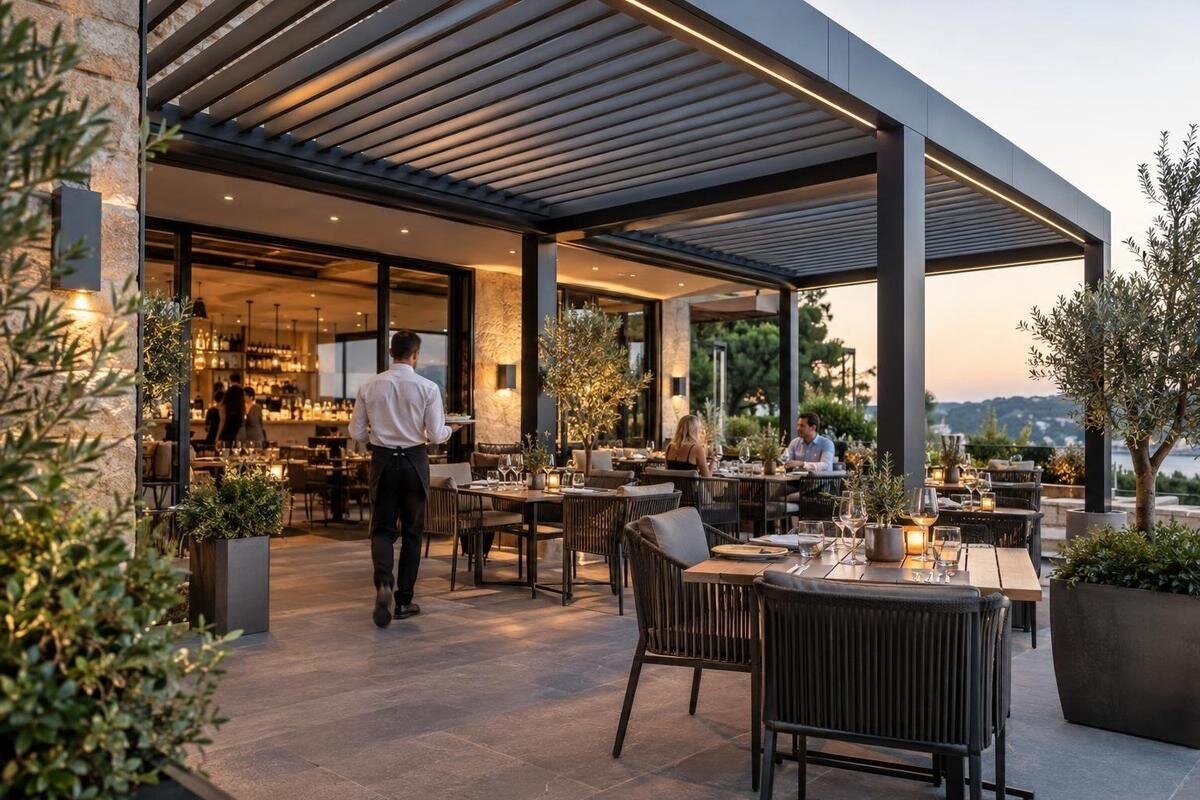
Restaurant outdoor dining
An outdoor dining structure needs to generate enough additional contribution to justify the full project cost and its ongoing expenses if it is to pay for itself. A simple payback estimate can make that question testable, but it cannot promise higher takings: more seats do not automatically mean more diners. Use your restaurant’s bookings, point-of-sale records, weather-related cancellations, labour costs and a project-specific quote. Compare a realistic year without the project with a realistic year with it, then show how the result changes when assumptions are less favourable.

Start with a no-project baseline
Write down the restaurant’s current trading pattern before estimating a benefit. Pull comparable periods from point-of-sale reports, booking logs, waitlists, cancellations and manager weather notes. Separate weekdays from weekends and lunch from dinner; include quiet periods as well as peak services. Note which existing outdoor tables are actually open, which indoor tables fill, and how often demand exceeds available seating. A record of a full dining room is more useful than a general impression that the terrace is popular. If records cover only part of the year, flag the gap rather than treating that period as representative. Record which seats or services the project would replace or preserve.
Define a comparison period and a no-project counterfactual: what is likely to happen over those same months if the venue stays as it is? Covers that move from an already usable indoor table to the terrace are not automatically additional. They count only if the move frees a seat likely to be filled by another diner, or if reliable records support an avoided cancellation or a booking the venue cannot currently accommodate. Describe the expected change in plain terms and keep it separate from existing trade. Count the net change after any seats removed or made unavailable, not just the gross number of new chairs. This makes the assumptions easier to check against later bookings.
Estimate realistic usable service days
A calendar day is not automatically a service day. Define what ‘usable’ means for this venue: the outdoor area is available, the restaurant is open, staff can serve it, and customers can use the tables in conditions the venue is willing to trade in. Work from the site’s booking and cancellation history, manager observations and operating season rather than importing a generic number of sunny days. If lunch and dinner have different weather exposure or demand, record them as separate service periods; one date might be usable for one sitting but not the other. Do not count special events as typical unless the records support their recurrence.
Build a calendar by month, day of week and service period. Mark full services, partial services and periods when the proposed area would not be used. Exclude periods when the venue is closed, staffing prevents outdoor service or the site would be out of action for another reason. If records are thin, use a conservative range and state why. Do not treat a pergola as a guarantee against rain, heat, wind or other disruption; use only operating conditions and product performance confirmed for the specific project. Keep any increase in trading periods separate from extra covers on days the venue already serves.
Estimate seating capacity from the floor plan
Use a measured floor plan of the proposed footprint, not the nominal pergola area, to work out what can operate. Position tables after allowing for customer circulation, staff carrying routes, the kitchen or service point, entrances and routes considered in applicable access and fire-safety reviews. Existing columns, doors, planting and service equipment can reduce the area available. Ask relevant professionals to review the actual plan; a sales sketch or area figure is not a substitute. The Wall-Mounted Pergola product page lists an area range from 9 to 24 m², but that catalogue range does not state restaurant seating capacity or confirm that a particular wall or site is suitable.
Convert the reviewed, workable layout into covers for each service period. A chair is not necessarily an extra cover: account for table combinations, service timing, set-up and clearing, and whether staff can serve the proposed arrangement without disrupting existing operations. Use the venue’s own table sizes and booking patterns rather than a generic seats-per-square-metre shortcut. If the project adds chairs but removes current tables, reduces usable circulation or leaves staff unable to serve a section, calculate the net change. Keep a layout drawing alongside the estimate so the cover assumption can be revised if the plan changes.
Forecast additional covers without double-counting
Capacity and demand are different inputs. Use bookings that could not be accepted, waitlist enquiries, documented turnaways, weather-related cancellations and the number of indoor seats that regularly remain available to assess whether extra outdoor covers could be filled. A full terrace at peak time is evidence about those particular services, not the whole year. For each period, estimate additional covers over the no-project baseline, not the total covers the new section could seat. If customers would otherwise dine indoors, count them only when freed seats are likely to produce additional paid covers.
Keep newly available service periods and extra covers during existing services in separate rows. For each row, multiply the number of relevant service periods by the genuinely additional covers expected per period, then add the results. For an existing service, count only the increase over its baseline; for a newly available service, exclude diners who would otherwise book another sitting at the venue. Do not count the same booking both as a recovered weather cancellation and a new terrace cover. Use recorded refusals to support demand assumptions. The Bloomcabin Pergola listing identifies a model and an area range from 9 to 24 m²; neither establishes additional bookings or a seat count.

Calculate contribution per additional cover
Do not multiply new covers by the average bill and call the result payback. Start with net sales per cover for the relevant daypart and menu mix, using the restaurant’s own accounts; be consistent about GST treatment and discounts. Subtract the variable costs attached to those covers, such as ingredients, beverage costs, payment fees and consumables, plus any incremental labour needed to serve them. The result is contribution per additional cover: the amount available before project-specific annual costs and the initial investment are recovered. Gross sales overstate what the project contributes.
Use a weighted figure if lunch, dinner, group bookings or promotions have different spend and cost profiles. Base the weighting on the expected mix of additional covers, rather than the mix across the whole restaurant. Include extra staffing when the project causes it, even if it is scheduled as an additional shift rather than paid by the cover. If owners work that shift, allow a realistic labour cost rather than treating their hours as free. Record stepped costs, such as another staff member needed above a volume threshold, separately from per-cover costs. If comparing the Bioclimatic Pergola product option with another proposal, use the same contribution assumptions unless the expected service mix differs.
Include the full upfront project cost
Use the complete cash cost of getting the dining area operational, not just the product line. Ask for separate figures for the structure, delivery, installation, site preparation, design and project reviews, and any required planning or other professional fees. Add enabling work identified for the venue, such as floor changes, drainage, lighting, power, furniture or landscaping, only where it is part of the proposal. Include staff training and lost trading during installation if either is expected. Rather than guessing a contingency percentage, identify known exclusions and use an allowance the operator and project professionals can justify.
Request an itemised scope so competing proposals cover the same footprint, configuration, site works and installation responsibilities. Record who supplies furniture, connections and follow-on trades, and whether tax is included; compare all values on the same GST basis. If considering the wall-mounted pergola option, distinguish the product allowance from the complete installed project cost in your worksheet. Mark each amount as quoted, estimated or excluded so an incomplete total is not mistaken for a firm price. Exclude sunk costs that will be paid whether or not you proceed, but include costs caused by the project. For leased premises, include any project-specific property costs. Show financing costs separately in a cash-based assessment so borrowing charges are not omitted or counted twice.
Add ongoing operating costs
Subtract the additional costs of operating and maintaining the area each year. Consider cleaning, routine maintenance specified by the supplier, inspections or servicing if applicable, extra staff time for set-up and pack-down, furniture storage, booking administration and utilities for equipment actually included in the design. Ask the insurer or service providers whether the proposal changes their costs instead of assuming that it does. If an expense occurs every few years, record its expected timing and annualised provision consistently; do not treat it as zero simply because it is not paid monthly. Do not assign an energy cost to equipment unless it is included and you have a reasonable operating estimate.
Count only costs caused by the project, while including the extra cover-related labour that was not already deducted per cover. Avoid counting the same labour in both places. Keep seasonal expenses aligned with the months when the area is operated, and account for planned maintenance downtime in the service-day estimate if it reduces trading. When costing a candidate, label it with the exact model, such as Bloomcabin Pergola, and request operating and maintenance information for the proposed configuration. The product listing itself is not an annual cost schedule.
Calculate simple payback and break-even covers
Once the operating assumptions and quotes are stable, calculate annual incremental contribution. For each service period, multiply genuinely additional covers by contribution per cover, then total the periods. Subtract the project’s additional annual operating costs to get annual net contribution. Simple payback in years is the upfront project outlay divided by annual net contribution, provided the denominator is positive. If it is zero or negative, there is no simple payback under that forecast. This is not gross revenue divided by the pergola price, and it must not count sales that would have happened indoors anyway.
To estimate the covers needed to recover the outlay within a chosen number of years, divide the upfront cost by that target period, add annual running costs, then divide by the weighted contribution per additional cover. This gives an annual break-even cover requirement under a simplified, steady-year assumption. Keep a separate calculation for each costed design. For a proposal based on the Bloomcabin Pergola model, attach its quote and layout to the corresponding worksheet so costs from one configuration are not combined with seating assumptions from another. Simple payback does not account for the time value of money, tax, finance terms or changing trade; use a fuller cash-flow assessment for those questions.

Test the estimate against weaker trading
Build a cautious, evidence-based case alongside the central estimate. Vary service periods, incremental covers, contribution per cover and project costs separately so you can see which assumption drives the result. Base a lower case on the venue’s observed weak periods, a realistic demand conversion and costs that remain unresolved; do not apply arbitrary percentage cuts just to create a neat range. Then test combinations of poor weather, reduced staff availability, lower bookings or higher quoted costs that could occur together. If the required break-even covers exceed credible demand in the venue’s own records, treat that as a warning rather than increasing the forecast to make the calculation work.
Check both the payback period and the cash required before the investment is recovered: the project may take time to become operational, and seasonal sales do not arrive evenly across the year. Compare the result with how long the operator expects to run the venue at this site, planned refurbishment, borrowing and other uses for the capital. Keep the model, footprint and included work consistent when changing one economic input; otherwise it is difficult to see what moved the result. If the Bloomcabin Bioclimatic Pergola listing identifies one of your shortlisted options, keep its proposal separate from the others while testing the same trading assumptions. Simple payback is not a guarantee of recovering the investment.
Check site suitability and quote scope
Before deciding, check the real site against the operator brief and actual floor plan. Relevant professionals should review the proposed structure, attachment or support, services, drainage and installation conditions, while applicable access, fire-safety and planning reviews are completed for that site. These checks may change the usable layout, cost or scope, so keep the financial model open until findings and a written quote are available. Do not infer commercial suitability from a product name, catalogue image or area range; suitability needs confirmation for the specific project.
Compare each final quote on the same basis: upfront outlay, included work, exclusions, delivery and installation, annual costs, usable layout, service periods and incremental covers. Confirm who coordinates follow-on trades and what happens if site work changes the plan. For a wall-attached proposal, the Wall-Mounted Pergola catalogue entry identifies a catalogue model; it does not establish that a restaurant wall or proposed connection is suitable. A commercial pergola enquiry is more useful with the venue’s floor plan, service requirements and site constraints, so suitability and costs can be assessed together. A promising payback alone is not enough.
Frequently asked questions
What is the basic restaurant pergola payback formula?
Divide the upfront project cost by the annual net contribution: contribution from genuinely additional covers, less added annual operating costs. The result is a simple payback period only when that annual amount is positive.
Should I count every seat under the pergola as an extra cover?
No. Count only customers who would not otherwise have been served, including people supported by a documented increase in capacity or avoided cancellations. A customer moving from an indoor table is not automatically an additional cover.
How do I estimate usable service days?
Use the venue’s own trading, booking and cancellation records. Separate services such as lunch and dinner where conditions or demand differ, and allow for closures, staffing and the operating limits confirmed for the project.
Should payback be calculated from sales or profit?
Use contribution from additional covers, not gross sales. Deduct the variable costs of serving them, then subtract added annual operating costs. Simple payback is not the same as accounting profit or a complete investment appraisal.
Can a product page tell me how many covers a pergola will add?
No. A product page can identify a model and may state an area range, but it does not establish the usable seating plan, customer demand, commercial suitability or likely takings at your venue.
The useful result is not a single optimistic payback figure, but a clear test of what must be true for the project to work. If the cautious case depends on unproven demand, ideal trading conditions or costs that are still unknown, the estimate is not ready to support a decision. If the numbers remain credible after the site review and quote are complete, the operator can judge the project against other uses of the venue’s space and capital.
