
Squeaking Pergola Mechanisms: Signs Maintenance Is Needed
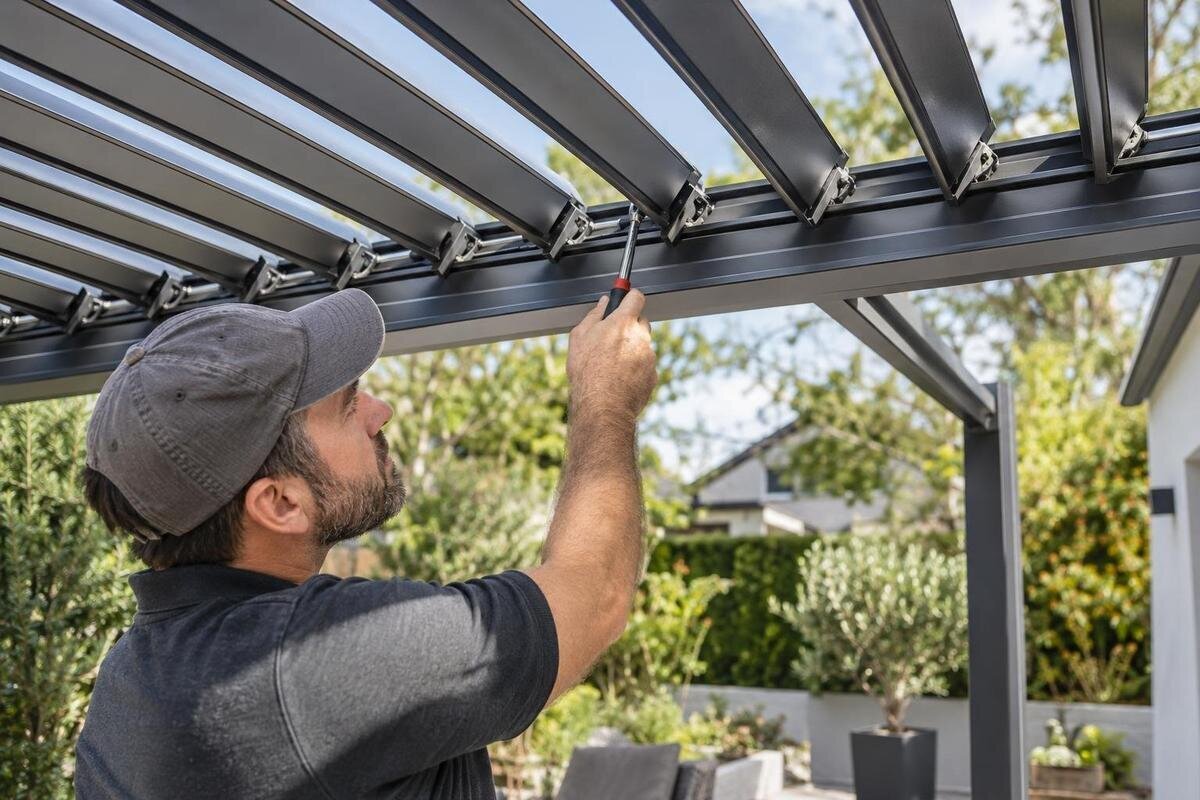
Pergola maintenance guide
A squeak from a pergola mechanism can be distracting, but the sound alone rarely tells you whether a part needs care, adjustment or replacement. The useful clues are when it happens, where it seems to come from and whether the pergola’s movement or appearance has changed. Sound can travel through the frame, so the apparent location may not be the source. Record observations before attempting maintenance. Do not spray a general-purpose lubricant, open a cover or force a moving part: use only products and methods approved for your exact model, and arrange qualified service if the mechanism behaves abnormally.

Before you request maintenance 1
What a pergola squeak can tell you
A squeak tells you that a sound is being produced under a particular condition; it does not identify a failed hinge, bearing, motor or fastener. It could come from a moving component, two surfaces making contact, an attached item or another nearby part. A pergola frame can carry sound away from its source, so the loudest point is not necessarily the part at fault. The same sound may also seem different depending on where you stand. Without inspection and model-specific guidance, naming a component from sound alone is speculation. Avoid tightening, bending, lubricating or taking anything apart just because it squeaks.
Frequency and accompanying symptoms matter more than the description of the sound. A single brief squeak with no change in movement or appearance gives less reason for urgent intervention than a recurring sound that becomes more pronounced or comes with hesitation, scraping or a visible shift. Note whether the pattern began after a change in use, cleaning or previous service, but treat timing as a clue rather than proof. Descriptions such as ‘high-pitched squeak’ or ‘short creak’ help communicate what you heard; neither establishes which part needs attention. If you are separately comparing options, the Bloomcabin Pergola listing provides a product-family reference, not a diagnosis of the pergola you already own. Keep the question of maintenance separate from a possible purchase, and base any care decision on the existing pergola’s manual and observed condition.
Record when the mechanism makes noise
Make a short log of exactly when the sound occurs. If it appears during movement, note whether it begins at the start, midway or near the end; whether it happens in one direction or both; and whether each normal operation produces it. If your pergola has a moving roof, describe the phase of travel rather than naming a part. Do not run repeated cycles simply to recreate the sound. Observe ordinary use only as permitted by the manual, keep clear of moving components and stop if movement becomes uneven, hesitant or resistant. A note is more useful than a deliberate stress test.
Also distinguish noise during movement from noise heard while the pergola is still. If it happens only while stationary, record whether it coincides with wind, rain or nearby activity instead of moving the mechanism to check. Note whether the sound is a single event or continues for a while, and whether the roof was open, partly open or closed, if applicable. These details help describe the circumstances without assigning a cause. If your paperwork identifies the model as the Bloomcabin Bioclimatic Pergola, copy that name exactly into a support request. A product-family name helps identify the enquiry but does not explain which parts are fitted or how to service them. If the model is unclear, say so and ask the manufacturer or supplier how to identify it rather than guessing from appearance.
Before you request maintenance 2
Locate the apparent source from a safe position
Listen from a normal, safe position at ground level and note the broad area where the sound seems strongest: one side, a roof edge, a post, a wall junction or more than one place. Record whether it seems to follow a moving part or stay in one area. These are clues, not a source diagnosis; noise can travel along a frame or through adjoining surfaces. Do not put a hand on a rail or panel while anything moves, remove a cover, climb to get closer or lean across the structure. If the suspected source is high or hidden, leave it for service rather than trying to pinpoint it yourself.
A phone recording made from that safe position can help show the timing and character of the noise. Keep the device away from the mechanism, and do not ask someone to operate it while you stand near moving parts. A still image of the general area can also help, provided it does not require climbing, lifting or touching anything. If your paperwork uses the name shown on the Bloomcabin Wall-Mounted Pergola product listing, copy it exactly; the name can identify the product family but does not prove that a noise near a wall originates at a connection. Say plainly if the location is uncertain.
Note weather and surrounding conditions
Keep weather and surroundings as context, not as a diagnosis. Note whether the noise was heard in still or gusty conditions, before or after rain, at a particular time, or after cleaning. Record only what you actually observed: a squeak after rain does not prove moisture caused it, and a sound in wind does not prove a part has loosened. You can also note nearby objects, branches or accessories that moved or contacted the structure, but do not remove fixed items or reach into the mechanism to test them. Avoid waiting for unsafe weather simply to gather evidence.
Compare entries from ordinary use over time rather than deliberately reproducing wind or rain. Keep the same basic details in each entry so you can distinguish a repeated pattern from a one-off event. For example, record the date, conditions, whether the pergola was moving and whether the noise sounded unchanged. Leave a detail blank if you did not observe it rather than filling the gap from memory. If the pattern prompts you to consider a different pergola, treat that as a separate buying question. The Bioclimatic Pergola product page identifies a named model, but it cannot establish whether that product suits your site or would resolve noise in the existing structure. Keep your symptom log available for the maintenance enquiry, and explain your site requirements separately when discussing a possible replacement.

Before you request maintenance 3
Visible changes that deserve attention
From a safe position, look for changes you can see without dismantling anything: a part that appears out of line, an uneven gap, obvious rubbing marks, debris near an exposed area, a cracked or bent-looking component, corrosion, loose-looking trim or a new gap at a junction. Compare with earlier photographs if available, but do not assume a mark identifies the source. Do not touch, press, tighten or pull a part to see whether it moves. If something is difficult to see from the ground, leave it for a technician with suitable access and the correct model information.
Give visible changes priority when they occur with the squeak, especially if a moving section no longer appears to travel evenly or a new contact point is obvious. Take a photograph from a safe distance and note when you first noticed it; do not try to clean or realign a concealed component. If the condition makes you weigh replacement, the Bloomcabin Pergola product page is a catalogue reference, not an assessment of whether your current structure is repairable or whether a replacement would fit. Have a qualified service provider assess the existing pergola before making that decision.
When to stop operating the pergola
Stop operating the pergola and seek manufacturer or qualified service guidance if the noise changes sharply, becomes a scrape or grind, or comes with jerking, hesitation, uneven movement, a part that catches or a visible shift. Do not keep pressing a control to see whether it will complete another cycle, and do not force a stuck part by hand. Keep people clear of moving sections while you arrange help. A new sound that appears with a clear change in function deserves more attention than a brief, isolated squeak, even if the pergola still moves.
If the sound is mild and intermittent while movement otherwise appears normal, record it and check the care instructions for your model; do not assume that normal movement rules out maintenance. If the manual says to stop use for a particular symptom, follow that instruction. If you cannot tell whether operation is normal, ask the manufacturer or installer rather than running tests. The useful threshold is a change in pattern, behaviour or visible condition, not a decibel level you estimate by ear or from a phone recording.
Before you request maintenance 4
Use only manufacturer-approved care methods
Do not reach for general-purpose oil, grease, penetrating spray, silicone spray or a household lubricant as a first response. A product that quiets a sound briefly may conceal rather than resolve its cause, and an unapproved product or method may be unsuitable for a particular component or finish. Do not apply lubricant to a joint, track, seal or drive mechanism unless the manual for your exact pergola explicitly approves the product and explains the method. The same principle applies to cleaning agents, pressure washing or abrasive tools around moving parts: no generic treatment is automatically suitable.
Find the manual for the exact model and check whether it specifies routine cleaning, lubrication, access limits and approved products. Instructions for a different model or a generic pergola video are not a substitute; care requirements can vary. If the manual is missing or does not address the squeak, ask the manufacturer or authorised service team what care, if any, is approved. Do not open a housing or remove guards to reach an internal part. Approved maintenance is different from experimenting with sprays until the noise stops.
What to include in a maintenance request
A maintenance request is easier to assess when it begins with facts. Provide the model name and serial or identification number if safely available, plus the purchase or installation date if you have it. Describe when you first noticed the squeak, how often it occurs, whether the pergola was moving or still, the apparent area and any change in operation. Add relevant weather, recent cleaning or previous approved service. Separate what you observed from what you suspect: ‘heard near the roof edge, source unclear’ is more useful than an unsupported claim that a specific hinge has failed. If the pattern has changed, give a brief sequence of events rather than describing every occurrence in detail. Finish with the question you need answered, such as whether to stop using the mechanism or whether an inspection is needed.
Attach a short audio or video recording made from a safe position, and a still photo of any visible change. Use an existing recording of an ordinary event rather than creating repeated test cycles for the request. Label each attachment with its date and a brief description, and explain which part of the recording contains the sound. Distinguish a general view from a close view so the recipient can understand where a visible mark or gap sits on the pergola. If your paperwork uses the name shown on the Wall-Mounted Pergola page, copy it accurately and include any model or serial reference from your records. A product-family name may not identify every variant. Say which identification details are unavailable rather than substituting details from a visually similar product.

Before you request maintenance 5
Check spare-part compatibility before ordering
Do not order a replacement part because it looks similar in a photograph or seems to match a measurement. Ask the manufacturer or supplier to confirm compatibility against the precise model and identification details, and provide your symptom record rather than selecting a component by guesswork. An apparently small part may be designed for a particular assembly; a mismatch can waste time and may not address the noise. Keep the existing part in place unless service instructions say otherwise. If something is already damaged or has come loose, do not try to refit it yourself.
Repairs involving a motor, wiring, internal drive components or structural connections should be assessed by a qualified service provider; do not open electrical housings to investigate a squeak. The Bloomcabin Bioclimatic Pergola page can help identify a product family, but a catalogue page is not a spare-parts diagram and does not confirm that a part, repair or upgrade is compatible with your pergola. Request confirmation of the exact part or approved work before proceeding, and ask who is qualified to carry it out.
What a maintenance assessment should clarify
Ask the service professional to explain what they believe is making the noise, what observations support that conclusion and whether further inspection is needed. A useful assessment should distinguish a normal sound from a component needing approved maintenance or repair, and tell you whether it is safe to operate while awaiting work. Ask which care method is approved for your model and what signs should prompt you to stop using it. If the source cannot yet be confirmed, a clear account of what remains uncertain is better than a guessed diagnosis. You do not need to authorise a part replacement before understanding the finding.
If a repair, upgrade or replacement is proposed, ask how the recommended option matches the model and site, and who is qualified to carry out the work. Clarify whether the proposal addresses the identified source of the squeak or concerns a separate improvement you have requested. For a purchase comparison, the Bloomcabin Pergola catalogue page lists the range from 9 to 24 m²; that information alone does not establish site suitability or compatibility with your existing mechanism. Compare the proposed work with the stated finding, rather than treating a larger intervention as an automatic solution. Where the assessment leaves more than one option, ask what each is intended to achieve. A squeak alone should not become a reason to replace a pergola that may only need approved service.
Frequently asked questions
Does a squeak mean my pergola has failed?
No. A squeak is a symptom, not a diagnosis. Note when it occurs and whether movement or appearance has changed. Recurring or worsening noise, especially with scraping, hesitation or visible damage, is a reason to seek model-specific maintenance advice.
Can I use WD-40, silicone spray or oil on the mechanism?
Only if the manual for your exact model specifically approves that product and method. Do not try a general-purpose spray or household lubricant to see whether the noise stops; it may be unsuitable and could mask the underlying issue.
Should I operate the roof several times to find the squeak?
No. Do not run repeated cycles just to reproduce a noise. Observe normal use only as the manual allows, keep clear of moving parts and stop if movement becomes uneven, hesitant or resistant.
How can I locate the sound without taking anything apart?
Listen from a safe position at ground level and note the broad area where it seems loudest. A short recording or still photo may help, provided you do not climb, touch moving parts, remove a cover or place a device inside the mechanism.
When should I arrange maintenance?
Seek advice if the squeak recurs or worsens, or comes with grinding, scraping, jerky or uneven movement, a part that catches, or visible change. If you cannot tell whether operation is normal, ask the manufacturer or a qualified service provider rather than testing further.
Treat a squeak as a pattern to document, not an invitation to experiment. If it recurs, grows louder or comes with abnormal movement or visible change, pause operation and seek model-specific service advice. If it is brief and the pergola otherwise behaves normally, keep a dated note and follow only approved care instructions. Knowing when, where and under what conditions the sound occurs gives a service professional a better starting point than a guessed lubricant or repeated test.
