
Why Does Water Drip When Pergola Louvres Open?
Pergola rainwater
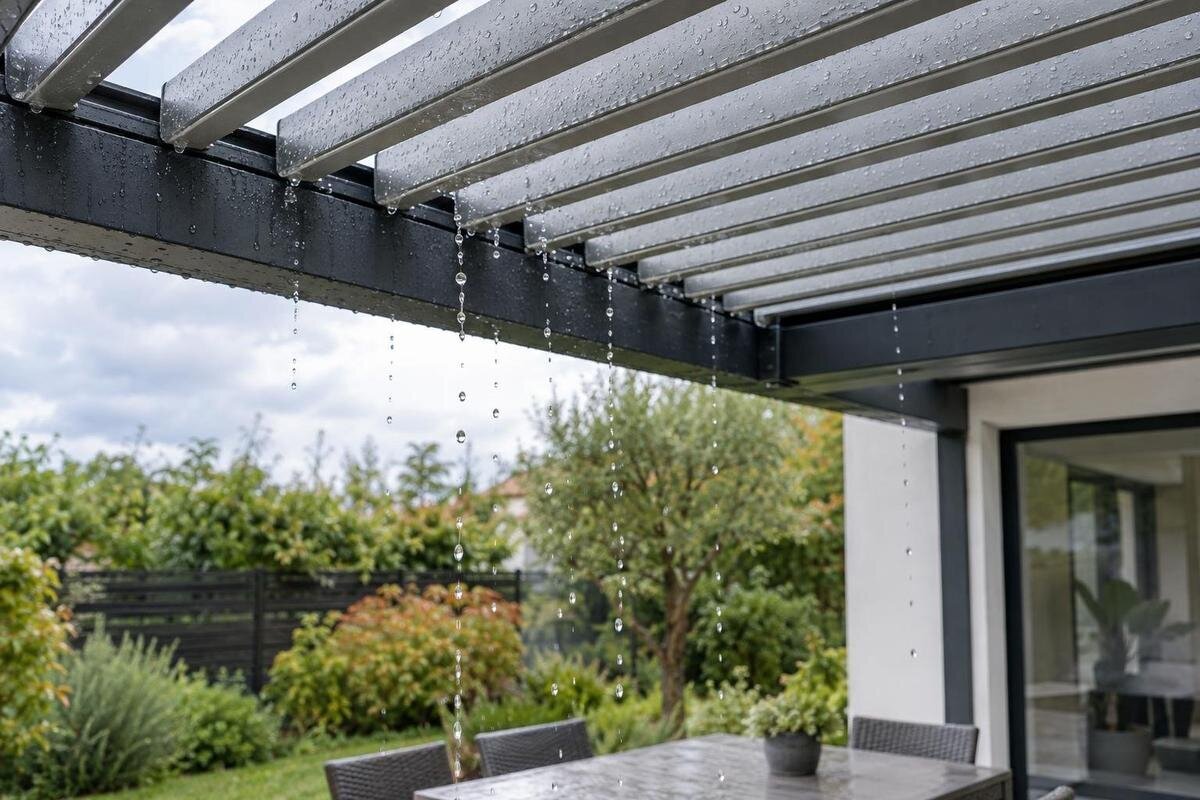
Water dripping as a pergola’s louvres open after rain can be startling, particularly when the roof seemed to have drained while closed. In many cases, movement releases water left on a blade, held at a joint or edge, or remaining within a drainage path: changing the louvre angle changes where gravity carries it. A few drops do not, by themselves, prove a fault, but persistent or recurring water deserves attention. The useful clues are the exact point of release, whether it begins with movement, what the weather was doing and how the roof behaves while stationary. Because louvre and drainage layouts vary, the instructions for the exact pergola should guide operation and diagnosis.

Questions to ask before buying 1
Why a drip can appear as the louvres move
Opening a louvre changes its slope and the position of its edges. Water left as a thin film, a bead at a seam or a small pool on the upper face can move towards the blade’s lower edge as it turns, then fall where it was not visible while the roof was closed. The first movement may also expose an underside or a gap that had been shielded. Water can run along a frame before dropping, so the wet patch on paving or furniture may be some distance from where it left the roof. If rain has only just stopped, runoff from wet surfaces can continue after the shower ends. A bead may be released only when the blade reaches a particular angle.
That timing is a clue, not a verdict. If a few drops appear during movement and then stop, residual water is plausible, but it cannot be declared normal for every louvred roof without the design information. Dripping that continues while the blades are stationary, starts during dry conditions or repeatedly emerges from one fixed joint deserves a closer look. There could still be water draining from a higher point, or new rain may be reaching the roof. Note the sequence—rain, pause, movement, drip—rather than labelling one event as a leak or as proof that the system has drained correctly. A drop alone says little about what water remains elsewhere.
Where rainwater may remain
Rain can remain on more than the obvious top face. Depending on the shape and joints, beads may sit along a louvre’s edges, around blade ends, at overlaps or near moving connections. Those are possible holding points, not components that every pergola necessarily has. A narrow lip can retain a little water, and a joint may shed it only when the blade changes angle. Water visible underneath may also have travelled from a wet upper surface or higher frame section. The place where a drop lands is not always where it collected, especially if it runs along a profile before falling. One damp area alone may therefore be a poor guide to the source.
Some designs guide rain into purpose-made channels or gutters, so water can remain in a route that is partly hidden from below. An outlet may continue to drain after the rain has eased, and a nearby louvre moving can change where the final drops emerge. For the Bloomcabin Bioclimatic Pergola, consult the matching drainage drawing to identify the intended path rather than inferring it from the product name. Observe only areas visible from the ground. A drip at the roof edge may mark the end of a route rather than the place where rain entered it; an unseen profile should not be assumed to carry water unless the drawing identifies that function.
Questions to ask before buying 2
The drainage route depends on the roof design
A louvred pergola is not a single standard drainage design. One roof may direct rain towards a channel with the blades in a specified closed position; another may use a different route, outlet or operating sequence. Those details affect whether a moving blade carries water with it or exposes a small amount held by the fixed frame. The word ‘louvred’ describes the roof style, not the exact direction of flow, the time needed to drain or performance in every rain condition. A model’s drawing should trace the intended route from roof surface to outlet and identify the blade position it assumes. A general product photo cannot answer those points, and a drawing for a fully closed roof may not cover a partially open louvre.
Information for a similar-looking pergola is not a safe substitute. When considering the Bloomcabin Wall-Mounted Pergola, match the instructions to the model and variant on the order or purchase documents. Check which louvre position the drawing assumes, where water is meant to run and whether it describes behaviour while the blades move. This distinction matters when comparing a closed-roof drainage diagram with water released during opening: they describe different roof positions. If the operating sequence is not explained, ask the supplier or installer to clarify it. A detail remembered from another roof cannot confirm how this installation should behave.
What the drip’s timing and location can tell you
From a safe spot, note whether the first drip comes from a blade edge, a fixed perimeter, a corner or a post, and whether it coincides exactly with movement. Record whether it happens on the first opening only, at several angles, or after the louvres have been left still. Note if it comes from one point or spreads along an edge, and whether there is a visible trail above it. These details can help you find the relevant part of the drainage diagram, but they do not identify a failed component on their own; a hidden channel can carry water away from where it emerges. Avoid repeatedly moving the roof just to reproduce the drip.
Write down when the rain stopped, whether wind or showers were still present, and how the roof had been positioned beforehand. A short video from a safe place may show the order of events, but do not move closer to film a mechanism in motion. Label the record with the product name on your paperwork—such as Bloomcabin Pergola—and any model or variant details available. Describe what happens before, during and after movement rather than recording only the wet patch left behind. Note whether the same pattern has happened before; this gives the person assessing it a clearer account than the word ‘leaking’ alone.

Questions to ask before buying 3
How weather changes the amount of retained water
Rainfall does not wet every face evenly. Wind direction and gusts can drive water towards edges or components that receive less water in calmer conditions; a long shower can leave more surfaces wet than a brief one, while a pause in rain does not mean every channel is empty. Blade angle before and during rainfall also changes which faces are exposed. These factors help explain why the same pergola may drip differently from one event to another, but they cannot predict how much a particular design should retain. Compare observations made in similar circumstances and distinguish continuing rain from water released after movement. A dry spell between showers may also leave some parts of the roof wet.
When rain is still falling, opening the louvres may expose the area below to more water or change the route of runoff. The permitted operating position and weather limits depend on the roof, so neither ‘always open’ nor ‘always keep closed’ is a reliable general rule. When comparing bioclimatic pergola options, ask what the operating guidance says about movement during rainfall and immediately afterwards. Keep those two situations separate: water falling through an opening during rain is not the same observation as retained water being released after it. Guidance for one roof position should not be assumed to cover every angle.
Safe ways to observe the problem
Observation from ground level is usually enough to find an approximate release point. Keep clear of moving louvres and do not reach between blades, try to catch water near a moving joint, climb onto the roof or use a ladder to inspect an inaccessible channel. Follow the supplied operating procedure, especially if the roof uses a powered mechanism. If movement becomes hesitant, uneven or accompanied by an unfamiliar noise, stop rather than forcing it and contact the supplier or installer. A drip question is not a reason to adjust a drive, wiring, brackets or fasteners, or to test the mechanism in a way the instructions do not describe.
If the roof stops in an unexpected position, a visible component appears loose or the movement changes suddenly, leave the assessment to a service person rather than trying to move parts by hand. For support with the wall-mounted pergola, provide the installed arrangement and the unit details from your purchase documents, along with the date and observed roof position. Avoid removing covers or dismantling anything unless the manufacturer’s maintenance instructions expressly permit that task. There is no need to recreate an event if doing so would put you near moving parts or water; describe the unexpected movement separately from the dripping.
Questions to ask before buying 4
When dripping points to a drainage issue
Dripping is more concerning when water keeps emerging from the same location after the roof has stopped moving and the drainage interval described for that model has passed, or when there is recurring flow, visible pooling or an outlet overflow. A blocked outlet is one possibility, but a restricted route, an installation issue, a damaged component or continuing flow from an upstream point can look similar from below. The drip’s position does not prove that the nearest channel is blocked. Compare the observed location with the model’s drainage diagram, and avoid deciding that a system is obstructed based on one drop immediately after opening. The instructions are needed to understand what drainage behaviour is expected.
From the ground, check only for obvious material at a location the manual says the owner may inspect, such as a visible, safely reachable outlet. Do not probe narrow openings or flush a hidden channel. For the Bloomcabin Pergola model, use its maintenance instructions to establish which areas are accessible and what cleaning is permitted. If routine access is not explained, ask before clearing anything. Record visible material, pooling or overflow without assuming that it proves a blockage. Passing those observations to the supplier or installer keeps the distinction clear between something you have seen and a cause that still needs assessment.
What to check in the operating instructions
Read the operating instructions and drainage information together. Look for a diagram that traces water from the louvre or roof surface to its outlet, notes any required closed or angled position, and identifies components that should be kept clear. Check whether the guide says how to operate the roof during rainfall, whether water can emerge as louvres move and what maintenance the owner may carry out. A diagram may describe an intended route without promising that no drop will occur under every combination of rain, wind and roof position. Separate those stated operating instructions from broad claims in a general brochure, and check whether the maintenance advice describes safe access.
If the documents leave a question unanswered, identify the precise gap: the drawing may omit the observed release point, show only a closed roof or leave the opening sequence unexplained. When enquiring about Bloomcabin’s bioclimatic pergola, refer to the relevant drawing and include any version or configuration details from your paperwork. Ask whether that point is part of the intended drainage path and which instructions apply while the louvres move. A simple sketch can help relate the drip location to the drawing. This makes the enquiry specific without presenting an assumed blockage, leak or other fault as an established diagnosis.

Questions to ask before buying 5
Questions to ask before choosing a pergola
Before choosing a louvred pergola, make rainwater behaviour a concrete product question. Ask for the drainage diagram for the exact roof, the operating position it assumes, where water is meant to exit and what the instructions say about opening or closing after rain. Ask which weather conditions the documents cover and what limits apply; a statement about pergolas in general is not the same as guidance for a particular model. If the seller points to a generic illustration, ask for material matched to the product family and the configuration you are considering. You are trying to understand how water is routed and what operation is approved.
If you plan to add side screens or an enclosure, ask whether the proposed arrangement is covered by the same performance documents and whether it changes drainage or operating advice. Do not assume a screen prevents water released as the louvres move, or that pairing a roof with walls makes the area weatherproof. When considering a wall-mounted pergola configuration, include the selected options in those questions rather than discussing the roof alone. Ask how optional elements are represented in the drawings and whether the information describes the complete setup you intend to buy. That is more useful than a general assurance about rain protection.
When to seek an assessment
Seek an assessment when dripping is prolonged, repeatedly returns at the same point, appears while the roof is still, or accompanies pooling or visible overflow. Tell the supplier, installer or service provider whether the pattern is new, has changed or has occurred since installation. Use the observation record to explain the sequence rather than repeatedly operating the roof to demonstrate it. Include safe photos or video if you already have them. The assessment should relate the observed behaviour to the actual drainage path, with particular attention to the recurring release point and any change in roof movement.
Do not deliberately cycle the roof in heavy rain, force a stiff mechanism, dismantle a gutter or seal a joint to stop an unexplained drip. Those actions can obscure the source or create a separate problem, and an unapproved fix may not suit the design. Ask the service person to assess whether the water is residual runoff, drainage continuing along its intended route or evidence of a fault, and what inspection or maintenance the manufacturer allows. Once the cause is established, follow guidance for that pergola rather than a rule copied from another roof. Movement can reveal water that was already present without showing why it remained.
Frequently asked questions
Does a drip when the louvres open mean the pergola is leaking?
Not necessarily. A few drops released as a blade turns may be water already on the louvre or in part of its drainage path. It is only one clue, though. Ongoing dripping, water appearing while the roof is stationary or repeated discharge from one fixed point should be compared with the drainage instructions for the exact model.
Why does water appear only when I move the louvres?
As a blade turns, its angle and lower edge change. Residual water can move towards that edge, or a newly exposed gap can let it fall. Water may also travel along a frame before dripping, so where it lands may not show where it was held.
Should I open the louvres during or straight after rain?
There is no single rule for every pergola. Follow the operating guide for your exact model, including any advice about use during rainfall or after it. If the instructions do not cover the situation, ask the supplier or installer rather than applying a rule from a different roof.
How long should the dripping continue?
There is no universal time that applies to all louvred roofs. Check what the model’s instructions say about drainage and post-rain operation. If water continues beyond what they describe, or the same dripping keeps returning, record the pattern and ask the supplier or installer to assess it.
Could a blocked channel cause the dripping, and can I clear it?
A restriction is one possibility, but a drip when the louvres move does not prove there is a blockage. Inspect only locations the maintenance guide identifies as owner-accessible. Do not probe or flush hidden routes; if you see pooling, overflow or persistent discharge, ask for an assessment.
Water released as louvres move is often rainwater left on a blade, edge or drainage path shifting to a new low point. The timing and location help explain what is happening, but a drip alone cannot confirm either a fault or correct drainage. Match what you observe to the instructions and diagram for the exact pergola. If the pattern persists, recurs or comes with pooling or unusual movement, have the model assessed rather than relying on a general rule for louvred roofs.
