
Adding Screens or Lighting to an Existing Pergola
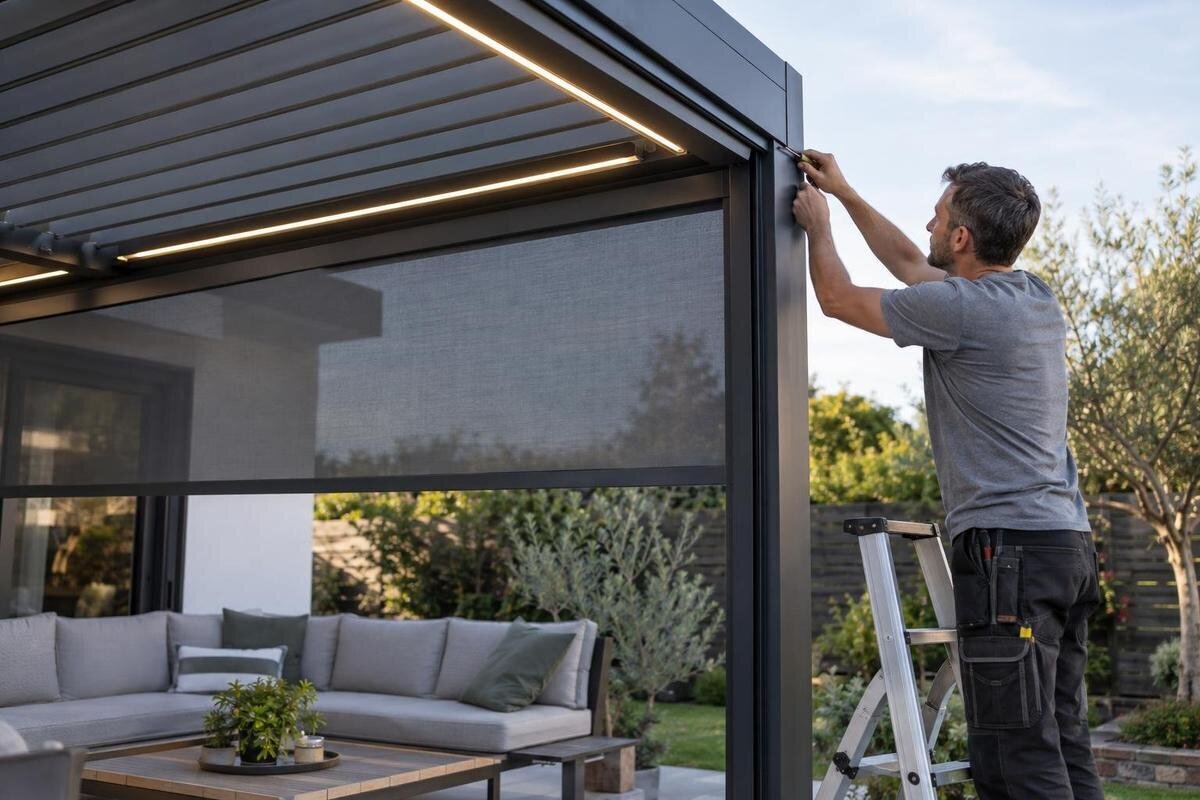
Pergola upgrades
Adding a screen or lighting to an existing pergola is sometimes possible, but the answer depends on the exact model and revision, approved mounting points and—where power is involved—the wiring and controls. Screen width alone does not establish fit, and a cable route that looks convenient may not be approved. Identify the pergola first, then confirm the accessory and available components with the manufacturer or its support team. The checks below help you decide what to gather before buying a kit, drilling or scheduling installation.

Can you add a screen or lights later?
Yes, in some cases, but “pergola accessory” does not mean universal fit. A screen might be a retractable side screen, a fixed panel or an insect screen; lighting might be battery-powered, plug-in or wired. These choices call for different mounting arrangements, clearances, wiring provisions and controls. A manually operated screen avoids questions about motors and controllers, but still needs approved mounts and room to move. Identify the structure and the accessory you want before comparing kits; an item that looks the right width may not attach or operate correctly.
Treat a retrofit as two separate checks: the manufacturer must approve the accessory for the specific pergola model and revision, and the installed frame and surrounding space must suit it now. Powered equipment adds a separate check for the supply, cable route and controls by qualified professionals. Confirmation that a bracket can be attached, or that an opening has the required width, does not settle these other questions. Keep drilling, cutting and ordering on hold until the fit and installation plan are documented.
Identify the pergola and its revision
Start with the records for the structure already in place, not a photo-based guess. Find the order confirmation, installation paperwork, product label, manual, model code and any serial or production identifier. Note the purchase or installation date if you know it, along with who installed the pergola and whether it has since been modified. If the paperwork names Bloomcabin Pergola, use the Bloomcabin Pergola product listing as a product-name reference in your enquiry. Keep model wording and suffixes exactly as recorded. Separate the purchase date from the installation date rather than treating them as interchangeable. If two records use different names or codes, include both and ask support to resolve the difference; do not choose whichever seems closest to a current listing.
Take clear photos of the whole structure from several sides, then close-ups of the label, beam ends, post connections, visible rails, existing cables and controls. Do not dismantle anything or open electrical enclosures just to get a better view. Mark which side you mean by “left” or “front,” and show where you want the screen or lights. A single close-up may miss differences between one side and another; wider views help support staff understand the layout.
Get the correct manual and accessory details
Use installation documents and technical drawings for the precise model and revision, not a manual for a pergola that merely looks similar. Look for an accessory list, kit or part number, specified attachment locations, wiring provisions, clearance requirements and any notes about moving roof components. If your records identify a Bloomcabin Bioclimatic Pergola, keep that product name alongside the identifiers from your installation. A current product page establishes product identity, not compatibility with an older frame; the same distinction applies to every catalogue link in this guide. Record the manual’s title and version, and note which drawing or page covers the proposed accessory. This lets support address a specific mounting or wiring question rather than guessing which instructions you have.
If you cannot find the right documents, ask the manufacturer’s support team for the manual and accessory information that matches your identifier. Ask for the exact kit number and whether it is approved for your model and revision, including any required brackets, adapters or controls. Clarify whether an accessory depends on factory provisions that may not be present on your pergola. Avoid relying on a retailer’s general description when the installation question is about a specific frame.
Choose the screen type and check its travel
Describe what you mean by “screen” before requesting a fit check. A retractable side screen, fixed panel and insect screen may use different guides, end fittings and attachment points; a manual screen and a motorized one also have different operating needs. Note which opening you want to cover, whether the screen should span all or part of it, and whether you expect it to retract. For an installation identified as a Bloomcabin Wall-Mounted Pergola, use that exact name when describing the opening. Explain the purpose as well: privacy, insect screening or another intended use. Ask whether the proposed accessory is designed for that purpose rather than treating all screen types as equivalent. A clear description helps support assess both the intended fit and how you expect to use it.
Check where the screen will sit both when extended and when retracted. Doors and windows, handles, furniture, steps and access routes can affect its movement or make operation awkward. Ask whether it could interfere with maintenance access, drainage or any moving parts on the pergola; do not assume these details from a photograph. Also ask about the manufacturer’s use instructions, including when a screen should be retracted. A screen should not be assumed to turn an open pergola into an enclosed or weatherproof room.

Confirm mounting points and frame condition
A bracket should not be attached just because a post or beam looks like a convenient surface. A screen and its fixings can transfer force to the frame, and a screen exposed to wind may behave differently from one stored away. Ask for a drawing that shows approved mounting points, required hardware, any adapters or reinforcement, and areas that must not be drilled. Do not use a moving roof part as a mounting surface unless the model-specific instructions explicitly allow it. If no approved attachment method is documented, pause rather than improvising.
The actual pergola also needs to be assessed, not only the accessory design. Point out any visible damage, movement at joints, missing pieces or earlier alterations, and provide that information to the installer. Distinguish what you can see from what you do not know: an unexplained hole or fitting should be described, not assumed to be an accessory mount. An accessory intended for a model does not automatically establish that an older or modified installation is suitable today. Have a qualified installer check the frame and its connections, and ask for further professional assessment if structural suitability remains unclear. If replacement is being considered, keep the Bloomcabin Pergola catalogue entry in a separate enquiry so that questions about the existing frame and a possible new purchase are not confused.
Plan the lighting power and cable route
First establish what type of lighting you want and how it is powered: battery, plug-in or fixed wiring are different arrangements. Do not assume a nearby outlet, an existing conduit or a cable tucked behind a beam is suitable for a new light. The cable route must be approved for the pergola and must not interfere with moving components or future service access. Do not drill into posts or beams or alter concealed wiring based on appearance. Have a qualified electrician assess and carry out any electrical work in line with applicable requirements.
Show the electrician and manufacturer where each light is intended to go, what controls are already present and what wiring is visibly accessible without removing covers. Describe whether you want lighting across the whole pergola or in particular areas, and whether each area needs separate control. These are planning questions, not instructions to alter the wiring yourself. Ask where a connection may be made, what components and protection are required, whether the existing supply or controller can serve the accessory, and how the system can be accessed for service. A nearby power source does not prove that it is appropriate for the proposed equipment. For an installation recorded as a Bioclimatic Pergola from Bloomcabin, include its identifiers in the lighting enquiry so the electrical assessment and product-compatibility response concern the same structure.
Check controls and how accessories work together
For powered screens or lights, identify the controls already in use. Record visible labels or model numbers on remotes and control units where you can do so safely, but do not remove covers. Ask whether the proposed accessory needs its own controller, a particular existing controller or a separate switch. A matching brand name or similar-looking remote is not enough to establish that an older control system will operate a new motor or light. Describe your preferred arrangement: separate operation for each accessory, or shared control where supported. If replacing a controller is proposed, ask which existing functions will be retained and whether other components must change with it. This helps you understand the full upgrade rather than judging only the new accessory.
Consider how the equipment will be used day to day. Will a screen block access to a control, door or service area? Could its movement coincide with a roof component or another powered accessory? Ask the manufacturer or installer to confirm any operating sequence or restrictions rather than assuming that controls can be combined. Describe the positions in which you expect to use the screen and roof, not just how they look when everything is retracted or closed. For an existing wall-mounted model, the Wall-Mounted Pergola listing from Bloomcabin provides the product name for that discussion. Keep the proposed operating arrangement in the installation scope so everyone understands which combinations have been confirmed and which remain unresolved.
Check whether parts and support are still available
Compatibility and availability are separate questions. A manual may show a screen or light kit that is no longer supplied, or a part number may have been replaced. Ask support whether a proposed replacement is approved for your exact model and revision, and whether it requires matching rails, brackets, wiring or controls. Do not substitute a generic component because its name or shape looks similar. When enquiring about an older model, distinguish its recorded identifiers from the current Bloomcabin Pergola range listing. Also distinguish a complete replacement kit from an individual replacement part: ask what can be retained and what must be changed together. If only some components are available, find out whether they form a complete, supported installation before committing to a partial order.
Before paying for a kit, request a clear list of what is included and what must be sourced separately. Confirm the part numbers for the main accessory and any mounting or control components, and ask whether retained parts from your pergola can be used. If colour or finish matters, ask how a replacement component will match the existing structure rather than judging from a small image. Keep the answer, part numbers and order details with the manual so there is a record of what was confirmed.

Coordinate the work with qualified professionals
Different parts of the decision may need different people. Ask the manufacturer’s support team to confirm model compatibility; have an installer assess access, clearances and mounting; and have a qualified electrician assess and complete electrical work. If the installer cannot confirm that the frame or its connections are suitable, ask whether further professional review is needed. Where local permits or inspections may apply, ask a qualified local professional to confirm what is required. Check the actual warranty terms before authorizing changes instead of assuming that an alteration will or will not affect coverage.
Before work is booked, request a written scope that identifies the approved accessory and part numbers, mounting locations, any proposed changes, the electrical and control plan, and who is responsible for each task. Confirm how access for future maintenance will be preserved and what will be checked after installation. Where more than one trade is involved, establish who will coordinate their work and resolve questions before the frame is modified. If a proposed plan involves drilling, cutting, generic rails or rerouted wiring that has not been approved, stop and ask for clarification. If a retrofit is not supported and replacement is being explored, use the Bloomcabin Bioclimatic Pergola catalogue page for a separate product enquiry. Compare the scope of replacement with the retrofit proposal without assuming that existing accessories can be transferred.
Use a compatibility checklist before buying
A sound “proceed” decision should have clear answers to six questions: Is the pergola’s exact model and revision known? Has the manufacturer confirmed the accessory and part numbers? Are the mounting points and any structural requirements approved? Is there enough clear space for the screen to move and for the structure to be maintained? Have qualified professionals reviewed the power, cable route and controls? Are the required components and support available? If any answer is unknown, mark it as pending. That is a reason to ask for more information, not to test the fit by drilling or ordering parts.
Turn the responses into a short purchase record, with each checklist item marked confirmed, pending or unavailable. Keep any conditions beside the relevant answer: for example, compatibility may depend on using specified brackets or replacing a control component. A conditional answer should not be recorded as an unrestricted yes. Compare the proposed order with the confirmed parts list and the installer’s scope, looking for items that neither includes or that both include. Resolve those gaps or overlaps before paying. If a required component is unavailable, ask whether the proposal needs to change rather than treating the missing item as something to improvise later. The final record should make clear what you are buying, what work is included and which questions, if any, still prevent the upgrade from proceeding.
Frequently asked questions
Will a universal pergola screen fit my frame?
Do not assume so. A screen’s width does not confirm that its brackets, guides, travel space or attachment points suit your pergola. Ask the manufacturer’s support team to confirm compatibility with your exact model and revision before ordering.
Can I add lighting if there are no existing cables?
Possibly, but the right approach depends on the light, its power source and the pergola’s approved cable routes. Have a qualified electrician assess any electrical work, and confirm with the manufacturer that the proposed mounting and route are suitable.
Can I attach a screen to any beam or post?
No. Use only mounting locations and hardware approved for the specific pergola. A screen and its fixings can transmit force to the frame, so a qualified installer should assess the actual structure and follow the manufacturer’s instructions.
What if the screen or lighting kit in my manual is discontinued?
Ask whether an approved replacement part or kit exists for your model and revision. Confirm whether it needs matching brackets, rails, wiring or controls. A similar-looking generic part is not proof of compatibility.
What information should I send with a compatibility enquiry?
Provide the model and any serial or production identifier, the manual or order details, clear photos of labels and the proposed installation area, and a description of the screen or lights you want. Include visible control or wiring details without opening enclosures.
The key distinction is between an accessory that happens to attach and one confirmed for the exact pergola already installed. A retrofit can be considered when model-specific compatibility, mounting provision, screen clearance, electrical planning and parts availability are all clear. If one of those remains uncertain, pause before modifying the frame or wiring. A documented fit check is more useful than trying to make a similar-looking component work.
