
Buying a Replacement Pergola: Can You Reuse the Existing Foundation?
Pergola buying guide
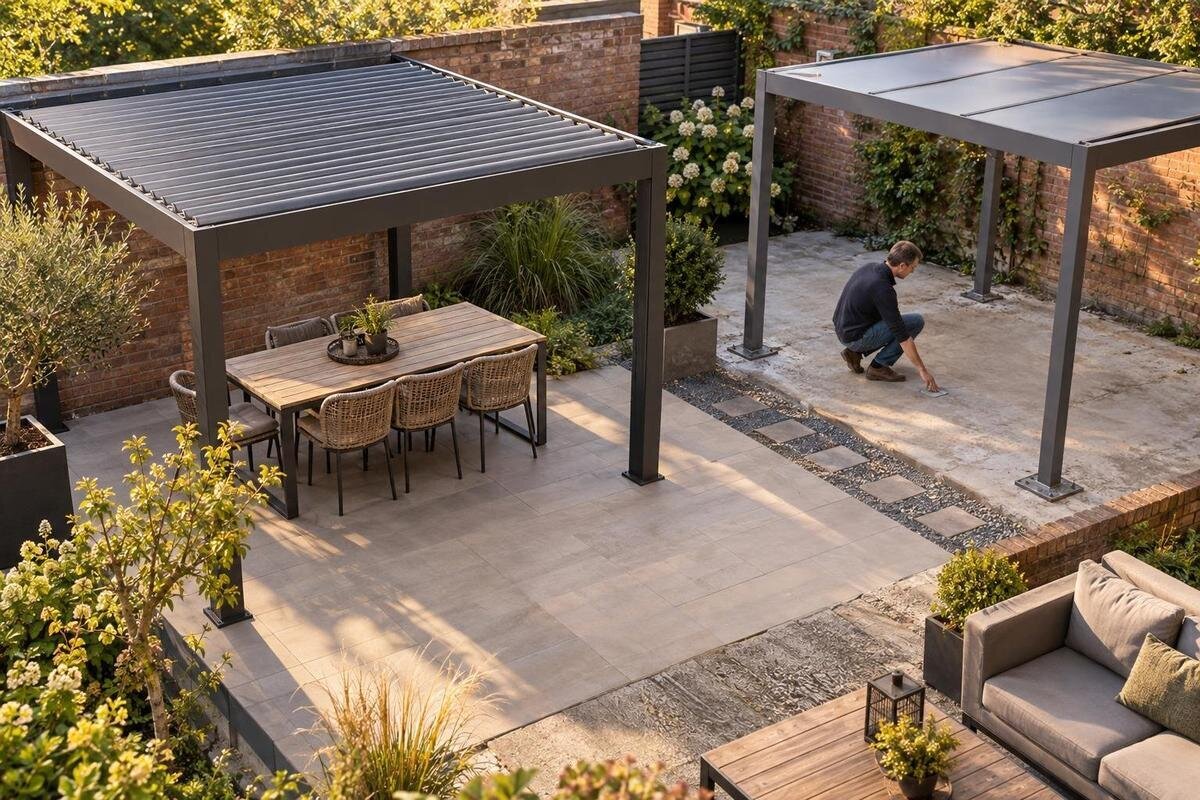
When replacing a pergola, it is tempting to treat the old foundation as a ready-made base: remove the frame and install the new posts in the same places. That may work in some cases, but the former structure does not prove the base will suit a different model. The supports may be hidden, deteriorated or positioned for another post layout; a new pergola may specify a different anchoring arrangement. Before choosing a replacement, document the existing site and compare it with current installation information for the exact product. Then price reuse, professional modification and replacement as distinct possibilities. This keeps a foundation assumption from becoming an expensive surprise after the order.

Treat the existing foundation as a separate purchase decision
A replacement pergola can involve more than removing the old posts and setting new ones in their place. The former frame may have been supported by isolated footings, a slab, surface-mounted brackets, deck framing or a connection to a building. These are different support arrangements, and a new structure may use another post layout or fixing method. Even when the patio looks unchanged, part of the support may be hidden or may have moved. Treat “same spot as before” as a measurement clue, not proof that the foundation is suitable. The old structure’s appearance, age and repair history are useful context, but none replaces a review of the actual base.
Separate the questions in your buying brief: is the existing foundation in suitable condition, and does the exact replacement model allow installation on it? A sound base can still be in the wrong position for new posts; convenient alignment does not make a deteriorated base acceptable. Review the product’s instructions alongside the actual site, not after the order. If you cannot answer both questions yet, leave reuse as an open option and compare it with modifying or replacing the base. Ask anyone preparing an installation quote to state whether their price assumes the old foundation can be kept. That assumption can change the work involved, so it belongs in writing.
Identify what supports the existing posts
Start by identifying what each post actually rests on. It may be a concrete pier below grade, a pad, a larger slab, a screw pile, deck framing or a bracket fixed to another structural surface. Pavers, patio finishes and deck boards can hide the support rather than serve as it. Note whether the old pergola stood independently or was attached to the house, and whether base plates or fasteners remain. If there were several posts, document every location; one accessible footing does not prove the others are identical or in the same condition. Count the supports and note any visible differences, since repairs or later changes may have left them unlike one another.
Look for original drawings, invoices, permit records or installation notes, and ask the previous owner or installer whether they are available. Photos taken during construction can show buried components that are no longer visible. Record accessible measurements, but do not treat a surface reading as evidence of a footing’s depth, reinforcement or capacity. If the support type remains uncertain, tell the installer before requesting a reuse quote. A qualified person can decide what further inspection is appropriate. Avoid breaking paving or exposing buried supports on the assumption that an informal look can confirm their suitability; the distinction between a finished surface and a structural support is especially important when posts sit over boards or pavers.
Match the new post positions to the existing supports
Measure the existing post locations, not just the outside edge of the old roof. Record the centre-to-centre distance between posts, the overall footprint, offsets from nearby walls and any visible change in level. A replacement may have roughly the same canopy area but place its posts farther in, use a different number of supports or leave a different overhang. Those differences matter when comparing footing centres with new post and base-plate positions. Keep a simple sketch with dimensions and photos, and label which measurements are approximate. Use consistent reference points, and make clear whether a dimension runs from centre to centre or from one outside edge to another.
Request dimensioned drawings and anchoring instructions for the exact model you are considering. Compare post locations, plate footprints and the permitted mounting surface; do not infer compatibility from a product photograph or a broad size label. When looking at the Bloomcabin pergola product page, use it as a starting point for questions, and ask the retailer for current installation information if it is not shown. A tape measure can establish where supports are; it cannot confirm what loads the existing foundation can safely take. Have a qualified installer or other relevant professional assess that part of the decision.
Assess visible condition and past movement
Look for visible clues before deciding to retain the supports. Cracks, flaking or spalled concrete, loose or bent hardware, corrosion, water that repeatedly collects, and uneven or shifted paving around a post are reasons to pause and seek an assessment. None of these signs, on its own, proves that the foundation must be replaced; equally, a clean surface does not certify it. Damage can be concealed beneath a plate or below grade. Photograph each post area and describe what you have noticed rather than trying to grade its structural condition yourself. Note whether the area stays wet after rain or has needed repairs.
History matters as well as appearance. Ask whether the old pergola ever shifted, needed tightening, was repaired after a storm or had drainage problems around its posts. Where freeze-thaw conditions affect the ground, seasonal movement may be relevant, but its effect depends on the site and foundation; a broad regional rule cannot settle the question. If the history is unknown, say so. When comparing the Bloomcabin pergola listing, get the exact product’s installation requirements and have an installer assess the old support system against them. Neither age nor previous use is proof that a foundation suits the replacement.

Check the new footprint against the site
Check whether the replacement fits the site as well as the old outline. Compare its proposed post centres and outside dimensions with doors, windows, steps, walkways, outdoor furniture, mature planting and the space needed to move around. The old foundation may have been positioned to avoid an obstruction that has since changed, or new posts may land in a path or over a paving joint. Consider the usable area beneath the canopy and the position of posts at ground level; a roof plan alone can hide a poor fit. Use the current site, not only old photographs, since paving, gates and planting may have changed.
Consider rainwater routes and the ground around the proposed posts too. A different roof or cover arrangement can change where water is directed, while nearby drains, slopes or wet areas may affect the base over time. If the posts need to move, do not assume that a convenient-looking patch of paving is a suitable new support location. For a Bloomcabin pergola product page you are considering, request current dimensions and installation drawings, then compare them with your site sketch. Product selection should follow those measurements, not the other way around.
Review deck and wall connections separately
A pergola supported by deck framing needs a different review from one sitting on ground footings. Deck boards are the visible surface; the framing below, its condition and the position of structural members affect where a post connection can be made. Reusing old holes or plates does not establish that they align with the framing needed for a new model. If the previous installation was deck-mounted, have a qualified deck or structural professional review the supporting assembly and proposed fixing method before you order. Mention any resurfacing or repair work, since a changed finished level can make old connection details harder to see.
A building-attached arrangement also needs to be considered separately. Existing holes, brackets or marks on a wall do not show that the new pergola uses the same connection or that the wall is an acceptable fixing surface; a wall finish alone does not reveal what is behind it. Identify whether the replacement is intended to stand independently or attach to the building, and obtain instructions for the exact version. For the Bloomcabin pergola listing for comparison, confirm the mounting configuration from current product information rather than interpreting a title, photo or old anchor positions. If an installer cannot confirm compatibility, price an alternative before purchase.
Get installation details for the exact replacement
Ask for the current installation guide, dimensioned drawings and anchoring details for the exact pergola model and configuration, not a similar-looking product. Confirm the stated post spacing, base-plate layout, types of surface the instructions permit and any anchor requirements. Ask which fixings are supplied and which, if any, must be selected for the site by the installer. These details are essential to a reuse decision; without them, comparing the old supports with the replacement remains guesswork. If a product has different versions, make sure the information matches the version you are considering.
Before ordering the Bloomcabin pergola product listing, send the retailer your foundation sketch and photos, and ask for a written answer tied to that exact model. Clarify whether the installation documents address existing footings and what information a professional needs to verify on site. Do not assume an installer can make an unapproved adapter or drill new holes in a base. If the instructions do not answer the reuse question, have a qualified installer review it before you commit, and include any additional work in the quote.
Include foundation work in the installation plan
Plan the work sequence with whoever will remove and install the pergola. If old posts conceal the base, a pre-order visit may reveal what can be assessed while the structure remains in place; in other cases, removal may be needed before the supports can be fully seen. Ask the installer what should be documented during removal, such as each footing’s position, the condition of exposed concrete and any remaining hardware. Agree on who records the condition and who decides whether work can proceed. This is practical record-keeping, not a substitute for an inspection, and it avoids planning demolition on the assumption that reuse has already been approved.
Clarify what is included in the installation work. Get separate written estimates for dismantling and disposal, inspection, any professionally approved adjustment or new foundation, and installation of the replacement. Ask whether site preparation, post anchors and work to restore paving or decking are included, excluded or still unknown. For the Bloomcabin pergola listing, compare the product information with the installer’s scope so a product-page price is not mistaken for a complete installed cost. Keep the same site sketch and photos with each quote; alternatives are easier to compare when they describe the same work.

Compare reuse, modification and replacement quotes
Ask for more than a yes-or-no opinion if the first assessment identifies a problem. Depending on the site, the options might be keeping the existing foundation, having a professional specify a modification, or installing a new support system. These are alternatives to evaluate, not instructions to alter the base yourself. Request an estimate that states what evidence it relies on, which work is included and what remains uncertain. A clear comparison separates the pergola purchase from foundation work and helps prevent choosing a model solely because its apparent footprint resembles the old one.
Compare the consequences as well as the quoted amounts. Reusing a base may reduce some disturbance but add assessment or adaptation work; a new base may involve more site work but fit the selected pergola directly. Neither route is automatically cheaper or simpler. Ask how each option affects paving, deck repairs, planting, drainage and access, and what happens if an inspection changes the recommendation. When reviewing this Bloomcabin pergola product page, ask for an estimate based on your intended installation arrangement rather than assuming the listing includes foundation work.
Resolve the foundation question before ordering
Before placing an order, make a short decision record: the exact model and configuration, measured post layout, known foundation type and visible condition, documents reviewed, and the installer’s view on compatibility. Add unresolved questions, such as buried support dimensions, a wall connection or anchor selection. If key details are missing, leave reuse undecided and arrange an assessment, or compare an option that includes a new foundation. This is more useful than writing “same size” on a quote because it distinguishes what has been confirmed from what still needs a professional answer.
Your final choice can then balance design, fit, installation scope and the certainty of the foundation plan. Ask the retailer or installer to confirm product-specific details in writing, especially if a quote depends on keeping the existing footings. If you are comparing this pergola product page, apply the same questions as for every candidate: current instructions, post positions, permitted anchor surface and who is responsible for assessing the site. If approval from a local authority or property manager may be relevant, confirm that before committing. Be clear whether the base is accepted, still needs assessment or is outside the proposed installation.
Frequently asked questions
Can I reuse the foundation if the new pergola has the same dimensions?
Not on dimensions alone. The new posts may sit in different places, and the anchors or approved mounting surface may differ. Check the exact model’s installation information and have a qualified installer assess the existing supports before treating them as compatible.
Does a solid-looking concrete pad mean it is suitable?
No. Its visible surface does not establish what is below it or whether its position and condition suit the replacement. Cracks or other damage are reasons to seek an assessment, but a clean appearance is not proof of compatibility either.
Should I remove the old pergola before ordering a replacement?
It depends on what can be assessed while it is in place. Gather existing plans and photos first, then ask the installer whether a site visit or removal is needed to inspect the supports. Agree on what should be recorded if removal exposes the foundation.
Can an installer adapt the old footings to new post positions?
Do not assume that adaptation is possible or allowed. It depends on the foundation, the replacement’s instructions and the site. Ask a qualified professional to assess any proposed change, and get its scope and cost in writing before ordering.
What if I cannot find plans for the existing footings?
Record what is visible, take photos and note any measurements you can make safely. Tell the installer that the construction details are unknown and ask what inspection is appropriate. Compare a reuse estimate with an option that includes new supports.
An existing pergola foundation may be reusable, but its past use is only one piece of evidence. The decision depends on the foundation’s condition, its position and the requirements of the exact replacement. Measuring the site, gathering records and getting a professional assessment lets you compare reuse with modification or replacement on realistic terms. That way, the foundation plan is part of the pergola purchase from the outset, rather than a question left until installation.
