
Buying a Large Pergola for Dining and Lounging
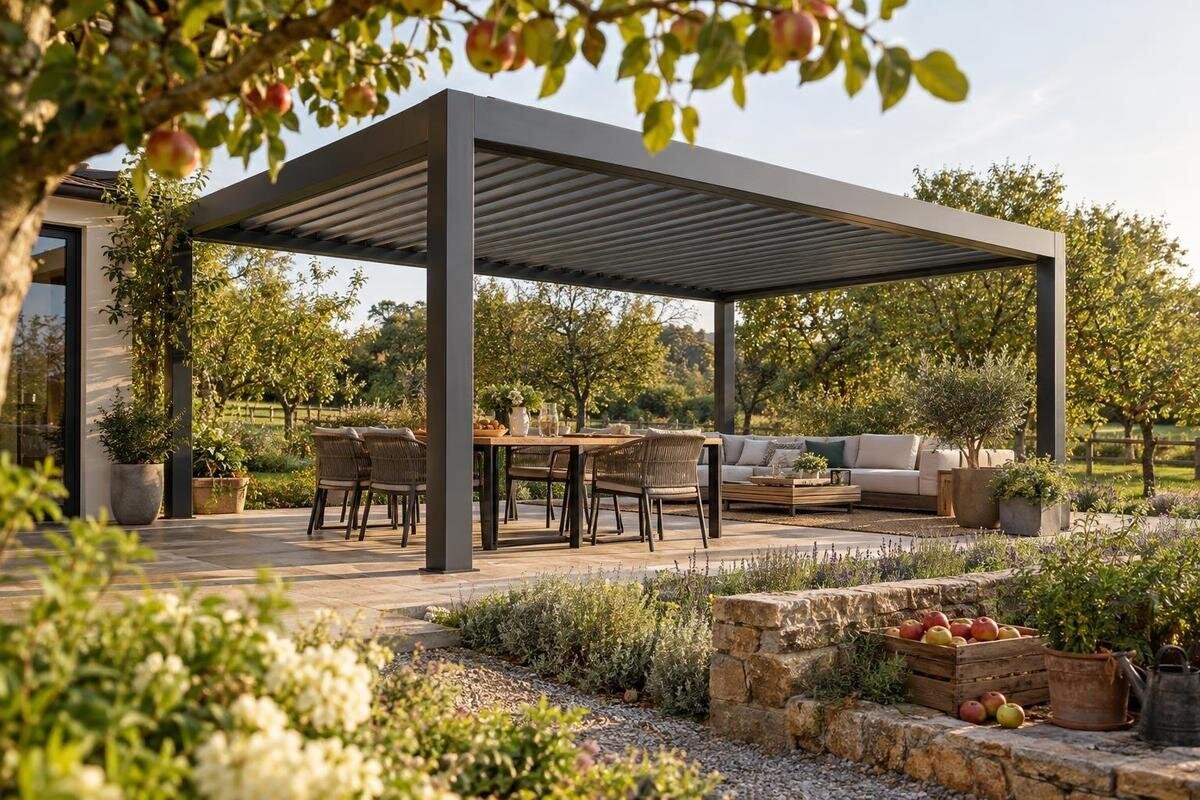
Pergola buying guide
Putting an outdoor dining table and lounge seating beneath one large pergola can make the two uses feel connected, but the structure must fit more than the furniture’s parked footprints. Chairs need room to pull back, people need clear routes between the house and each zone, and the site must accommodate the pergola itself. Before buying, measure both furniture groups in use, sketch the arrangement you want, and compare it with the structure’s stated dimensions and installation requirements. That turns “large” from a vague label into a practical fit decision.

Measure the usable outdoor area first
Treat the pergola’s footprint as only one part of the plan. First map the outdoor area that is genuinely available: note exterior doors and their swing, steps, gates, railings, fixed planters, built-in seating and any route that must remain open. Measure the clear area instead of assuming that every part of a patio or yard can take furniture or posts. A wide-looking site may narrow near the house, and an existing path can divide the usable space. Also note edges bounded by fences or planting, and features you use routinely, such as a storage door or service point. Those boundaries matter before choosing a structure described as large.
Place both functions inside that boundary on a simple top-down sketch. Draw the table and lounge pieces as blocks, mark the pergola’s outside dimensions and, if the listing shows them, its post positions. A rough scale drawing or paper cut-outs can reveal overlaps that are hard to spot by eye. Leave some blank space for movement; a tightly filled plan can look more workable on paper than it feels in use. For a first comparison, keep a Bloomcabin pergola listing alongside the plan and rely only on details it actually states. A lifestyle photograph or the word “large” cannot confirm that both zones fit.
Measure furniture in its everyday positions
Measure the dining set in the state you use it, not only as it arrives or sits between meals. Record the table’s length and width, including any extension you expect to use, then measure the chairs and how far they move when someone sits down or stands up. If the table has more than one configuration, note both its everyday size and the largest size you expect to use. Count the normal number of chairs and note whether one needs to be pulled farther back for people to pass. Put measurements in the same units and label width and depth clearly; a mixed-unit or reversed sketch can mislead your size comparison.
For lounging, measure the complete arrangement: sofa or chair length, coffee or side tables, footstools and any separate recliner or bench. If seating is modular, draw the everyday configuration rather than trying to accommodate every possible rearrangement; test a second arrangement only if you genuinely expect to use it. Include room to approach a seat and reach the table, not just the furniture outlines. Seat count alone is not a reliable guide to the space required, since pieces vary in size. Keep these notes together when reviewing one pergola product page; an image does not demonstrate how your particular furniture will fit.
Plan how the two zones fit together
Choose a relationship between the zones that suits the site’s proportions and the way you move through it. In a wide area, placing the dining table and lounge set side by side can give each group its own space. On a narrower, deeper patio, arranging them end to end may fit better, but consider whether people would need to walk through one zone to reach the other. Neither layout is automatically better: preserve a direct route from the house and decide whether conversation between the groups or a quieter lounge area matters more. If the table is usually occupied during gatherings, avoid making that seating area the only route to the lounge.
Set the table and seating in relation to doors, views and everyday serving routes, then check how the pergola supports affect the plan. If the design has perimeter posts, make sure a post does not land where a chair needs to move or where people naturally cross between zones. Mark any known support positions before settling on the placement of furniture. Do not estimate clear space from a product photo; look for dimensions that are actually stated. Use a pergola listing to compare only for explicit footprint or support details, and ask about any missing measurement before treating the layout as workable.
Allow for chair movement and clear paths
Treat circulation as part of the floor plan, not as whatever space remains after placing the furniture. Trace a route from the house to the dining chairs, from dining to lounge seating and onward to any gate or garden path you use. The route should still work when a chair is pulled back and someone is seated, rather than only when the set is neatly tucked in. Consider practical trips with plates, drinks or cushions, and avoid making the shortest path pass through a tight gap between the table and sofa. Think about the space you need to serve the table as well as the space needed to reach a seat.
Test that route at full size before deciding on a footprint. Mark the proposed boundary with tape or another temporary marker, place the furniture if possible, pull out the chairs and walk the path while carrying an empty tray. Open nearby doors and gates as you normally would, and check whether guests can move without interrupting someone who is seated. If the path feels awkward in this trial, adjusting the furniture plan may be easier than hoping a larger frame solves it. Compare your test with a linked pergola product page only after checking the measurements that the page explicitly provides.

Understand the pergola’s footprint and height
Check what each dimension in the product information refers to. Overall width and depth may describe the roof edge, the outside of a frame or the distance between supports; these measurements are not interchangeable when deciding where chairs and lounge furniture can sit. Look for the exterior footprint as well as any stated clear span or post spacing. If only one set of dimensions is shown, ask what it measures and whether any projections extend beyond the marked footprint. This matters when a path or boundary leaves little room around the structure, since the space available for furniture may differ from the space it occupies.
Height deserves the same care. A listed overall height is not necessarily the clear height beneath the lowest part of the structure, so find out which measurement is given and whether it suits people standing, seated furniture and anything you plan to move underneath. Look at nearby eaves, gutters, branches or other overhead features that could interfere with placement. On the Bloomcabin pergola page, use only dimensions and height details stated there; if the information does not answer a fit question, get clarification rather than guessing from the image. Where components can move, check for any stated operating space or height requirements as well.
Check the shade you need at different times
A large frame does not by itself tell you how much usable shade the roof provides. Check whether the design has an open top, a fixed covering, adjustable elements or a covering sold separately, and confirm exactly what is included with the model you are considering. Compare the stated roof coverage with the locations of the table and lounge seats; the structure’s outside footprint may be larger than the area covered overhead. If shade over both groups is important, use the published roof details rather than relying on a broad category name or a staged photograph.
Sun moves over the day and changes angle over the year, so consider when you actually eat and lounge outdoors. Observe where shadows fall at those times, including shade cast by a neighbouring building or tree, and note whether the table and seating need shade simultaneously. If one zone is used more at a particular time, you may choose to prioritize its position and accept that the other receives more sun at some times. A brief note of the time and place of your observations can help when comparing options. These observations set expectations, but they do not replace checking the pergola’s stated roof configuration and coverage.
Confirm the site and installation requirements
Confirm that the site suits the installation method specified for the particular model. Find out whether it is intended to stand independently or requires attachment to a wall, and what kind of supporting surface the instructions identify. A product’s name or appearance cannot establish that an existing deck, patio or wall is suitable. If the location is raised, the supporting surface is uncertain, or the installation involves attaching to a building, have a qualified professional assess it before ordering. Ask about the required attachment or support method rather than trying to adapt the product yourself; suitability depends on the model and the site.
Think beyond the footprint as well: avoid blocking routine access to doors, downspouts, storage and service points, and consider drainage so the furniture zones remain practical. Depending on the property, ask the municipality, condo corporation, landlord or property manager whether any approval or placement rules apply; do not assume a neighbour’s setup answers the question for your site. If this pergola product page does not state the installation requirements you need, ask the seller or a qualified professional to clarify them before committing to a location.
Compare product details that affect the purchase
Compare product pages against the same set of needs instead of ranking them by how spacious the photographs look. For each one, note the stated width, depth, height, support spacing, roof coverage, installation method and package contents, when that information is available. Keep a separate note of details that remain unknown; a blank specification is a question to resolve, not evidence that the product will meet your plan. For the Bloomcabin product listing, judge suitability only by published information and answers you receive, not by assumptions based on a product name or image.
Once the footprint is plausible, check what the order would include and what needs to be budgeted separately. Confirm whether the covering, fittings or other parts shown in product images are included, and look for any stated delivery, assembly or site-preparation costs. Do not treat an accessory as part of the purchase unless the listing or seller confirms it. Compare the complete amount at the time you are ready to order, including any confirmed extras or services you need, rather than basing the choice on a headline price alone.

Plan delivery and assembly access
Delivery access deserves attention with a large structure, even if the final position is straightforward. Check how the seller describes delivery, where goods are left and whether unloading assistance is included, if those details are available. Measure gates, stairs, narrow turns and the route from the drop-off point to the assembly area; package dimensions can differ from the assembled pergola. Include the entire route, not just the distance from the street to the patio, and note any tight turns or changes in surface. Ask for package dimensions and weight where necessary rather than assuming every component will fit through a side entrance or travel easily across a yard.
Decide who will assemble the pergola and what the product instructions require before you place an order. Confirm which components, fixings and tools are supplied, whether preparation or professional installation is needed, and who will handle work that calls for specialist judgement. A large footprint can also require enough clear space to assemble the structure before it reaches its final position. For the relevant pergola product page, use its own stated assembly details and ask about anything that is not explained; do not assume a similar-looking design has the same process.
A full-size layout test before ordering
Bring the plan back to the actual site for one final full-size trial. Mark the pergola’s outer boundary and, where the published plan makes them clear, the support points; arrange the dining and lounge furniture inside it. Pull the dining chairs out, sit in the usual places, reach the side tables and repeat the route between the house and both zones. This catches conflicts that a plan view can hide, including a chair meeting a post or a path disappearing when seats are occupied. If you cannot move the furniture, use measured outlines rather than estimating how much room it takes.
Before ordering, write down any unresolved questions: what the dimensions measure, the usable height and roof coverage, site compatibility, included parts, and delivery or assembly arrangements. Resolve anything that could change the location or size before paying, particularly support spacing and installation requirements. If the layout works only with chairs pushed in or a route blocked, revise the furniture arrangement or choose a different footprint. The goal is not to fill every available metre; it is to buy a structure whose stated dimensions let dining and lounging work together in the space you have.
Frequently asked questions
How do I choose a pergola size for dining and lounging?
Measure the dining set and lounge furniture in their usual positions, including chair movement and the routes between them. Compare the combined plan with the pergola’s stated outer dimensions, usable space and support positions, while leaving room for access.
Should the dining and lounge zones be side by side?
Not necessarily. Side-by-side layouts can work in wider spaces; end-to-end layouts may suit a narrower, deeper area. Choose the arrangement that keeps the main route clear and does not force people through a busy seating zone.
Which furniture measurements matter most?
Record the dining table’s length and width, its extended size if relevant, and how far chairs move when occupied. For lounging, measure the full arrangement, including side tables and footstools, plus space to approach and use each seat.
Will a large pergola shade all the furniture?
Its overall footprint does not confirm how much shade the roof provides. Check the stated roof coverage and configuration, then consider where shadows fall at the times you plan to dine or lounge.
What should I confirm before placing an order?
Confirm what the stated dimensions measure, the usable height and roof coverage, and the installation requirements for your site. Also check what is included, delivery access, assembly arrangements and any site-specific approvals you may need.
A successful large-pergola purchase brings dining and lounging together without making either use awkward. Base the choice on measured furniture, real movement space and the pergola’s actual footprint, rather than on a photograph or a size label. When both zones fit, routes stay clear and the installation details suit the site, the structure is more likely to work as part of your everyday outdoor space.
