
Buying a Pergola for a Windy Location: What to Check
PERGOLA BUYING GUIDE
Buying a pergola for a windy location calls for more than comparing appearance. Wind exposure can vary across a yard, while anchoring, roof configuration and accessories all affect which product information is relevant. Before choosing a model, describe the conditions at the proposed site and find manufacturer guidance for the exact setup you plan to buy. An informed decision depends on documented requirements and an installation plan suited to the property, not on a general claim that a pergola is heavy-duty.

Wind exposure at the proposed site
A wind assessment starts with the exact spot you hope to cover. A yard can be sheltered near the house and much more exposed a few metres away; gaps between buildings, open fields, corners and changes in elevation can alter how wind reaches the site. Walk the proposed footprint from more than one direction and note where wind seems channelled, blocked or redirected. Pay attention to gusts as well as the usual breeze, and consider whether stronger winds arrive from a seasonal direction. This is a practical site description, not a technical rating, but it gives you more to discuss with an installer than simply saying the yard gets windy.
Make a brief site record rather than relying on a single visit. Note where the intended posts would sit relative to the house, fences, trees, sheds and any open edge, along with the directions from which you have experienced the strongest gusts. Consider whether seasonal leaf cover changes the shelter offered by trees, or whether planned landscaping could alter it later. Local wind information can add context, but it cannot decide whether a particular model is suitable. If the setting is notably exposed or difficult to describe, bring those details to a qualified installer or building professional when discussing the purchase.
Pergola structure and complete configuration
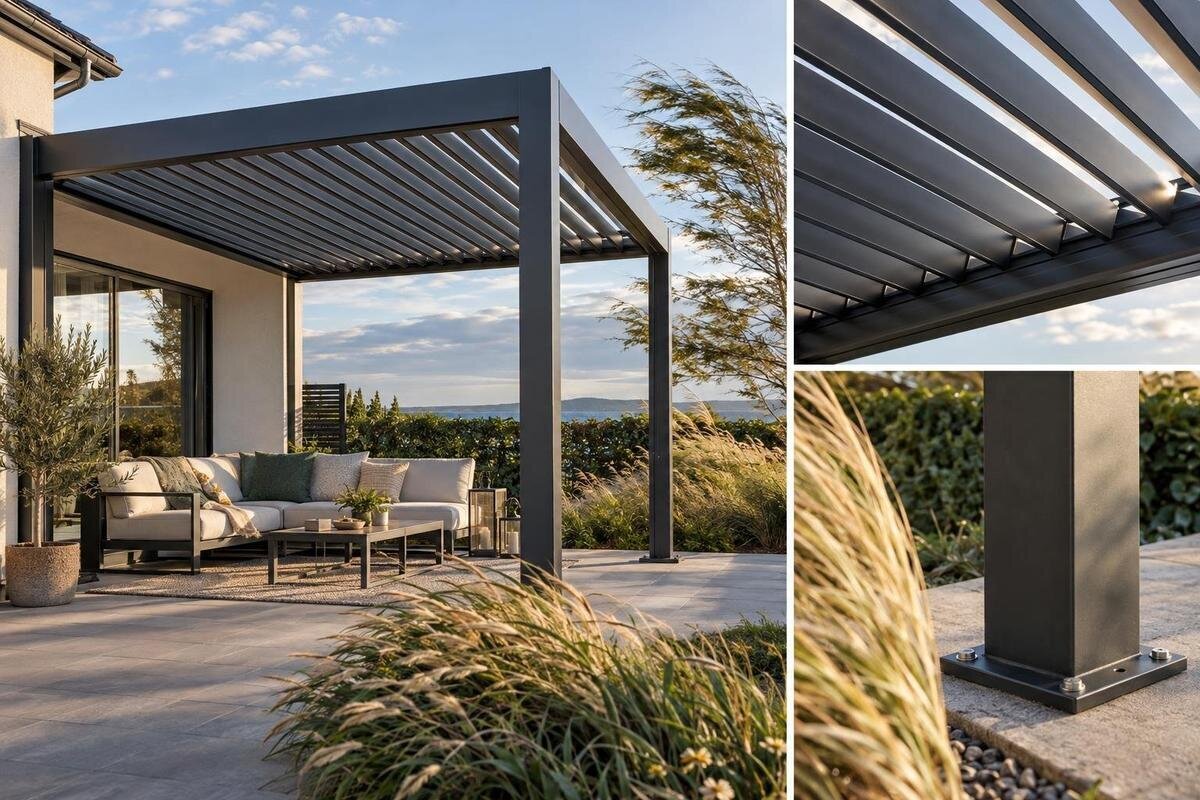
Assess the complete structure rather than judging from post thickness or weight in a photo. Posts, beams, joints, roof elements, base connections and supplied hardware work as one assembly; an attractive, substantial-looking frame does not show how those connections are designed or how the full pergola performs in wind. Compare the construction information the manufacturer actually publishes, such as materials, component dimensions, connection details and the models covered. A product image cannot verify these points. Use the general pergola listing to see what is stated, then identify anything that remains unclear. A broad category name or marketing adjective is not a performance specification.
Compare the setup you plan to buy, not only the main frame. Footprint, height, roof arrangement, movable parts and side screens or other attachments may affect which configuration the manufacturer’s guidance covers. Ask whether the information applies to the exact model and size, with the intended accessories fitted and the roof in the relevant position. If a listing describes only the frame or an assembly without add-ons, do not extend that guidance to a different setup without confirmation. For multiple configurations, ask for information on each one. Your comparison should reflect what will actually be installed, not just the product as pictured.
Model-specific wind documentation
Look for clear manufacturer guidance rather than relying on phrases such as heavy duty, reinforced or suitable for outdoors. Useful information may identify applicable wind limits, operating restrictions, configurations covered and required installation conditions. Ask which model and size the information applies to, who issued it, and whether it describes the complete assembled pergola or only one component. A figure without units, definitions or context is difficult to use responsibly; do not guess what it means or convert it yourself. If there is no wind-specific documentation, record that as an open question rather than assuming a general product statement establishes suitability.
A useful answer connects product information to your location. Share the site exposure you recorded and ask whether the published guidance is relevant to the actual conditions and support surface; a general rating does not automatically resolve every site question. When checking the bioclimatic pergola product page, read only the specifications and instructions it actually provides. The name identifies the product category, not a wind rating or approval for a particular yard. If details are missing, ask the supplier or manufacturer for written clarification and consult a qualified local professional where an assessment is needed. Keep any response with your order information.
Anchoring for the actual support surface
Treat anchoring as part of the pergola purchase, not a detail to solve after delivery. Identify the surface where it would stand: soil, a concrete base, paving and a raised deck can present different constraints. Do not assume that an anchor included with a product is suitable for every base, or that a surface that looks solid is appropriate for the installation described by the manufacturer. Ask what support, footing or fastening method the instructions require and whether the product documentation names any excluded surfaces. The answer needs to relate to both the pergola and the actual site, rather than to a generic idea of how outdoor structures are secured.
Before deciding, check whether the installation documents explain the permitted support surface, required anchors and any site conditions that need review. If the base at your home is not covered, do not improvise or choose a substitute based on appearance. Ask the supplier what information the manufacturer requires, then have a qualified installer or other appropriate professional assess the site. When reviewing the product details for this pergola, look for explicit anchoring and installation information; if it is not provided, treat that as an unanswered point. A clear plan can affect the model you choose, the work involved and whether the purchase is practical.

Placement and local wind patterns
The proposed position can affect how exposed the pergola feels, but a sheltered-looking corner is not proof that a model is suitable. Nearby walls, fences, trees and outbuildings may block wind from one direction or redirect it from another. A gap between structures can also behave differently from an open area. Avoid assuming that placing a pergola close to a house, behind a fence or under trees automatically solves the wind question. Consider the spot alongside the manufacturer’s guidance and anchoring requirements, not as a replacement for either.
Compare possible locations on the property and describe their differences to the installer. A small shift could change the surrounding barriers, the directions of exposure or the surface available for anchoring, so assess the proposed footprint rather than the yard in general. Do not rely on a universal rule about which way to orient a pergola; the site and model both matter. The bioclimatic pergola listing can be reviewed for its stated information, but its category label does not determine the best location. If placement is part of the solution, have a professional confirm that the selected spot and installation remain consistent with product guidance.
Roof positions and optional accessories
The roof and any attached elements should be considered as part of the wind configuration. A fixed roof, open slats, movable parts, fabric shade, curtains and privacy screens are not automatically equivalent arrangements. Even if an accessory is available for a model, that alone does not establish how the full setup should be used in wind. Ask whether the manufacturer’s guidance covers the roof position and each accessory you plan to install. If guidance describes only a bare pergola, do not assume it also applies once a screen or covering is added.
For adjustable or removable elements, find out whether the instructions specify a position, removal or other operating restriction for windy conditions. Do not invent a safe threshold or assume that an open, closed or partially adjusted roof is always the right choice. Check the documents for the exact configuration, and ask for clarification if the instructions are unclear. The product page labelled bioclimatic pergola may help identify the listing you are considering, but the label does not establish how its roof behaves or what wind conditions it can handle. Confirm those points from product-specific guidance before choosing accessories or finalizing the order.
Construction, assembly and upkeep
Compare the construction details the manufacturer provides rather than ranking pergolas by material or finish alone. Look for information about the frame, connectors, joints and assembly requirements, and note whether the guidance applies to the complete model you intend to order. Material type or a polished appearance does not establish wind capacity. Product photographs also cannot show the design of every connection or confirm how parts fit together. If a specification is missing, ask for it instead of drawing conclusions from a picture. Reviewing the pergola product page can help you see what information is published, but any gap still needs an answer from the supplier or manufacturer.
Assembly matters to the buying decision because the manufacturer’s wind guidance may depend on the pergola being put together exactly as described. Check whether the instructions identify the required components, tools, sequence or installer qualifications, and whether any parts must be purchased separately. Ask how the product is intended to be maintained and whether the documents identify components that need periodic attention. This is not a reason to assume a model is fragile; it is a way to understand what ownership involves. If an installer is doing the work, share the instructions before accepting a quote so the proposed labour and anchoring plan can be compared with the product requirements.
Installation and wall-mounted designs
Decide who will assess and install the pergola before you place an order. Some buyers may plan to assemble it themselves; others will want a qualified installer to review the exposure, support surface and manufacturer’s instructions. In either case, make sure the person responsible has the exact model information and knows about any accessories or roof positions that affect the configuration. Ask what site details they need, whether they can assess the proposed anchoring approach and what work is outside their scope. A product purchase and a site-specific installation assessment are different tasks, so clarify both rather than assuming one automatically includes the other.
A wall-mounted design raises an additional question: whether the wall and the prescribed connection are suitable for one another. Check which wall construction the manufacturer permits and what information the installer needs about the structure behind any exterior finish. Do not assume that a visible wall or cladding can support an attachment simply because the product is described as wall-mounted. Review the wall-mounted pergola listing for the information it actually provides, then have a qualified professional assess any uncertainty about the wall and fixings. If the permitted connection cannot be confirmed for your home, do not treat the product label as proof of compatibility.

Order details to confirm before checkout
Before ordering, make sure you are comparing the exact model and configuration discussed with the supplier or installer. Confirm the stated size, roof arrangement, included components and any accessories that are listed separately. Check which installation documents apply and whether they address your planned support surface. The product page is a starting point, not a substitute for missing details: the page for the wall-mounted pergola should be read for what it states, not as confirmation that it fits a specific property. If several versions look similar, ask the supplier to identify the one covered by the documents you have reviewed. That reduces the chance of planning around the wrong configuration.
Also consider practical ordering questions that affect the installation plan. Confirm how the components will reach the intended location, whether your installer needs documentation before work begins and whether any additional items are needed. Read the store’s current order, cancellation and return terms before checkout; do not assume they will resolve a site-fit problem after purchase. Keep written answers about configuration, anchoring and installation with your order records. If a key answer is still pending, pausing is more useful than guessing and finding out later that the chosen model or accessories do not match the plan.
Comparing pergolas against site evidence
A simple comparison record can keep the decision grounded. For each model, note the wind information available, the size and configuration it covers, the roof and accessory restrictions, the anchoring requirements and the support surfaces described in the instructions. Beside those details, record what remains unanswered for your yard. This makes it easier to compare like with like and to ask focused questions, rather than weighing a clear specification against a broad sales phrase. A model with an unknown installation requirement is not automatically unsuitable, but the uncertainty needs to be resolved before you rely on it for an exposed location.
Use the same site description and questions for each option. If a supplier cannot confirm which guidance applies, or an installer cannot match the proposed anchoring approach to the property, do not fill the gap with assumptions about weight, material or appearance. Ask for the missing information, consider a different configuration, or wait until a qualified professional can assess the site. The right buying choice is the one whose documented requirements can be compared with your actual conditions. That approach is more dependable than selecting a pergola simply because it looks sturdier than the alternatives.
Frequently asked questions
Can any pergola be called windproof?
Do not treat a pergola as windproof based on its name, appearance or a broad marketing description. Suitability depends on manufacturer guidance for the exact model and configuration, the conditions at your site, and installation that follows the product instructions. If wind-specific information is not available, ask before buying.
How can I tell whether a pergola is suitable for my yard?
Compare the site exposure with product-specific wind guidance and anchoring requirements. Check which model, size, roof position, accessories and support surface the guidance covers. If the documents do not address your conditions, ask the supplier or manufacturer for clarification and consult a qualified local professional.
Does a heavier pergola handle wind better?
Weight alone does not show how a complete pergola performs in wind. The frame, connections, roof, anchoring and installation all matter, and a heavier-looking product may still lack relevant site-specific guidance. Base the comparison on documented information for the full assembly, not weight or appearance.
Can I add privacy screens or shade later?
Only add screens, shade or other attachments if the manufacturer’s instructions allow them and the applicable wind guidance covers that arrangement. Accessories can change the configuration being assessed. Confirm compatibility and any operating restrictions before ordering, rather than assuming an add-on is only decorative.
Who should assess anchoring and installation?
Ask the manufacturer or supplier for the product’s installation requirements, then have a qualified installer or other appropriate local professional assess the site if the surface, wall connection or exposure is uncertain. They can identify what information is needed for your property without relying on a generic anchor recommendation.
Choosing a pergola for a windy yard is an exercise in matching product information to the site. Describe the exposure, compare the complete structure and its anchoring requirements, and confirm that the guidance covers the roof and accessories you intend to use. A model that looks substantial is not necessarily documented for your conditions. If the support surface, wall connection or wind information remains uncertain, resolve that question with the supplier and a qualified local professional before placing the order.
