
Buying the Right Pergola for an Outdoor Kitchen
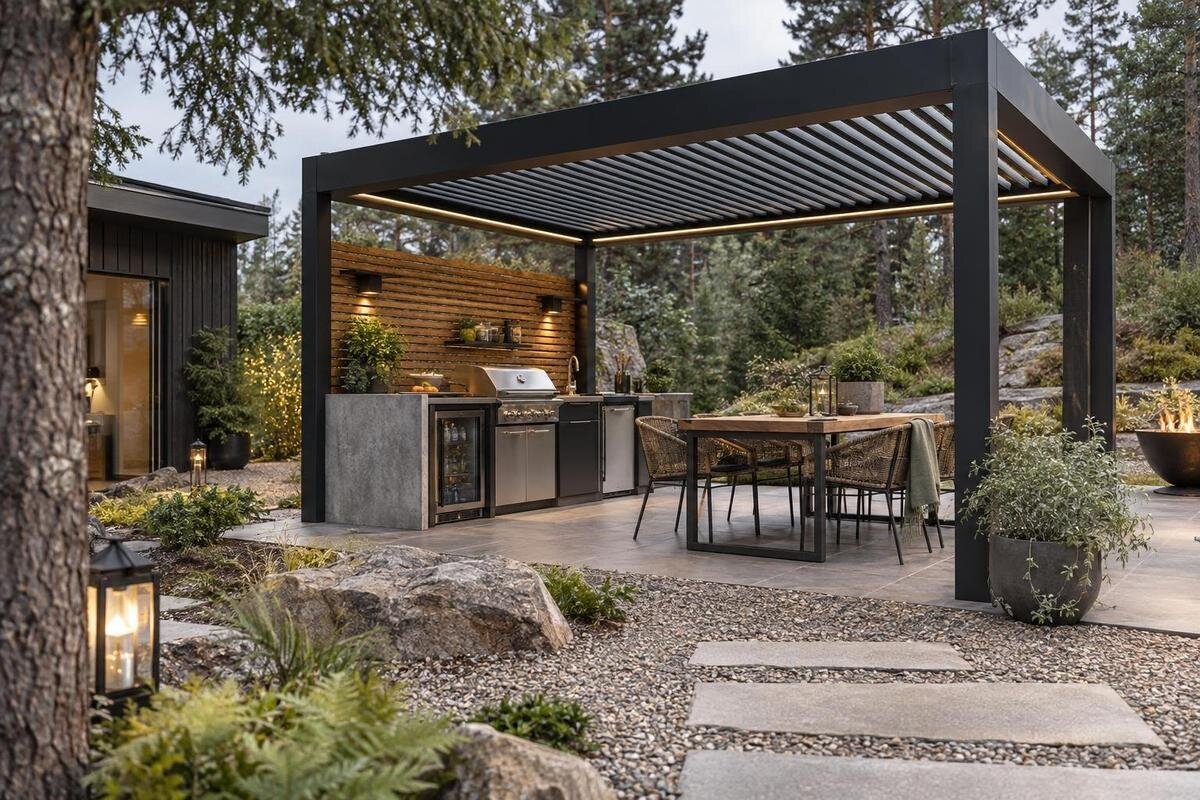
Pergola buying guide
An outdoor kitchen changes what a pergola needs to accommodate. It has to cover a workable area without crowding the cooking appliance, prep counter, circulation route or dining table, and it must suit the conditions around the equipment. When you buy a pergola for an outdoor kitchen, start with the layout you use, then compare shade, roof design, materials, mounting and site requirements. The aim is not simply to put a roof above the grill; it is to make cooking and eating more comfortable while preserving appliance clearances and clear movement. Product drawings and manufacturer instructions matter more than a model name or appealing photo.

Before you buy 1
Map the cooking and dining footprint
Plan the pergola around every part of the outdoor kitchen, not just the grill. Include the cooking appliance, prep counter, storage or serving surface, any island, and the dining furniture you expect to use at the same time. Mark the normal work route from the house to the kitchen and the route from cooking to the table; note where people pass, where cabinet doors open, and where chairs need room to move. Include access to appliances and storage, not only their footprint. A layout that looks generous on an empty patio can become crowded once several people are cooking, serving and sitting down together, so measure the busiest arrangement you expect to use.
Measure the usable patio or deck, then sketch the proposed roof outline and post positions to scale. Include projections shown on the supplier’s drawings, not only the nominal footprint, and account for any step, railing, doorway or existing furniture. Draw door and cabinet swings, and show chairs in use rather than pushed in. Keep appliance clearances separate: a pergola’s outside dimensions do not establish that a cooking station fits beneath it. Compare your plan with any dimensions or post-layout drawing supplied for the Bloomcabin pergola listing; if the details are not provided, ask before ordering. The model name and product photo are not substitutes for a measured plan.
Pergola placement beside the home and yard
Choose a position that connects naturally with both the home and the yard. A door from the kitchen, a pass-through or the route to the patio can make serving easier, while a spot near a garden path can affect how people move through the yard. Watch the sun at the hours you expect to cook and eat: useful shade at lunch may not fall in the same place in the evening, and nearby buildings or trees can change the pattern. Mark doors, windows, downspouts, steps, railings, trees and utility routes on your plan, since each can affect placement, access or site work.
A wall-mounted option raises questions that a freestanding plan does not. Confirm that the specific model is intended for your wall type and ask a qualified installer to assess the wall, fixing method and planned loads; do not assume an exterior wall is suitable because it is nearby. A freestanding arrangement also needs a support and anchoring plan that matches its site. If the structure would sit on a deck or near buried services, have the relevant professionals assess the site before finalizing post locations. The wall-mounted pergola listing names one style to compare, but the name alone does not establish compatibility with your home.
Before you buy 2
Choosing the amount of shade
Shade needs depend on when and where you use the outdoor kitchen. Note whether direct sun reaches the prep counter, grill controls, dining seats or serving surface during your usual cooking hours. The dining area may matter more than shade over the appliance, or the reverse if the kitchen is used mainly in the afternoon. Consider how shade shifts through the seasons and whether nearby buildings or trees already block some sun. A pergola that covers only part of the patio can still be useful if its post positions and roof line protect the area you value most.
Compare roof designs by the shade they actually deliver, not by category names. An open top, fixed covering and adjustable system can differ in how much sky they block and whether you can change that coverage. A name such as bioclimatic does not, by itself, tell you the mechanism, operating range or shade pattern. Ask for product drawings and written details, then consider how the proposed shade falls on both cooking and seating zones. Use the bioclimatic pergola listing as a model to investigate, not as proof of any particular roof operation or performance.
Appliance clearances and airflow
Treat the appliance maker’s instructions as a design input before settling on roof size or material. Grills, smokers and other cooking equipment can have different requirements for clearances, overhead coverage and surrounding ventilation. Check the manual or ask the appliance manufacturer about the exact outdoor configuration, and have a qualified installer assess whether your proposed pergola and appliance can be used together. Do not assume that an open-sided structure, a taller roof or an adjustable roof automatically satisfies those requirements. If a stated clearance conflicts with the plan, change the layout or choose a different arrangement rather than judging the gap by eye.
Smoke, heat and cooking residue also affect where the structure and furniture make sense. Think about the direction smoke tends to travel in the proposed location, the opening of doors and windows, and whether an existing or planned exhaust system has been designed for the setup. Keep the pergola concept separate from any appliance hood or ventilation component: one is not automatically a substitute for the other. Ask the appliance maker and relevant trades to confirm any required ventilation, clearances or permitted overhead arrangement. This check can rule out an unsuitable location before you pay for a structure that does not fit the cooking plan.

Before you buy 3
Making room for dining and serving
Treat the eating area as a planned zone, not the leftover space under the roof. Draw the table at its actual size and include chairs in use, not just pushed in; leave the routes diners take to the kitchen and the house visible on the sketch. Consider whether someone carrying a hot dish can move from the prep counter to the table without weaving between seated guests. If the kitchen and table need different shade, position the roof around the overlap of their most important uses, or decide which area gets priority. That choice can prevent a pergola sized only around the counter from leaving the dining area outside the cover.
Think about the transition between covered and uncovered parts of the patio. A roof edge can frame the table while leaving room for an existing grill station, planting bed or access route; however, the actual post positions and projections determine whether that arrangement works. Place the table, serving cart and chairs on your scaled plan, then compare those needs with the measurements and drawings available for the Bloomcabin pergola product page. If the page does not show a needed dimension or a clear view of the post positions, request it rather than estimating from a photograph. Keep space for routine cleaning and moving furniture as well as for a full meal.
Comparing materials and maintenance
Compare materials by the care and finish they require in the conditions around your kitchen, rather than choosing from appearance alone. Wood, aluminum and steel are all terms buyers may encounter, but material labels do not describe the full construction. Ask what the posts, beams and roof components are made from, how exposed surfaces are finished, and which fasteners or fittings are included. Food splashes, grease, moisture and outdoor exposure can affect cleaning and upkeep, so request the supplier’s care instructions for the actual finish. If you prefer a low-maintenance routine, define what that means to you and check the recommended work, not just a general claim.
Ask how the surface should be cleaned, whether the finish needs periodic attention, and which care products should be avoided. Also ask how replacement parts or refinishing are handled if wear appears, without assuming that one material will suit every site. The same questions apply to a named option such as the Bloomcabin bioclimatic pergola listing: confirm its listed materials and finishes for the exact configuration, and seek written details if they are missing. Compare care requirements alongside appearance, purchase cost and the cost of professional installation; a finish you like is a better fit when its upkeep also matches your routine.
Before you buy 4
Site support, drainage and weather information
Check the actual installation surface before choosing the final footprint. A patio slab, deck, paving, lawn or uneven area can call for different assessments, and the product’s mounting instructions determine what preparation is expected. Consider where rainwater already drains and, if the chosen roof collects or directs water, where that water would go in the planned layout. It could affect a doorway, cooking area, adjacent planting or a neighbour’s yard. Do not assume a pergola can be fixed to any surface simply because it appears level. If the site or support requirements are unclear, get a qualified installer to inspect them before ordering.
Outdoor conditions vary by location and exposure, so verify the exact product’s published wind, snow and other relevant performance information for your site. A pergola’s appearance or generic category name is not a load rating, and information for one configuration does not automatically apply to another. Have a qualified professional determine whether the structure and proposed supports suit the site; avoid making calculations from a product photo or model label. If you are considering attachment to the house, include the wall and connection in that assessment. Bloomcabin’s wall-mounted pergola page can help identify a product to review, but installation suitability still needs to be confirmed for the specific property.
What to expect from pergola roof styles
Set a realistic expectation for weather protection before comparing roof styles. Many buyers want both dappled shade and an area that stays dry, but those are not the same requirement. Open or spaced roof elements can admit sun and rain; a more continuous or adjustable arrangement may alter coverage, yet names and photos do not prove that a product is rainproof or suitable for particular conditions. Decide which matters most—shade, airflow, rain management or a balance—and ask the manufacturer how the exact roof configuration behaves when open and closed.
Also ask what operating limits, maintenance and water handling apply to the exact model. If a roof has moving parts, confirm whether they are manual or powered, how they are controlled, and whether the maker specifies positions for particular weather; do not infer these details from the word bioclimatic. Review those points for the bioclimatic pergola page as you would for any candidate. If dependable rain protection is essential over appliances or dining furniture, compare documentation for a cover specified for that purpose rather than treating the word pergola as a guarantee of an enclosed roof.

Before you buy 5
What to confirm before ordering
Before placing the order, match the exact model and configuration against your plan. Confirm the listed outside dimensions, post arrangement, roof type and colour, plus what is included and what is an optional accessory. Check the installation drawing for the roof projections and any components that affect placement. Verify that the chosen mounting style, planned surface and cooking appliance arrangement all match the information you have gathered. If a key detail is missing or ambiguous, ask the seller for written clarification and keep it with your order paperwork. A model name alone is not enough to distinguish configurations or establish that a particular setup is included.
Consider the entire purchase, not just the structure’s listed price. Ask whether site preparation, assembly, anchoring components or professional installation are separate items, and request an itemized quote where appropriate. Check delivery access: a narrow gate, stairs or limited driveway space may affect where bulky packages can be received, so measure the route and confirm arrangements before checkout. Review the seller’s stated order, delivery, return and warranty terms for the exact purchase rather than relying on assumptions. Once the specifications are clear, compare them with the product listing and the final invoice so the model, options and quantity match what you intended to buy.
Matching the pergola to your routine
Use a short ranking to turn the research into a choice. First remove options that cannot fit the measured footprint, meet the appliance requirements or be supported at the planned location. Then compare the remaining choices by the shade they can provide, the cooking-and-dining arrangement, material care and the weather details you have verified. This keeps a preferred colour or roof style from outweighing a requirement that affects everyday use. If the kitchen is used mostly at one time of day, give that pattern more weight than a theoretical all-day arrangement.
Before committing, walk through a typical meal in the proposed layout: imagine carrying groceries in, prepping food, tending equipment, serving guests and clearing dishes. Check that the pergola edges and posts do not interrupt those movements, and that the dining zone remains usable when chairs are occupied. If the plan only works when furniture is moved or a route is left unused, revise the layout rather than treating the drawing as a best-case exception. The right outdoor kitchen pergola is the one that fits the appliance guidance, site and routine together, not simply the largest structure that can be placed in the yard.
Frequently asked questions
How do I choose the right pergola size for an outdoor kitchen?
Do not size it from the grill alone. Map the appliance, prep surfaces, storage, routes through the space, dining table and chairs, then add the proposed post positions. Use the appliance maker’s clearance information and the pergola’s actual dimensions. If the drawings do not show a detail you need, ask the seller or a qualified installer before ordering.
Can a pergola go over a grill?
It depends on the specific grill, pergola and proposed layout. Check the grill manufacturer’s instructions for requirements about overhead coverage, clearance and ventilation, then ask a qualified installer to assess the arrangement. An open-sided design or a particular roof style does not automatically make a setup suitable.
Should I choose a wall-mounted or freestanding pergola?
Choose based on the site and the layout, not the name alone. A wall-mounted option needs to be assessed for compatibility with the particular wall and fixing method. A freestanding plan also needs suitable support at its proposed location. Ask a qualified installer to review the exact model and site before you commit.
Will a pergola keep my outdoor kitchen dry?
Do not assume that it will. Pergola roof designs differ, and a product name or photo does not confirm rain protection or water management. Check the exact model’s documentation for how the roof behaves in each position and what conditions it is intended for. If dependable rain cover is essential, compare products specified for that purpose.
What material is best for an outdoor kitchen pergola?
The right choice depends on the exact construction, finish, site exposure and maintenance you are willing to do. Ask what the posts, beams and roof components are made from, what care the finish requires, and which cleaning products are suitable. Compare those details alongside appearance and installation requirements rather than relying on a material label alone.
A pergola purchase for an outdoor kitchen is easiest to judge from a measured plan and verified requirements. Set the cooking and dining zones first, decide what shade and weather protection actually matter, then compare materials and mounting against the site. Confirm appliance clearances with the equipment maker and ask a qualified professional to assess structural suitability where needed. With exact dimensions, configuration and order terms in hand, you can compare options on how well they support a normal meal outdoors—not only on how they look in a product image.
