
Choosing ZIP Screens or Outdoor Curtains for a Pergola
Pergola buying guide
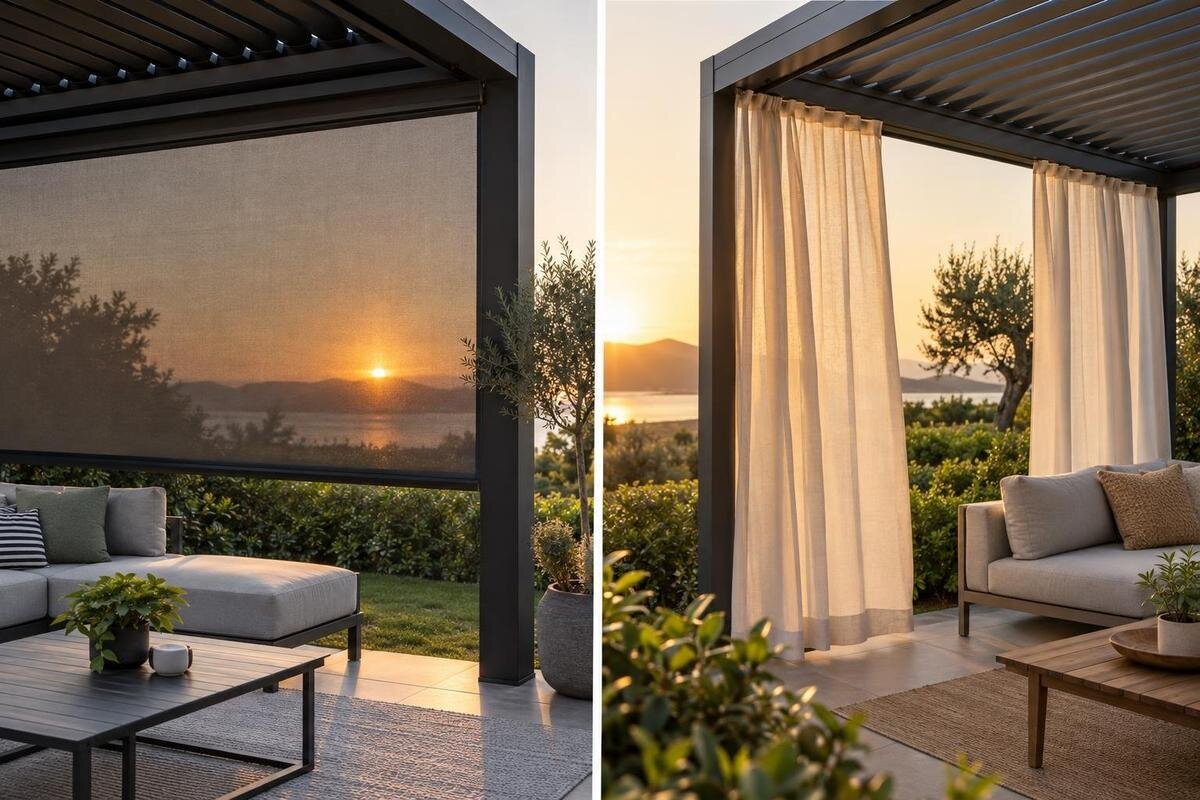
ZIP screens and outdoor curtains can both add shade or screening to a pergola, but they behave differently when you deploy, open and maintain them. A typical ZIP screen travels vertically with fabric guided at the sides; a typical curtain slides along a track and gathers. That affects the clear opening, airflow, sightlines and care routine. The better option depends on each side’s main job and on the limits and compatibility documented for the exact accessory. Compare the fabric, operating path and instructions—not just the words “screen” and “curtain.”

Shade and privacy needs on each side
Work out what you want each side to do before comparing materials. It might be to block low-angle sun at a particular seat, soften a direct view from a neighbouring property, reduce glare or add privacy while retaining some outward visibility. Rank these needs separately for each side; the same problem rarely affects every edge. Denser fabric can obscure a view but also reduce airflow, while a more open weave may preserve more visibility. Note when you use the pergola and whether you expect the covering to stay open, sit partly open or be closed most often.
Record the pergola model, size and side you want to cover before requesting options. Bloomcabin lists its Bioclimatic Pergola in a 9 to 24 m² range; that area information helps identify the model, but it does not confirm that a ZIP screen or curtain is included, offered or approved. Use the Bloomcabin Bioclimatic Pergola listing as a model reference when asking about options for your exact configuration. Ask whether a proposal is a manufacturer-approved accessory or a third-party system, and request a drawing for the selected sides. Include a short description of your priorities: for example, shade at the dining table may matter more than screening an unused corner. Identify any view you want to keep and any opening that needs to remain accessible. This gives the supplier a more useful brief than a request to enclose the entire pergola.
How the two systems deploy and retract
In many ZIP-screen systems, fabric travels vertically and its edges are held in side guides; the panel may retract into an upper housing. The exact control can be manual or powered, and not every system allows the same stopping positions, so check how the proposed screen operates. Outdoor curtains usually slide sideways along a track or rod and gather at one end. Depending on the hardware, they may be drawn partway or split in the middle, but neither arrangement is automatic. Ask to see the actual mechanism and operating instructions, not just a fabric sample.
Sketch the opening and mark doors, steps, seating and other places where fabric could obstruct a route or a view. Side guides and a screen housing may occupy part of the opening; gathered curtains take up space along their track. The clear opening and the panel’s full coverage are not necessarily the same measurement. Use the Bloomcabin Wall-Mounted Pergola page to identify the model, then ask for dimensions of the proposed assembly in its open and closed positions. On the drawing, distinguish permanent hardware from fabric that moves out of the way. Mark where a curtain gathers and where a lowered screen ends. This helps you compare what remains visible and accessible in each position, rather than treating “open” as a promise that the whole side will be unobstructed.
Airflow depends on fabric and side coverage
A fabric’s weave and coverage matter more to airflow than the words ZIP screen or outdoor curtain. Some mesh fabrics pass air while reducing part of the breeze; denser fabrics can restrict more. Curtains also range from open-weave to close-woven, and a partly gathered panel leaves different gaps from one drawn across the full side. Air can enter or leave through openings at the ends or below a panel, so the number of sides covered affects the overall result.
Ask the supplier for published information about the fabric’s openness or air permeability, if available, and clarify what the figures describe. Keep the comparison tied to the proposed fabric and panel layout; a small sample will not show the effect of covering several sides. If the Bioclimatic Pergola model listing is your reference, include the model, size and intended side coverage in the enquiry. Consider the arrangement you would actually use while seated: one side closed, two sides partly open or several panels deployed. Mark the remaining openings on your plan so that you can compare layouts consistently. Also distinguish between wanting less breeze at one seat and wanting airflow throughout the seating area. Those are different priorities, and a fabric description alone does not explain how well a complete arrangement will meet both.
Privacy changes with fabric, gaps and lighting
A screen is not automatically private simply because it is lowered. How clearly people can see through it depends on the fabric, viewing angle and light on each side. At night, a brighter space behind a screen can make movement or silhouettes more visible from outside. Curtains may provide more visual coverage when fully drawn if their fabric is opaque, but gaps at the sides, top or bottom can still leave sightlines. Ask about the actual fabric rather than relying on a category name.
Check the view from the places where you sit or stand, and from the direction you want screened. Decide whether you need coverage across the whole side or only a particular section; posts, doors and gaps can affect the result. If you are asking about the Bloomcabin Pergola product page, identify the side and privacy goal as well as the model. For a fabric comparison, assess samples against the same background and under similar lighting, rather than comparing one in sunlight with another indoors. Include both daytime use and an evening with the pergola lights on if those matter to you. Describe the result you want: obscuring detail, reducing a direct view or blocking the view entirely. This makes the enquiry more precise without assuming that a screen provides one-way privacy or that every curtain fabric is opaque.

Where side coverage will block the sun
Before choosing which side to cover, note when direct sun reaches the seating area and where it comes from at those times. The useful position can change through the day and across seasons. A vertical panel can shade a seat when it sits between the sun and the person using it, but it will not block light approaching from another direction or from above. Base the plan on the actual sun path at your pergola rather than choosing a side from its compass direction alone.
A simple plan can show the pergola, the seat you want to shade, the direction of sunlight at the time you use it and the side that would intercept that light. Record a few observations during your usual hours outdoors, rather than relying on one photograph. Note whether the problem is direct sun on a person, glare across the table or light entering an adjacent room; keep the comparison focused on the area you want to protect. Consider whether the deployed panel would also block a view or make a doorway less convenient. Curtains that move across a track may offer a different way to adjust coverage than a screen that lowers across an opening. Check the available movement for the exact system, and mark the proposed covered area on the plan rather than assuming either option can be positioned freely.
Read wind limits for the exact accessory
There is no reliable rule that every ZIP screen handles wind better than every outdoor curtain. A useful wind limit must apply to the accessory you are considering and to its dimensions, installation and deployed position. Check whether the instructions distinguish between operating the covering and leaving it in place, and whether they address gusts or particular panel arrangements. A wind rating for the pergola structure is not automatically a limit for a side screen or curtain.
For a Wall-Mounted Pergola model listing enquiry, name the exact model, size and proposed side arrangement when asking for the accessory’s wind documentation. Information for a differently sized panel or the pergola alone cannot answer that question. Keep operating limits separate from guidance on leaving the covering deployed: you need to understand both before comparing systems. Ask what the instructions mean by retracting or securing the covering, and whether the specified position is fully open, fully closed or something else. Do not substitute your own interpretation of “secured” for the supplier’s directions. Follow those instructions when conditions change. If no documented guidance applies to your proposed setup, do not assume it can remain deployed in windy conditions or infer a limit from the fabric’s weight or appearance.
Compare cleaning and seasonal care
Outdoor fabric can collect dust, pollen, tree residue and marks from regular use. Cleaning methods depend on the specific material, so check its care instructions before using a detergent, removing a panel or trying a more intensive cleaning method. Do not assume a curtain is machine-washable or that a screen fabric can be treated like ordinary household fabric. Ask how the material should be cleaned and whether it needs to be dry before it is rolled up or put into storage.
A ZIP system may also have side guides or a housing that needs care according to the maker’s instructions. Curtains have their own track or rod, and their care can depend on whether the fabric is designed to come off. Ask what routine checks are expected, whether the fabric can be replaced separately and what storage guidance applies when the pergola is not in use. Compare the practical work involved, not just the cleaning method: can you reach the areas that need attention, and who would remove and refit the fabric if required? If seasonal removal is specified, decide where you would keep it and how you would organize the panels and their fittings. Ease of care is specific to the proposed product, not guaranteed by choosing a screen or curtain.
Measure the opening and operating clearance
Use the measurement points specified by the pergola and accessory suppliers; do not rely on the overall floor area to size a side panel. Record the dimensions they request and note posts, wall connections, door openings and other obstructions near the proposed track or guides. If the opening is irregular or the attachment needs to be assessed, ask for an approved drawing and have a qualified installer review the proposed fit. Avoid assuming that a rail or guide can be added to the structure simply because there appears to be room.
Check the usable opening in both states. Curtains need space along their track for the fabric to gather; a ZIP screen needs room for its guides and retracted housing. Confirm that the operating control can be reached and that the covering will not interfere with a normal route through the pergola. If the Bioclimatic Pergola model page is your reference, use the exact selected configuration for this check: its stated area range does not provide accessory clearances. Add furniture to the drawing at its intended position, including chairs pulled out from the table. Compare the space left for passage with the covering open and closed. Keep these everyday clearance checks separate from the installer’s assessment of the attachment, so that a system that fits the structure also fits the way you use the space.

Confirm compatibility and current availability
Separate four questions when you contact the seller: is the screen or curtain offered, is it included or optional, is it approved for your exact pergola configuration, and can it currently be ordered? A photo of an installed accessory or a general product description may not answer all four. Use the Bloomcabin Wall-Mounted Pergola as a model reference, then confirm whether a proposed covering fits your size and the sides you want to use. Do not treat a third-party system as included or compatible without confirmation.
Ask for the accessory name, fabric or configuration details, compatible model and size, and the number of sides it covers. Request the relevant operating, care and wind instructions before deciding, and check who can answer questions about the combined setup. Make sure the proposal identifies what you are ordering: fabric, guides or track, controls and any other specified components should not be left to assumption. If you are comparing two quotations, check whether they cover the same openings and include the same work before judging the totals. For a system from another supplier, confirm compatibility with both parties rather than assuming standard-looking hardware will fit. Availability can change, so verify it for the specific accessory and pergola configuration when you are ready to order, rather than relying on a general image or an earlier enquiry.
Daily handling and partial coverage
Partial coverage can be a deciding factor, but it is worth considering how often you would adjust it. Think through ordinary moments such as carrying a tray, opening a patio door or seating guests instead of judging only by an image of a fully covered pergola. Would you normally leave the side open until the sun reaches the table, or keep it covered for privacy throughout the evening? A curtain’s gathered position and a screen’s available stopping positions affect those routines. Compare the adjustments each proposed system allows, including whether you can keep the route you use most often open while covering the area that needs shade or screening.
Ask for an operating diagram or demonstration that shows the system open, partly deployed if possible, and fully closed. For a Bloomcabin Pergola model listing, identify the exact model and side layout when asking which, if any, approved screen or curtain is offered. During the demonstration, follow the sequence you would use at home: open the covering, move through the opening and return it to your preferred position. Check where you would stand to operate it and whether the controls are convenient for the people who will use it. If several sides are proposed, ask how each is adjusted rather than assuming they work together. Use this final comparison to choose between otherwise suitable options: the preferred system should provide the coverage you need without making routine access or adjustment unnecessarily awkward.
Frequently asked questions
Are ZIP screens automatically better in wind than outdoor curtains?
No. ZIP describes a type of guided edge, not a universal wind limit. Check documentation for the exact accessory, size, installation and deployed position. A limit for the pergola frame or a different screen does not establish what the chosen covering can withstand.
Which option preserves more airflow?
Neither category has one fixed answer. Compare the fabric’s published openness or air-permeability information, how much of the side it covers and whether other openings remain. A small fabric sample can help you judge its look, but it cannot confirm airflow through a full panel.
Do ZIP screens provide privacy at night?
Not necessarily. Visibility depends on the fabric, lighting on each side and the viewing angle. A lit space behind a screen may be easier to see into after dark. Check a sample in similar lighting, and do not assume the fabric gives one-way privacy.
Can I add a curtain or ZIP screen to any pergola?
Do not assume so. Ask the pergola maker and accessory supplier to confirm compatibility for the exact model, size and side layout. Similar-looking posts or a convenient mounting surface are not proof that an accessory is approved or supported.
Are outdoor curtains easier to clean?
Not automatically. Care depends on the fabric and its instructions; ZIP systems also have guides or other hardware to maintain. Compare cleaning directions, whether fabric can be removed, storage guidance and access to replacement parts before choosing.
Base your choice on how you need each side to work, not on a photograph of a fully enclosed pergola. A guided, vertically retracting screen and a sideways-gathering curtain offer different movement and fabric choices; neither category has one universal answer for airflow, privacy, care or wind. Once you know which opening you want to cover, compare the exact system’s operation and instructions, then confirm that it fits and is available for your pergola model. The best fit is the option that meets your shade and privacy priorities while preserving the access and everyday handling you need.
