
Fabric-Roof or Aluminum Louvred Pergola: What to Compare
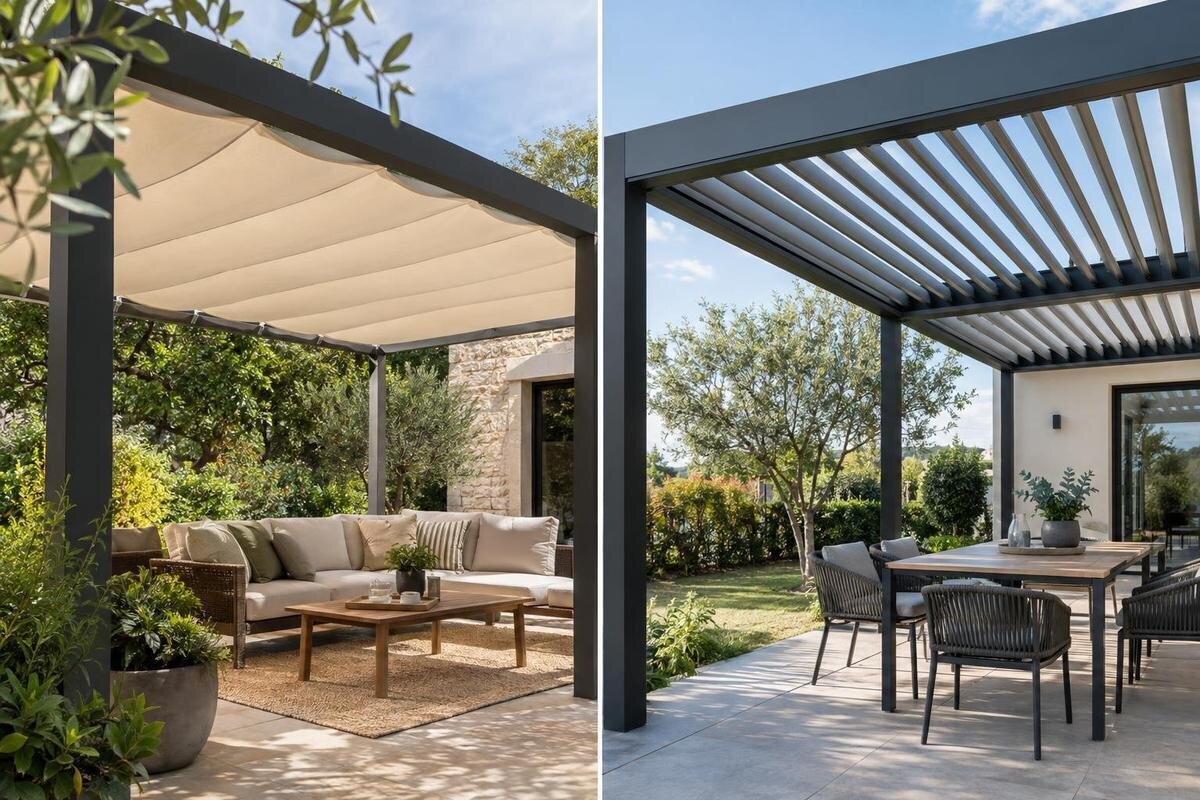
Pergola roof comparison
Choosing between a fabric-roof pergola and an aluminum louvred pergola comes down to how you want to change the overhead cover, what upkeep you will accept and which weather conditions the exact model is designed for. Fabric roofs may be fixed or retractable; louvres pivot to vary the opening between blades. That difference affects shade, airflow and operation, but it does not settle rain protection, snow limits or maintenance. Compare instructions for the exact models you are considering, not just roof labels, product names or catalogue photos.

How the two roof systems move
The basic distinction is the moving part. A fabric roof uses a canopy: depending on its design, it may stay in place or travel along supports and gather, fold or retract. Check how much of the roof it can uncover, whether it can stop partway and where the fabric rests when open. The gathered section may still cover some area or cast shade, so a diagram is more useful than a label such as “retractable”. An aluminum louvred roof uses multiple blades that rotate between positions. Their angle changes the gap overhead, but the travel range, control type and any locking procedure depend on the model. Do not assume fabric retracts or louvres are motorized; ask whether operation is manual or powered, where the control sits and how much clear space moving parts need.
Catalogue wording can identify a model, but it is not an operating manual. The Bloomcabin Bioclimatic Pergola listing gives a size range from 9 to 24 m²; that identifies listed size options, not whether a particular configuration has fabric or louvres, how it moves or what weather it can handle. Match the exact configuration to its product description and manual before comparing it with a fabric-roof unit. Look for diagrams showing open, partly open and closed positions, then confirm the control and any step needed before changing them. If a listing offers choices, record the roof and operating option you are comparing. A broad category name or gallery image cannot answer those questions.
What operation is like day to day
Opening convenience depends on more than whether a roof is described as adjustable. A fabric canopy that slides or folds may need room for its full travel and a clear route free of branches, lights or other fittings. Check where the fabric bunches and whether the open canopy still shades part of the frame. A fixed canopy has no deployment step, but cannot be drawn back to expose that opening. With louvres, consider how the control is reached, how much effort it takes, whether it can be set at intermediate angles and whether one control moves the whole roof or separate zones. If possible, assess the controls from the place you will use the patio, not only from a product photo.
Keep roof operation separate from mounting style when comparing the Bloomcabin Wall-Mounted Pergola with other options. The wall-mounted designation does not tell you how the roof opens or what controls it uses. For either roof system, ask which positions are allowed in wind or rain and whether movement must stop under certain conditions. If an optional powered mechanism is part of the exact offer, check its instructions for power interruptions, manual operation and access to controls; do not count on backup features unless specified. Include these procedures in your assessment of daily convenience, especially if changing the roof position involves more than simply using a handle or control.
Shade, airflow and daylight
An extended, opaque or tightly woven fabric canopy generally gives a more continuous shade surface than spaced blades, but the amount of light passing through depends on the fabric’s documented construction and rating. A product photo or colour is not a dependable guide to glare control or UV performance. Ask for stated light-transmission or UV information, then check coverage at the times you use the patio. Consider how shadows move across the seating area and whether the roof affects daylight through nearby windows. If the canopy retracts, opening it changes exposure; if it is fixed, that adjustment is unavailable.
Louvres let you alter blade angle and may leave gaps that admit sky, light and air; closing them does not create the same shade pattern as a continuous fabric canopy. The pattern changes with blade position and sun angle, while cross-breezes also depend on open sides and surrounding buildings. No roof position guarantees a particular temperature, privacy level or glare control. When considering the Bloomcabin Pergola, look for its specified roof material and drawings of the opening positions. Use those details to assess how light may reach your seating area and nearby windows at different times of day, rather than relying on the model name.
Rain protection depends on roof details
With fabric, check whether the exact canopy is described as waterproof, water-resistant or intended mainly for shade, and read how the manufacturer defines that wording. Seams, edges, slope, tension and support arrangement affect where water travels; appearance alone cannot confirm that water will drain freely or rule out pooling. Find out whether the maker allows the canopy to remain deployed in rain, whether it must be put in a particular position and what care is required after a wet period. Wind-driven rain and runoff at the edges are also worth asking about if furniture, a doorway or a walkway sits below. Do not treat a shade canopy as a rain roof without clear instructions.
With louvres, ask what the manufacturer means by closed, how water is directed and whether the instructions describe gaps or conditions in which rain can enter. Some designs use channels or internal drainage, but that cannot be assumed for every pergola. An adjustable roof is not automatically watertight, and a roof that manages ordinary rain may still have restrictions in certain conditions. When reviewing the bioclimatic pergola listing, compare the specified closure and runoff arrangements with those of the fabric roof. Check where discharged water exits and whether the route needs regular clearing, particularly near a doorway, seating area or neighbouring property.

Routine cleaning and inspection
Fabric-care tasks depend on the fibre, coating, colour and whether the cover remains installed or is designed to come off. Pollen, dust, leaves and bird droppings can accumulate; ask which brush, cloth and cleaning products are permitted, how to deal with stains and whether the canopy must dry before storage. Do not assume pressure washing, household cleaners or a particular wash schedule are acceptable. Check how the maker wants seams and attachment points inspected, and whether the cover can be reached safely from the ground. Nearby trees may increase debris or sap exposure, so consider the setting as well as the cleaning instructions.
Aluminum louvres avoid fabric-specific washing and storage, but they still need model-specific attention. Dust or leaves around moving joints and drainage channels may affect movement or runoff; follow the maker’s cleaning method rather than forcing a blade or applying lubricant without approval. Check which components are intended for owner care and which require service by a qualified person. For a model from the wall-mounted pergola listing, include access to the roof and its drainage in your maintenance comparison. Compare tasks, intervals and approved cleaning materials across both manuals; cleaning components within reach from the ground is different from a task that requires special access.
Wind, snow and freezing conditions
Wind guidance matters for both systems, but the permitted limit and required roof position are set by the exact model, not by the word “pergola”. A broad fabric surface can be affected by gusts; retracting or securing it may be required for some designs, but only the manual can say what is allowed. Louvres also have different positions and mechanisms, and their permitted use in wind can vary. Look for written operating limits, directions for leaving the roof when unattended and instructions about pausing adjustments during strong gusts. Ask whether a limit concerns operating the roof, leaving it in a position or both. Do not treat a general “all-weather” phrase as equal to a stated limit.
Snow and ice need separate confirmation. A roof may have limits for accumulated snow, wet snow, ice or winter operation, and the permitted position is not obvious from a photo. For an option on Bloomcabin’s bioclimatic model page, look for guidance covering the exact configuration, including what to do before forecast snowfall and whether the roof must be open, closed or otherwise secured. Clarify whether the instructions cover different blade positions and periods when the mechanism is iced or frozen. Do not infer capacity from aluminum construction, blade count or a fabric’s appearance, and do not climb onto a pergola or improvise snow removal.
Plan for seasonal use and storage
Decide whether the pergola will stay set up through the full outdoor season or be closed down for part of the year. If a fabric canopy is removable, confirm that removal is part of its intended care, how it comes off and where it may be stored; not every canopy is designed for routine removal. If it retracts, ask whether retraction alone is the required off-season position. Storage conditions, drying and refitting all affect how manageable the routine is. Include the time and need for suitable storage in your comparison rather than assuming the fabric is seasonal. If that routine is unlikely to suit you, prioritize a model whose documented instructions fit your habits.
For louvres, check the manufacturer’s directions for periods of non-use, cleaning before winter and the permitted position during snow or freezing conditions. Do not assume blades should be left open or shut, or operate a mechanism when ice may have restricted it; follow model guidance. When considering an option from the Bloomcabin Pergola listing, include seasonal preparation in your comparison of ownership tasks. Look for instructions on clearing debris from channels, checking movement after a long pause and arranging any inspection. Also consider whether furniture below would obstruct access to drainage or controls when those tasks need to be done.
Repairs and replacement over time
Ask whether replacement canopy fabric is available for the exact frame and how the correct variant is identified. Colour, dimensions, attachment points and product generation can all affect fit, so a generic sheet is not a safe substitute. Find out whether the maker documents repairs or expects a complete replacement, and what condition the frame must be in before refitting. Keep model identifiers, purchase records and care instructions together so you can name the right roof later. These checks do not predict fabric life; they show what options exist if the canopy becomes stained, torn, stretched or otherwise unusable.
For a louvred roof, identify which parts are replaceable and whether blades or mechanism components are available for the exact model. Ask how adjustments and repairs are handled, whether owner servicing is permitted and which moving parts need inspection under the manual. Aluminum construction does not make the roof maintenance-free: blades, joints, finish and drainage still need care. Compare written maintenance and parts information rather than assuming a rigid roof will need no attention or a fabric roof must be replaced as a whole. For either option, note how to identify a component if the product line changes.

Make a like-for-like comparison
Before comparing quotes or product pages, hold the basics constant: the same covered footprint, mounting type and roof area, with a similar degree of openness. Record how each roof operates, the positions it offers, the effort and space needed to use it, and what the named model includes. Then compare fabric care with blade-and-drainage care, plus documented rain, wind, snow and temperature limits. A price comparison is not like-for-like if one option includes controls, side panels, gutters or a different frame arrangement; confirm package contents and exclusions rather than assuming photographs show everything. Keep optional features separate from the base-roof comparison.
Make a short list of intended uses before choosing: meals outside, a shaded sitting area, gardening tasks or access to daylight from a nearby room. For each, note whether you need a cover fixed in place, an opening that can be exposed, several shade positions or reliable rain management. When comparing Bloomcabin’s wall-mounted model, assess its wall connection and site requirements separately from its roof mechanism. For any listing, compare only details tied to the exact roof configuration, footprint and installation arrangement you plan to buy. If products differ on other features, record those differences rather than attributing them to fabric or louvres.
Choose by your everyday priorities
Fabric may fit when the specified canopy gives you the coverage you want and its fixed or retractable arrangement matches how often you will open, clean or store it. A fixed cover can make sense if you always want a roof overhead; a retracting one can expose more sky only if its travel range actually gives the opening you need. Either choice should match its rain and winter instructions to your intended schedule. Judge the actual fabric, movement range and care tasks, not a broad promise of shade or a photo with the canopy fully deployed.
Louvres may fit when adjusting blade angle is a priority and you are comfortable following the roof’s drainage, cleaning and weather directions. Think about whether you will use the adjustment, whether controls are reachable from the patio and whether documented rain behaviour matches your expectations; closed blades are not automatically a sealed ceiling. For each essential requirement—opening, light, rain protection, seasonal use and upkeep—mark whether the model meets it or whether the answer remains unresolved. If an essential weather or maintenance detail is missing for the exact model, do not fill the gap with assumptions; that uncertainty may outweigh an attractive feature.
Frequently asked questions
Does a fabric pergola roof keep rain out?
Only if the specific canopy and its support and drainage design are intended for rain, and the instructions allow it to remain deployed in those conditions. Check the wording about waterproofing, seams, runoff and care after wet weather. Appearance or the term “water-resistant” alone does not confirm that the area will stay dry.
Is an aluminum louvred pergola waterproof when closed?
Not automatically. Blade overlap, seals, roof geometry and drainage vary by model, and wind-driven rain may behave differently from direct rainfall. Check the manual for guidance on rain with the roof closed and where water drains. Adjustable blades are not proof of a sealed ceiling.
Which pergola roof needs less maintenance?
Neither type has a universal advantage. Fabric needs the care specified for its material and may require drying or storage; louvres need attention to the blades, moving joints and drainage. Compare the tasks, intervals, access and approved cleaning products in the manuals for the exact models.
Can I use either pergola in winter?
Only within the limits documented for that model. Check guidance for snow, ice, wind, roof position and any canopy removal or storage. Do not infer winter suitability from the fabric or aluminum alone, and do not operate a frozen mechanism unless the manufacturer’s instructions allow it.
Can I fit a fabric canopy to an aluminium louvred pergola?
Do not assume the parts are interchangeable. Roof structures and attachment systems differ, so use only fabric specified for the exact frame and model. Ask about compatible replacement parts, dimensions and fittings. A generic cover may not fit or be approved for that pergola.
Fabric can provide a continuous canopy, but it retracts only if designed to do so; louvres change the overhead opening by turning their blades. The useful comparison is between the exact models’ instructions and the way you expect to use the patio: shade, open sky, rain, cleaning and seasonal limits. Choose the roof whose documented behaviour suits that routine, and leave unverified weather claims out of the decision.
